
The Conversation
Subscribe
  • Academic rigour, journalistic flair
  • For curious minds
  • Expert news and views
  • Debate and ideas
  • From the curious to the serious

Hot Topics

  1. Gay marriage
  2. Australia in the Asian Century
  3. Convergence review
  4. Federal Budget 2012
  5. War on drugs
  6. Bob Brown
  7. Explainer
  8. Square Kilometre Array
  9. Medical myths
  10. Transparency and medicine

A house for half the cost? Here’s how

Welcome to Safe as Houses, a series delving into a topic close to the heart of many Australians – property. This is not a series on where the market might be heading. Instead we aim to explore how we view property and float some alternative ideas. Along with poorly behaved sporting figures, Kyle Sandilands…

6tmkshdh-1323927125-1323927172
Reducing the finance costs of housing will also reduce house prices. Flickr/kennymatic

Welcome to Safe as Houses, a series delving into a topic close to the heart of many Australians – property. This is not a series on where the market might be heading. Instead we aim to explore how we view property and float some alternative ideas.

Along with poorly behaved sporting figures, Kyle Sandilands, and casual police brutality, crushingly large mortgages are basically accepted as an unpleasant fact of life.

But what if we could change the way we repaid our loans to pay less interest and enjoy improved home affordability? Adjunct Associate Professor at the University of Canberra, Kevin Cox explains how.

In The Conversation this week, Keith Jacobs argues that falling house prices would lead to positive outcomes for the Australian economy. Here I propose a way to reduce the cost of housing that will, over time, also reduce house prices.

A reason for unaffordable housing is that the finance costs of purchasing a house with a loan is at least twice as much as it needs to be. Reducing the cost of finance will reduce the total cost of purchasing a house. This will, in turn, reduce the pressure on house prices as it will reduce the financial profitability of traditional housing loans and direct finance to other more productive and profitable uses.

Most loans are used to transfer control of an asset from one person to another. The person receiving the loan agrees to pay rent for the use of the asset while ever they have the use of the asset. When they relinquish control of the asset they no longer pay rent on the asset. Let us assume the asset is a fleet of five cars. A borrower rents five motor cars and so pays rent on five cars. If they return one car they pay rent on the four remaining cars and they do not pay rent on the returned car.

Money loans work differently. Let us assume that the rent on five units of money is one unit of money. If one unit of money is returned then rent is continued to be paid on five units of money – not four. We treat money loans differently from other asset loans because we create money with an interest coupon attached at the time of creation. This gives money a value over time by the way it was created. Money when it is saved should have an interest coupon attached. Money when it is created should not have an interest coupon attached.

Most people think banks take in deposits and lend the deposits. Unfortunately this is not the way the system works. When a bank gives a loan the bank creates new money to lend. This money is deposited in the borrower’s account. There was no deposit lent or money saved – instead the bank created money and deposited it. This newly created money immediately attracts interest. This is the underlying reason why, in the above example, rent continues to be paid on five units not four because banks have to pay interest on newly created money.

Because we create money with an interest coupon and because interest itself attracts interest then the amount of money needed to keep the system operating compounds. In the ancient world the Sumerians, Babylonians, Jews and Romans understood the unsustainable nature of debt and periodically they had a debt jubilee to remove the excess debt. Muslims and Christians tried to solve the problem by banning interest.

There is another solution. We can change the rules on how to repay loans. We continue to pay rent (interest) on money but pay no interest on accumulated interest.

Using existing loan repayment rules, if we have a loan of $100,000 with a yearly interest rate of 20% and we repay $20,000 each year then the loan is never repaid. Each year the $20,000 repayment does not reduce the capital on which interest is paid and it means we pay interest on the money that has been repaid. The new proposed rules of repayment are for repayments to come off the principal and no interest is to be charged on unpaid interest.

At the end of the first year, with these new rules, the borrower still owes $100,000 but the amount of money on which interest is paid in the next year is $80,000. This means that at the end of the second year the amount owed is $96,000. Each year the amount owed will reduce until finally the debt is repaid. With both sets of rules the same amount has been paid so the economic outcomes are the same. The difference is that the new rules extinguish the debt.
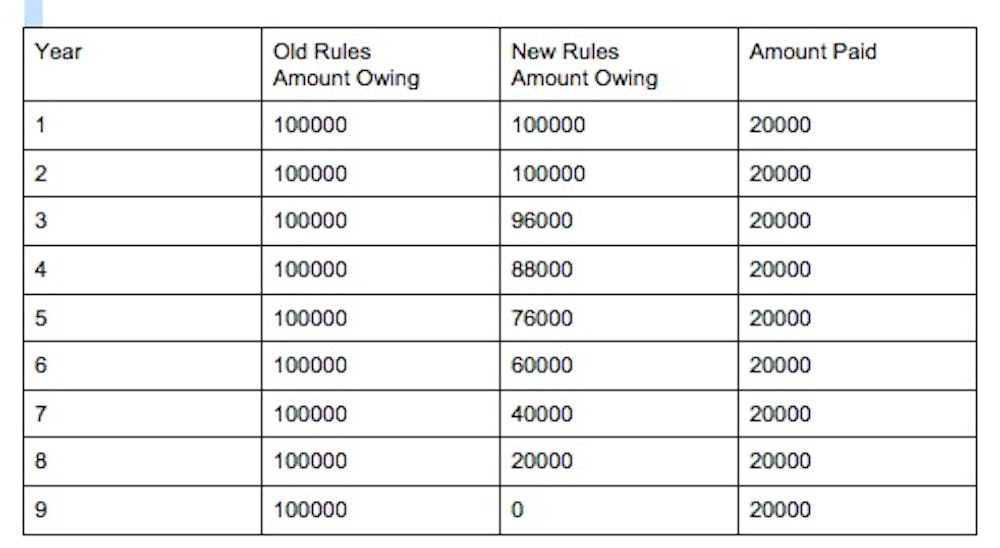
Supplied by Kevin Cox

This simple change to repayment rules could make a dramatic change in the cost of capital goods financed through loans. For example, the interest charges on a home loan of $500K at 7% over 30 years is about $611,000 while the total interest charges on a loan with revised rules with the same size repayments is $225,000.

If the approach is adopted it will mean that housing in Australia will become affordable without a collapse in house prices.

In systems terms the positive feedback mechanism of interest on interest has been removed. In most systems positive feedback almost always leads to instability. Removing mechanisms that cause positive feedback means the system has a better chance of stabilising. What this means for house prices is that the inflationary pressures will be reduced.

For banks, it means they will find it more profitable to lend existing deposits for housing rather than create new deposits with new money. However, money still needs to be created so banks will have deposits to lend. (I describe one way to do this in a previous article. )

In summary, the issuing of credit through the creation of interest bearing money leads to a compounding of debt, which unnecessarily increases the cost of credit.

By changing loan repayment rules, the cost of credit is reduced which reduces the cost to transfer capital assets to the benefit of both the buyer and seller.

This is the fourth article in the Safe as Houses series. Read the other instalments here:

Join the conversation

Comments (65)

  1. Permalink
    Geoff Henderson

    Geoff Henderson

    Student (logged in via email @skymesh.com.au)

    Nice idea to get loan costs down. Perhaps a risk of "Jevons Paradox" emerging - some borrowers may increase their total loan because they can pay back a higher amount under the new scheme.

    Another option might be to adjust the aspirations of new home buyers.
    When my parents built their post-war home circa 1950, it was barely complete. No shed, no landscape, no fences or even floor coverings. These things came in time, and were often collaborative - neighbours would work together to build fences…

    show full comment

    1. Permalink
      Kevin Cox

      Kevin Cox

      (Adjunct Associate Professor at University of Canberra)

      Geoff,

      I agree with you that currently people buy more than they sometimes want or need - and I would argue that the current repayment system encourages that behaviour.

      With this proposal people will commit to a level of repayments that has a minimum level per month and is fixed for the period of the loan. Part of signing up for a package, and an ongoing requirement, will be proving that the buyer can meet the payments through showing ongoing income and expenditures. Some people now get into…

      show full comment

      1. Permalink
        Geoff Henderson

        Geoff Henderson

        Student (logged in via email @skymesh.com.au)

        Kevin thanks for the extra insights.

        I am a little unsure about some of the behavioural and financial assumptions and that couples will always react rationally. Still your model does address a buyers ability to repay a loan, and hopefully that might act as a restraining factor.

        Perhaps an option is to build the larger home but only complete a reasonable living area sufficient for healthy living but without the immediate high cost. This would defer some of the costs to a future time but there are practical arguments against this too.

        1. Permalink
          Kevin Cox

          Kevin Cox

          (Adjunct Associate Professor at University of Canberra)

          Geoff,

          One of the features of the proposed repayments system is the ongoing testing of assumptions. The system is being designed as an ongoing experiment. One hypothesis is that people will get the minimum they need but in a way that they can add capital expenditure as they get more income. We will test if that hypothesis is correct. Another hypothesis could be that people will tend to commit to an absolute amount rather than a percentage of disposable income to their housing. Another hypothesis will be that people will spend more to save more in the future - for example the takeup of renewable energy sources for heating and electricity.

          1. Permalink
            David Collett

            David Collett

            (logged in via Twitter)

            Great article Kevin. If we started to implement this idea now it would mean Australians will start paying off their mortgages a lot faster, which then means the total amount of money in the economy will shrink (lowering GDP etc).

            You mentioned above how new money will still need to be created.

            Do you have any thoughts regarding the best way to create fiat money to replace the debt money that is currently dominating the system?

  2. Permalink
    Greg Surname

    Greg Surname

    (logged in via Facebook)

    "The Conversation is an independent source of information, analysis and commentary from the university and research sector — written by acknowledged experts and delivered directly to the public."

    The author of this article has no clear expertise in economics, so I have to ask, where are the economists out there?

    I fail to see how the proposed scheme is in any way differentiable from reducing interest rates. Both actions reduce the total cost of a loan of a fixed amount. Would lowering interest rates make housing less affordable? It could just make prices increase further as borrowers feel that they can afford to borrow more.

    1. Permalink
      Kevin Cox

      Kevin Cox

      (Adjunct Associate Professor at University of Canberra)

      Dropping interest rates may cause borrowers to borrow more and so may increase house prices.

      By contrast the proposed scheme is unlikely to cause house prices to increase because most people who purchase a house over a long period make their purchase decisions around the amount they have to pay each pay period. It is expected that people will continue to repay at about the same rate they do today. The scheme is likely to reduce the time buyers take to pay - not increase the price of houses.

      1. Permalink
        Greg Surname

        Greg Surname

        (logged in via Facebook)

        Want to buy a house for half the cost? Here's how ... buy a cheaper house and pay off your loan in 6 years instead of 30 years.

        Your scheme is equivalent to reducing the interest rates and reducing the maximum term of loans so that repayments remain fixed.

        What would happen if this were implemented though? Would prices decrease or would prices remain stable, leading to (new) buyers being priced out of the market and creating a generation of people who will never own a home.

        1. Permalink
          Kevin Cox

          Kevin Cox

          (Adjunct Associate Professor at University of Canberra)

          As I have explained above Rent and Buy is not equivalent to reducing interest rates. There is no "rent on rent" and the rent can be made to reflect the value of the underlying asset. With loans interest is unrelated to the asset purchased and can vary according the whims of the finance sector.

          How costs are reduced makes a difference to the behaviour of people and how we implement systems matter. In this case the price of houses is unlikely to rise because payments are based on how much people…

          show full comment

          1. Permalink
            Greg Surname

            Greg Surname

            (logged in via Facebook)

            Whether it be interest on a loan or "rent based on the value of the underlying asset", the net effect is the same. You agree to pay a sum of greater value than the value of the asset in exchange for being able to pay for the asset over a period of time and the longer the period of time, the greater the difference between the amount paid and the value of the asset.

            You say that "With loans interest is unrelated to the asset purchased" but interest is proportional to the value of the amount borrowed so your statement requires further clarification.

            "Payments are based on how much people can afford to pay each week - not on how long it takes to buy a property." But, the less you pay each week, the longer it takes to buy a property and the more interest/rent you pay. Clearly these two things are connected.

      2. Permalink
        Derek Bolton

        Derek Bolton

        Retired s/w engineer (logged in via email @gmail.com)

        So drop interest rates and shorten the mortgage to make the instalments the same. As Greg says, it is exactly equivalent to a drop in rates.

  3. Permalink
    Steve Bennett

    Steve Bennett

    (logged in via Twitter)

    I think what you've done is successfully invent a different way of selling exactly the same financial product. Ultimately any loan is an agreement between two parties to transfer an asset in exchange for money, as you say - whether you call the money "rent" or "interest" or "paying off the principal first, then the interest later" is really beside the point.

    The glaring error in your argument is here:
    "For example, the interest charges on a home loan of $500K at 7% over 30 years is about $611…

    show full comment

    1. Permalink
      Kevin Cox

      Kevin Cox

      (Adjunct Associate Professor at University of Canberra)

      Steve,

      In the new repayments scheme the banks are NOT involved. No one is expecting them or asking them to give up their business model.

      The new repayments scheme removes the need to create interest bearing debt as the mechanism to transfer assets. What has been done is what others call a peer to peer credit arrangement where the buyer and the seller agree with each other on the terms of the transfer of ownership of an asset without the involvement of a third party. In this case it is without…

      show full comment

      1. Permalink
        Steve Bennett

        Steve Bennett

        (logged in via Twitter)

        Wait, so all this talk about paying principal first, and not collecting interest on the interest was just a distraction from the actual crux of your proposal: that vendors and buyers set up private credit arrangements without banks?

        I think you explained it a lot better here: http://cscoxk.wordpress.com/2011/09/14/rent-and-buy/

        You're essentially talking about a completely different "rent and buy" approach to transferring property, which, well, combines aspects of renting and buying. Is your company Envesting a broker of such arrangements?

        1. Permalink
          Kevin Cox

          Kevin Cox

          (Adjunct Associate Professor at University of Canberra)

          Steve,

          Yes it is a different way of transferring assets but it also works if the asset is money. People who have money or who have an asset can use the same payment schedule. Rent and Buy was an earlier iteration of the idea. The critical component is that interest bearing money is not created as part of the transfer. The reason for the new iteration is to take advantage of the existing legal structure of mortgages and make it as close as possible to the way people think that loans work…

          show full comment

  4. Permalink
    Derek Bolton

    Derek Bolton

    Retired s/w engineer (logged in via email @gmail.com)

    I find the article utterly unconvincing. It's not April 1, is it?

    1. "Money is treated differently from other rents."

    Well, yes: you don't pay off a car rental in additional cars. But this statement is simply wrong:
    "If one unit of money is returned then rent is continued to be paid on five units of money – not four."
    No you don't - you pay rent on the four units plus a bit more for the interest on the one returned. That's considerably less. And if you instead were to repay the one…

    show full comment

    1. Permalink
      Kevin Cox

      Kevin Cox

      (Adjunct Associate Professor at University of Canberra)

      Thanks Derek for bringing this up as it is the issue where everyone has trouble - but it is at the heart of the massive expansion of debt.

      In my illustration with the cars I was trying to show the difference between the asset being rented and the rent. With money we make no distinction between the money that was rented and the rent. We treat them as though they were the same. The difference is often expressed as money as a store of value and money as a measure of value. Money when it describes…

      show full comment

      1. Permalink
        Derek Bolton

        Derek Bolton

        Retired s/w engineer (logged in via email @gmail.com)

        I see no attempt here to answer any of my points.

        This bit is pure waffle: "When we charge interest we are not creating new value nor new assets and so the interest should not attract interest. " No, the charging of interest does not create new value, but if you choose not to pay that interest immediately (in addition to whatever you're paying off the capital) then that does create new value for you. You get to keep that much money for another year.
        If I borrow $100, the interest is $10, and I repay $20 off it, am I paying $20 off the capital or the $10 interest and $10 off the capital? There's no way to know, for the excellent reason that there is no real difference.

        1. Permalink
          Kevin Cox

          Kevin Cox

          (Adjunct Associate Professor at University of Canberra)

          Derek,

          If you do not pay the interest there is no new value added for you. You do not have any extra money - you have a debt. If you have made a repayment then you have less money and that should come off the capital you owe first.

          The conceptual problem is that interest is a book entry. It is not a money asset and hence it should not attract interest as it does not have value until it is paid. The finance industry has persuaded us that it is reasonable to make book entries and to charge…

          show full comment

          1. Permalink
            Derek Bolton

            Derek Bolton

            Retired s/w engineer (logged in via email @gmail.com)

            Suppose I borrow $100 from you for 1 year at 10%. At the end of the year I pay back the $100, but find myself short of the other $10. By your argument, the $10 I owe has no value and should not attrract further interest if I defer paying it. And that will be true the next year, and the year after. So I never need to pay the $10.
            Actually, I lied. I did have the $10 available, but chose instead to lend it out at 10% interest. Right there is the value of not paying the $10. It's an asset that I have and you do not, yet it is rightfully yours.

            Yes, money does have time value - partly, though not exclusively, because it depreciates. Bank notes in my pocket do not increase in value, but that's because I'm leaving them in my pocket, which is my choice. Just because an asset *can* be wasted doesn't mean it was worthless. I could have invested them.

      2. Permalink
        James Walker

        James Walker

        (logged in via Facebook)

        OK, know that Derek and Geoff have explained the article:

        No, you don't return the capital first - ever. For starters, you *can't* - in the car example, the car has depreciated while being used. Secondly, attempting to do so creates a contractual nightmare: you owe interest...on what? A car you don't have? A debt you don't have? Thirdly, you open yourself to all manner of rorts, most of which are currently illegal but would immediately be reopened by such a system. Basically, what you are proposing…

        show full comment

        1. Permalink
          Kevin Cox

          Kevin Cox

          (Adjunct Associate Professor at University of Canberra)

          James,

          I am explaining an alternative payment schedule between a buyer and a seller. To say you can't reduce the capital owed first in this context is incorrect. Of course you can.

          There is no proposal to create any money whether real or funny. That is the point. The transfer of assets is being done without the need to create new money.

          To say there is no motivation to pay off interest is incorrect. The motivation is the same as in any mortgage contract. The mortgage contract will say the mortgage still holds while-ever rent is owed and the contract says that if payments are not made on the mortgage then the holder of the mortgage can force a sale.

          The contract can include clauses to allow rent owed to be adjusted for inflation. The contract can include clauses to allow the capital value of property to go up and down and with it rent to go up and down.

          1. Permalink
            David Collett

            David Collett

            (logged in via Twitter)

            This proposal is still original in my eyes and it's worth having a go at making it work. Maybe in a follow up article would we be able to see a real world example of it in operation? I.e. pretend someone owns a house with say 25% equity with a normal mortgage on variable interest rate, decides to sell via private sale and someone puts in an offer with this new scheme. What would the proposal look like? Say the median house price is $550,000, the seller has a mortgage of $412,500 at say 7.3% variable. Ignoring all transaction costs what will the proposal look like to the vendor?

            1. Permalink
              Kevin Cox

              Kevin Cox

              (Adjunct Associate Professor at University of Canberra)

              David,

              It is intended to set up the system and see if buyers and sellers wish to participate. What you suggest could be part of the system description so that both buyers and sellers can see how variations in the rules affect them. Part of that could be a comparison with traditional loans.

    2. Permalink
      David Collett

      David Collett

      (logged in via Twitter)

      Now I am having problems with this again.

      "At the end of the first year, with these new rules, the borrower still owes $100,000 but the amount of money on which interest is paid in the next year is $80,000. This means that at the end of the second year the amount owed is $96,000."

      If I lend you $100,000 with an interest rate of 20% and you only pay me back $20,000 each year, and we have a legal contract about the deal, what exactly are you proposing to change with our contract?

      Derek: it's an interesting exercise asking the RBA what the minimum deposit ratio for Australian banks is. It's basically nothing, hence why they offer mortgages requiring only a 3% deposit.

        1. Permalink
          David Collett

          David Collett

          (logged in via Twitter)

          Hmm, then it sounds like the change you are talking about would be a change to the accounting conventions? I am just trying to understand where the change would be made and how to be able to picture it clearly.

          For example, if parliament tried to implement your idea tomorrow would that mean they are making a change to the accounting standards so that interest repayments are considered to be contributions off the principal? What proportion of an interest payment would go toward the principal and what proportion would go toward interest?

          What about the bank's perspective? If the accounting standards changed in Australia so a proportion of their monthly interest payments from the public and business have to be considered as payments off the principal then what would that mean for their ability to source funding on the short term money markets overseas that they are heavily reliant on?

          1. Permalink
            Kevin Cox

            Kevin Cox

            (Adjunct Associate Professor at University of Canberra)

            David,

            There are no accounting conventions or standards to be changed. It is a change in the mortgage repayment schedule. Governments do not need to get involved. It is only to do with the agreement between the buyer and seller. The banks can become involved if they wish by purchasing the new mortgages from the seller with existing cash deposits.

            1. Permalink
              David Collett

              David Collett

              (logged in via Twitter)

              Kevin, I see what you mean that the banks could choose to change their repayment schedules. But without forced government intervention no bank in their right mind is going to offer a much less profitable product. So if there is no government intervention I do not see how this idea could eventuate. And if there is government intervention I don't see how the banks could implement it without forcing them to increase capital adequacy ratios, which means credit growth slows down.

              1. Permalink
                Kevin Cox

                Kevin Cox

                (Adjunct Associate Professor at University of Canberra)

                David, we do not need banks to be involved in the transfer of assets. If you are a seller and you own a house and you no longer wish to use it yourself then the choices are:

                1. Sell it for cash and do something with the money.
                2. Rent it.
                3. Sell it on instalments with an agreement as described here and secured with a mortgage.

                It is easy to demonstrate that (3) gives the greatest return for the seller. It is also better for the buyer. However, if you sell it with method 3 then you possess a mortgage with a repayment schedule which you can sell to someone for cash. Self managed super funds and ordinary super funds are likely to find these attractive investments compared to the stock market, property trusts, bank deposits and rental properties. Banks will not find them attractive unless they find themselves with cash deposits and few willing borrowers.

            2. Permalink
              Derek Bolton

              Derek Bolton

              Retired s/w engineer (logged in via email @gmail.com)

              Then I don't get how it changes anything. The bank would simply offer such a deal at a higher interest to compensate.
              E.g. consider a conventional mortgage for $100K at 12% over 8 years. Total repayment would be $20125/year for a total of $161K. As the banker, I would offer you the alternative of a loan where you only pay interest on the outstanding portion of the capital, but at a rate of 20.125%. The interest accumulates as you show (omitting the decimals): 20K+16K+12K+8K+4K=60K for a total of 61K. It looks the same to you, and the bank is happy. (Btw, your table is wrong - the 9th line shouldn't be there.)

              1. Permalink
                Kevin Cox

                Kevin Cox

                (Adjunct Associate Professor at University of Canberra)

                Derek the table is correct. It is incomplete as it only shows 9 years and it does not show the accumulated interest but was done this way to illustrate the effect of the different rules.

                Banks have nothing to do with the new repayment schedule so discussing what a bank would do to get the same return as they currently get is missing the point. The idea is to show that banks, and the creation of new money, are unnecessary as a mechanism to transfer ownership of an asset from one person to another.

                The rules are - repayments come off capital. Interest accumulates and is paid after capital is paid and interest does not compound. This is a different repayment schedule - nothing more. The repayment schedule removes unnecessary financial costs. Of course the banks will try to persuade people to use the existing system because they get paid more to transfer assets from seller to buyer. What is being offered is a choice to sellers and buyers. We will let the market decide.

                1. Permalink
                  Derek Bolton

                  Derek Bolton

                  Retired s/w engineer (logged in via email @gmail.com)

                  I don't see how the table can be right. We agree, I think, that the interest for the first year would be 20K, for the second year 16K, then 12K etc. Summing:
                  20+16+12+8+4 = 60
                  So the total to be paid is 100K+60K = 160K.
                  In 20K instalments, there must be 8, not 9.

  5. Permalink
    Jay R

    Jay R

    Mining Engineer (logged in via email @hotmail.com)

    There is a difference in long term and short term loans.

    Hire a car for a day, you can pay for it when you return it (or return 1 of 5 cars etc).
    Hire a car for 30 years, you will need to pay for it at least monthly.

    The issue is that money owed for services rendered needs to be paid within a reasonable time period. Doesn't matter what the service is, be it interest, car hire etc. It works this way because businesses have bills to pay to other businesses, etc etc, and money owed is a risk because you may never get it.

    What you are suggesting is that people provide a service of capital, but not be paid for that service until it is returned ~30 years in the future. Stupid.

    1. Permalink
      Kevin Cox

      Kevin Cox

      (Adjunct Associate Professor at University of Canberra)

      Jay R with normal repayments interest is paid on interest. In the suggested system no interest is paid on interest. When an interest debt is created no extra capital is provided to the borrower and so the borrower should not be required to pay interest on something they did not get. When a borrower makes a repayment the lenders have receiving some of their capital back and so the borrowers should not have to pay interest on the money returned.

      The approach is in wide use in the trading of commodities. It is called peer to peer credit where the organisations involved do not bother to use banks to provide credit but supply it to each other for minimal cost.

      1. Permalink
        Jay R

        Jay R

        Mining Engineer (logged in via email @hotmail.com)

        Peer to peer credit is about removing banks as an middle man, thus lowing the costs for lenders and borrowers. It has nothing to do with your idea of not paying interest bills when they are incurred.

        "When an interest debt is created no extra capital is provided to the borrower and so the borrower should not be required to pay interest on something they did not get."
        No, capital is provided to the borrower, and it is used to pay their interest bill.

        This is no different to deciding that we should not pay our electricity bills until we move house and disconnect the service.

        Think of loan repayments as 2 parts - one part is the interest charged based on the current value of the loan, and one part is a repayment. The interest charged is always based on the total debt, which in unarguably fair. The interest bill then should be paid as per any other bill in life.

        1. Permalink
          Kevin Cox

          Kevin Cox

          (Adjunct Associate Professor at University of Canberra)

          Jay R,

          The rules for the repayment of loans are an agreement between the borrower and the lender. They are not a law of nature. I suggest we revisit in a year's time and let the market decide whether the new set of rules have appeal to lenders as well as borrowers.

  6. Permalink
    Geoff Henderson

    Geoff Henderson

    Student (logged in via email @skymesh.com.au)

    Kevin has proposed a different approach to lending/borrowing/purchasing homes. It is certainly a great time for it - if any of you guys have kids, ask yourself how they might ever get their own home.

    It's a good discussion, and options should be proposed to try and see in a way that makes home ownership more available to more people, especially younger people. It is an important topic, and if you think about it, the young people of today are going to be called to help the aging population - think…

    show full comment

    1. Permalink
      Derek Bolton

      Derek Bolton

      Retired s/w engineer (logged in via email @gmail.com)

      Geoff, while new ideas are always welcome, there's only so much time to afford their consideration. It is therefore appropriate to shoot down those with demonstrable fundamental flaws without delay (being careful, of course, to avoid disparaging ad hominem remarks).
      I believe I have performed that service for Prof Cox's scheme. The fundamental flaw is his untuition that the interest portion of a debt is inherently of such a different nature from the capital portion that it should not incur further interest. A disproof comes from a thought experiment comparing serial single year loans with one multiyear loan.
      If, despite this, you can salvage from it something useful, good luck to you.

      1. Permalink
        Geoff Henderson

        Geoff Henderson

        Student (logged in via email @skymesh.com.au)

        Thanks Derek, I suppose any of us have the right to approach a discussion as we see fit, and I think that is good because it widens the range of discussion. I find your approach interesting because as I see it, you seem to be satisfying some sense of duty to put paid to Kevins argument. And to suggest some temporal urgency to do so seemed unnecessary - well it took many years for the flat earth concept to be debunked, but over time it was settled.

        But you do acknowledge my wish to draw a positive from the discussion - thanks for that. But I suspect you missed my point. My wish was that the tone of the discussion itself would be more positive, because positive discussion is conducive to more creative argument. If you shut down those with ideas, good or bad, you stop progress of any sort, new ideas are fundamental to beneficial change.

      2. Permalink
        Kevin Cox

        Kevin Cox

        (Adjunct Associate Professor at University of Canberra)

        Thanks Derek for pointing out what you think is the flaw in the argument. The proposal does not depend on whether or not people believe there is any justification for putting interest on interest. It will stand or fall on whether the new rules for transferring an asset over a period of time are accepted by buyers and sellers. It is early days yet but the indications are that the rules will be well received in the market place.

        With respect to my intuition being faulty it is not my intuition…

        show full comment

  7. Permalink
    James Walker

    James Walker

    (logged in via Facebook)

    "The new repayments scheme removes the need to create interest bearing debt as the mechanism to transfer assets. What has been done is what others call a peer to peer credit arrangement where the buyer and the seller agree with each other on the terms of the transfer of ownership of an asset without the involvement of a third party."

    Then Kevin, the simple way to prove your scheme is to demonstrate it: loan money on these terms to a homebuyer. Don't have the money? No probs, you have a career, set up an investment property, and then sell it to the tenants, using their repayments to cover the mortgage - you should still be entitled to the negative gearing benefits etc.

    1. Permalink
      Kevin Cox

      Kevin Cox

      (Adjunct Associate Professor at University of Canberra)

      James this is correct. We will never know until we run an experiment. Yours is one suggestion on where investment houses will come from.

      Rent and Buy offers a more certain higher return than investing and renting. We expect property investors - particularly developers - to supply the dwellings for others to buy.

      1. Permalink
        Derek Bolton

        Derek Bolton

        Retired s/w engineer (logged in via email @gmail.com)

        No, there is no need to conduct such an experiment for real. A thought experiment suffices.

        As Greg S and I have pointed out, a suitably chosen combination of lower interest rate and shorter repayment schedule produces precisely the same number and amounts of instalments. Therefore there is nothing new provided by this concept, It is entirely achievable within standard (fixed interest) mortgage arrangements. OK, so most mortgages these days are variable, but that only makes the maths harder - same result.

        Kevin, please try to understand this so that we can all concentrate on our day jobs. Have you found a qualified economist that supports your idea?

        1. Permalink
          Kevin Cox

          Kevin Cox

          (Adjunct Associate Professor at University of Canberra)

          Derek,

          You and Greg S completely miss the point of the article. What is being suggested is another way or arranging the transfer of value that does not use a traditional loan. Of course you can change the interest rate to reduce the cost of the house to be the same - but that is not what the article is about.

          It is a fact that if a buyer can find a seller to agree to the terms of the transfer as suggested then it will cost the buyer half as much as using a traditional loan to purchase a house…

          show full comment

          1. Permalink
            Derek Bolton

            Derek Bolton

            Retired s/w engineer (logged in via email @gmail.com)

            Perhaps, but I feel rather that you are missing the point of the thought experiment. If the "black box" view of the financial transactions involved is indistinguishable from a shorter term conventional mortgage at a lower interest rate then that is what is, regardless of any words you use to dsescribe it or philosophy you use to support it.

            If the transactions cannot be made to look identical in this way then, yes, I have missed something.

            1. Permalink
              Kevin Cox

              Kevin Cox

              (logged in via LinkedIn)

              Your thought experiment is comparing two loans. The thought experiment in the article is to compare loans with peer to peer credit.

              As you say, traditional economics says that it does not matter how the transaction is carried out provided the end result is the same. A traditional economist may say that Rent and Buy is equivalent to a loan if the cost is the same. In fact you will find that most macro economic analysis assumes that debt does not matter!!

              This is why traditional economic predictions are so often wrong. The thought experiments do not consider all the factors. How payments are made change the system behaviour. In this case dropping interest rates on loans is likely to cause house prices to rise but Rent and Buy is more likely to cause house prices to drop.

              The only way to find out what will happen is to implement the system and see what occurs.

              1. Permalink
                Derek Bolton

                Derek Bolton

                Retired s/w engineer (logged in via email @gmail.com)

                You say "How payments are made change the system behaviour." Yet you seem to be agreeing that payments are made in exactly the same way.
                If the payments are the same in timing, amounts and number then any perceived difference is theological.
                If it walks like a duck and quacks like a duck...

  8. Permalink
    Paul Sherry

    Paul Sherry

    Engineer (logged in via email @sherryhome.net)

    I'm glad to see the engineers commenting here see the fundamental flaws in this article. It's a pity economists aren't required to have a better understanding of mathematics. Prof Cox, can I ask what you teach / specialise in? I honestly think you should have run this idea past some maths professors at the university before deciding to publish it.

    1. Permalink
      Kevin Cox

      Kevin Cox

      (logged in via LinkedIn)

      Paul,

      I have run the idea past several mathematicians, economists and other mathematically literate people. They agree with the maths.

      The system is not attractive to lenders who act as intermediaries by creating loans. It is attractive to buyers of property as it costs them less and it is attractive to genuine investors in property as they can get a higher rental returns on their investments. This happy state of affairs comes about because we have removed financial charges that come from…

      show full comment

      1. Permalink
        Paul Sherry

        Paul Sherry

        Engineer (logged in via email @sherryhome.net)

        Sorry for the perceived personal attack but I did not see any mention of your background and I do think this is relevant for this article.

        I certainly agree that this method is 'not attractive to lenders who act as intermediaries by creating loans. It is attractive to buyers of property as it costs them less' however I do not agree with the statement 'it is attractive to genuine investors in property as they can get a higher rental returns on their investments'.

        What is a 'genuine investor…

        show full comment

        1. Permalink
          Kevin Cox

          Kevin Cox

          (logged in via LinkedIn)

          Paul,

          You are treating the sale as though it were a loan. What is proposed is not a loan but is similar to the Islamic Musaraka. What we wish to do is to make a more flexible, payments system that is still Halal but is accessible to all and does not have religious overtones and some of the unnecessary restrictions imposed by the current interpretation of Islamic Law.

          The comparison that Derek and others makes is between two loans and of course you make loans that will cost half the price…

          show full comment

          1. Permalink
            Paul Sherry

            Paul Sherry

            Engineer (logged in via email @sherryhome.net)

            Well, there really is no difference between a real investor and financier. I currently own and rent two homes and 'seller finance' one home in the US. So I am both a 'real investor' and financier. At the end of the day I am only interested in maximizing the amount of money I generate from these investments in 10/20/30 years. If I were to apply your revised interest schedule to the 'seller finance' spreadsheets I use to calculate ROI I would need to jack the interest rates way up to match the ROI…

            show full comment

  9. Permalink
    Gray Ramsey

    Gray Ramsey

    water (logged in via email @gmail.com)

    Kevin, if I were selling my house the best financial option is to take cash and invest it - even in a savings account - as I then DO get paid interest on my interest. That being the case why would I participate in your ideal?

  10. Permalink
    Mik Blyth

    Mik Blyth

    Business owner (logged in via email @gmail.com)

    I find this article a little bit misleading/confusing what you have done (your example) is compare a loan in the new system over a period of 9 years (or 10), yet your example is against a loan of $500,000 over 30 years, why not compare it against a loan for $500,000 over 9 years from a bank, I done just that through a mortgage calculator and the total paid bank mortgage came to $175,327.24 in total interest charges, which is some nearly $50,000 less than your system.($225,000 interest paid) I do not work for a bank or any financial institution. fairs fair, if you do articles like this then at least compare apples with apples.

    1. Permalink
      Kevin Cox

      Kevin Cox

      (Adjunct Associate Professor at University of Canberra)

      Mik

      The table is over 10 years and is used as an illustration and is nothing to do with the $500K example.

      What I am comparing is the same size repayments per month. With the new loan system the loan is repaid more quickly with the same size repayments. In fact it does not matter in the new system whether we make the repayments smaller the total amount of interest will be almost the same whether it is paid off over 30 years or 15. The reason for the difference is that there is no interest on interest in the new system.

  11. Permalink
    Mik Blyth

    Mik Blyth

    Business owner (logged in via email @gmail.com)

    Just a follow up to my previous post, I can see the fundamental idea, in that if things dont change things will remain the same, The total interest charges could be tweaked by using a lower interest rate in your idea, BUT has thought been put into other area of this, what if the person you bought the property off went bankrupt? Anyone who buys any assets regardless of who or what they are need security and traditional banks give us this (disputed) I know which I would prefer to use and that would be a 100 year bank, only when rates are lower enough to become attractive would the system gain more attention.This system then really becomes no better than a business angel who has to identify the risks/rewards and if the rewards are too low then the transaction will not eventuate.

  12. Permalink
    Mik Blyth

    Mik Blyth

    Business owner (logged in via email @gmail.com)

    Oh just me again, what would the tax implications be for the rent-buy scheme, the part where the owner has gained $225,000 unearned interest income as compared to traditional CGT?

    1. Permalink
      Kevin Cox

      Kevin Cox

      (Adjunct Associate Professor at University of Canberra)

      I tried to keep it simple and not include inflation but the repayments and interest owing all increase with inflation.

      In the new loan system the tax is favourable for the lender because the first few years the capital is returned and this is untaxed. Once the capital is paid back then the interest is taxed whereas interest is taxed from year one with regular loans.