
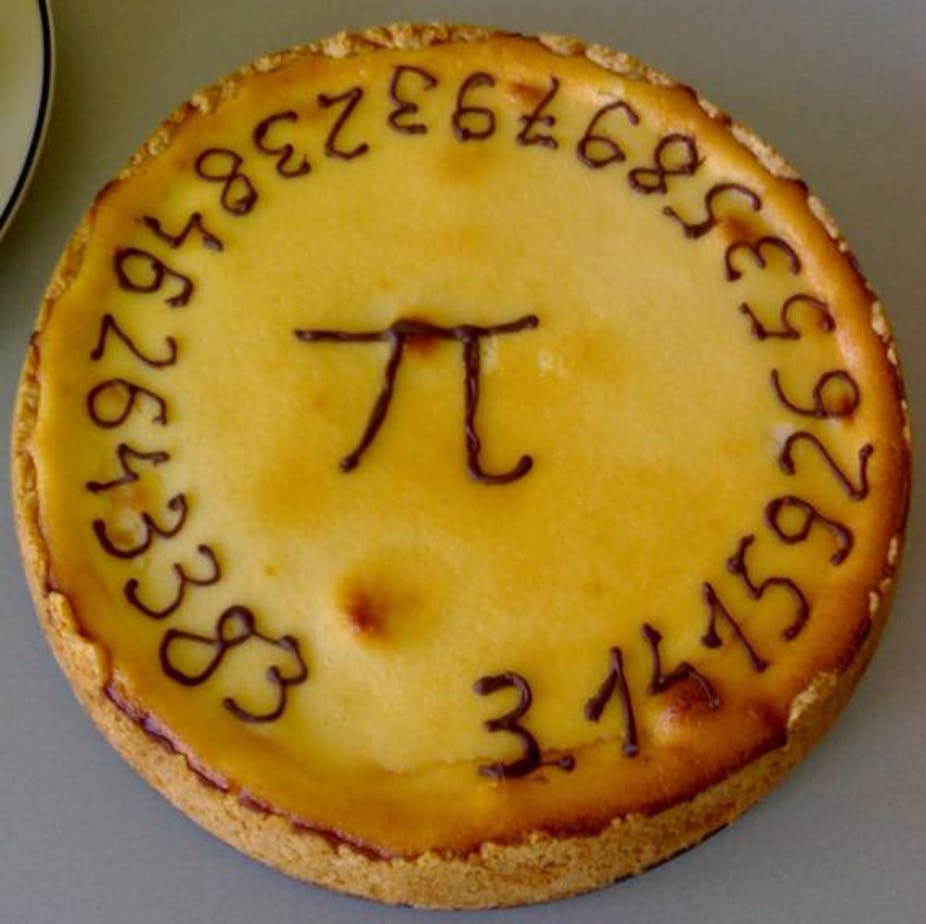
Some people have argued that Pi’s days are numbered and that other tools, such as tau, could do its job more efficiently. As someone who has studied Pi throughout his entire working life, my response to such challenges is unwavering: Pi is the gift that keeps on giving.
People call me Doctor Pi. I have played with Pi since I was a child and have studied it seriously for 30 years. Each year I discover new, unexpected and amusing things about Pi, its history and its computation. I never tire of it.
Erm, what is Pi?
Pi, written with the Greek letter π, has the value of 3.14159 …, is the most important number in mathematics. The area of a circle of radius r is πr2 while the perimeter has length 2πr.
Some Pi facts? OK
- Without Pi there is no theory of motion, no understanding of geometry or space/time.
- Pi occurs in important fields of applied mathematics.
- Pi is used throughout engineering, science and medicine and is studied for its own sake in number theory.
- It fascinates specialists and hobbyists alike.
The history of Pi is a history of mathematics
The most famous names in mathematics – Leibniz, Euler, Gauss, Riemann – all play their part in Pi’s illustrious history. In approximately 250BCE Archimedes of Syracuse rigorously showed that the area of a circle is Pi times the square of its radius.
Isaac Newton computed Pi to at least 15 digits in 1666 and a raft of new formulas for calculating Pi in the intervening years have vastly expanded our understanding of this irrational, irreplaceable number.
In my capacity as Doctor Pi – an affectionate name given to me by my students and colleagues – I have met Nobel Prize winners, pop stars and variety of colourful characters, many of whom go potty for this number.
So why the broad attraction? What is the secret of Pi’s enduring appeal? It appears in The Simpsons (doh!), in Star Trek (beam me up!), and in British singer-songwriter Kate Bush’s lovely 2005 song Pi:
“Sweet and gentle and sensitive man With an obsessive nature and deep fascination for numbers And a complete infatuation with the calculation of Pi.“
In the song’s refrain, Bush recites the first 160 digits of Pi (but messes up after 50!) Pi shows up in the movie The Matrix, episodes of Law and Order, and Yann Martel’s Mann-Booker prize winning 2001 novel Life of Pi. No other piece of mathematics can command such attention.
Memorising Pi
The current Guinness World Record for reciting these by rote is well in excess of 60,000 digits.
This is particularly impressive when you consider that Pi, having been proven irrational in the 18th century, has no known repetition or pattern within its infinite decimal representation.
A former colleague of mine, Simon Plouffe, was a Guinness World Record-holder a generation ago, after reciting Pi to approximately 4,700 digits.
Not surprisingly, there is a trend towards building mnemonics whereby the number of letters in a given word represents a digit in the series. For example “How I need a drink, alcoholic of course” represents 3.1415926. This mnemonic formed the basis of a Final Jeopardy! question in 2005.
Some mnemonics are as long as 4,000 digits, but my current favourite is a 33-digit self-referrent mnemonic published in New Scientist on Pi Day (March 14) last year.
Is Pi really infinite?
In a word: yes. So far, it has been calculated to five trillion (5,000,000,000,000) digits. This record was set in August 2010 on Shigeru Kondo’s US$18,000 homemade computer using software written by American university student Alex Yee.
Each such computation is a tour-de-force of computing science.
Estimates suggest that within the next ten to 15 years a quadrillion (1,000,000,000,000,000) digits of Pi will probably be computed. As relatively-recently as 1961, Daniel Shanks, who himself calculated Pi to over 100,000 digits, declared that computing one billion digits would be “forever impossible”. As it transpired, this feat was achieved in 1989 by Yasumasa Kanada of Japan.
It’s a kind of magic
Although it is very likely we will learn nothing new mathematically about Pi from computations to come, we just may discover something truly startling. Pi has seen off attacks in the past. It will see off attacks in the future. Pi, like its inherent magic, is infinite.
The battle continues.
Further reading:
Join the conversation
Comments (16)
Adam Thomas
(logged in via Twitter)
You're argument for Pi appears to be an appeal to authority, 'this is the way we've always done it', 'we need a circle constant' and 'people really like irrational numbers'. The first two are clearly fallacious, the third is a straw man argument and Tau is equally irrational.
No one is arguing that we no longer need a circle constant. The proponents of Tau are arguing that it is a better circle constant.
To prove that Pi's days are _not_ numbered, you need to prove that it is a better circle constant than the alternatives like Tau.
Paul Dalgarno
(Editor, The Conversation)
Thanks for posting this, Adam. I'd be keen to hear from anyone who believes Tau is superior to Pi as a circle constant, and why. And are there any more Pi fans out there? Make your views known ... There are no dead ends in Pi chat, only curves.
Jane Rawson
(Editor, The Conversation)
It seems to me that tau's main drawback is a PR one: its name has no association with delicious baked treats. Have mathematicians considered re-naming it "tart"?
Jon Borwein
(Laureate Professor of Mathematics at University of Newcastle)
Frankly ``Tau vs Pi" is completely irrelevant to me, but authority has its uses especially in such a well-cultivated field as mathematics. In my most recent computations we worked in base two and so all you need to do is to move the floating point.
Rogan Tinsley
(logged in via Twitter)
I'm with Adam regarding the arguments in the article.
Tau has clear advantages.However, Pi still has a place, but maybe it needs to share the stage.
Scott McCue
(logged in via Twitter)
Aliens are more likely to use tau as their "circle constant". And if we could do it all over again, we'd probably go for tau instead of pi. But Jon is right to predict that pi will remain our number one transcendental number (followed by e, not tau), unless the aliens come of course.
Electronics News
(logged in via Twitter)
While it would be all too easy to fall into the deep end of complex mathematical discussions, may I recommend Vi Hart's video as providing a clear, concise and very practical argument for Tau's case? http://www.youtube.com/watch?v=jG7vhMMXagQ
barrie stokes
(Mathematican at University of Newcastle)
Pragmatically the advantage of embracing tau is that if we eat a special pi(e) on pi day 3/14, and another on tau day 6/28, we get to eat one tau = 2 pi's per year. Surely that's progress. And I think that e to the i tau equals one gets rid of the slightly awkward minus one in the "most beautiful formula".
Schmy Seymour
(logged in via Facebook)
Doctor Pi: five trillion = 5,000,000,000,000
or did you mean five billion?
Tau fans: Euler's identity is amazing because of the negative! It's easy to make x^y = 1; just make y=0 and x can equal anything! Not hard. Try making x^y= -1. (without x= -1). To make the identity special, you would need: e^(i.t/2) = -1. Yuck.
Similarly, for every argument about tau replacing 2.pi, you could argue the opposite by using pi is better than t/2. Area of a circle? (t/2).r^2? Why not just A = p.r^2?
The tauday.com site loses all credibility for mistaking tau with Tao (pronounced "Dao").
Honestly, I feel this whole tau thing is either an April Fool's joke or an elaborate trolling. Next you'll be arguing Base 10 is bad and we should switch to Base X. (Let X equal your flavour of rant and have at it, kids.)
Matt de Neef
(Editor, The Conversation)
Thanks Schmy, we've fixed the "five trillion" error.
Justin H
(logged in via Twitter)
I'm sorry for what might be a naive question, but isn't the study of Pi based on the assumption of Euclidean space, and therefore shouldn't we be making every effort to define space before we search for the true circle constant? Can anyone point me to some good experimental results on confirming Pi?
Troy Barry
Mechanical Engineer (logged in via email @gmail.com)
I once did a statistical experiment (Monte Carlo) which demonstrated that pi=3.14+/- 0.05 or thereabouts, from a few hundred runs of the test. When I presented the reults to my maths class they were amazed*.
*That I had bothered to drop a needle on a piece of paper hundreds of times and record the results.
Mini Mi
Evil Clone (logged in via email @gmail.com)
5 trillion is actually 5,000,000,000,000 rather than the measly 5 billion stated in the article.
Matt de Neef
(Editor, The Conversation)
Thanks Mini Mi. We've fixed the error.
jim morris
(logged in via email @yahoo.com)
So how much are you getting paid for being DoctorPi?
Matt Stevens
Senior Research Fellow/Statistician (logged in via email @gmail.com)
Estimates suggest that within the next ten to 15 years a quadrillion (1,000,000,000,000,000) digits of Pi will probably be computed. As relatively-recently as 1961, Daniel Shanks, who himself calculated Pi to over 100,000 digits, declared that computing one billion digits would be “forever impossible”. As it transpired, this feat was achieved in 1989 by Yasumasa Kanada of Japan.
SO WHAT? What is the point? Is the accuracy that important that the sky would fall down? I doubt it.
Mathematics should be about parsimony, eloquence, simplicity. The argument for Tau seems to be a no brainer. When it comes to teaching mathematics, it should be clear, obvious, and about parsimony, if you want to engage a young persons mind. Not everyone has the maths gene, but it does not mean that these people should be locked out of the beauty of Maths. If something is easier to calculate using Tau, then it should be used. Simple, end of argument. So, wehn is the change going to happen?