
The Conversation
Subscribe
  • Academic rigour, journalistic flair
  • For curious minds
  • Expert news and views
  • Debate and ideas
  • From the curious to the serious

Hot Topics

  1. Gay marriage
  2. Australia in the Asian Century
  3. Convergence review
  4. Federal Budget 2012
  5. War on drugs
  6. Medical myths
  7. Bob Brown
  8. Square Kilometre Array
  9. Explainer
  10. Transparency and medicine

Australians can’t ignore the health impacts of climate change

Climate change is already harming Australians’ health and poses a significant threat for the future, according to a report released today by the Climate Commission. The Critical Decade: Climate Change and Health report synthesises existing information about the expected impacts of climate change locally…

Miki-jpg-1322611505-1322611765
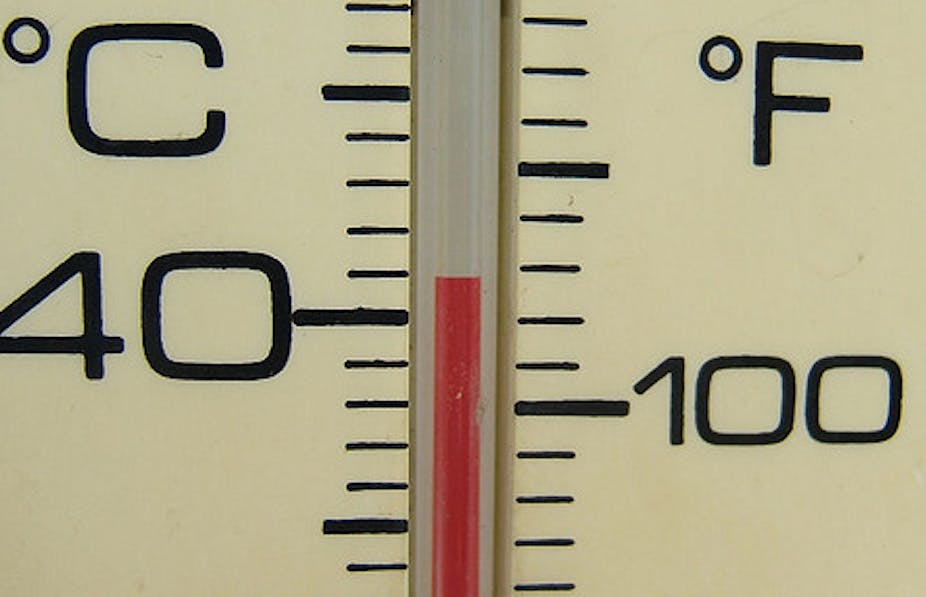
With the number of days over 35 degrees expected to rise, Australia can expect a rise in heat-related deaths and illness. Miki

Climate change is already harming Australians’ health and poses a significant threat for the future, according to a report released today by the Climate Commission. The Critical Decade: Climate Change and Health report synthesises existing information about the expected impacts of climate change locally and warns of more heat-related deaths, a rise in infectious diseases and greater mental ill-health.

Climate Commissioner and co-author of the report Professor Lesley Hughes explains the findings:

Our good health is the foundation for our way of life, our society and our economy. We all need clean air, clean water, tolerable temperatures and good food to sustain our health. Climate change threatens the health of the ecosystems we rely on, undermines our food security and pollutes the atmosphere that gives us a stable climate.

The Climate Commission’s report, The Critical Decade: Climate Change and Health, is a summary of the latest scientific findings about how climate change affects our health.

Some of the direct risks of climate change include heat waves – extreme heat kills people. Our health is also affected by extreme events, such as bushfires, floods, cyclones and droughts, and it is predicted that the frequency and/or the severity of these events will increase in the future.

Then there are the more indirect aspects. We know, for example, that extended periods of drought can be associated with increased stress and mental health problems in rural communities.

AAP

In terms of a temperature rise of a few degrees, what specific impacts can this have on the body and what are we likely to see in terms of greater illness and death?

At the moment, we know that when we get heat waves, which are several days in a row at hotter than average temperatures (for southern states this might be several days in a row in the high 30s up to mid-40s), there is an increase in hospital admissions and increase in death rates, particularly amongst the elderly and people who have pre-existing chronic illnesses, such as kidney and heart disease.

Heat is a silent killer and even in a developed country like Australia, people die from the impact of excessive heat.

What kind of economic impact are we likely to see from the increased burden on the health system?

Our health infrastructure during some natural disasters and very hot periods often doesn’t have the resources to cope, for example, with sharp increases in hospital admissions.

There will also be economic impacts of rising temperatures via the impact on occupational health. People who work outside, in unventilated environments, in mines and agricultural industries, for example, are vulnerable to the impacts of excessive heat. Any increase in the number of days lost due to heat will have an impact on productivity, with flow-on impacts to the economy.

In terms of an increase in infectious diseases, what changes can we expect to see over the next five to ten years in Australia?

Dengue is already in Australia – at the moment it’s confined to the northern areas of Queensland. It’s carried by mosquitoes called Aedes aegypti. The area that the mosquito can live in is dependent on the climate – humidity, rainfall and temperature.

We’re very confident that temperatures will continue to rise and if that comes with an increase in rainfall and humidity as well, it is likely that the area occupied by the mosquito will expand. If this happens, a much larger portion of the population will be potentially exposed to infection.

AAP

Who is likely to be most affected by these changes?

The risks from climate change will particularly affect sectors of the community that are already vulnerable – such as the elderly, children, people in lower socio-economic groups, people who live in remote regions, and Indigenous communities.

The report tells us that prevention is better than cure. What type of preparation is needed in the short- to medium-term to get us ready to cope with these health impacts?

Our health system needs to plan ahead to cope with the climate change that is now unavoidable.

We need to plan for increased hospital admissions during periods of hot weather in the future. Our emergency management services also need to be prepared for potential increases in the frequency and intensity of extreme events such as floods and bushfires.

The health professions have a very important role to play. This report has been endorsed by a large number of professional health bodies, including the Australian Medical Association, the Australian Nursing Federation and the Public Health Association, and some of the best known and most respected medical professionals in Australia, including Professor Peter Doherty, Professor Fiona Stanley, and Professor Ian Frazer.

This report should be a wake-up call to build awareness about the health risks of climate change.

Join the conversation

Comments (16)

  1. Permalink
    Marc Hendrickx

    Marc Hendrickx

    (Geologist)

    No response yet from the climate commission! I guess the sounds of dissenting opinions are harder to hear if you push your head deeper into the sandpit.
    The commission's abuse of public trust is a travesty!

  2. Permalink
    Marc Hendrickx

    Marc Hendrickx

    (Geologist)

    Another expert disagrees with the government's climate propaganda unit:

    From Roger Peilke Snr, a missing voice at The Con.
    http://pielkeclimatesci.wordpress.com/2011/12/04/summary-report-on-international-conference-on-climate-change-shifting-science-and-changing-policies/

    a) Dr. Lembke argued that the increasing number of vector borne diseases is, rather than a consequence of increasing temperatures as stated in the IPCC, is from the enormous urbanisation which is taking place on our planet. He…

    show full comment

  3. Permalink
    John McLean

    John McLean

    (logged in via email @connexus.net.au)

    Australians also can't ignore that
    (a) the authors of this report have poor understanding of the meteorlogical conditions that cause heatwaves (see http://www.quadrant.org.au/blogs/doomed-planet/2011/02/the-mythmakers),
    (b) that droughts cause higher temperatures not vice versa,
    (c) that droughts and poor environmental policies contribute substantially to the risk of bushfires
    (d) that rainfall in Australia is largely driven by the El nino-Southern oscillation,
    (d) that CSRO climate modelling has…

    show full comment

    1. Permalink
      Tim Scanlon

      Tim Scanlon

      (Climate and Agronomic Extension at Department of Agriculture and Food - Western Australia)

      John, I can't see any science cited in any of your points. Your links are even less interesting, as they are written by you and once again reference no science of any kind (newspaper articles and blogs don't count John).

      The past 15 years have contained 12 of the hottest years ever. Rainfall decreases across the southern half of Australia. Increased intensity of storm events. Higher average summer temps and drier fuel loads. Decreased average annual runoff. Etc. I think it is you who doesn't understand what makes a drought.

  4. Permalink
    Marc Hendrickx

    Marc Hendrickx

    (Geologist)

    In the climate commission's latest report I note that the section on mosquito borne diseases does not reference the work of epidemiologist Paul Reiter. Wonder why? Perhaps Lesley Hughes or co-author Tony McMichael would care to explain.

    Here's Paul's background from wiki...
    Paul Reiter is a professor of medical entomology at the Pasteur Institute in the city of Paris[citation needed], France. He is a member of the World Health Organization Expert Advisory Committee on Vector Biology and Control…

    show full comment

    1. Permalink
      Mike Hansen

      Mike Hansen

      Mr (logged in via email @gmail.com)

      A profile of Paul Reiter can be found here

      http://www.desmogblog.com/paulk-reiter

      Extracts
      Reiter sits on the "Scientific and Economic Advisory Council" of an organization called the "Annapolis Center for Science-Based Public Policy." The Annapolis Center is a US think tank that has received $763,500 in funding from ExxonMobil and has been very active in playing down the human contribution to global warming.

      "Reiter was a signatory of a 2006 open letter to [Canadian] Prime Minister Stephen Harper titled "Open Kyoto to Debate" which denied the existence of man-made global warming and encouraged inaction on climate policy."

      1. Permalink
        Mike Hansen

        Mike Hansen

        Mr (logged in via email @gmail.com)

        ad hom attack?

        Marc - are you referring to your claim made above
        "climate commission has little to do with scientific evidence and more to do with maintaining Groupthinking networks, ego and undeserved reputation."

        Is the profile of Paul Reiter inaccurate? If not, why is it not relevant in the same way that all the authors here provide a Disclosure statement?

        1. Permalink
          Marc Hendrickx

          Marc Hendrickx

          (Geologist)

          Mike, I didn't bother looking at the desmog blog profile as I don't consider the site to be a reliable source of information.

          As the disclosure statements on The Conversation are provided by the authors I don't put much weight on them either. It would be interesting to know for instance the extent of Lesley's involvement with activist NGO's but I doubt she will provide the information.

      2. Permalink
        Marc Hendrickx

        Marc Hendrickx

        (Geologist)

        How typical to go for an ad hom attack and ignore Reiter's research record in the peer reviewed literature. Blinded by confirmation bias just like the climate commission.

        To editor's could you please arrange a piece by Reiter to counter the mis-information and alarmism being spread by Lesley Hughes and co?

    2. Permalink
      Tim Scanlon

      Tim Scanlon

      (Climate and Agronomic Extension at Department of Agriculture and Food - Western Australia)

      Marc, even a cursory look at the peer reviewed literature can find not only current evidence of increased incidence of diseases as a result of climate change, but plenty of other analysis of climate relationships as well. Such as:
      http://www.nejm.org/doi/full/10.1056/NEJMp0912931
      http://rstb.royalsocietypublishing.org/content/356/1411/1057.short
      http://jama.ama-assn.org/content/275/3/217.short
      http://www.nature.com/nature/journal/v438/n7066/abs/nature04188.html

      The paper I did find by Reiter is an interesting one: http://www.ncbi.nlm.nih.gov/pmc/articles/PMC1240549/
      When you actually read it, you can see his bias present in the interpretation of results. He is down playing one influence to over state another by not taking into account changes that have occurred over time. Quite simply, he makes some valid points, but it doesn't change the result.

      They even held a conference on this sole topic, it was deemed that important:
      http://www.sciencedaily.com/releases/2007/08/070811220220.htm

      1. Permalink
        Marc Hendrickx

        Marc Hendrickx

        (Geologist)

        It is interesting to note the close relationship between a number of authors in the papers you have cited. McMichael, Patz, Koval, Campbell-Lendrum. While McMichael has been prolific in the literature you should be careful not to confuse quantity with quality. It seems the same old arguments and erroneous opinions are often repeated.

        Reiter, who represents the competition, has been equally busy with other scientists:
        http://www.thelancet.com/journals/lancet/article/PIIS0140-6736(97)12483-7/fulltext

        show full comment

        1. Permalink
          Tim Scanlon

          Tim Scanlon

          (Climate and Agronomic Extension at Department of Agriculture and Food - Western Australia)

          Marc, you have ignored my point completely. Reiter's work, whilst valid, is not as relevant to current climate change as you would have us believe. When you then look at the rest of the work done, you quickly understand that human health is at risk from climate change.

          You are essentially wanting to throw out the bulk of peer reviewed research in favour of one author who doesn't have that much to add to the topic. That is not good science.

          1. Permalink
            Marc Hendrickx

            Marc Hendrickx

            (Geologist)

            Tim, it appears the point missed by you entirely. I did not suggest throwing out the bulk of peer reviewed research I merely wanted some overlooked peer reviewed research done by respected researchers included. Without this only one side of the science directed by just a small group of researchers is being pushed, clearly for political reasons, that have little to do with science.

            The commission's very unscientific approach is correctly labelled as cargo cult science.

            1. Permalink
              Tim Scanlon

              Tim Scanlon

              (Climate and Agronomic Extension at Department of Agriculture and Food - Western Australia)

              What part of relevant have you missed Marc? What part of bulk of peer review literature is "a small group of researchers"?

              I know you want to label everything you disagree with as "cult science" and "biased" or "polically motivated" but that is just erronous thinking. You are cherry picking the data and scientists you want to believe rather than being objective. You need to open your eyes and your mind to the body of evidence, rather than this blinkered approach you have now. You are being unscientific.

              1. Permalink
                Marc Hendrickx

                Marc Hendrickx

                (Geologist)

                Tim, Tim, Tim,
                It's a strange, topsy-turvy world we live in when someone who calls for both sides of a complex scientific argument to be aired (ie me) is labeled a cherry picker, blinkered and closed minded; while someone (ie you) calling for the presentation of only one side of the debate, just one side, believes himself to be free of bias.

                Feynman said: The idea is to try to give all the information to help others to judge the value of your contribution; not just the information that leads to…

                show full comment

  5. Permalink
    Doug Cotton

    Doug Cotton

    (IT Manager)

    Those who are still worried by the warnings of those advising the IPCC that temperatures will sore by three degrees or more by 2100 could take comfort from a paper published last year the implications of which are not widely understood.

    But before I get to that, consider firstly these two plots.

    The first http://theconversation.homestead.com/60years.jpg shows only 0.6 degrees of warming at sea surface level over the last 60 years. It's not hard to see that this indicates only another 0.9 deg…

    show full comment