


From today, plastic bags are banned in the NT. The ACT will follow suit in November: in 2009 the ACT abandoned its 14-year old “No Waste by 2010” strategy and replaced it with a ban on plastic shopping bags. While campaigns against plastic bags have found a place in the public’s heart, will getting rid of them really make a difference?
Aspiring to zero waste
“No Waste by 2010” achieved a 70% reduction in waste to landfill in the first half of the program. It also created up to 200 new jobs in recycling. But in 2009 the then Chief Minister, Jon Stanhope, announced that zero waste was only ever an “aspirational” goal and could not be achieved.
The axing of the zero waste policy has effectively handed over the Territory’s waste management to the waste industry. It has a vested interest in ensuring continued and increasing waste to landfill: that’s where the profits lie.
In place of the zero waste program the government proposed street level recycling bins in public areas and an organic waste recycling trial. To date neither of these initiatives has been realised.
In late 2010 the ACT government announced a ban on the use of polyethylene polymer (HDPE) plastic bags from 1 November 2011, with a transition period from 1 July. Heavier grade LDPE, or “boutique” bags, lightweight biodegradable plastics and the “barrier” bags that are provided in fruit and vegetable sections of supermarkets will not be affected.
High-profile, unsightly and cheap to ban
Lightweight, waterproof and with a high tensile strength, the popular HDPE “singlet” bags have come to represent a growing waste problem. Australians use a staggering 4 billion of them a year. Sixty million of those are in the ACT.
Despite the efforts of retailers - including Target, the now defunct Borders, and hardware giant Bunnings - to phase out plastic bag use, and despite the increasing use of alternative bags by consumers, plastic bags are still proliferating in landfills and littering the countryside.
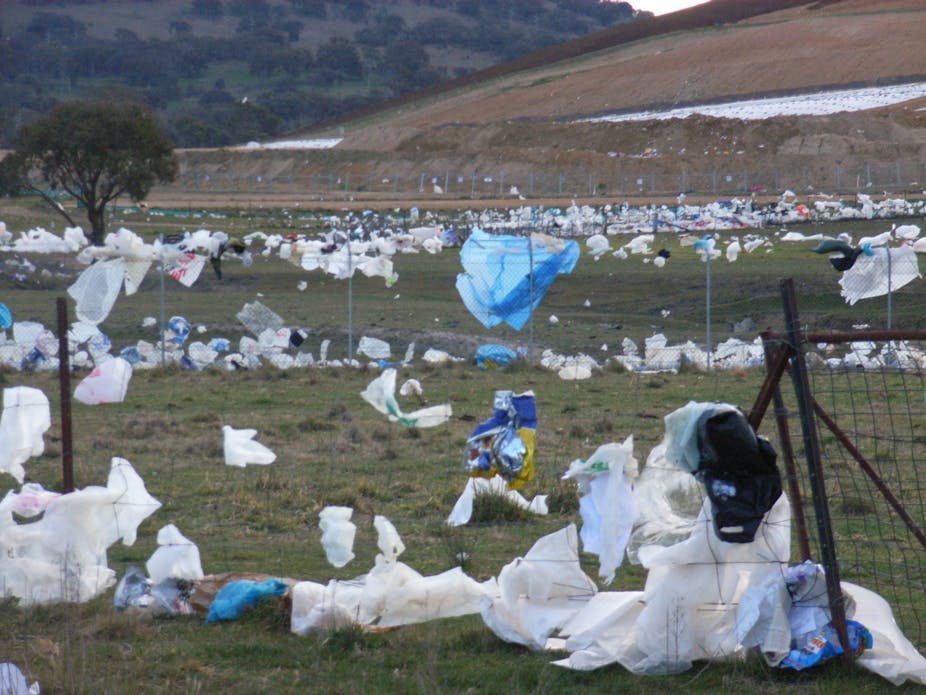
They are among the most visible signs of waste as they blow across parks and paddocks, catch on fences and clog waterways.
Banning the use of these bags is drop-dead easy policy for a government whose record on waste management has gone from national leader in the 1990s to laggard.
Banning plastic bags will cost the government virtually nothing more than the cost of printing some informational flyers while pushing full responsibility for implementing the policy on to retailers and consumers.
The environment doesn’t care about ugly
But what environmental effect will the policy achieve?
The impact of HDPE bags on the marine environment is well documented. There have been numerous recorded instances where wildlife and domestic or farm animals have died as a result of ingesting them. But research by the Environment Agency of the UK indicates that the overall environmental impact of this plastic is considerably less than that of cotton or other environmentally friendly bags.
A life cycle analysis of a number of different types of shopping bags found that a cotton shopping bag would have to be used 131 times to be below the total global warming potential of a HDPE bag used only once.
Of course, a cotton bag can be used repeatedly for years and when it reaches the end of its life as a shopping bag could potentially be reused for something else and never end up in landfill. But the point made by the study is that the impact of HDPE bags in terms of global warming is negligible.
There is, however, the visual problem. The fences around landfills are invariably covered with these bags and they also pose litter problems around shopping centres, carparks and other open urban areas.
In effect this is a myopic policy response to a symptom and destined to be little more than a high profile litter campaign.
Concentrate on compost?
In terms of the total waste volume in the ACT plastic bags comprise only a very small fraction. While they are a highly visible component, 60 million plastic bags weigh less than 60 tonnes.
This is insignificant against the 30,000 tonnes of food that, according to the ACT Conservation Council, goes to landfill in the ACT every year from the commercial sector alone. That’s 30,000 tonnes of waste that could be diverted from landfill and recycled as compost if the government had the will and foresight to introduce a commercial composting facility.
The HotRot in-vessel composting unit currently in use at the Australian National University campus processes over 4 tonnes of food and other organic waste every week, reducing the waste to landfill from that one organisation by 230 tonnes a year.
The ACT opposition has raised concerns about the plastic bag ban policy with regards to hygiene and public health. This appears to be more about the opposition’s need to raise an objection than any real policy alternative.
It is highly unlikely that hygiene standards in individual households will be abandoned simply due to the absence of HDPE bags and there is no evidence that public safety could be compromised.
A waste of good policy
A better objection on the part of the opposition might be that the policy is a cynical exercise in shifting the onus for waste management from government to the commercial and community sectors while not addressing more environmentally pressing areas of waste.
Canberra is a very clean city. This is a source of civic pride for government and citizens alike. It is part of the city’s projected image as the national capital and as the city grows, it is something that will be increasingly difficult to maintain.
Banning HDPE shopping bags will reduce the visual impact of waste. But without integrated policy for reductions in other areas of the waste stream it is only a very small Band-aid on a very large sore.