




Given our rapid depletion of resources, especially raw materials, and Australia’s ever-increasing waste creation, it’s time to ask: what are the best ways to encourage resource recovery and recycling to get to “zero waste”?
South Australia’s money-back container recycling scheme is a success story, with bottle-recycling rates the highest in the country. But the question is whether we achieve zero waste through recycling alone.
Our research says: no. The focus needs to be on avoiding waste creation in the first place. We have to re-think the way we design and construct products and buildings to make it easier to re-use or disassemble them at the end of their life.
A good example of transformation in the construction sector is the take up of prefabrication, with machining off site. This allows for almost zero-waste production of building components, easy retrieval of materials and components, and building elements that are easy to re-use when the building is being demolished.
How do we stop producing waste?
From a purely economic point of view, producing waste is not a good move as it is a waste of materials paid for. More waste only suits a group of suppliers who make money out of higher than necessary consumption and repeat customers. In a future economic model, these suppliers will need to look for a better business model.
Unfortunately, reversing the existing, wasteful business systems and manufacturing practices isn’t a fast, easy or cheap process. If we can begin at the beginning, and design waste out of the picture, we can recover not only the final product, but also the energy, materials and time embodied in the product or building.

Today, zero waste is the most discussed concept for municipal solid waste management systems. Working towards zero waste has become a worldwide movement that changes the way we design, construct, operate, maintain, disassemble and recycle products, buildings and cities. Simply put, zero waste means no unnecessary and unwanted waste from a product – at any stage of its life-cycle.
Zero waste is radical in its ramifications, and it requires more than a top-down, government-imposed approach. To be successful, it needs to be embraced and implemented by citizens and community groups, business and industry.
We need to see the big picture and face the real problem. We cannot have infinite growth and consumption on a planet with finite resources.
Annie Leonard’s The story of stuff has a powerful message about consumerism and waste, while Paul Hawken and Michael Braungart are exploring zero waste theory and behaviour change, trying to alter our throwaway society.
Waste management expert Paul Connett notes that “during the 20th century, the focus was on waste management and how to get rid of waste efficiently and with minimal damage to our health and the environment. The 21st century focus needs to be on resource management and sustainability for future generations. Therefore the real problem is fighting everyone’s over consumption”.
Recycling helps, but only if people want to recycle
But instead of talking about consumption, the media mostly reports recycling rates; simplistic stories that don’t challenge readers to truly rethink their consumption and waste creation.
For instance, Fairfax Media reported on 14 February 2012 that recycling isn’t going as well as previously thought. Participation in bottle recycling, in particular, is lower than anticipated (the official Australian beverage container recycling rate is 52%, whereas environmental groups dispute it and put this figure at 38%).

There has been ongoing piecemeal debate, especially in Victoria, about whether a cash-back recycling scheme for bottles would help. (Bottling companies pragmatically suggest “more bins” would actually do more to improve recycling rates). This is all understandable and of some help, but fails to address the true scale and importance of the issue.
What motivates people to recycle is now one of the core waste management research concerns. A quick look at recycling issues in South Australia provides further insight.
Container deposit legislation (CDL) is one of the most important policies in South Australia’s recycling success story. It was introduced in 1977.
Targets must be quantified and there must be a way to check they’re being met. According to the Environmental Protection Agency, the rate of recycling cans and bottles was 80.4% in the 2009-2010 financial year. To raise this rate, the bottle refund doubled to 10 cents in 2008; overall, recycling has increased more than 10% since. From January 2012, the Northern Territory has adopted the SA model for beverage container recycling.
New research by our centre on how to encourage recycling reveals that people are motivated to recycle for many reasons: personal, social, economic or environmental benefits. People are positively motivated by direct economic benefits so the South Australian refund has increased over time.
However, other factors, such as availability of recycling facilities (such as recycling bins and centres), policies and regulations (landfill bans, landfilling levies) and socio-cultural factors (behavioural change) are also significant contributors to achieving zero waste through recycling.
Zero waste is possible: here’s how
Today, it is technologically possible to build a zero-waste and zero-carbon emission city. The question is: are we willing to do so? We would have to design and manage products and processes to systematically avoid and eliminate the volume of waste and materials. This means decoupling the rise in consumption and growth from an increase in material use, and developing new thinking and technology, for the stages from design, to production, to recovery.
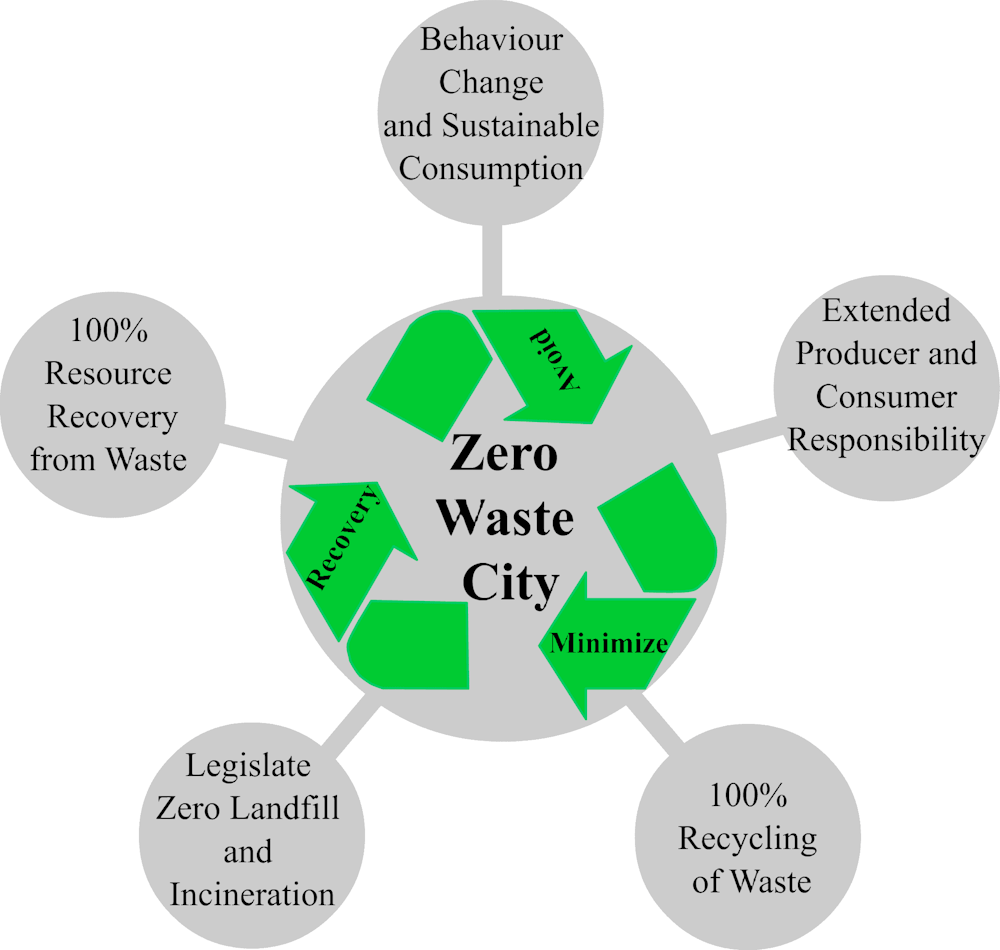
Extended Producer Responsibility (EPR) legislation is about to be passed in Australia. It will require producers to be responsible for their products’ entire lifecycle (beyond the selling date), and will include take-back agreements and changes to the way consumer products can be recycled.
EPR is one of the prime strategies for improving recycling rates. In every stage of product design, marketing, retail and end-of-life management systems, producers can contribute and improve overall recycling rates through EPR. Right from the outset, industry will have to incorporate a new ethic: of clean production, responsible packaging and designing for zero waste principles.
Adelaide and Canberra achieve Australia’s highest rates of diversion from landfill: over 70%. What must be asked is whether 100% (or close to) recycling is possible?
It is possible if we stop producing non-recyclable products, and if we recycle every single product we consume. Products are often non-recyclable if the are a composite of various materials, for instance melted together materials on electric circuits in computers and copiers. This makes the entire device difficult and economically unattractive to repair or recycle (compared to the purchase of a new product).
We need to act as an environmentally responsible community rather than a hyper-consumptive society. Container deposit legislation and personal behavioural changes in recycling systems can be useful tools for achieving zero waste.
But there is also a great need for interdisciplinary research into achieving zero waste, behaviour change and better industrial design.