
The Conversation
Subscribe
  • Academic rigour, journalistic flair
  • For curious minds
  • Expert news and views
  • Debate and ideas
  • From the curious to the serious

Hot Topics

  1. Gay marriage
  2. Australia in the Asian Century
  3. Convergence review
  4. Federal Budget 2012
  5. War on drugs
  6. Medical myths
  7. Bob Brown
  8. Square Kilometre Array
  9. Explainer
  10. Transparency and medicine

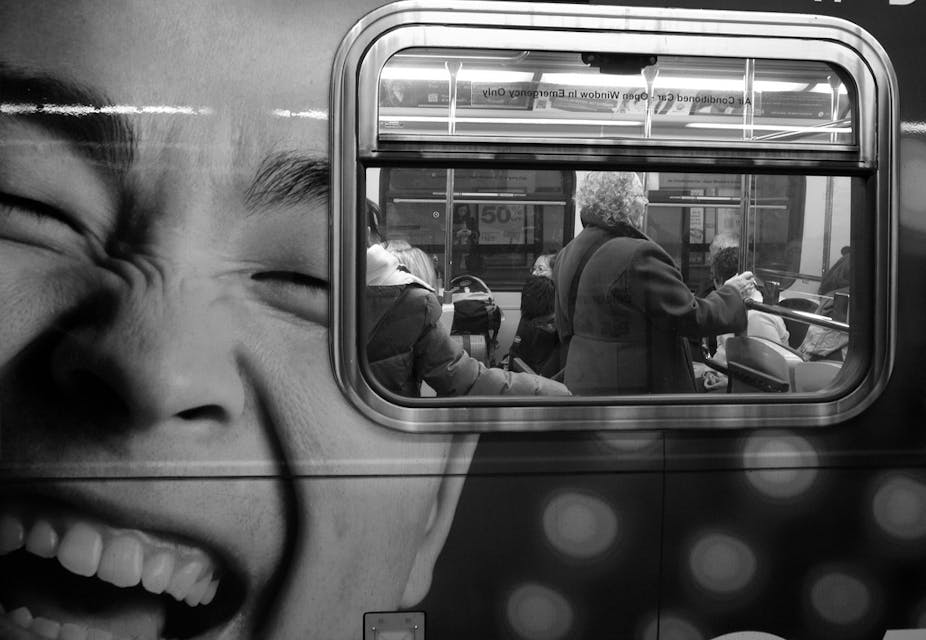
Big belly laughs – why is it okay to laugh at fat people?

Recent articles on perceptions of overweight and obese people have attracted a lot of attention from those with something to say about the overweight and the obese. One point that seems clear from the comments following these articles is that it’s okay to laugh at fat people. Hollywood entertainers…

G8m3dsmq-1329286539
One reason we feel comfortable laughing at fat bodies is because we believe we can assess an individual’s personal and moral characteristics by their body. Robert Danay

Recent articles on perceptions of overweight and obese people have attracted a lot of attention from those with something to say about the overweight and the obese. One point that seems clear from the comments following these articles is that it’s okay to laugh at fat people.

Hollywood entertainers such as Eddie Murphy, Mike Myers, Courtney Cox and Gwyneth Paltrow have secured big pay cheques and even bigger laughs by putting on fat suits. Why do we find this funny? Why are fat suits and the act of dressing up as fat for the sake of laughs, not considered offensive as other forms of derogatory behaviour, for instance, as blackface?

Stigma against fat people is well researched and documented. Even the sight of two fat people kissing is apparently too gross for some to handle.

If you find yourself sceptical about the level of hostility directed at fat people, just wait a few hours and then read the comments at the end of this piece (or read the comments about this earlier piece). Notice how some people will hide their contempt behind concern – “I’m just thinking of health.” Others will cloak it in a perceived cost to themselves – “Obesity costs taxpayers x amount of dollars!”

Maybe we laugh at fat because we believe that fat people should be blamed for their fatness. We think that fat people are fat because they eat too much and never exercise. None of this bears out in research. Research has yet to establish a way for a fat body to become, and stay, a slim body, and permanent weight loss is not possible for 95% of the population.

Another reason we may feel comfortable laughing at fat bodies is because we believe we can assess an individual’s personal and moral characteristics by their body. Fat bodies tell us that the person is lazy, out of control, and lacking willpower – characteristics that are all undesirable.

If someone is lacking morally, then we feel all right, perhaps even justified, in our taunting; we have the moral high ground, and really, we’re just shaming them for their own good.

What if laughing at fat people is a safe way to express our other biases and prejudices? While it’s incorrect to assert that fat prejudice is the last socially acceptable kind of prejudice, it’s true that unlike other areas of oppression (sexism, racism, classism), there are no legal protections based on weight or height in most countries.

And because poor people are more likely to be fat than people with more money – women are more likely to be fat than men and ethnic minorities are more likely to be fat than whites – fat prejudice and discrimination are likely tied into other forms of oppression.

Consider a list of traits associated with fatness – lazy, stupid, undisciplined, unattractive, unsuccessful – against a list of traits associated with thinness – active, smart, disciplined, attractive, successful.

Now replace the words fat and thin with poor and rich – or with black and white.

People of all body sizes laugh at fatness, including fat people because many believe their fatness to be a temporary state due to a lack of such variables as time, energy, willpower, or even illness. In fact, fat people are just as likely to hold anti-fat attitudes as slim people because they internalise the attitude they’re surrounded with their entire lives.

Join the conversation

Comments (60)

  1. Permalink
    Kath Read

    Kath Read

    IT Librarian (logged in via email @gmail.com)

    How hard is it to just simply adopt Wil Wheaton's law and "Don't be a dick."

    Seriously, what kind of sad, sorry person has to find humour in the humiliation of others? How hard is it to treat your fellow human beings, no matter what shape or size they are, or how they look, with dignity and respect? How hard is it to mind your own business about other people's bodies/health?

    Clearly, it's nigh on impossible for many people - look at the comments around mine for evidence that it is just not possible for many people to allow fat people to live their lives in peace, without ridicule or vilification.

    I love to laugh - in fact I'm known for my laugh. But I would be deeply, deeply ashamed of myself if those laughs ever came from humiliation or ridicule of people based on how they look.

    Again, it comes down to a superiority complex. So long as people like these can drag others down, they feel built up themselves.

    I find that so pathetic.

  2. Permalink
    Jennifer Watts

    Jennifer Watts

    Author (logged in via email @hotmail.com)

    Here is a simple truth...we are not gingerbread cookies cranked out of an assembly line and pressed into a similar form. We as the human race are varied and beautiful in our many forms. If we were all the same, it would be a true shame because variety is what makes life interesting.

    I have an interesting case study for you to ponder from within my own family. My mother was born VERY poor in the American South in 1953, the 6th of 7 children. Their family were so poor that they did not get…

    show full comment

  3. Permalink
    Frances Lockie

    Frances Lockie

    Policy officer (logged in via email @gmail.com)

    I take comedy quite seriously, in that it can be a really effective tool for commenting on society or creating dialogue. It's a subtle yet powerful medium for change and I have such respect for people who do it well.

    Which is why I can't stand fat jokes. I find fat jokes a really lazy form of comedy. Fat people, due to their stigmatised position in society, are easy targets. It's a cheap laugh. I don't know why someone would emulate Wil Anderson when they could be aiming for Barry Humphries.

  4. Permalink
    Diann Arcana Johns

    Diann Arcana Johns

    (logged in via Facebook)

    People love to mock others and fat is all they have left that they can publicly malign without much resistance. I mean it must feel so good to hate someone openly with little repercussions. They can savor the word fat before spitting it out at someone. They justify their hate by crying about their precious tax dollars as if fat people don't pay taxes. They equate fat with uneducated and on the government teat. I work 40 to 50 hours a week. I never miss work. I rolled over the max of what I could…

    show full comment

  5. Permalink
    Kitt Kat

    Kitt Kat

    (logged in via Facebook)

    People who lampoon, degrade or bully fat people by their behaviour do so because:

    THEY LACK SOCIAL, CULTURAL AND EMOTIONAL SOPHISTICATION.

    Or, they have a sense of worth based on NOT being fat, subliminally or blatantly sucked in by sick media ideals or the advertising push of a billion dollar weight loss and pharmaceutical industry. Their sense of NOT being fat is fuelled by their perceived own self discipline and obesity hoax paranoia which empowers them to believe they are morally and physically…

    show full comment

  6. Permalink
    Eileen McGarvey

    Eileen McGarvey

    Residential Skills Specialist (logged in via email @hotmail.com)

    One thing I find interesting is that if I am with friends who are thin and fat comes up as a joke or otherwise they don't seem to realize that *I* am fat.

    I think this is because in their minds fat=bad, ugly, loathsome and yet me, their friend, =fun, smart and kind and they can't make the contradiction make sense so they just pretend it doesn't exist.

    How many people know fat people in their lives who are somehow the "exception" to the stereotypical fat person? Are they really the exception or is believing that the only way to make your opposing "realities" mesh?

  7. Permalink
    Alicia Benjamin

    Alicia Benjamin

    (logged in via Facebook)

    "permanent weight loss is not possible for 95% of the population."

    ^ I highly disagree with this statement.

    Fat or not, I think we should each be striving to live a healthy lifestyle that incorporate regular movement. Walking at a moderate pace for up to 30 minutes a day--or 3,000 steps--has rewarding health benefits, like cutting the risk of heart disease by as much as 40% and lengthening your life span by 1.3 years. (source: Harvard School of Public Health)

    I think, as a society, we have…

    show full comment

    1. Permalink
      Diane Fruchtman

      Diane Fruchtman

      Student (logged in via email @indiana.edu)

      I don't think there is any question that modern western society is unhealthy.

      We sit too much, we eat bad food, we are stressed; we smoke, we binge drink, we do crazy things to look socially-acceptable.

      But to fix the problem, we need to focus *only* on health, not on weight.

      Focusing on weight leads to:
      --even poorer eating habits and yo-yo dieting
      --supporting the diet industry with money that could go to actually improving your life
      --binge exercising
      --allowing your self-esteem…

      show full comment

    2. Permalink
      Diane Fruchtman

      Diane Fruchtman

      Student (logged in via email @indiana.edu)

      Alicia,

      Weight loss=/=health. Quite frequently, weight loss means the opposite. If someone's metabolic numbers, bloodwork, blood pressure and strength are normal or even admirable, why would you want them to change what is obviously a healthy lifestyle just so that they look smaller?

      Furthermore, what you say about movement and exercise is absolutely true, but it doesn't really make people thinner. It certainly doesn't make them thin enough to escape fat jokes or fat stigma.

      To be really healthy as a society, we need to promote movement without assuming that it will make people thin. And we have to stop thinking it's ok to make fun of fat people.

      D

      1. Permalink
        Alicia Benjamin

        Alicia Benjamin

        (logged in via Facebook)

        Diane,

        Did you ever see me use the word "thin?" No. That's not what I was saying. Please go re-read my post. I am not advocating for a thin society. I am advocating for a healthy society. Excess body weight is not healthy. Nor is being too thin or under-nourished.

        I did not say that moving more would yield weight loss, or make someone thin. Nor did I say that moving more should be motivated by escaping fat jokes. So, yeah.

        We each have a responsibility to ourselves. I think "fat" people…

        show full comment

        1. Permalink
          Amy Dobek

          Amy Dobek

          MSW Student (logged in via email @gmail.com)

          Actually, Alicia, the only thing you can know by looking at a fat person is that (1) they are fat and (2) what your own prejudices are towards fat people. Fat is not an outward sign of ill health. I have a community of friends who are "fathletes." They eat moderate portions of nutritionally balanced food and exercise for hours on a daily basis because they want to. They have triglycerides, blood pressures, and cholesterol levels much lower than most thin people do, yet folks take one look at a belly roll and declare that they are unhealthy. That IS stigma, by definition.

          You are also absolutely wrong in your disagreement with the statement that "permanent weight loss is not possible for 95% of the population." Study after study after study has shown that most people who attempt long-term weight loss completely regain ALL of that weight within 2 years, and then add MORE weight, which is a greater detriment to their health than if they had never lost the weight at all. This is fact.

          1. Permalink
            Alicia Benjamin

            Alicia Benjamin

            (logged in via Facebook)

            Amy,

            I respectfully and adamantly disagree with you on both accounts. How is "fatlete" not a derogatory word? I'm sorry, if you are fundamentally overweight, you are not a healthy person. I'm talking EXCESS weight. Like fifty pounds + over what you should weigh based on a waist-hip ratio.

            And people who gain all the weight back sound like they fell victim to dieting. I'm not talking about dieting for permanent weightloss. I'm not even talking about weight loss as the solution... that is typically…

            show full comment

            1. Permalink
              Jasie Stokes

              Jasie Stokes

              (logged in via Facebook)

              The word you use in caps, EXCESS, is still very problematic with this issue. Every body is built differently and there's no "should" when it comes to weight. Really, weight is irrelevant to the health conversation when there are athletes who are metabolically healthy and still "fifty pounds +" over some magic number that doesn't even exist.

              The main point of this whole post and conversation is that the arbitrary numbers and ratios people place on other people's bodies is just plain wrong and leads to social stigma and all of the health problems that comes with stress, depression, and low self esteem. If you want people to be healthy, stop harping on their weight.

              1. Permalink
                Alicia Benjamin

                Alicia Benjamin

                (logged in via Facebook)

                Jasie,

                I used all caps to emphasis that I'm not talking about people who are carrying around a little extra weight. I'm talking about those who are obviously overweight. We're also not talking about athletes like linebackers.

                It's a matter of opinion. We're each entitled to our own.

                You have a good point about the arbitrary numbers and ratios. But those exist for a reason. On the onslaught, they were thought to be a good measure of health. Are they flawed? Yes. But America is getting fatter and fatter... and that's okay? Why is that okay? I guess that's my point here.

                As someone said in another comment, society tends to laugh at where the problems lie. It's a sort of coping mechanism. Doesn't make it right, but that's what is happening. I don't believe in making fun of people with serious health issues.

                - Alicia

    3. Permalink
      Amy Dobek

      Amy Dobek

      MSW Student (logged in via email @gmail.com)

      D'OH! I forgot to address one point. You said, "I think, as a society, we have a right to expect or hope for certain outcomes in how people are living their lives."

      Alicia, because this is a free country, you are absolutely free to think that if you choose. Just as I am absolutely free to tell you to mind your own business when you attempt to put your expectations on me. Your rights end where mine begin; no exceptions. Certain men who lived in your hometown some 200+ years ago understood this and helped write those protections into the document that formed the foundation of this country.

      You can hope all you like that I will live my life to your standards but that's just as realistic (and arrogant) as my hoping that you will live YOUR life to MY standards. Sound fair?

      1. Permalink
        Alicia Benjamin

        Alicia Benjamin

        (logged in via Facebook)

        Understood. Just know that acceptance of standards that include unhealthy living goes against my principles. It's something I strive to achieve, a state in which I "let things go" so people can do as they please. I don't impose my thoughts or beliefs on anyone in real life. I don't go around "preaching" a vegan diet. But this is an online conversation about a societal issue; therefore, I have the right to say that under no circumstances will I ever be able to understand this issue without wanting to change (fix) it.

    4. Permalink
      Andrew McNicol

      Andrew McNicol

      (PhD candidate (Media) at University of New South Wales)

      It's not capitalism and fast food that make people fat. In some cases, perhaps, but many who eat healthy food and exercise regularly also find it difficult or impossible to maintain what we are told to believe is a healthy weight.

      "Are you hoping that Americans finally learn how to accept "fat?" If so, why? Why is it okay to be fat?"

      To state that it's okay to be fat is not to state that it's okay to be an unhealthy, lazy burden on the rest of society. The issue addressed here is that society often acts as though it's _not_ okay to be fat. (Your question highlights that view.) How did we get that way? I agree with the author that this is a major problem well worth addressing.

      Comments that suggest people should exercise more inappropriately blame those who are constrained by their social environments, financial situation or the simple fact that their bodies are naturally different to what society tells us is physically desirable.

      1. Permalink
        Alicia Benjamin

        Alicia Benjamin

        (logged in via Facebook)

        Andrew,

        Capitalism and fast food certainly don't help. We live in a society where our set of priorities dictate that it's okay to work fourteen hours a day, then rush through a drive through for dinner that we'll likely eat in the car. Behaviors are what cause us to lead unhealthy or healthy lives. I cite movement as an example of ways in which people can be more in charge of their health, not just weight loss, via the little things that make a big difference.

        Another is diet, which is fundamentally…

        show full comment

        1. Permalink
          Amy Dobek

          Amy Dobek

          MSW Student (logged in via email @gmail.com)

          Thank you, Cat, for an articulate and well-reasoned article.

          The only way to stop shaming and stigma is to stop shaming and stigma.

          I was a fat kid who was bullied and shamed by others because society said it was OK to bully me that way. No one should EVER have to experience the hours and years of tears and self-hatred that I did. I don't care who you are - doctor, lawyer, merchant, chief - it is not OK to make fun of someone based on his appearance. It's arrogant and it's cowardly and the…

          show full comment

        2. Permalink
          Amy Dobek

          Amy Dobek

          MSW Student (logged in via email @gmail.com)

          On most of this statement I will absolutely agree. We have many, many places where we disagree (like about whether it's OK to be fat), but much of society is definitely geared toward unhealthy, rush-rush, convenience lifestyles, and I agree that this needs to change.

          On a couple of other points, however, I will challenge you to rethink your perceptions. For the sake of argument, I'm presuming you didn't know the individuals on the Boston Commons, but you say you saw a mother and daughter sitting…

          show full comment

          1. Permalink
            Alicia Benjamin

            Alicia Benjamin

            (logged in via Facebook)

            Amy,

            You're right. I do feel, however, that since I work in the health space and have seen the 'standard' in American diets, I draw conclusions based on norm. The relationships between the two aside, it was disheartening for me personally to walk by and see a toddler child reaching into a big bag of fast food. The older woman had her own bag, of which she was partaking. So, yes, I did draw my own conclusions. This is just one example I cited. But you see, I used to be that person... and yes, I may be coloring the world with my own perceptions, but that's what we all do. I'm not trying to judge. I'm trying to show compassion for someone who I can relate to. It may not be coming out the right way, and for that I apologize.

            - Alicia

  8. Permalink
    Alex John Crandon

    Alex John Crandon

    Surgical Oncologist & Director Qld Centre for Gyn Cancer (logged in via email @igcs.com.au)

    There are an awful lot of misconceptions about obesity. We don't understand a lot about what controls our body size and while obese people do eat too much it is th control of the desire to et that is not understood.

    Our body seems to have a monitoring method of our size. Just as we have systems that monitor breathing. While you can slow your breathing for a time your rising CO2 levels will force you to then increase breathing to get back to what your body determines is normal. Similarly with…

    show full comment

    1. Permalink
      Amy Dobek

      Amy Dobek

      MSW Student (logged in via email @gmail.com)

      I take exception to your statement that "obese people do eat too much." I have a number of friends that do NOT eat too much and yet cannot lose body weight. There are a number of physical conditions that contribute to weight gain, and a vast number of medications for which weight gain is a side effect. Please do not make blanket assumptions about an entire population based on behaviors you've observed in only a portion of it.

      I understand the questions that arise about showing people from 50 years ago as smaller in girth - but here's a fascinating corollary: we are getting TALLER, too, on a global level. It's entirely possible that the same genetic mechanisms that determine increased height are also determining increased weight points.

    2. Permalink
      Frances Lockie

      Frances Lockie

      Policy officer (logged in via email @gmail.com)

      Your comment adds nothing to the conversation about what can be done about fat stigma now. This article is about prejudices, not how and why people can to be fat.

    3. Permalink
      Rob Crowther

      Rob Crowther

      Architectural Draftsman (logged in via email @westnet.com.au)

      I went to school in the sixties/seventies. My children have only recently completed.

      We compared school photos and the immediate thing that hit me was the girth of faces. In my photo we were thin and only a few have rounded faces – and rounded bellies to match.

      The kids photos had a few thin people, most were rounded and about a tenth were just plain old fat.

      How does that fit with current knowledge because to the layman, it would appear to me the difference between 1968 and 2008 is the car and McDonalds.

      1. Permalink
        Alex John Crandon

        Alex John Crandon

        Surgical Oncologist & Director Qld Centre for Gyn Cancer (logged in via email @igcs.com.au)

        Rob, I noticed that as well.
        I was in Primary School in the 1950's and High School in 1960's. My father had a hobby interest in home movies. After he passed away I found hours of movies he had taken as I was growing up. The interesting thing was that there was almost no-one who was overweight let alone obese. Not only was there no fat kids, there were almost no fat parents.

    4. Permalink
      Thomas Marshall

      Thomas Marshall

      Architectural Assistant (logged in via email @gmail.com)

      I think your point is quite valid with regard to dieting, but if that is the case, then an increased amount of exercise should help to maintain a healthy balance.

      Of course people's physical dispositions vary, but arguments about genetics or natural weights seem to ignore that people are getting fatter than they have ever been before.

      1. Permalink
        Alex John Crandon

        Alex John Crandon

        Surgical Oncologist & Director Qld Centre for Gyn Cancer (logged in via email @igcs.com.au)

        Thomas, I get the impression and partly from my very fit and active son that exercise contributes about 80% to fitness and 20% to weight while diet does the opposite. Diet makes a major difference to weight and a little to fitness.

        Other problem is that with regular exercise you get the desire to eat more rather than to reduce your weight/body size.

        There's a lifetime's research and several PhD's in this.

  9. Permalink
    Trudy Williams

    Trudy Williams

    (logged in via Twitter)

    In Australia, men are more likely to be overweight/obese than women so this weakens one of your claims that "fat prejudice and discrimination are likely tied into other forms of oppression". The numbers for adults are 68% men and 55% women are overweight or obese. In total, about 61% of the population carries excess weight - fat is the word you use.

    Perhaps your piece about fatness is not about 'ordinary' overweight but rather about people with significant obesity - morbid obesity? I'd suggest, therefore, that you be upfront and use the term ...very fat...not just fat, using your choice of word.

    For the record. I don't find humour in a person's body size whether they are overweight or underweight. I find humour in life's situations and these may just happen to involve a person who is overweight because more than half the Australian population is overweight.

  10. Permalink
    John Wright

    John Wright

    Director (logged in via email @energytesting.com.au)

    Dear Cat
    Could you please reference these two statements;
    1. We think that fat people are fat because they eat too much and never exercise. None of this bears out in research.

    2. ....and permanent weight loss is not possible for 95% of the population.

    Support the tone of your article, but interested in these particular statements.
    Thanks John

  11. Permalink
    Mat Hardy

    Mat Hardy

    (Lecturer in Middle East Studies at Deakin University)

    As an overweight person who eats too much and doesn't exercise enough, I can only take comfort in the fact that I am relatively comfortable financially. That's why I prefer to narrow my mockery and only poke fun at poor fat people.

  12. Permalink
    Tim Scanlon

    Tim Scanlon

    (Climate and Agronomic Extension at Department of Agriculture and Food - Western Australia)

    Humour is about making fun of someone or something. The very fact that something is funny is because of preconceptions and observations and what the joke does with those. Fat people are just like any other group that is made fun of for others' levity. It would only be discriminatory if comedians and other jokers ONLY told jokes about fat people.

    So don't go getting offended: http://www.youtube.com/watch?v=cycXuYzmzNg

    1. Permalink
      Peter Fox

      Peter Fox

      (logged in via email @gmail.com)

      Thanks Cat.

      With some of the comments made about the "prejudices" inflicted upon fat people, we have to keep in mind that those of us who are of the healthy weight range are in fact the minority. If not for migration (Asian migrants typically have low waist circumferences/BMI), no doubt our rate of obesity would be even higher.

      Although fat jokes are not my choice of humour, we have to recognise that laughing at a problem is part of society acknowledging that it's a serious issue.

      I find…

      show full comment

  13. Permalink
    Troll Bait

    Troll Bait

    Computer Geek (logged in via email @yahoo.com.au)

    I guess we'd better stop laughing at blond jokes then; unlike fat people, blond people had no choice in the matter...

  14. Permalink
    Alex John Crandon

    Alex John Crandon

    Surgical Oncologist & Director Qld Centre for Gyn Cancer (logged in via email @igcs.com.au)

    There is a serious side to this topic. As an oncology surgeon who spends his life managing gynaecological cancer I see this every day.
    The most common gynaecological cancer in the western world is endometrial (uterine) cancer. The single bigest risk factor is being female, although that is a statement of the obvious as it can't occur in males - no uterus!

    However, the biggest risk factor amongst women is obesity. Fat has the ability to produce oestrone an oestrogen with a low level of biological…

    show full comment

    1. Permalink
      John Wright

      John Wright

      Director (logged in via email @energytesting.com.au)

      Alexander, you are absolutely right this is serious. Linking to your earlier post, there has already been significant research in this area, enough to fill several lifetimes worth of PhD programmes. Much of this research conducted in the first half of the 20th Century and then discarded, not because the data was poor, but because the general conclusions were seen to exacerbate that great satan 'heart disease'.
      In your chosen profession, the arrogance of many Surgeons (MRD - nonsense doesn't happen…

      show full comment

  15. Permalink
    Sonja Hennessy

    Sonja Hennessy

    (logged in via Facebook)

    Obesity is a disease which kills about 100,000 Americans each year. It's not a joke for people to laugh at. Show some mercy on people who are suffering because of something frankly beyond their control. Anti-fat/shallow crankiness is just as, if not more, replusive than obesity itself.

  16. Permalink
    Joseph Bernard

    Joseph Bernard

    Director (logged in via email @parasoft.com.au)

    I wonder if any of the 900 million starving people on the planet are laughing at Fat people? .. sorry but get over it!

  17. Permalink
    William Stephen

    William Stephen

    (logged in via Facebook)

    The statement 'research has yet to establish a way for the fat body to become slim and permanent weight loss is just not possible for 95% of the population' is just not true. What research has not done is produce a magic pill, surgery of other 'quick fix' which is what modern western society seems to feel it is owed. What the research says is if you expend more calories than you consume over time, you lose weight. If you consume more than you expend, you gain weight. Over time is the key. We moderate…

    show full comment

  18. Permalink
    Kitt Kat

    Kitt Kat

    (logged in via Facebook)

    I just saw someone comment that the 7 deadly sins were fair game. It was only a matter of time before someone used religion to justify fatphobia. Oh hang on ... it was a joke at the expense of fat people. I bet it would be a real knee slapper with the American Tea Party ... you'd fit right in.

    1. Permalink
      Tom Hennessy

      Tom Hennessy

      Retired (logged in via email @cool.zzn.com)

      You may THINK only people 'with religion' are able to recognize undesirable 'qualities' but I suspect that the ONLY reason you don't recognize gluttony to BE an undesirable quality is the fact you , personally , are unable to recognize and undesirable quality. Much like picking your nose or farting in an elevator. Imho.

  19. Permalink
    Kerry Beake

    Kerry Beake

    (logged in via Twitter)

    I see the same fat hating trolls have reappeared here with all of their armchair imagined knowledge and wisdom. Whatever your views or beliefs please attempt to engage that single brain cell to comprehend the discussion is about prejudice, discrimination and basic lack of empathy and compassion towards people of size. Hating, shaming. pontificating. judging. theorising and generally being a self-important dick is exactly the behaviours that are being displayed here and which is recognised as being counter-productive to improving health outcomes, both mental and physical for people of all sizes. It is just a relevent for people of size who are judged and shunned etc as it is for thin people who are also brushed off because well they look normal. Discrimination hurts many many people. So start addressing your own prejudices and discrimatory behaviour before passing judgement on anyone else

  20. Permalink
    Russell Hamilton

    Russell Hamilton

    Librarian (logged in via email @gmail.com)

    "Consider a list of traits associated with fatness – lazy, stupid, undisciplined, unattractive, unsuccessful – against a list of traits associated with thinness – active, smart, disciplined, attractive, successful."

    Maybe you'd have seen it differently if you had been skinny - I remember doing Julius Caesar at school and reading :

    Let me have men about me that are fat;
    Sleek-headed men and such as sleep o' nights;
    Yond' Cassius has a lean and hungry look;
    He thinks too much: such men are dangerous.

    and thinking how it was true that fat people were fun and happy (Hattie Jacques, Oliver Hardy,Jackie Gleason et al.) while thin people were miserly and miserable. There are lots of stereotypes out there!

    A lot of the humour re fat people is really about pretension/vanity - a fat person who thinks they can be a ballerina or whatever, and it's not so terrible to laugh at that sort of stuff.

  21. Permalink
    Rob Crowther

    Rob Crowther

    Architectural Draftsman (logged in via email @westnet.com.au)

    It would seem to me this is one of those things Gaussian distribution would predict so 95% appears outlandish on the surface.

    That said I have met people who are overweight and do the right thing with exercise and food. Their version of overweight however is less than 10Kg and they still have that look of physical ability about them.

    Most, however, look puffy. I tend to think those people have made a lifestyle choice.

    As always, the disclaimer is medial ailment and my observation is those with them generally seem to be doing the best they can with what they have. The bell curve seems to be a predictor of individual effort here as well.

    1. Permalink
      spinning sevens

      spinning sevens

      xxxxxxxxx (logged in via email @fuse.net)

      Well, I suppose everyone needs a hobby.

      In the U.S., it is cheaper to buy a cheeseburger from McDonald's than it is to walk into the local grocery and buy an apple.

      To me, the issue is about access to healthy food and knowledge. Perhaps there are a few alleged food items that need to be restricted, for example sugary drinks and sodas... restricted how, I don't know. Prevent those receiving public assistance from purchasing such items? Ban trans-fats as NYC did?

      Then we get into…

      show full comment

      1. Permalink
        Rob Crowther

        Rob Crowther

        Architectural Draftsman (logged in via email @westnet.com.au)

        Oops. Should have read the bio. This is an American author.

        In Australia, my views are politically central. Converting that to American pretty much makes me a rampant communist.

        I suppose that explains my concept of personal freedoms.

        Also, I am clearly unaware of your food prices. My error – gets back to not reading the bio.

  22. Permalink
    Joseph Bernard

    Joseph Bernard

    Director (logged in via email @parasoft.com.au)

    Why Laugh?
    Maybe because "laughing is a coping strategy" .. (google it)
    What is there to cope with? The shortened life expectancy? The ill health? Food bill? All the different health issues? The stairs?
    When faced with all the consequences of being over weight we either laugh or cry! To say nothing as if everything is ok.. what is that? Just a machine.. wakeup people, surely it is human to have an opinion and surely it is Human to react to a condition that after all will significantly affect your life.

  23. Permalink
    Michel Syna Rahme

    Michel Syna Rahme

    (logged in via email @hotmail.com)

    Basically....people can watch the crap on Channel 10 all day long and spend small fortunes on diet tips and weight loss magic.... but its pretty simple - more calories in than that being burnt over a period of time generally results in weight gain!

    This is not about laughs or peoples feelings.... this is about 7 billion people on a small planet all needing to eat, so sorry this is about principal.... Obese people, however nice and genuinely sweet, should just really regulate their calorie intake and get healthy and save that money better spent for their children's education and a pushbike so they can ride down to the beach for a surf after their homework!!!!!!!!!!!!!!!!!!!!!!

    What is the excuse for obesity again?

  24. Permalink
    John Wright

    John Wright

    Director (logged in via email @energytesting.com.au)

    Tim Scanlon is absolutely right here - what the teller and receiver find funny expose their own misconceptions, insecurities, prejudices and for all to see. Humour is subject to taste and fashion.

    As a youngster growing up in the 60's there were as many tasteless jokes about Biafra (Nigerian civil war) as there were about 'the mother-in-law' or the blond or the effete nature of a particular football player. Simply put, a lot of humour offends, society finds amusement in points of difference. Tall, short, fat, thin all have fun made at their expense. The only difference is that popular society points the finger at the fat person and says your fault.

    If there was a better understanding of the causes of obesity, then I am sure the effects would be more compassionately handled.

    1. Permalink
      Frances Lockie

      Frances Lockie

      Policy officer (logged in via email @gmail.com)

      I find that last sentence a bit disturbing. People need to understand why I'm fat before they can treat me with compassion?

      1. Permalink
        John Wright

        John Wright

        Director (logged in via email @energytesting.com.au)

        Frances I have no idea whether people treat you with compassion or not. The point as I am sure you understand is that ignorance very often leads to prejudice. Societal attitudes to obesity are in part fuelled by this ignorance and the humour directed at the obese is a reflection of the prejudice. Sorry if you can't see that.

        1. Permalink
          Frances Lockie

          Frances Lockie

          Policy officer (logged in via email @gmail.com)

          No, I get that ignorance begets prejudice. I just don't think the solution to ignorance is people knowing the causes of obesity.

          Like Cat said, "Another reason we may feel comfortable laughing at fat bodies is because we believe we can assess an individual’s personal and moral characteristics by their body ... If someone is lacking morally, then we feel all right, perhaps even justified, in our taunting; we have the moral high ground, and really, we’re just shaming them for their own good…

          show full comment

    2. Permalink
      Tim Scanlon

      Tim Scanlon

      (Climate and Agronomic Extension at Department of Agriculture and Food - Western Australia)

      I'm glad someone read my comments and not just vote them down. Thanks John.

      I think the main difference between humour and an attack is context and intensity. This is when ridicule is used rather than a joke everyone can laugh at.

      And like I said in my previous comment, people have to lighten up a bit. Everyone is the butt of a joke at some point for all sorts of reasons. There are plenty of jokes that are offensive to various groups in society, yet they are widely accepted and laughed at. Considering the minority that a lot of these groups involve, it is actually more condemnatory and bigoted to make these jokes because of the myths and stereotypes it perpetuates. I don't see anyone sticking up for the science and computer geeks here.

      1. Permalink
        Frances Lockie

        Frances Lockie

        Policy officer (logged in via email @gmail.com)

        Mate, you're making a wee fuss over -8?! You need to check out the ratings some of my (and other fat activists') comments got on the article that started this whole discussion: https://theconversation.edu.au/showing-it-like-it-is-a-library-to-fight-fatist-images-in-the-media-4252

        "people have to lighten up a bit." - Spoken like a true white guy! You need to check your privilege.