
The Conversation
  • Academic rigour, journalistic flair
  • For curious minds
  • Expert news and views
  • Debate and ideas
  • From the curious to the serious

Hot Topics

  1. Gonski review
  2. The Antarctica Diaries
  3. Medical myths
  4. Explainer
  5. Facebook
  6. Talking about death and dying
  7. Murray Darling
  8. Food security
  9. More…

Bikes as transport: getting Australian women along for the ride

Cycling for transport in Australia is characterised by several “missing” population groups: women, children, adolescents and older adults. Women comprise about one-fifth of commuter cyclists in Australia. In countries such as the Netherlands, Denmark and Japan, more women than men travel by bike. There…

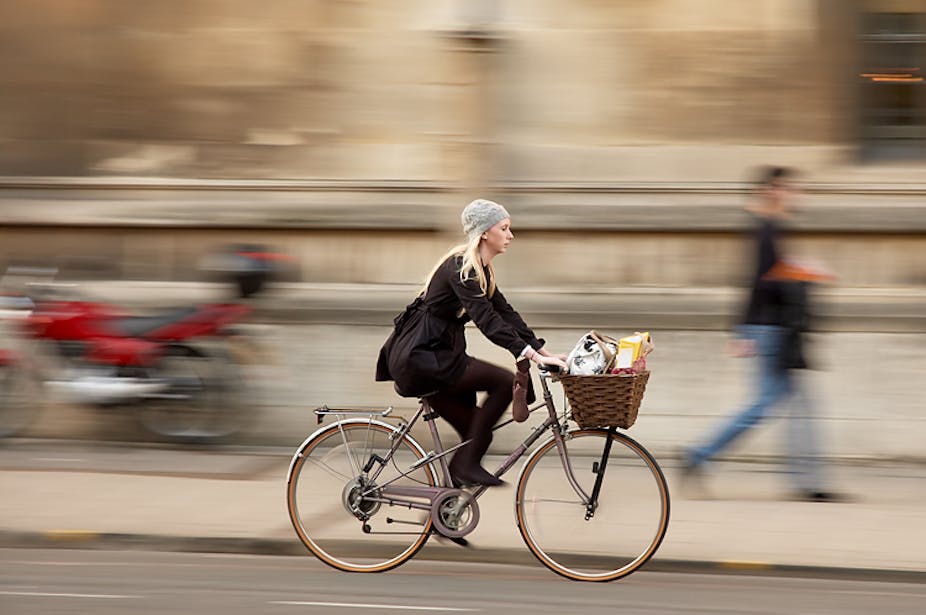
Woman_cycling_kamshots
European women love to get on their bikes. kamshots/Flickr

Cycling for transport in Australia is characterised by several “missing” population groups: women, children, adolescents and older adults.

Women comprise about one-fifth of commuter cyclists in Australia. In countries such as the Netherlands, Denmark and Japan, more women than men travel by bike.

There has been considerable speculation about why cycling for transport in Australia is less socially inclusive than in a number of other industrialised countries. For women, explanations have centred on time constraints, household responsibilities, and concerns about traffic hazards and personal safety.

While all these factors undoubtedly play a role, a recent analysis of international comparative data adds another perspective. It has found that women ride bikes for transport when the environment is friendly to cycling.

Make cycling safe, convenient and fast, and women will do it

Whether you look at national, city or local government area data, when bike riding makes up a bigger proportion of trips, the proportion of women cycling also increases.

City level data is shown in the graph below. It shows that the measures that make cycling generally appealing are those that are particularly important for women: safety, convenience and fast travel time for the short to medium-distance trips that characterise urban living.

Cycling graph
Bicycle mode share of trips and percentage of female cyclists, large cities.

Traffic safety, in particular, is a key factor for addressing gender equity in cycling. Concerns about safety are a major barrier to cycling in Australia, and a greater barrier for women than men.

While actual injury risk is important from a road safety perspective, subjective risk perceptions appear to be more important in shaping cycling behaviour, particularly for women.

Cycling injury data in Australia and the UK indicate that women are actually at lower risk of a traffic-related cycling injury than men, particularly for the more severe injuries. However, consistent with gender differences in risk aversion in general, women are both more concerned about safety and more affected by safety concerns.

Relative to men, women prefer to use cycling routes where they can get further away from motor vehicle traffic. They are also more likely to go out of their way to use a safer route, and to cycle more cautiously in traffic.

In Australia, road safety is about cars

While Australia is among the world leaders in road traffic safety in general, the focus has been on protecting motor vehicle occupants. Cycling safety has been relatively neglected.

Serious injury rates for cyclists in Australia are increasing. They are several times higher than fatality and injury rates in the high-cycling industrialised countries of Europe and Asia.

In Australia, efforts to increase cycling and improve the safety of cyclists have focussed on separating cyclists from motorists. Investment in cycling infrastructure has been ad hoc and inadequate.

cycling Japan
Older women have gone missing in the Australian cycling population. (marcusuke/Flickr)

Effective cycling safety measures that potentially affect motor vehicle flow are avoided. There has also been a misplaced reliance on the “safety in numbers” concept whereby cycling supposedly becomes safer as more people cycle, due to factors such as higher visibility.

Countries such as the Netherlands, Denmark, Germany and Japan take a different approach. If you’re making a short to medium trip in an urban area, they encourage you to ride a bike.

These countries have consistently implemented a range of transport, traffic safety and urban planning measures that systematically prioritise cycling over car travel for these trips.

Measures include establishing an extensive network of high quality bicycle routes that provide:

  • good separation from motor vehicle traffic where appropriate

  • good management of interactions between bicycles and cars where complete separation is not feasible.

How do “high-cycling” countries do it?

There are many policies aimed at improving the ways cyclists and drivers interact.

Intersection treatments can provide safe flow for both bicycles and cars. Extensive traffic-calmed urban areas with speed limits of 30 km/h or less make cycling more appealing.

Road safety measures consistently make the safety of cyclists more important than keeping motor vehicles moving. For example, car drivers have the legal responsibility to avoid collisions with cyclists and pedestrians. The principle is that the responsibility for injury prevention lies with the operator of the vehicle that can cause most harm.

Cycling transport
Bikes need to take their place as another form of transport. (Mikael Colville-Andersen)

Because of these measures, cycling environments are both safe and pleasant. Cyclists rarely experience the hazardous and unpleasant interactions with motorists that characterise cycling in countries such as Australia and the USA.

It is important to recognise that these high-cycling countries are not “anti-car”; rather, they provide a more level playing field for a wider range of ways of travelling.

As in Australia, motorways and arterial roads provide for high-speed, high-volume motorised travel between major population centres. But transport and urban planning measures make cycling faster and more convenient than car travel within cities, towns and suburbs.

It’s not just regulation that makes cycling more appealing for women, children and older adults. In high-cycling countries, people are more likely to use bicycles appropriate for everyday travel – more upright bikes, in other words. Their bikes have a bigger carrying capacity (so you can take your children and do your shopping), and it’s normal to ride in everyday clothing rather than sports gear (including to work).

Because of these measures, cycling is seen as a convenient form of everyday travel for everyone, rather than a vigorous form of sport and exercise that is more appealing to young to middle-aged men.

Australia’s path forward

In countries like Australia, where few women cycle for transport, many of the factors described above are either lacking or only partly addressed.

More people, and more women, would cycle if we prioritised bicycle travel over car travel for many of the daily trips that are part of urban life. Think of the short trips you make everyday that could be on a bike if cycling was easier: taking the kids to school, picking up some things at the shop, going to work or to the gym.

Urban environments designed for safe, enjoyable bicycle travel are quite unlike those where cycling is simply tacked on to the “real transport business” of moving cars as quickly as possible at all times in all locations.

The evidence shows that as bicycle travel becomes a convenient, safe and enjoyable everyday transport option, increasing numbers of girls, adolescents and adult women will almost certainly go along for the ride.

Related articles

Newsletter Don’t show this again

Subscribe to our daily e-mail newsletter to receive our top stories each day—delivered straight to your inbox.

55 Comments

  1. Alan Todd

    Alan Todd

    logged in via Facebook

    Cycling for transport in Australia is characterised by several “missing” population groups: women, children, adolescents and older adults.

    What an indictment of twenty years of failed Australian bike policy and advocacy. It is clearly time for a new direction, and one not incessantly focussed on "road safety" and helmets. Yes, I will mention helmets. And no, Tim churches, there is no clear evidence of a benefit from mandatory helmet laws. You fail to distinguish again between efficacy in the…

    show full comment
    1. Tim Churches

      Tim Churches

      logged in via email @gmail.com

      Alan, regarding your statements that "...there is no clear evidence of a benefit from mandatory helmet laws..." and that I "...fail to distinguish again between efficacy in the event of an accident, and the population level findings that compelling cyclists to wear helmets has not reduced the incidence of head injury pro rata...": neither of these assertions are true.

      Please note the positive results of the most recent study into the effects of the cycling helmet laws at the population level at…

      show full comment
  2. Mandy Rhook

    Mandy Rhook

    logged in via Facebook

    Like Jane O'Donnell, I too am a regular cyclist, ride to work and was also recently hit by a car. My helmet saved my life too - even with it on, I had concussion, and whiplash injuries, amongst other things. I am one of the lucky ones - making a full recovery. It takes me 20 seconds at work to fix my "helmet hair". I wear full make up to work, and ride in my work clothes - on cycles paths most of the way. I don't get too sweaty as I don't push hard on my commutes - just enjoy the ride! I have a large basket on the back of my "ride to work" bike, I put my handbag in it, and can stop off and shop for dinner on the way home. I am also a regular road and mountain bike cyclist - I say "just do it" to women who have not yet given it a go. I think plenty of people are missing out on an anjoyhable part of the work day - some "me" time!

  3. Jo Waugh

    Jo Waugh

    logged in via Facebook

    As a female cycling commuter in Adelaide, I am constantly finding myself the object of awe and wonder over my decision to cycle. Although they presumably find no fault with my appearance at work, many of my female colleagues find the idea of cycling horrifying due to the effect it may have on their hair. That, combined with the 'onerous' task of packing a bag filled with work clothes each morning, puts them off. Personally, I find cycling far more relaxing and enjoyable than sitting in peak hour traffic or waiting for public transport. Yes, the risks are higher, but riding defensively reduces them considerably. I don't think cycling will really catch on the way it has in Europe until driving a car becomes a truly awful experience, either through increased traffic, or controls imposed on driving.

    1. Paul Richards

      Paul Richards


      Thanks for sharing your experience. I enjoyed it.
      The 'fear' is the big issue with cycling, fear of appearance and damage.
      I agree defensive driving or awareness of the environment is the key issue, and I am sure all long term cyclist understand what you mean. Experienced rides react safely to incidents without a thought to risk.
      The challenge is to giving people the opportunity of pleasant hours riding like yours to overcome the fear, and gain handling skills.
      Jan has made a good case for levelling our playing field.

  4. Alan Todd

    Alan Todd

    logged in via Facebook

    Tim,
    Thanks for the list of meta analyses claiming a positive relationship between mandatory helmet wearing and reduction in head injuries. I was unaware of Lee et al (2005) and McPherson et al (2008), doubtless because they deal with child only helmet compulsion, which is an area I have limited concern with. I have read the other studies you quote, though not recently. I note with interest that you do not include Attewell Glase and McFadden (2001). This was the meta analysis widely quoted by…

    show full comment
    1. Tim Churches

      Tim Churches

      logged in via email @gmail.com

      Alan, I provided a non-exhaustive list of studies into the effectiveness of mandatory helmet laws at the population level in order to show that your assertion that "there is no clear evidence of a benefit from mandatory helmet laws" is incorrect. The Attewell Glase and McFadden meta-analysis, and the more recent Elvik re-analysis of their meta-analysis both consider the efficacy of bicycle helmets, not the effectiveness, and hence I didn't include them in my list.

    2. Jake Olivier

      Jake Olivier

      Senior Lecturer in Biostatistics, POWCS at University of New South Wales

      Alan,

      Your comments that state "an increased risk of exposure to accident of 14%" and "a reduction in kms cycled of 22%" after MHL cancels out a 15% reduction in injuries is flawed with respect to our analysis. Firstly, we noted a 25% drop in the head/arm ratio and a 29% drop in the head/leg ratio after MHL which are both greater than the 15% you quoted. A one in four drop is no small amount especially considering a number of cyclists were wearing helmets before MHL and not everyone wore helmets…

      show full comment
      1. Alan Todd

        Alan Todd

        logged in via Facebook

        Jake,
        The claim that an increased risk of exposure to accident of 14% after MHL cancels out a 15% reduction in injuries was not made in respect to your analysis, but in respect to the findings of Elvik and Enke, and later Elvik’s reanalysis of Attewell et al. Some confusion may have arisen as I accidentally misquoted your paper as finding a 15% reduction in head injuries in the event of an accident rather than the 25% drop in the ratio of head to arm or 29% drop in the ratio of head to leg injuries…

        show full comment
      2. Paul Richards

        Paul Richards


        Jake,
        Jan's article has never been about helmets - it's about increasing participation.

        I liked what you wrote here on The Conversation - 23 June 2011.
        Another article one focused on good infrastructure would be welcome.
        I agree helmets can be important for riders, but just a part of the big picture.

        World's best practice is in Copenhagen.
        http://www.copenhagenize.com/2011/08/case-for-bicycle-infrastructure.html

  5. Jan Garrard

    Jan Garrard

    Senior Lecturer, School of Health & Social Development at Deakin University

    Jake, please don't apologise for the bike helmet discussion. It is good to obtain and discuss evidence about important and controversial policy issues around cycling participation and cycling safety. For what it's worth, this is my take on the issue.

    The evidence that helmets reduce the severity of head injuries in the event of a crash is convincing. Evidence for the impact of compulsory helmet-wearing on cycling participation is inconsistent (and generally lacking). The impact of removing compulsory…

    show full comment
  6. Allen Fugler

    Allen Fugler

    Clinical and Forensic Psychologist

    logged in via email @tpg.com.au

    While what you say Jan makes complete sense I reckon you are missing a least one point-women do not like wearing helmets when riding bicycles to commute. Several young women have told me the reason the bicycles ow provided in Melbourne have not been all that well used is because people do not want to have to carry a helmet everywhere they go. Considering research tends to indicate the wearing of the 'skid lid' is of little value one can hardly blame them!

    1. Tim Churches

      Tim Churches

      logged in via email @gmail.com

      Allen, your assertion that "...research tends to indicate the wearing of the 'skid lid' is of little value..." is just not true. The overwhelming majority of peer-reviewed studies and meta-analyses* into the efficacy of cycling helmets have found that helmets very significantly reduce the risk and severity of head and upper facial injuries in the event of a cycling accident (and cycling accidents, more than half of which don't involve a car, are very common). Furthermore, the majority of studies into the effects of bike helmet promotion campaigns and mandatory helmet laws in various countries have found reductions in head injury rates in cyclists which can be reasonably ascribed to helmets. For a discussion of the most recent of such studies, see http://theconversation.edu.au/putting-a-lid-on-the-debate-mandatory-helmet-laws-reduce-head-injuries-1979

      * as opposed to anti-bicycle-helmet blog pages...

      1. Luke Turner

        Luke Turner

        logged in via Twitter

        Tim Churches, in your recent study which claimed to identify a reduction in the head-to-limb injury ratio following introduction of the helmet law in NSW, the benefit actually declined in the period following the law change. There was very little discussion of this important point in your paper.

        Do you have any theory as to why the safety benefits you identified had virtually disappeared within 18 months of the introduction of the helmet law? According to your data the head-to-arm and head-to-leg ratios both ended up HIGHER at the end of the analysis period than they were at the start. Hardly a convincing result.

        The overall effect was small and transient - certainly not justification for a law which makes it a criminal activity to ride a bike without a particular safety device.

        1. Tim Churches

          Tim Churches

          logged in via email @gmail.com

          Luke, look at panels A and C of Figure 3 in our paper - there is a clear and sustained step down in the head injury rate in cyclists, but no significant change in the head injury rates over the same period for pedestrians (panels B and D in Figure 3).

          1. Luke Turner

            Luke Turner

            logged in via Twitter

            The reductions in injury rates in Figure 3 could have been caused by a large reduction in cycling, which is widely acknowledged to have happened when helmet laws came into force. If I look at your Figure 4, which you have made "exposure-free", by taking the ratio of head-to-limb injuries, the declines are not clear and sustained, they are small relative to the general monthly variations, and are then actually reversed in the time following the law change. As your paper states:

            "Based on the original analysis there is some evidence that the initial improvement in head injury rates diminished over the 18 months following legislation as shown by the increasing post-law head to limb injury ratios in Fig. 4."

            I wonder what the result would be if you extended your analysis window, say to 3 years of data either side of the law change. Did you look at a longer analysis period at all?

            1. Jake Olivier

              Jake Olivier

              Senior Lecturer in Biostatistics, POWCS at University of New South Wales

              Luke,

              Your comments about our paper are simply not true. As Tim has pointed out, there was a clear (and statistically significant) drop in the ratio of head to arm injuries at the time of MHL. We also noted that drop for arm to leg for cyclist, but no drop in either ratio for pedestrians. As you have pointed out, the model estimated an increase in the ratio, but this drop was highly insignificant (p-value=0.5) with an incredibly small monthly change in the ratio after MHL 1.006 (95% CI: 0.960-1…

              show full comment
              1. Luke Turner

                Luke Turner

                logged in via Twitter

                Jake which of my comments are "simply" not true?

                The reductions in injury rates in Figure 3 of your paper may have been caused by a reduction in cycling. Your paper does not claim to show otherwise, as you have eliminated the rate of exposure in your model by assuming that the only concern is whether the ratio of exposure to head injuries and exposure to limb injuries remains constant. It may well be possible that exposure to ALL injuries increased following the legislation change - your model…

                show full comment
                1. Jake Olivier

                  Jake Olivier

                  Senior Lecturer in Biostatistics, POWCS at University of New South Wales

                  Actually, Luke, we do make the claim that cycling numbers or any other measures of exposure have been accounted for in our models. As I have demonstrated in our paper and on The Conversation, if you let x and y be the number of head and arm injuries respectively and let n be the exposure to injury, the head to arm risk ratio is (x/n)/(y/n)=x/y. The model assumes equal exposure for both head and arm injuries (i.e., n is the same for both) and our results demonstrate this is a reasonable assumption…

                  show full comment
                  1. Luke Turner

                    Luke Turner

                    logged in via Twitter

                    Jake, thanks for your response.

                    I have read your paper and I understand what you have done. I understand that you have "accounted" for exposure by assuming that exposure to head injury and exposure to limb injury is equal at all times (but not constant over time) - this may be a reasonable assumption in isolation, but it is not a reasonable basis to draw the conclusions that you have drawn. Your main result is that: "repealing the law cannot be justified", and then you claim that "our result does…

                    show full comment
              2. Tim Churches

                Tim Churches

                logged in via email @gmail.com

                Could all anti-helmet commentators and bloggers please read http://en.wikipedia.org/wiki/Null_hypothesis before latching on to Jake's use of the technical term "hypothesis-driven" in his response above. In our recent study, we did indeed have an a priori null hypothesis that was being tested, and that was that the introduction of cycling helmet laws in NSW had no observable effect when examining whole-of-population data on head injuries in cyclists. This is the same null hypothesis tested by Dorothy Robinson last decade, and by Alex Voukelatos and Chris Rissel last year (their study was retracted due to arithmetic, graphing and other data errors, not because their null hypothesis was invalid). In our study, we demonstrate statistically significant evidence that that null hypothesis should be rejected - in other words, that is is very unlikely to be true that the introduction of cycling helmet laws had no effect on head injuries in cyclists.

        2. Paul Richards

          Paul Richards


          Luke your points are valid.
          But whether the cycle helmet works, or is justified isn't the point of Jan's article. - It's perception - how do we encourage cycling?

      2. Tim Paton

        Tim Paton

        Automotive Engineer

        logged in via email @timpaton.net

        No doubt, helmets can be effective in reducing the severity of a head injury when used in an instance that would cause a mild to moderate head injury without a helmet.
        That can be said equally for many activities: cycling, motoring, jogging, climbing ladders, skiing, playing golf, getting out of bed in the morning.
        If there's a valid case for compulsory bicycle helmets, there's a comparably valid case for compulsory motoring, jogging and golfing helmets.
        Nobody seriously questions (although some…

        show full comment
    2. Angelina Russo

      Angelina Russo

      logged in via email @culturecycle.org

      I have to admit to being a little mystified by the idea that women don't want to carry around helmets. Have you seen the bags we like to carry? A 300g helmet hardly counts as an obstacle compared to the 4kilos we will happily carry for a trip to the shops...

      I wonder whether cycling to work can be seen as a "transport option". When I cycle long distances on the weekends I wear lycra and a helmet which probably does nothing for my hair, but then, I usually have to wash it after a long cycle anyway…

      show full comment
    3. Paul Richards

      Paul Richards


      Allen, I agree with your point and I am sure Jan does.
      Safe riding can be done without a helmet. Our response to the needed transport system change has meant compromise, or win, lose. Large transport vs cycles - cycles lose.

      Jan highlights a win, win scenario where helmet use is optional, and a model where the cycle accident rate falls yearly and uptake grows. Particularly by women and children. Compulsory helment use is redundant in the European model.
      Which backs up your experience and we circle back to the point of Jan's article.

      But I do disagree with your view helmets don't work.
      But qualify it with the issue of 1.5 tonnes or more of steel, being the point of difference. How could the work effectively? Car - vs - cycle.

    4. Tim Churches

      Tim Churches

      logged in via email @gmail.com

      Jan, congratulations on an excellent article which most eloquently summarises both the challenges and the way forward for increasing cycling-for-transport in both sexes and all age groups in Australia. And so nice not to encounter any mention of helmets (reader comments notwithstanding) - complaints by a noisy minority over our two-decade-old helmet laws always seems to derail more serious debate about what really needs to be fixed, and built, in order to promote everyday cycling in this country.

      1. Etienne de Briquenel

        Etienne de Briquenel

        logged in via Twitter

        Tim, I agree that concentrating solely on helmet laws is unconstructive, but disregarding them completely when trying to discuss effective cycling advocacy is even more unconstructive. I have been riding a bike in Melbourne for the past twenty years and have noticed two things: (1) Modal share for bikes has hardly shifted one iota, and (2) it is no more safe than it was in 1990. This to me represents a serious indictment on what has passed for cycling advocacy in this time, both in attracting everyday people (especially women) to bikes and providing a safe environment for them. As long as we have finger-in-the-ears intransigents like yourself at the forefront of this business then we can expect another twenty years of mediocrity.

        And yes Jan, an excellent piece. And I hope Tim wasn't too taken aback by the wonderful photos accompanying it.

        1. Tim Churches

          Tim Churches

          logged in via email @gmail.com

          Etienne, I'm not quite sure why you characterise me as being "...at the forefront of this business..." or why I need to be blamed for any future mediocrity when it comes to cycling infrastructure. I'm just a humble epidemiologist who tries to make sense of the data. And a cyclist, but I think I am allowed that.

          And no, I am unphased by photographs of helmet less cyclists. I spent a few weeks in the Netherlands last year and I was similarly unperturbed by the thousands of unhelmeted cyclists riding on the superb cycling infrastructure there, much of which is completely separated from motor vehicle traffic. I also noted the large numbers of Dutch sporting cyclists (of all ages), who ride in peletons on the road with the cars, and who all wear helmets. Every single one - their clubs mandate it.

  7. Steven Fleming

    Steven Fleming

    logged in via Twitter

    Change is too slow in coming. Portland and Minneapolis have taken a shortcut. Waterfront promenades and rail trails provide totally segregated routes. The drawback is that cyclists not motivated by fitness perceive the rail-trail routes to be circuitous. I'm part of a group of architects and urban designers looking at ways to mitigate against this, as a first/practical way forward for countries like ours. http://behoovingmoving.livejournal.com/122301.html

  8. Paul Richards

    Paul Richards


    Your perspective is enjoyable Jan.
    "It is important to recognise that these high-cycling countries are not “anti-car ..."
    In this sentence you get to the heart of the issue, our cultures fear.

    Car drivers aren't anti-cycle in European cities, because they also enjoy cycling in the revitalised and humanised cityscapes they drive around. Having evolved a balance by dropping the hierarchy approach to transport and give the car-truck a realistic status in their transport systems. "..... more level…

    show full comment
  9. Mora Main

    Mora Main

    logged in via Facebook

    great article - restoring the balance between cars & bicycles and giving bikes proper recognition as a valid transport mode is one of the keys to safer urban cycling; helmets are a dis-incentive for slower moving, short trips when people are wearing city clothes. checkout congested Vienna for great improvements to cycling infrastructure - and polite vehicles, giving bikes priority at all marked crossings. Sydney's hills can raise a sweat in summer which can require a change of clothing at destination - cycle route planning needs to seek out clever ways of getting up hills and using infrastructure such as constructed ramps (see Vienna's circulcar ramps on the Danube island giving access to the bridge bikeways) and bridges where these will ease the slope angles.

  10. Derek McKinnon

    Derek McKinnon

    Manager

    logged in via email @atcm.com.au

    While I generally agree with your article, I feel you have missed a significant factor. Heat. I live in Brisbane and commuted by bike for many years. It was only possible when my workplace had a shower. Talking to women in the office they were generally not open to cycling because they saw getting dressed and doing makeup at work was too much hassle. This obviously doesn't apply to all women, but does have an affect. I believe if you ran a regression analysis against both heat and required commuting distance you would find a high correlation with female participation.

  11. Sally Knyvett

    Sally Knyvett

    logged in via Twitter

    I live in wollondilly, a large semi-rural shire just south west of Sydney. Cycling is becoming more popular as recreational exercise, but with the distances to schools and shops will probably preclude cycling for everyday domestic purposes for some time. The cost to council for separate cycle facilities would be too great to justify in all but the major townships. In rural areas, where, unlike the city, quiet back streets, interconnecting parks etc are not available, and road speeds are often 80km…

    show full comment
  12. Jane O'Donnell

    Jane O'Donnell

    logged in via Twitter

    I'm a mum, and I cycle to work, i drop my primary schooler off amongst a sea of SUVs. Saying I don't want to wear a helmet because of my hairstyle is insulting to all women. I was recently hit by a car , Police, Ambulance the works, only some dental work to be done, the helmet saved my brain, and possibly my life. I have since changed my route to only side streets and bike paths. The short strech of shared road that I used to ride, with white painted bike lane is ignored by motorists, fair enough.

  13. Jan Garrard

    Jan Garrard

    Senior Lecturer, School of Health & Social Development at Deakin University

    Thanks for your feedback, Alan. You are correct, the Melbourne and Sydney data are for work trips - bike mode share for all trips is similar, though a bit higher than for work trips (1.7% in Melbourne). Similar graphs exist for country-level data and for local government areas (eg within Melbourne), so the relationship between bike mode share of trips and % female is strong and consistent. Make cycling convenient, fast, and safe and "they (including women, kids and older adults) will come". And, for sure, it's not just about bike lanes, as Jane's comment illustrates.

  14. Peter Teow

    Peter Teow

    logged in via email @yahoo.com

    My wife, for one, refuses to consider riding on the roads in Sydney, and especially for our children.
    There really isn't much of an argument I can make, as it makes little sense to expose bone and flesh to metal objects 20x your mass (with or without a helmet is really a moot point here).
    And with an average car traveling at 60kmh having more kinetic energy than a barrage of bullets, and this is reflected in the cost of lives compared to firearms.

    While there are very many careful drivers out…

    show full comment
    1. Paul Richards

      Paul Richards


      Peter,
      your wife is not alone in aversion to the risks.
      There is a real need to separate cars and cyclists. But like speeding fines and red light cameras, policing has reached as many as it can. It's time for structural change of the city landscapes, to make your wife and other potential riders comfortable.

      Leading city planner and architect Jan Gehl demonstrates his an others planning in Copenhagen. The model works well and everyone wins.
      http://www.youtube.com/watch?v=rstEWMD89L8

  15. Rosemarie Speidel

    Rosemarie Speidel

    Community Engagement Officer

    logged in via email @ozemail.com.au

    Well done Jan great article. Living in Clifton Hill now (Suburb in the City of Yarra, Vic), it so refreshing to see more and more women riding everyday, many dropping children off on the way to work. It appears to me that there are a number of factors which have influenced this. Urban design (shops, schools, and the CBD are all in easy cycling distance), nearly all streets have cycle lanes and have 40km speed limit, most people work in white collar jobs, cycling has become normalized (people ride in everyday clothing with bicycles designed for urban riding) and the more women see other women riding the more likely they take it up themselves. It takes time to achieve a cultural change and a package of measures need to be adapted to get more women riding as part of everyday life.

  16. Ngaire O'Leary

    Ngaire O'Leary

    logged in via Facebook

    I have been riding bicycles as a commuter and as a cycle tourist for many years. Based on what other people have expressed to me as their concerns with riding, particular in Sydney, I think helmets and the lack of separated bike paths are a relatively minor concern in stopping females from using cycling as transport.
    The concern that gets expressed to me time and again is the sheer aggression of the traffic, and this is a very valid fear. It would be unusual for me to get through a week of commuter…

    show full comment
    1. Paul Richards

      Paul Richards


      Ngaire,
      thanks for sharing what has been my experience. Being a car owner in inner city Melbourne, aggression you mention is brought on by gridlock and it's frustration.
      As a cyclist, awareness of this makes me cautious of pressure points in traffic.
      We both know the need to wear a helmet is a symptom, as Jan's says;
      "infrastructure has been ad hoc and inadequate.."

  17. Richard Monfries

    Richard Monfries

    logged in via Twitter

    Couldn't agree more with Jan's position.

    The irony is that cycling will become safer for all cyclists when more people ride; there really is safety in numbers.

    'We' (women, men, children, et al) will have a more visible presence on the road to other road users when there are more of us, and we therefore cannot be ignored.
    The more there are of 'us', the more 'we' are also beholden to ride safely, with due care, with confidence, and obeying the rules of the road at all times.
    'We' are classed…

    show full comment
  18. John Harland

    John Harland

    bicycle technician

    logged in via email @gmail.com

    What struck me particularly in The Netherlands (ten years ago) was the equality between road users. Three enabling factors stood out:

    - 30 km/h speed limits in urban areas

    - police treating as serious motorist aggression against cyclists and pedestrians

    - consistency of rules of movement of all modes: pedestrian, cyclist and motorist.

    It is far easier to walk on a Dutch path because you can predict what everyone else will do. In Australia nobody knows quite what to do because we have passively…

    show full comment
  19. Alan Davies

    Alan Davies

    logged in via email @bigpond.net.au

    Jan, I agree with the proposition that safety is the pre eminent issue for cycling.

    I'm curious however about your data. Judging by the share of trips your graph shows bicycles capture in Melbourne and Sydney, I'd say the data for those cities is work trips. This is an important point because the journey to work accounts for less than a third of all trips in Melbourne and Sydney and is generally more amenable to bicycle use than other sorts of journeys, like social and shopping trips.

    I'm surprised to see bicycles have such a high mode share in Tokyo.

    If you take out the cities where bicycles have >10% mode share, the relationship between mode share and women's use appears to be far less compelling. It could be there are special reasons - that are hard to replicate elsewhere - why cities like Copenhagen and Berlin attract so many cyclists. It might not simply be a matter of building better infrastructure and expecting "they will come".

    1. Paul Richards

      Paul Richards


      Allen, I can't agree that
      " ..... Melbourne and Sydney and is generally more amenable ..."
      Any trip over sevens days in Melbourne or Sydney on a bicycle is barely comparable to the use of the infrastructure in Europe. From my understanding of this issue I can't see how any separation of data is relevant.
      "If you take out the cities where bicycles have >10% mode share ...."
      The point of difference between the European model and our attempts, is they have achieved 33.3% 'mode share'. Our cycle ratio is low on the graph, less than 2% for cycle commuters - car-cycle-public transport.
      So yes, you are right women's use appears to be far less compelling.
      That's Jan's point about safety, and female perception.
      I'm curious about your point, just as you are about Jan's data.
      Do you mean women don't make up half the workforce?
      Can you please clarify your meaning? I value your perspective.

      1. Alan Davies

        Alan Davies

        logged in via email @bigpond.net.au

        Hi Paul
        Not sure what you mean in reference to my use of the term "amenable" - but just to be clear, I was saying bicycles are a more attractive/amenable option for the journey to work than they are for other sorts of trips.
        Re the 10% figure, here I'm arguing that the relationship between women's propensity to ride and the share of work trips captured by bicycle is less compelling for cities where the bicycle mode share is t seem to fit very convincingly over this range…

        show full comment
        1. Paul Richards

          Paul Richards


          Hi Alan,
          I didn't understand your reference to "amenable" either. My cycling experience in Melbourne, Adelaide and Perth, means the word - "amenable" - just doesn't come to mind in the context of cycling alongside cars and trucks in any 'mode'.

          Yes, I agree with you that safety is a deterrent for both sexes.
          Are you suggesting the physiological difference doesn't count?

          That male levels of testosterone aren't apparent in the heightened and focused driver mindset we have encouraged in our transport…

          show full comment
          1. Alan Davies

            Alan Davies

            logged in via email @bigpond.net.au

            Paul

            Only around a third of my reply seems to have shown up (that's why I posted it twice, but neither worked properly), that's why it suddenly stops making sense. Yet your post is about as long as mine and you didn't have any trouble (??). I'll try again here (fingers crossed):

            Not sure what you mean in reference to my use of the term "amenable" - but just to be clear, I was saying bicycles are a more attractive/amenable option for the journey to work than they are for other sorts of trips.

            Re…

            show full comment
            1. Paul Richards

              Paul Richards


              I disagree, short trips work just as well, grab the bike jump on and go.
              No helmet, special clothing, or prep makes this really possible.
              As the the chart:
              How can the data show 'fear', what set of statistics could?
              But the table does demonstrate that cities that have be humanised have more women cycling.
              The street interviews of riding women in Europe bear this out as does Jo's below.

            2. Russ Degnan

              Russ Degnan

              -

              logged in via email @deggles.csoft.net

              Alan, on the less than 10% issue. The problem is the relationship is not linear so it is hard to see on that graph. I looked at this for Australian SLAs a while back here and it holds up:
              http://deggles.csoft.net/post.php?postid=1427

              As a rule, for every doubling of mode share, the percentage of women cycling increases by around 10%.

              As further evidence, I've had a student do a basic research projects measuring the percentage of women cyclists on different streets (with/without cycle lanes) and the percentage of women (and to a lesser extent, commuter bikes) on streets with cycle lanes is much higher. It measured as double, but it was a small study, worth repeating.

          2. Paul Richards

            Paul Richards


            Allan,
            as for Tokyo, just use google maps - set to satellite and highlight their cycle-ways.
            Their cities design approach makes sense.

      2. Alan Davies

        Alan Davies

        logged in via email @bigpond.net.au

        Hi Paul

        Not sure what you mean in reference to my use of the term "amenable" - but just to be clear, I was saying bicycles are a more attractive/amenable option for the journey to work than they are for other sorts of trips.

        Re the 10% figure, here I'm arguing that the relationship between women's propensity to ride and the share of work trips captured by bicycle is less compelling for cities where the bicycle mode share is t seem to fit very convincingly over this…

        show full comment