


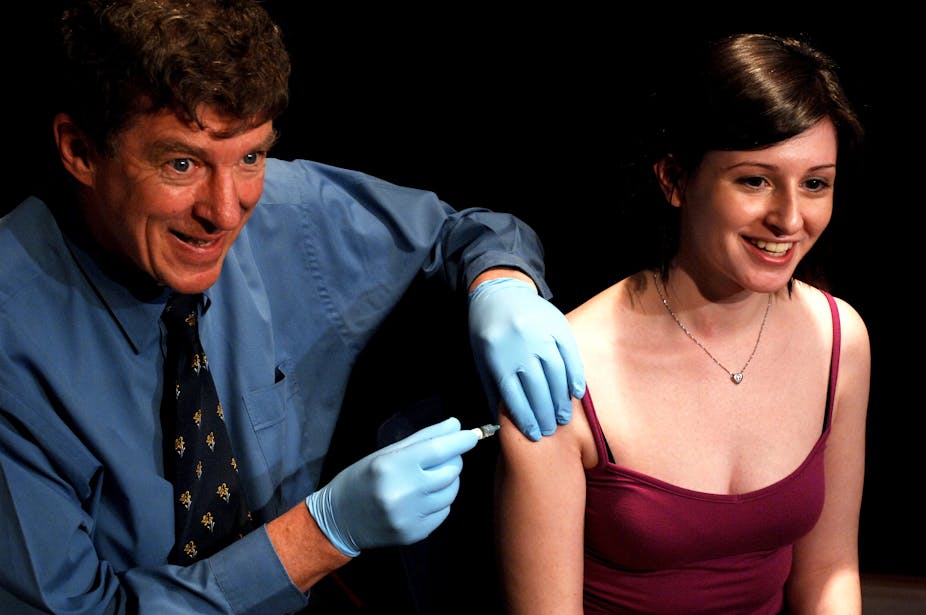
Boys are likely be offered subsidised vaccinations against the sexually transmitted, wart and cancer-causing human papillomavirus (HPV) following a government committee recommendation to expand the use of the vaccine beyond young women.
The Pharmaceutical Benefit Advisory Committee (PBAC)‘s recommendation that the federal government place CSL’s Gardasil vaccine on the Pharmaceutical Benefits Scheme for use by boys and young men was a “public health breakthrough” which could possibly lead to the eradication of genital warts, said Professor Andrew Grulich of the University of New South Wales’ Kirby Institute.
“We’ve had the evidence for a couple of years now that the vaccine is highly effective in boys,” Professor Grulich said.
As they age, males carrying HPV faced an increased risk of anal cancer, penile cancer, and cancer of the back of the throat.
But as well as protecting young men from genital warts, researchers have found immunising boys helped prevent HPV infection in girls, linked to cancers of the cervix, vulva, vagina, and anus.
“There’s a substantial benefit to girls, because our vaccination rate in girls is only about 80%, so by vaccinating boys we’re protecting girls; that’s what we do with rubella – we vaccinate boys not because we think it’s a serious disease in boys but because it prevents the pregnancy complication,” Professor Grulich said.
“The protection [given by Gardasil] is close to complete against genital warts – one of the most common sexually transmitted infections – and together with the vaccination of women this really does raise the possibility that we might be able to eradicate genital warts which would be just an extraordinary achievement.”
It was extremely important to vaccinate “young adolescents before the onset of sexual activity”, Professor Grulich said. “After a few years of sexual activity it’s likely that men will be infected [with one of the four strains covered by the vaccine] … and you only benefit from it if you haven’t already been infected. But having said that, people who haven’t had many sexual encounters might not have been infected thus far and could benefit from the vaccine.”
Professor Thomas Faunce of the Australian National University’s College of Law and College of Medicine, Biology and the Environment, said it was highly likely that the Federal Government would follow PBAC’s advice about Gardasil for boys, which appeared today on a list of drug recommendations. “They’re not bound to take into account the recommendation but it’s very rare that they don’t.”
The recommendation to approve a drug made by an Australian firm, CSL, was great news for the Australian industry, Professor Faunce said.