The Conversation
Subscribe
  • Academic rigour, journalistic flair
  • For curious minds
  • Expert news and views
  • Debate and ideas
  • From the curious to the serious

Hot Topics

  1. Gay marriage
  2. Australia in the Asian Century
  3. Convergence review
  4. Federal Budget 2012
  5. War on drugs
  6. Medical myths
  7. Bob Brown
  8. Square Kilometre Array
  9. Explainer
  10. Transparency and medicine

Can art change minds where science can’t?

“Artists are shape-shifters and in this there is a perennial, ferocious hope; the hope which transforms, which whispers of possibility, of vision, of change and radical healing. Existing art about climate change has this characteristic, acknowledging the truth and severity of the issue but also affirming…

Gsrm9wvg-1328849585
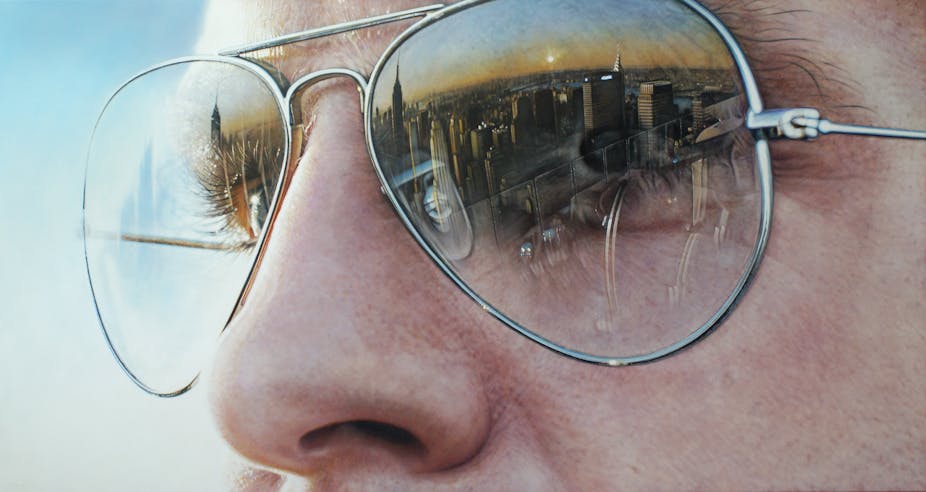
Art reflects back the crisis we’ve created. Simon Hennessey: Sunset over Metropolis

“Artists are shape-shifters and in this there is a perennial, ferocious hope; the hope which transforms, which whispers of possibility, of vision, of change and radical healing. Existing art about climate change has this characteristic, acknowledging the truth and severity of the issue but also affirming within it something of grace, seeing the starlight within the night.”“ – Jay Griffiths, 2009

How can art communicate to a sceptical public the current state of climate? Scientists agree human influence is paramount in explaining climate change, but the public at large is not drawn naturally to science education. With this in mind, art’s power to target the emotions of an audience could be particularly effective.

Metro Gallery in Melbourne has been running an exhibition, “Climate Change: The Wonder and the Dread”. We are investigating audience response to the art works (and whether the art persuades in a manner not otherwise achieved through intellectual means), and the processes involved in the art making itself.

We think insights communicated in images and metaphor might contribute to the development and implementation of environmental policy by communicating in ways that have not been achieved by science communication.

The artists in the exhibition responded to the idea of climate change in diverse ways.
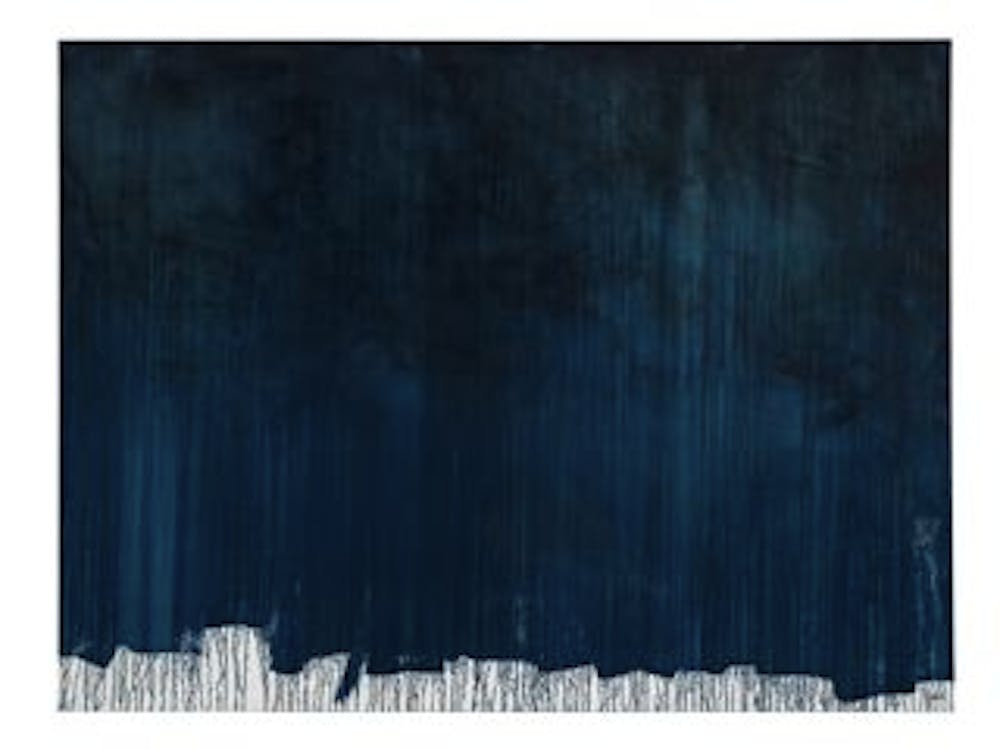
Antarctica Stormie Mill

Stormie Mill’s vast spread of blue with ice fringes at its base is spectacular in its impact. The melting ice is the subject and yet the first response is one of wonder at the beauty perceived in what is indeed catastrophic. The painter produced what was in some ways an abstract painting (titled, “Antarctica”), but it simultaneously brings to mind the experience of melting ice on a vast scale. The depth and allure of the blue expanse seduces the viewer and leads inevitably towards reflection.
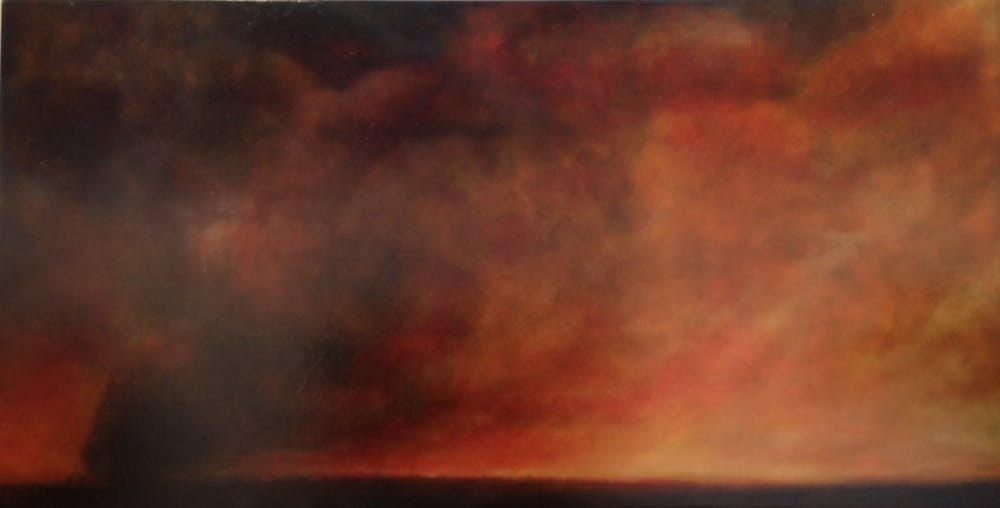
Untitled Vincent Fantauzzo

Vincent Fantauzzo, in contrast to Mill’s engagement with water, creates a painting of fire. It is fire unlike any fire one has ever seen: it seems to embody the concept of fire itself. It is intoxicating in its drawing power – one wants to enter it, even knowing its deadly power. Of course fire was, we are reminded, stolen from the gods by Prometheus to aid us as functioning humans. Its beauty and its terror is immanently embodied in a land that human beings continue to misuse and abuse. The fire becomes, of our own making, a brutal avenger. And so the thoughts around the painting emerge as groups that surround it at the exhibition discuss its impact on them.
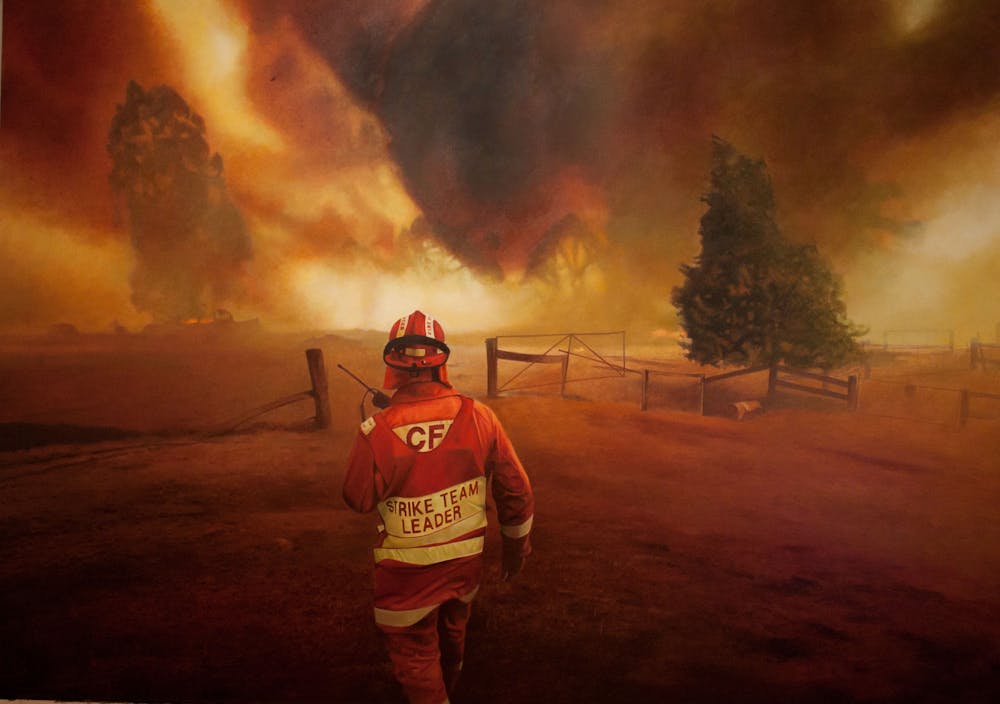
Inferno Daniel Smith

Daniel Smith’s “Inferno” deals directly with a fire that is in the process of destroying homes and lives. This painting in the super-realist mode shows that the actual event of fire belongs by nature in “the super real”.
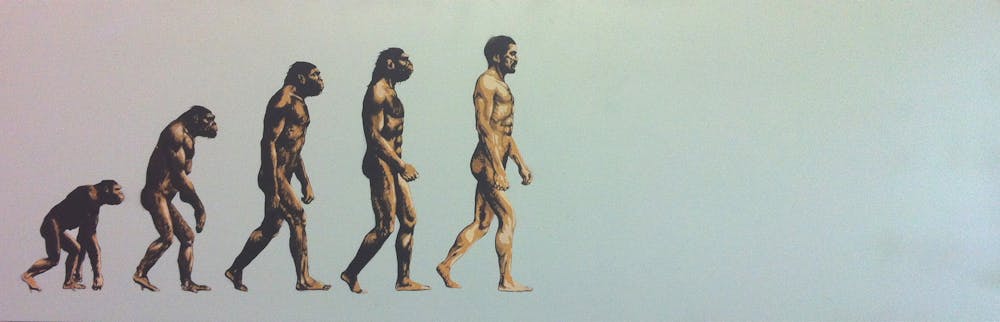
End of the Line ELK

Evolutionary knowledge is the perspective drawn on by ELK. In painting man’s evolution from the ape, he simply leaves a long space after man. Man does not evolve beyond himself as he becomes defined in history as ultimately self-destructive.

Each of these responses to climate change deals with different aspects of it and yet creates debate amongst their audience that leads to, we believe, greater awareness of how we are involved in a world that is becoming increasingly warmer which is having dire effects.

Furthermore these paintings remind us that climate change is due to the way we use our natural resources and how we live with little concern for future generations.
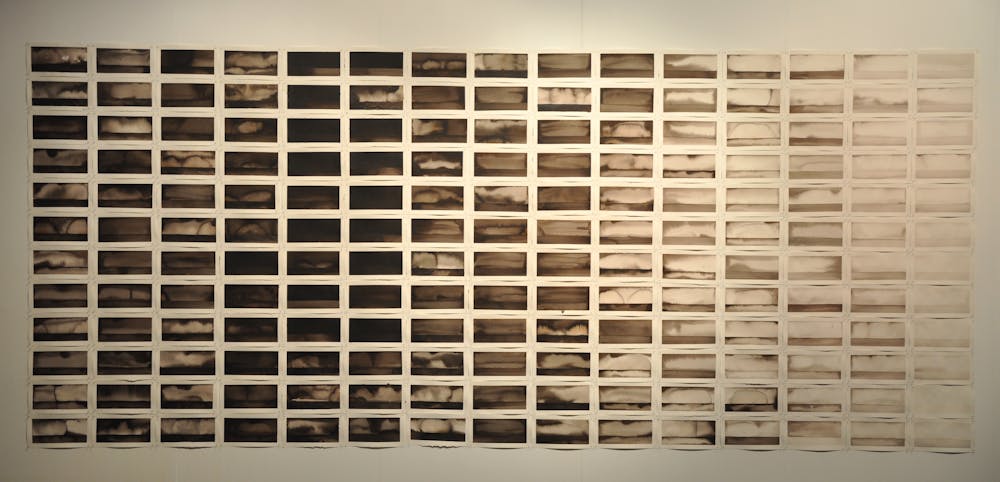
The Land Stood Empty Michael Peck

Michel Peck’s “The Land Stood Empty” is a multiplicity of “windows” with different parts of the human body erratically categorised. It is a view of our own vivisection and our refusal to learn that harmony and unity is the way to understand our ontology and its place in nature itself. It’s what humans do – we are always prepared to make sense of the world via inappropriate systems.

subject JKB Fletcher

As JKB Fletcher reminds us in his “subject”, the body, our body, is not in charge of nature to tame and destroy through ignorance or greed, but, instead, it is of nature itself. And thus on a woman’s body he paints the drought inflicted land.
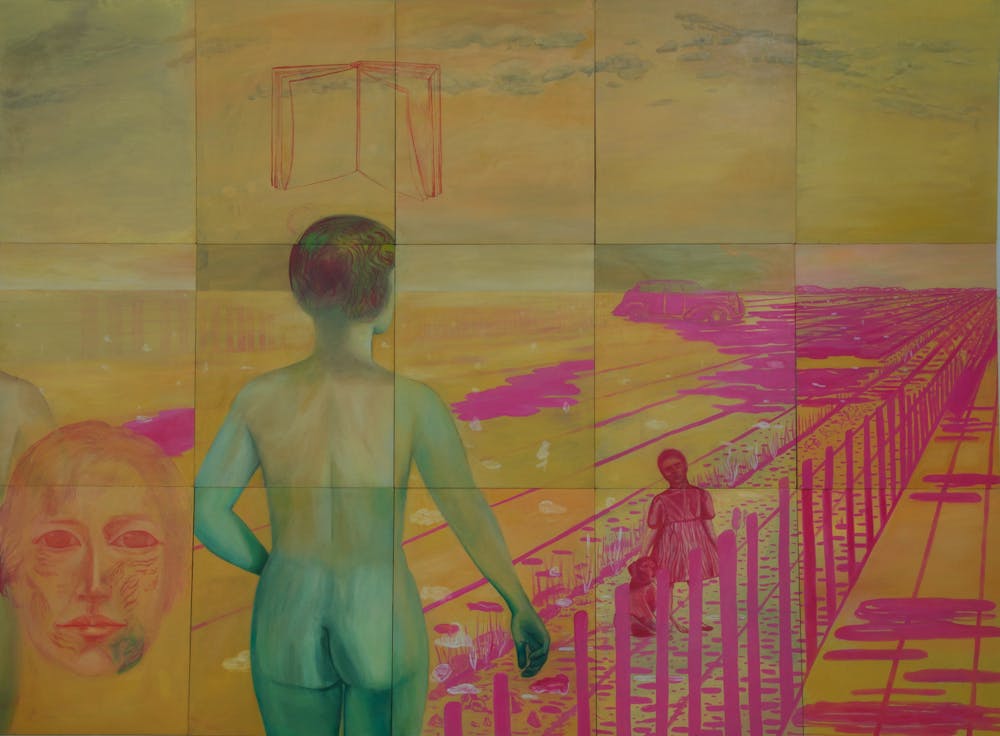
I Remember the Bay Deborah Walker

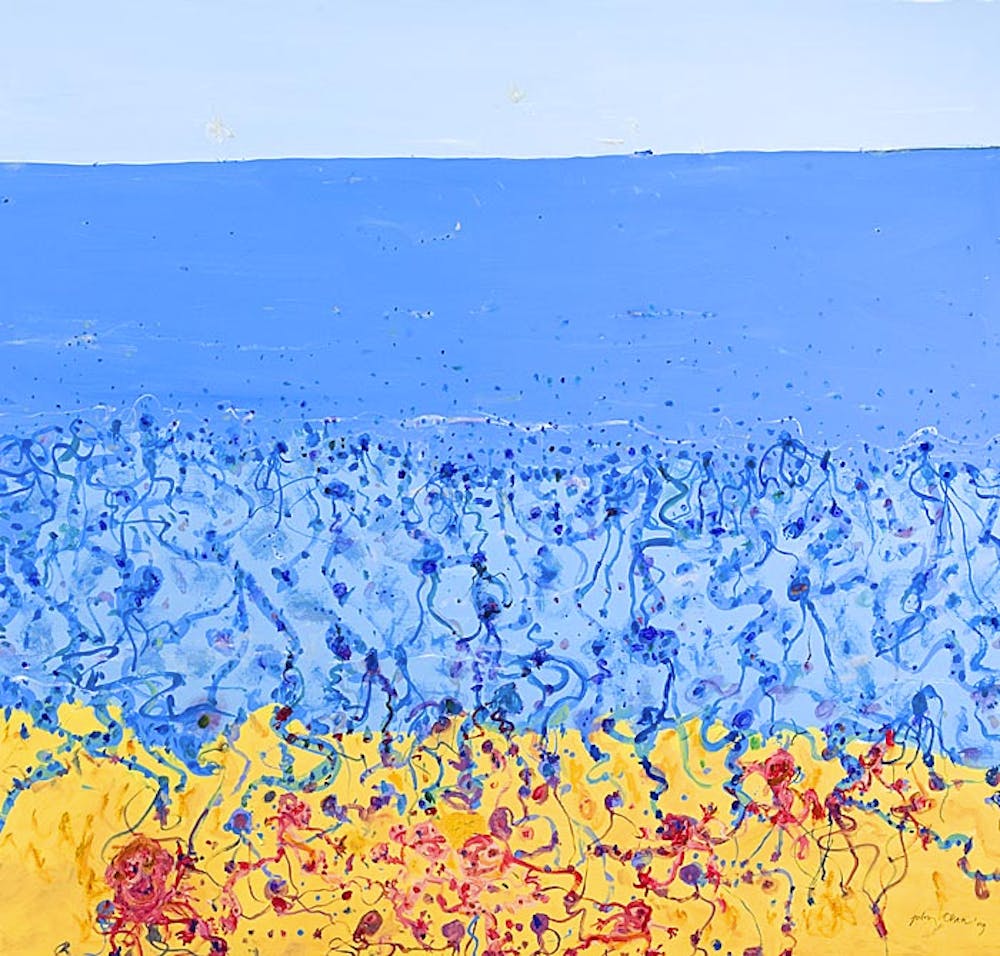
Popping Blue Bottles John Olsen

Deborah Walker’s “I Remember the Bay” and John Olsen’s “Popping Blue Bottles” might be called “memory” paintings as each presents landscapes from their pasts. Olson shows us what we have to lose in his rendition of sea, sand and sky. Walker, in investigating the poetics of space, travels back in time to a childhood fraught with both pain and promise. Her work heralds destruction whilst reminding us of our human capacities to make connections and to create knowledge.
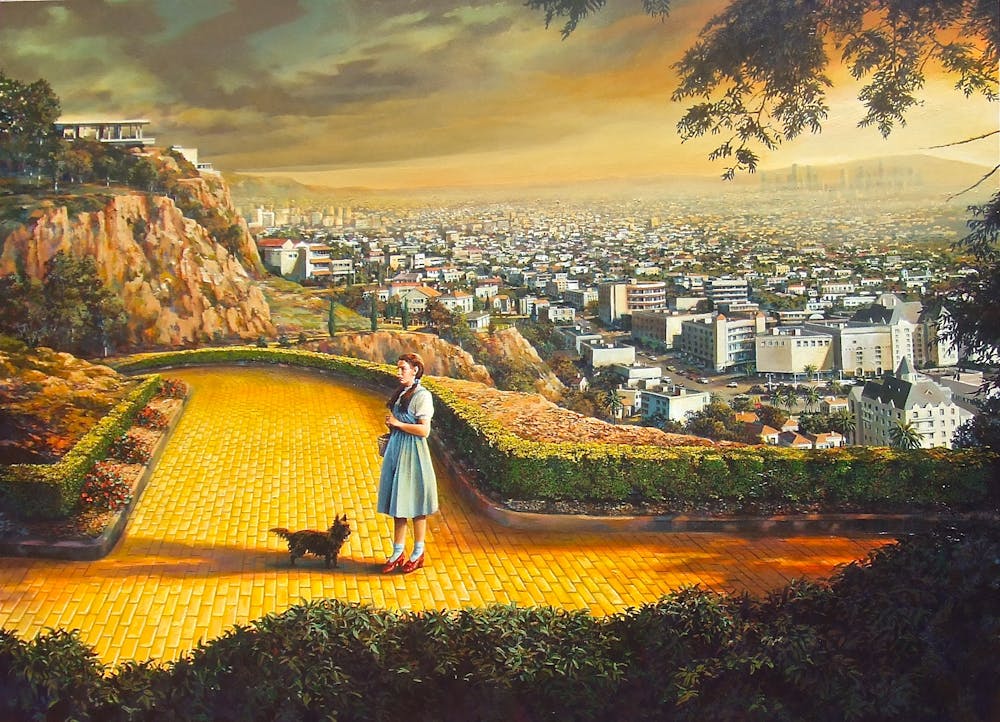
Somewhere over the Rainbow John Forrest

John Forrest’s “Somewhere over the Rainbow” and Ben Howe’s “Interval” deal more with allegory and utilise either myth or philosophy to enact the dread and the wonder of climate change. Forrest dramatises the Yellow Brick Rd from The Wizard of Oz, and has Dorothy turning her back on the American dream that was fuelled inappropriately by the world’s natural resources. The road of yellow bricks in the foreground focuses on broken dreams as it contrasts with a modern city drenched in pollution, presented here in the same hues as the road.
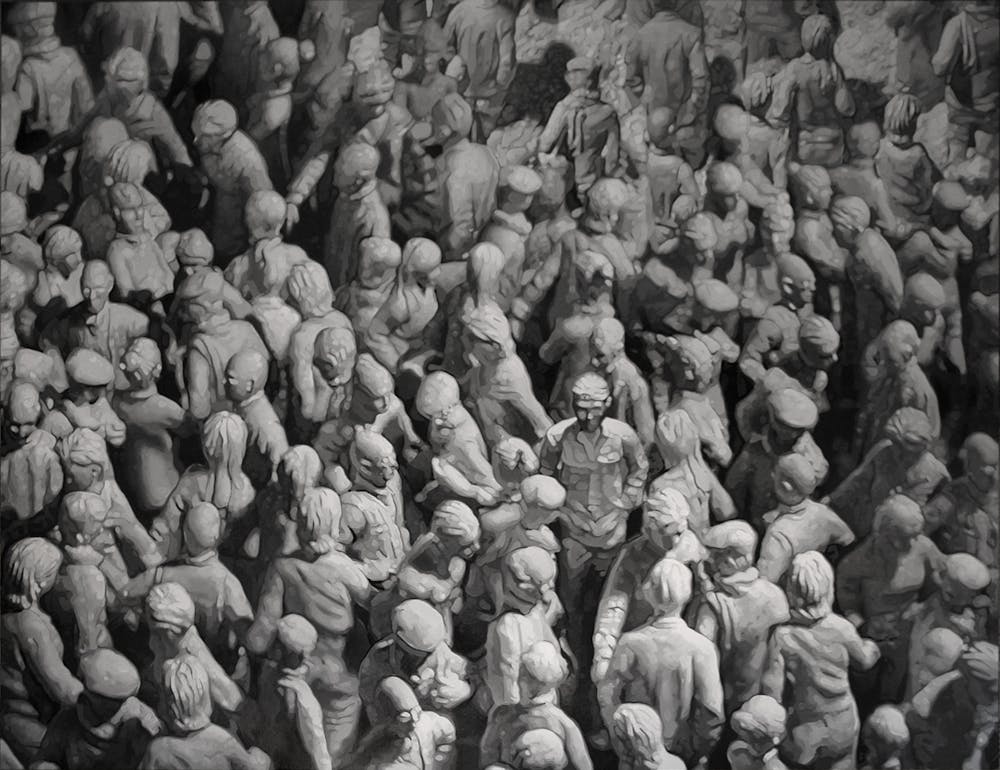
Interval Ben Howe

Ben Howe created archetypal figures in clay and placed them in a crowd of aimless, chaotic walking. The existential angst of relentless seeking is evident. But this extraordinary painting of people (yet people as clay) moving somewhere and nowhere has in its midst one figure that confronts the viewer from its centre. This is where the eye focuses and it is to an invitation to take action, to merge as a community – to take responsibility for the world that we have in our care.

Can art be a problem solver? We believe it has a part to play in alerting the human imagination, in concert with an emotional response to images, to debate and therefore to give further voice to what we can all do to protect the natural world from further unnecessary destruction.

This exhibition proposes that art can change human consciousness in revolutionary ways and as such has a place in human history as an agent of change. We may prefer to affix dark sun glasses to hide behind, as well as avert the glare of our reality; but as Simon Hennessey portrays in his painting, “Sunset Over Metropolis”, the glass reflects back to us and on us a world in a state of crisis.

As Ben Howe’s central figure demands: it is time for action.

Join the conversation

Comments (12)

  1. Permalink
    Kathryn brimblecombe-Fox

    Kathryn brimblecombe-Fox

    Artist (logged in via email @kathrynbrimblecombe-fox.com)

    I think we need to be careful not to see art's role as didactic. That is too simplisitc as well as implying a prescriptive element. Rather, at its best I believe Art's catalytic agency is its capacity to trigger conversations, either with oneself or others. These conversations potentially lead to questions and answers never previously pondered, new insights and perspectives... on all sorts of things These conversations end up not being about the Art at all, yet something in Art [albeit not all Art…

    show full comment

  2. Permalink
    Jodi Newcombe

    Jodi Newcombe

    Director, Carbon Arts (logged in via email @carbonarts.org)

    Thanks for this excellent review of an exhibition that I was sorry to miss. My organisation - Carbon Arts - is built on the premise that art is a powerful and necessary communicator of climate science and a spring board to action. This year we are focusing on public art, in particular art driven by real time data in sustainable buildings and precincts, as a means for engaging the public in a journey to a more sustainable future. Artistic engagement in green infrastructure can create the reward and visibility that may lead to greater acceptance of alternative futures. Gallery exhibitions are also important, and some of the works in this exhibition are exceptions. For more about us: www.carbonarts.org

  3. Permalink
    Paul Richards

    Paul Richards

    (logged in via Twitter)

    Ann - some of my closet friends are film makers, so my bias shows. As sc ifi follower and student of foresight I can assure you film making as an art medium qualifies for mindset change also. We can explore thousands of ideas over a 100 minutes of fantasy or the reality of documentary films, that can have a profound effect on our perspective of science. All forms of art can raise our awareness, some of the greatest paradigm shifts for me have been exhibition art, but the same is true of some films.

  4. Permalink
    Jan Vones

    Jan Vones

    (logged in via Facebook)

    The skyscrapers reflected in the sunglasses are glorious. I would love to be in that landscape. If only there were some cooling towers from nuclear plants. Oh, well, we'll see some new ones soon enough in Georgia.

    1. Permalink
      John Nicol

      John Nicol

      (logged in via Facebook)

      Jan,

      I am not sure what it would be about cooling towers which you would like to see. To watch PURE steam, water, H2O, going into the air without a skerric of carbon in sight, should not be an indicator of concern.

      I know it is used regularly on TV to illustrate the amount of carbon dioxide man is putting into the atmosphere and to try to drive home the message that this could be detrimental, but it really is a most dishonest form of presentation.

      What is being urged upon us here, is…

      show full comment

      1. Permalink
        Michael J. I. Brown

        Michael J. I. Brown

        (ARC Future Fellow and Senior Lecturer at Monash University)

        One always needs to treat John Nicol's use of quotes with great caution. One may get the impression he has cut and paste them from an original source. This is often not the case.

        Let's take... Tim Flannery's "The cities in Eastern Australia will be out of water by 2010".

        Google this quote and it turns up nothing. The correct quotes in their proper context can be found at http://watchingthedeniers.wordpress.com/category/tim-flannery/

        Even if one disagrees with what Tim Flannery says, one surely must agree that the invention of material does not assist an informed debate.

        1. Permalink
          John Nicol

          John Nicol

          (logged in via Facebook)

          My dear Michael,

          Such nit picking is usually regarded as a last resort of the desparate!

          I would not have taken the time to quote each of these very familiar statements by Tim Flannery and OK he did say "by 2009" - I gave him the latitude of an extra year.

          There are other quotations which can be found in addition to those in your reference - all of which I did not read agasin - including one which is often quoted which is something like - not necessarily verbatum - "that there may be…

          show full comment

      2. Permalink
        Jan Vones

        Jan Vones

        (logged in via Facebook)

        My comment was entirely sincere, John. I love skyscrapers and I love nuclear plants. Rhe first painting was cool, if you discount the perhaps paranoid eyes.

        I, friends, and members of my family have worked in downtown Manhattan. Friends and coworkers lost their lives there. An older relative of mine built and then mothballed nuclear power plants the last of which was put on line while I was a child.

        I found all the other images unworthy of comment, but so that I am not misunderstood they were facile and deceitful editorial cartoons on which to much effort had been lavished. You are not alone, John.

        1. Permalink
          John Nicol

          John Nicol

          (logged in via Facebook)

          Thank you for your reply Jan. I am sorry if I misinterpreted your comments. I agree with you also about the first of the pictures and also your remarks about the others. I can now appreciate fully what you are saying but am not sure of the reference to Manhattan and the deaths of your friends and coworkers. Were they related to the dreadful event of the Twin Towers? I feel so much for you no matter what caused their deaths.

          Please accept my apologise for my earlier remarks regarding the steam and cooling towers. John Nicol