


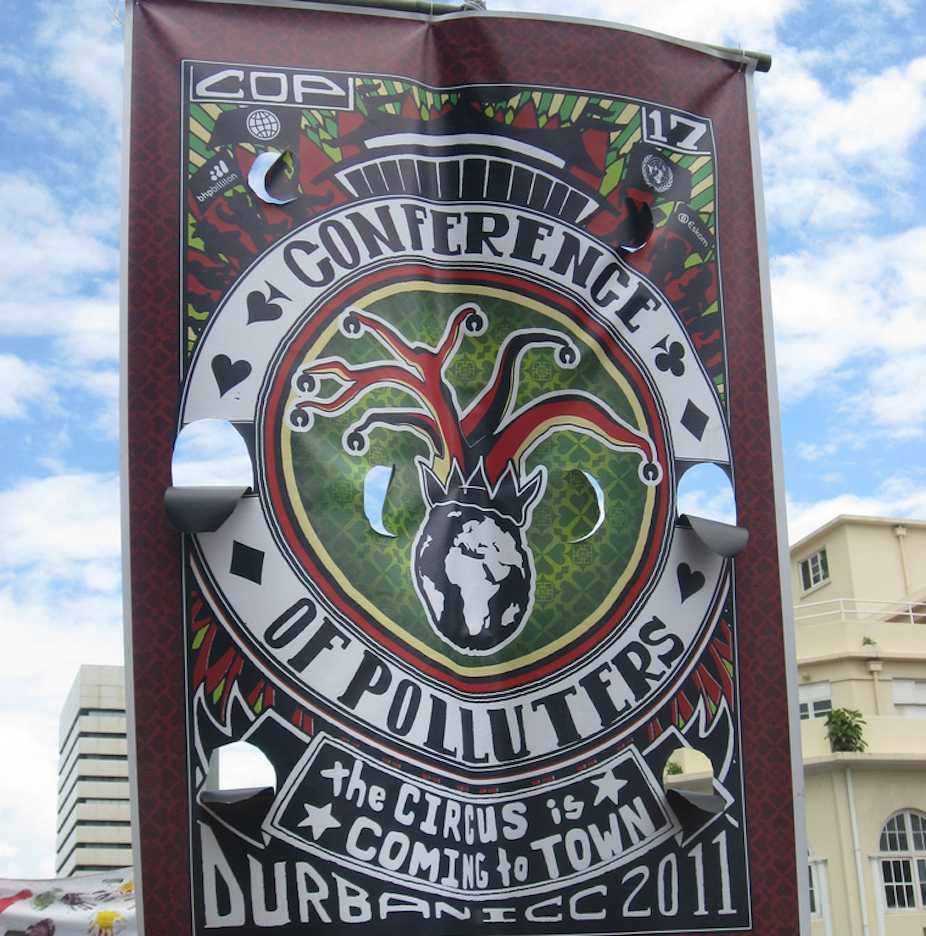
DURBAN CLIMATE CHANGE CONFERENCE: In a global day of action for climate justice, thousands of protestors complained about the slow progress in international debates on climate change at the United Nations conference in Durban. One of the chants of the campaigners was “Climate justice … not climate apartheid”. Banners dubbed the Durban event a “circus” – a “conference of polluters”.
They could have been talking about the meeting’s record on intellectual property and clean technologies. It has been marked by divisions, deadlocks, and delays in Durban. The topic is a critical one for climate change, biodiversity protection, and the energy crisis.
The United Nations Framework Convention on Climate Change 1992 encouraged governments to “promote and cooperate in the development, application and diffusion, including transfer, of technologies, practices and processes that control, reduce or prevent anthropogenic emissions of greenhouse gases”.
Such clean technologies include forms of renewable energy such as solar power, wind turbines, geothermal energy, and marine power; innovations in energy efficiency; as well as climate-ready crops, biofuels, and carbon-friendly farming; and hybrid cars such as the Toyota Prius, green buildings, and smart grids.
But developed countries have been fiercely jealous about guarding intellectual property rights in clean technologies. There have been complaints at Durban that the belligerent exercise of patent rights has created barriers to access clean technologies, especially among developing countries and least developed countries.
The Copenhagen Accord 2009 and the Cancún Agreements 2010 established a Technology Mechanism, consisting of a Technology Executive Committee and a network of Climate Innovation Centres. The creation of a web of Climate Innovation Centres is designed to facilitate collaboration between the private sector and the public sector on the development, transfer, and deployment of clean technologies.
However, the Copenhagen Accord 2009 and the Cancún Agreements 2010 failed to reach a consensus on dealing with intellectual property and climate change.
The discussions in Durban in 2011 have featured a similar level of acrimony and procrastination on the issue of intellectual property and climate change.
The debate in Durban
Ironically, given the discord between the nation states, the slogan for the Durban talks is “Working Together: Saving Tomorrow Today”.
The United States Government has argued there should be strong intellectual property rights protection of clean technologies. The United States Special Envoy for Climate Change Todd Stern has argued: “The way you drive technological development is through intellectual property rights. So it would be really a huge mistake to weaken those.”
The United States has been particularly tense about competition with China over clean technologies. Westinghouse Solar Inc. recently filed for patent infringement against Chinese solar-panel maker Canadian Solar Inc. The United States Department of Energy sought to block the sale of solar patents from the bankrupt Evergreen Solar to Chinese purchasers.
The International Centre for Trade and Sustainable Development has released a policy paper, encouraging the nation states to overcome their impasse. The paper suggests: “Policymakers should start with non-controversial technical solutions, later moving on to options that involve the use of intellectual property rights and licensing as well as pooled procurement strategies.” The Centre, for instance, suggests the fast-track examination of patent applications for green technologies is non-controversial.
India has called for “accelerated access to critical mitigation and adaptation technologies and related intellectual property rights”.
“Given the serious energy poverty and developmental challenges many developing countries face and are compelled to prioritize,” India says, “access to critical mitigation and adaptation technologies is central to their ability to address climate change.” India wants a regime that “balances rewards for the innovators with the common good of humankind and thereby enables developing countries to take early and effective mitigation and adaptation actions at the national level.”
India has been supported in its position by other members of the BASIC group, which also includes Brazil, China, and South Africa. In their view, “discussions on these important issues [of equity, trade and intellectual property rights]… would contribute to a comprehensive and balanced outcome at Durban”.
The African Group has argued that developing countries should make full use of the flexibilities of the international regime of intellectual property “to address adaptation or mitigation of climate change, in order to enable them to create a sound and viable technological base”.
One of the Progressive Latin American states, Venezuela, asked that “the Parties shall ensure that intellectual property rights and agreements shall not be interpreted or implemented in a manner that limits or prevents any Party from taking any measures to promote mitigation of climate change.”
Somewhat more radically, Bolivia has argued that developing countries and least developed countries should treat clean technologies as global public goods, which are not subject to intellectual property rights protection.
Least developed countries, small island states, and countries vulnerable to the impacts of climate change are also sympathetic to flexible options to address intellectual property and climate change.
A climate commons for intellectual property
In my book, Intellectual Property and Climate Change: Inventing Clean Technologies, I argue that a climate commons for intellectual property could foster co-operation and collaboration on clean technologies. While still respecting intellectual property rights, there should be scope for flexible uses of clean technologies.
It is critical to address international law’s fragmented approach to intellectual property and climate change. Developed nations need to be bound by an effective system of technology transfer of environmentally sound technologies. Too often, obligations regarding technology transfer have been ignored, overlooked, and scorned. Developing countries and least-developed countries should have intellectual property regimes, which take into account their position on the Human Development Index.
There must be a differentiated approach to clean technologies under patent law. Patent offices would benefit from procedural reforms, including fast-tracks for green patent applications and better databases and search engines.
Patent law reform for clean technologies also needs to be substantively reformed. There has been much concern about research and development on clean technologies being impeded by patent log-jams and thickets. One solution for this ‘tragedy of the anticommons’ would be to establish a Global Patent Pool to enable the sharing and exchange of clean technologies. Another option would be the development of a system of flexible, open licensing – a Climate Commons – modelled on the Creative Commons blueprint. Compulsory licensing could also be used to address patent gridlocks, climate emergencies, and anti-competitive behaviour.
Finally, the intellectual property regime should be supplemented by complementary models of innovation. The National Renewable Energy Laboratory in the United States has incubated the development of a wide range of clean technologies, which have been then commercialised by private companies. This model should be emulated elsewhere.
The Technology Mechanism – with its web of Climate Innovation Centres – should be operationalised. More environmental prizes could also help, especially given the impact of the H-Prize for Hydrogen, the L-Prize for Lighting and the Saltire Prize for marine energy.
The Green Climate Fund will play an important role in funding innovation on clean technologies. Thomas Pogge’s proposal for an Ecological Impact Fund also deserves further consideration.
Without improvements to the intellectual property regime, developing countries will not be able to achieve the objective of advancing appropriate mitigation and adaptation actions at the scale and speed warranted by the United Nations Framework Convention on Climate Change 1992.