


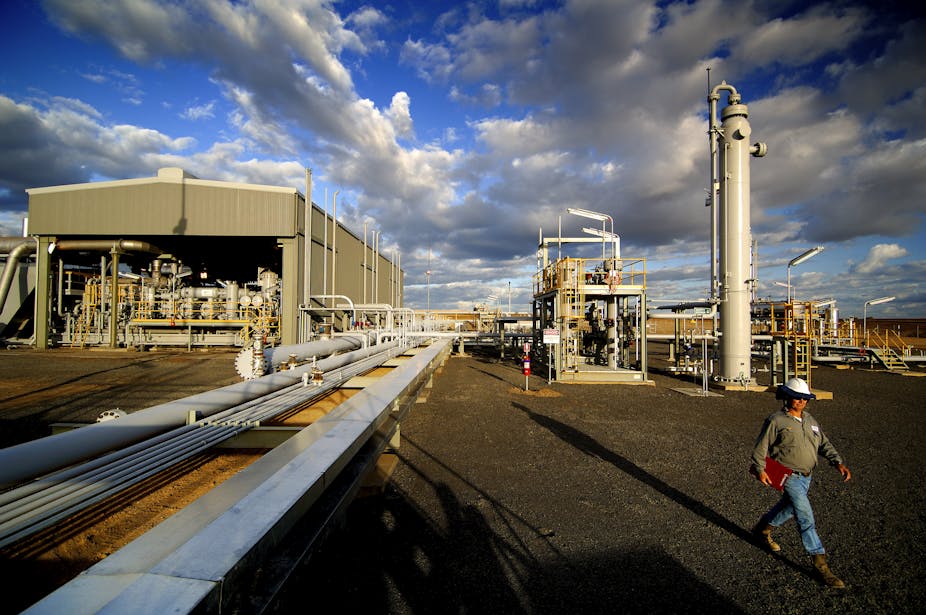
The Mineral Resources Rent Tax passed through the House of Representatives last week, but not without negotiations with the Greens and independent MPs.
Perhaps the most significant outcome of negotiations was the announcement of an Independent Expert Scientific Committee to advise state and federal governments about the impacts of large coal and coal seam gas (CSG) projects. The decision is a very welcome one.
Until now, government approvals for CSG projects have been granted on the basis of environmental impact statements (EISs) generated by proponents of the development they are assessing. As a result, and given the large tax revenues coming from the projects, such assessments are hardly likely to have been free of bias.
The problem of bias in the assessment and approvals process is inherent in all resource developments, not just coal seam gas (CSG) and large coal projects.
While there will now be greater scrutiny of new projects, the horse has bolted in Queensland, where four large projects — to mine gas in the hinterland and ship liquified natural gas (LNG) out of Gladstone — have already received state and commonwealth approvals.
With these Queensland CSG projects already going ahead, more accurate assessment of their greenhouse gas emissions by the Australian and state governments is a high priority. The environmental impacts of our big mining and gas projects go to the very core of national and international efforts to tackle climate change.

Greenhouse uncertainties of coal seam gas
The uncertainties surrounding the impacts of CSG are not confined to farmland, water tables and catchments. There are now serious doubts emerging whether a wholesale switch from coal to gas will help curb global climate change.
It’s inevitable there will be some leakage of methane gas during CSG development and processing. In assessing CSG emissions, a multiplying factor is applied to methane, which has many times the global warming potential of carbon dioxide. This multiplier allows us to talk about methane’s warming potential in terms of carbon dioxide equivalents generated in burning.
While methane burns cleaner than coal, the carbon dioxide equivalent of the leakage of gas from wells, pipelines and processing plants must be added to emissions from combustion.
Two pieces of research published earlier this year – one by Richard Howarth and colleagues and one by Tom Wigley – suggest “unconventional” gas (shale and coal seam) is no cleaner than coal. In fact, both pieces of research suggest shale and CSG can emit a greater quantity of greenhouse gas per unit of energy generated.
The researchers’ results are based on data from actual gas developments and coal mines in the US and use recent scientific findings to assess the greenhouse impacts of gas and coal.
In contrast, an “independent” study by energy services provider WorleyParsons, published earlier this year concluded that CSG (mined in Australia and burned in China) will emit just over half the carbon dioxide equivalents of coal.
Because actual data is scarce in Australia, the WorleyParsons forecast of CSG emission levels is taken from forecasts used in the EISs of Australian CSG/LNG proposals. These assume best practice in terms of managing emissions while also using low estimates of the global warming potential of methane.

The truth is, we won’t know the leakage rate of methane from CSG in Australia until projects are operational.
Furthermore, research by Drew Shindell and colleagues suggests the global warming potential of methane is greater than is presently assumed by international organisations, the Australian and US governments and in companies’ EISs.
The global warming factor used by these organisations is one tonne of methane equals 21 tonnes of carbon dioxide equivalent over a 100 year period. According to Shindell and colleagues, that factor should be 32 tonnes equivalent over 100 years, and 105 over 20 years.
This finding has important implications for greenhouse gas reporting by all countries that produce, and will be producing coal seam gas.
The Australian equation
In Australia the consequences of the science are two-fold. First, the Government’s estimates of greenhouse gas emissions by 2020 and 2050 should include the updated factor for methane. It is arguable that the factor of 105 should be used by LNG companies’ when reporting their methane emissions (and indeed used for other emitters of methane) to 2020.
Second, the passage of the Clean Energy legislation means that from next year, tax will be raised per tonne of carbon dioxide equivalent of emissions. The tax on LNG companies will increase with the correct factoring for methane.

The EISs of four CSG companies exporting LNG out of Gladstone suggest their cumulative annual emissions in Australia at peak production will be 35 million tonnes of carbon dioxide equivalent. If the updated global warming factor for methane over 100 years (32 tonnes equivalent) is adopted then this rises to 53 million tonnes of carbon dioxide equivalent a year. The use of the warming factor for methane over the 20-year horizon (105 tonnes equivalent) gives 175 million tonnes a year.
CSG is classed as a trade-exposed industry under the Clean Energy legislation and would be protected from the full impact of a tax increase that results from the adoption of the updated warming potential for methane. But coal mining, which also emits methane, would be exposed to the full impact of such an increase.
Serious faults have been exposed in the EIS and approval process in relation to CSG. These are being corrected, but a review of the methodology for assessing all large resource projects is called for.
Meanwhile, given that large CSG extraction and processing developments will go ahead without further legislative impediments in Queensland, it is incumbent on the state and commonwealth to carefully monitor not only effects on land and water tables but the leakage of methane.
Companies need to make the investments required that will facilitate accurate measurement of gas leaks across all CSG projects. The cumulative emissions must then be factored into national greenhouse accounting.
There should be an updating internationally of the factor applying to methane as a greenhouse gas, based on the scientific evidence. Otherwise greenhouse accounts will not reflect the climate change implications of large increases in the use of LNG.
Where countries have tax or cap-and-trade schemes for greenhouse emissions, the international adoption of an updated factor for methane will increase imposts on producers of coal seam and shale gas, as well as on other large emitters of methane.