
The Conversation
Subscribe
  • Academic rigour, journalistic flair
  • For curious minds
  • Expert news and views
  • Debate and ideas
  • From the curious to the serious

Hot Topics

  1. Gay marriage
  2. Australia in the Asian Century
  3. Convergence review
  4. Federal Budget 2012
  5. War on drugs
  6. Medical myths
  7. Bob Brown
  8. Square Kilometre Array
  9. Explainer
  10. Transparency and medicine

Do you know your neighbour? Lending a hand and the Queensland floods

Neighbours are a source of growing aggravation in Australia and we are lodging more official complaints about each other than ever before. Excessive noise or odour, inadequate levels of property maintenance, roaming animals and general forms of anti-social behaviour are all potentially cause for complaint…

Queensland_floods
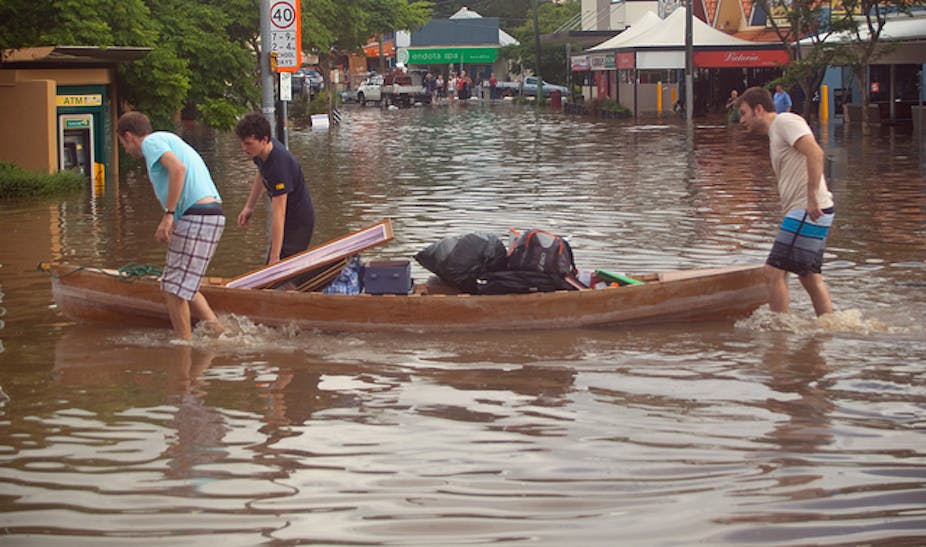
Australians willingly helped their neighbours when it was needed during the Queensland floods of 2011. Flickr/RaeAllen

Neighbours are a source of growing aggravation in Australia and we are lodging more official complaints about each other than ever before. Excessive noise or odour, inadequate levels of property maintenance, roaming animals and general forms of anti-social behaviour are all potentially cause for complaint.

Yet the overwhelming message that flowed from events like the floods in Queensland and Victoria last year was one of neighbours, friends and even strangers rallying to assist flooded residents in their hour of need.

As the waters rose, neighbours banded together to sandbag each others’ homes and move possessions to higher ground. Once they receded, information, food, homes and equipment were freely shared. Observers lauded the spirit of community that prevailed.

So, why are neighbours still there when needed even if their noise, smells and habits are cause for complaint the rest of the time?

Poor planning

The rise in neighbourly tensions has been attributed to poor council planning laws which create increasingly dense living areas. Otherwise blame has been put on the breakdown of society, which has reduced familiar neighbours to intolerant and inconsiderate strangers.

It is true that neighbourhoods are changing and that good urban planning can help reduce potential conflict. Yet there is no evidence so far that suggests complaints are more likely to arise in high density or transition suburbs than any other.

Nor can we say that the close-knit ties we once enjoyed have been uniformly lost. Many people still have frequent and positive contact with neighbours.

There are therefore two ways we can explain this contradiction. The first relates to the tension between neighbourliness and privacy, the second to conflict and civility.

Finding a balance

Research shows that neighbourly support and interaction were particularly high in older working class suburbs. But so too were conflict and gossip. Everyone knew everyone else’s business.

Today, we are more protective of our privacy and expectations of neighbourly conduct have changed. “Good” neighbours are friendly but not too friendly, they keep a respectful distance but are there when needed.

This is a precarious balance based on an unspoken moral code. This makes breaches nearly impossible to avoid.

It also means we are less likely than ever to know our neighbours.

Avoiding confrontation

Social distance does not solve the issue of physical proximity. Neighbours may not know each others’ names but they learn a lot about each other nevertheless, some of it quite intimate.

This proximity requires careful management to prevent private lives encroaching upon others’ domestic spaces and causing offence.

It may be that neighbourly conflicts have not increased, simply that problem neighbours are now dealt with through formal channels rather than over-the-fence conversations. Low levels of social contact, coupled with the desire to maintain friendly distance and avoid conflict, renders people reluctant to confront offenders.

As a start, they may try to ignore the problem. But complaints to a third party offer a final resort, allowing complainants to remain anonymous and uninvolved.

A costly habit

The problem for councils, however, is that significant resources are expended in investigating petty disputes. Anonymous complaints also create an environment of suspicion among neighbours.

There is a possibility that the wave of goodwill exhibited during the floods will minimise neighbourly conflicts, or at least reduce registered complaints. But it may also create new sets of expectations about neighbours and new forms of conflict if these normative codes are breached. Time will tell.

Join the conversation

Comments (7)

  1. Permalink
    John Browne

    John Browne

    Surveyor (logged in via email @hotmail.com)

    This is a true story. It's a "Sydney" story.

    So a group of us were standing around at a high school reunion (state northern beaches school) a few years back. Street and email addresses had been distributed before the event so we all new where everyone now lived. We had all gone through 6 years of high school together.

    Then someone commented to two of the guys in the group how remarkable it was that they had ended up in the same street (in a pretty well-to-do North Shore suburb).

    So these two looked at each other. "Do we?" they said in disbelief.
    They looked at each other again.
    Then it dawned on them (one is a high profile CEO and the other a prominent local solicitor). Turns out they had lived across the road from each other for the previous 5 years.

    1. Permalink
      Lynda Cheshire

      Lynda Cheshire

      (ARC Future Fellow in Sociology at University of Queensland)

      Thanks for your response, John. There are probably a lot of stories like that.

      Russell, there are regular attempts to foster comunity by creating residential areas with walkable public spaces where people can interact, community groups and organisations, and other such local hubs. Property developers of master planned communities do this all the time, drawing on a new urbanist design philisophy. They even employ community development workers to help kick-start the process.

      But comparative research…

      show full comment

  2. Permalink
    Lynda Cheshire

    Lynda Cheshire

    (ARC Future Fellow in Sociology at University of Queensland)

    Hi Russell, there is no evidence readily available to compare the volume of complaints between suburbs so we can't tell if high density or transition suburbs generate more problems. But anecdotal evidence from councils indicate that they receive no more complaints from these kinds of suburbs than from any other. It's something we plan to investigate further in our research. And yes, of course, there are fewer local ties than there use to be so we are less likely to know, and interact with, our neighbours. But that's not true for everyone. Neighbouring is now more elective - you do it if you want to but not if you don't.

    1. Permalink
      Russell Hamilton

      Russell Hamilton

      Librarian (logged in via email @gmail.com)

      Hi Linda - I'm not sure about "Neighbouring is now more elective - you do it if you want to but not if you don't".

      When I was growing up I knew the name of everyone in the street. I was one of 5 kids which was common enough, so my siblings friends were around, and my parents contacted their parents about birthday parties or sleepovers etc. We all walked down to the local beach. We all saw each other in the local butchers, greengrocers and delicatessen - we knew their names and they knew ours…

      show full comment

      1. Permalink
        Lynda Cheshire

        Lynda Cheshire

        (ARC Future Fellow in Sociology at University of Queensland)

        That's a good point. Maybe it's easier to opt out than opt in. You are right, neighbouring styles aren't always individually determined, although it's possible for two neighbours to strike up a really good relationship even if they don't have the same kind of connection with anyone else in the street. But usually, neighbouring styles are collectively produced so it would certainly be difficult for one resident to try to establish a strong sense of community with their neighbours if the general norms are based on a more privatised. mobile existence.

        The main point I am trying to make is that we cannot say good relations between neighbours have universally declined since there will always be some people who do have a similar kind of neighbourly experience that you describe, even if they are now in the majority.

        1. Permalink
          Russell Hamilton

          Russell Hamilton

          Librarian (logged in via email @gmail.com)

          Hello again - I guess I don't like the terminology ' opt in, opt out' if many of the options have in fact been withdrawn. If people are happy with the way things have trended, and value privacy more than community, then that's that. But if people decide they would rather have more community, then we need to re-invent chances to interact. We won't be all catching the bus together (I hope) but perhaps more local swimming pools, tennis courts, events/courses at the public library, matching of volunteers/mentors with others, not approving houses that present mostly garage doors to the street ... whatever, it will have to be planned for.

          Sometimes just letting things drift along with people doing as they please at the time doesn't end up with the same people getting what they wanted long-term, because they hadn't really thought about it.

  3. Permalink
    Russell Hamilton

    Russell Hamilton

    Librarian (logged in via email @gmail.com)

    "Yet there is no evidence so far that suggests complaints are more likely to arise in high density or transition suburbs than any other." Just wondering if there is no evidence, or there is evidence that there are no more complaints ....

    "Nor can we say that the close-knit ties we once enjoyed have been uniformly lost." Not uniformly, but surely there are fewer ties due to reduced family size, women working, FIFO workers, local shops replaced by big shopping centres, increased wealth meaning more diverse/distant recreation activities etc