The Conversation
Subscribe
  • Academic rigour, journalistic flair
  • For curious minds
  • Expert news and views
  • Debate and ideas
  • From the curious to the serious

Hot Topics

  1. Gay marriage
  2. Australia in the Asian Century
  3. Convergence review
  4. Federal Budget 2012
  5. War on drugs
  6. Bob Brown
  7. Explainer
  8. Square Kilometre Array
  9. Medical myths
  10. Transparency and medicine

Doctors' orders: debunking homeopathy once and for all

Homeopathy’s got a bit of a run in the media in recent months and the stories are by no means positive. It all started in April when the medical press highlighted the National Health and Research Council’s (NHMRC) impending statement on the practice. The ABC’s Australian Story then broadcast “Desperate…

Vitasamb2001
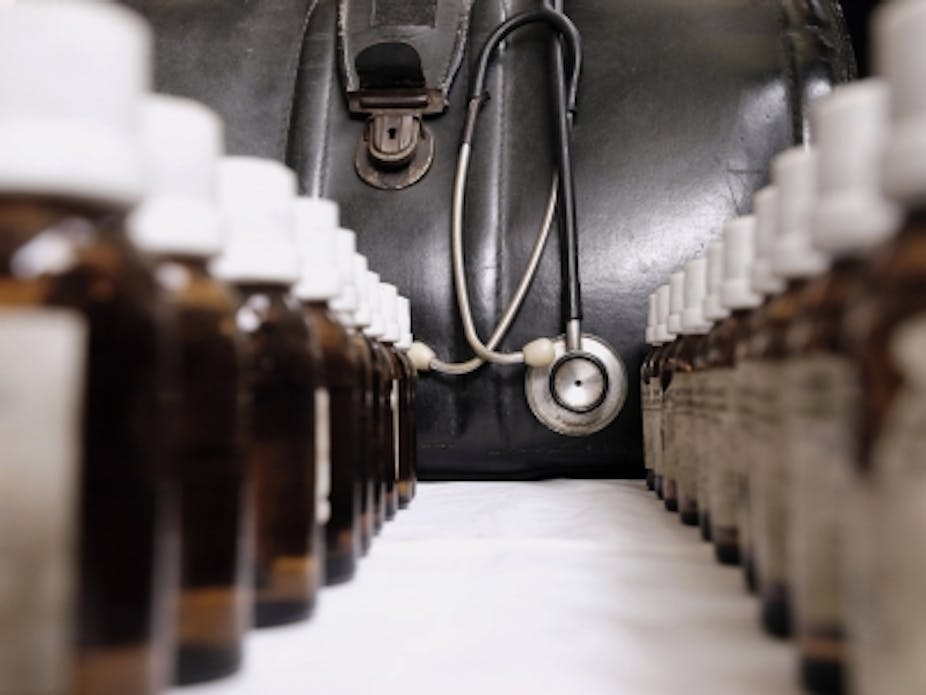
The placebo effect may be making people feel better but it should never be substituted for real medicine. vitasamb2001/FreeDigitalPhotos.net

Homeopathy’s got a bit of a run in the media in recent months and the stories are by no means positive.

It all started in April when the medical press highlighted the National Health and Research Council’s (NHMRC) impending statement on the practice.

The ABC’s Australian Story then broadcast “Desperate Remedies” bringing the non-medical base of homeopathy into the spotlight and last week, the commercial stations jumped on the bandwagon with Channel 7’s Today Tonight running a story about it.

The NHMRC is still finalising its statement, which, it says is based on one by the UK House of Commons Science and Technology Committee.

It has also said it will likely recommend insurers to not pay for homoepathy because studies have found it to be ineffective.

The genesis of homeopathy

Homeopathy is a system of health care based on the idea that “like cures like” – substances that cause the same symptoms as an illness can cure that illness.

And the idea that extremely small dilutions, so small that there’s almost no chance of the original substance being present, are more effective than more concentrated solutions.

If the former sounds a bit like alchemy, that’s because it is. “Like cures like” is a fundamental principle of medical alchemy, endorsed by no less than the father of pharmacology Paracelsus.

Homeopathy reflects this idea because when its founder Samuel Hahnemann first formulated his approach in 1796, alchemy was on the wane but still influential.

Medicine looked nothing like it does today at the time, with extreme treatments like bleeding, purgatives and heroic concentrations of opiates in common usage.

Using fruit juice to combat scurvy would only be widely implemented in five years' time; vaccination lay six years in the future; and the germ theory of disease and the Law of Mass Action over 50 years in the future.

So it’s not surprising that homeopathy became popular: in an era where conventional treatment was just as likely to kill you as cure you, the gentler ultra-dilute tonics of homeopathy would at the very least not harm you.

Medicine evolved as we came to better understand the body and developed effective medicines.

But homeopathy didn’t. It remained mired in the same 18th century alchemical thinking.

The homeopathic hospitals of the 19th century either closed or were converted (the former Prince Henry’s Hospital in Melbourne where I used to work started life as a homeopathic hospital).

A little drop won’t do it

Homeopathy has a symptom-based approach to medicine – it ignores the actual mechanisms of disease. Take insomnia, for instance, the treatment for it is (among other things) “Coffea 30C”.

Coffea is caffeine, the substance in coffee that keeps you awake and the 30C describes how much the caffeine is diluted.

Now, most people would instinctively feel that giving caffeine to someone with insomnia is not the best idea, but the magic is apparently in the dilution.

The C in 30C means the solution has been diluted to one part in a hundred and 30C means the solution has been diluted one in a hundred 30 times.

If you take a drop of your morning coffee and drip it into the nearest dam, the concentration of caffeine in the dam would be higher than 30C dilution of caffeine.

In fact, a 30C dilution is highly unlikely to contain a single molecule of caffeine.

Erhart_n_karl
Homeopaths claim the mirror image of a substance’s effect gets stronger with dilution. Erhart_n_karl

Our every day experience is that when you dilute something, it gets weaker. Homeopaths claim that, contrary to our experience and the laws of physics, substances get stronger as they become more diluted.

Or, rather than getting stronger, the mirror image of their effect gets stronger. So, caffeine, a stimulant, somehow becomes an effective sleep aid.

Homeopaths have a number of different, mutually contradictory explanations for this. One of the most popular is that water retains a “memory” of the substances in it.

Now if this were true, water would retain the memory of all the substances that have ever been in it, and the effects would be rather obvious to all.

We can see why the dilution can’t work by considering caffeine again. We know that caffeine make us more alert by stopping the action of a brain hormone.

Diluting caffeine out won’t make the brain hormone work harder, nor will a “memory” of caffeine.

Homeopaths explanations are incoherent and require everything we know about how the body works to be wrong.

Any apparent effect of homoeopathy is purely due to the placebo effect, where people feel subjectively better just because we are paying attention to them. But the underlying disease doesn’t get any better, and we should never substitute real medicine for placebos.

But does it actually work?

We can talk about theory all day, but what if there were evidence that homeopathy actually worked? That would trump any discussion of theory. Clinical trials have been done on homeopathy, and the results aren’t good.

Now, not all clinical trials are equal but good quality clinical trials show homeopathic remedies have no effect. Whether for asthma, attention deficit disorder or side effects of cancer medication (podcast here). For some diseases such as dementia, there are simply no good clinical trials to evaluate.

The most recent evaluation of the evidence for homeopathy was the UK government’s Evidence Check 2: Homeopathy. After reviewing the best scientific evidence and submissions from stakeholders, the review concluded that homeopathy showed no evidence of efficacy.

What’s the NHMRC got to do with it?

The NHMRC is Australia peak body for evaluating and promoting best health practice, so it’s entirely appropriate for it to rule on the effectiveness of homeopathy.

It’s rulings have several implications – doctors will be reluctant to prescribe remedies that have no proven efficacy, for instance, and insurance companies will be reluctant to pay out on them.

Australian adults have the right to choose treatments for their aliments (or choose not to be treated). But they need access to the best-available evidence so their choices can well informed.

The tragic story of Penelope Dingle shows what happens when people don’t have such access.

Join the conversation

Comments (29)

  1. Permalink
    Ian Musgrave

    Ian Musgrave

    (Senior lecturer in Pharmacology at University of Adelaide)

    Jon Wardle said "I don't know if placebo can be described as people feeling "subjectively better just because we are paying attention to them".

    That is pretty much what it is (except in some special circumstances, and things like regression to the mean), we know that almost any attention will make people feel subjectively better (did you follow the link in the article to the asthma trial?). Heck, even wheeling in a complex looking machine, which doesn't do anything, makes people feel better.

    But it doesn't do anything to the underlying problem. Asthmatic people taking placebos (inhalers or acupuncture needles), say they feel better, but their lung function doesn't improve. The use of placebos means that effective therapies will not be used, to the detriment of the patient. And I wouldn't dignify what homoeopaths do as "effective counselling techniques", beyond what anyone paying attention to you does.

    1. Permalink
      Jon Wardle

      Jon Wardle

      (NHMRC Research Scholar, School of Population Health at University of Queensland)

      Hi Ian. Placebo response does mean "I please" and is about people feeling subjectively better, but my point was it may result from non-specific or specific reasons beyond that extra attention.

      In no way would I suggest that we should ignore improving physiological function in people. Although you quote the asthma study, there are numerous studies which do in fact suggest placebo affects physiological function in many people. Unfortunately I think placebo is an often unfairly maligned and under-appreciated phenomenon.

      The fact that you suggest that homeopaths shouldn't be 'dignified' by further investigation due to your assumption that it is only the attention that works (and at this is what your suggesting that's what they are) is a little concerning.

      Not exploring the potential of placebo in this case seems more like a scientific grudge than good science. We're supposed to ask difficult questions that make us feel uncomfortable, not shy away from them.

    2. Permalink
      Carole Hubbard

      Carole Hubbard

      conservationist (logged in via email @iimetro.com.au)

      Its all very well to pooh-pooh something you don't understand and take a superior, all-knowing stance, ridicule and talk down a proven effective remedy such as homeopathy.
      Homeopathy has been around for 200 years with a proven history of cures for many conditions that regular doctors couldn't cure.
      There is a long-standing trend in allopathic medicine to talk down and ridicule any modality that competes with marketshare. The wars between allopathic and alternative modalities has been going on…

      show full comment

      1. Permalink
        Sue Ieraci

        Sue Ieraci

        Public hospital clinician (logged in via email @healthcaresd.com)

        Ms Hubbard - homeopathy has been around for a long time but, contrary to your assertion, does not have a supportive evidence-base. This has nothing to do with market share - the big Homeopathic multinationals are doing well, marketing "remedies" with essentially no ingredients at a huge profit. One of the largest - the French company Boiron, has been prosecuted for making false claims about its products. In the 200 plus years that homeopathy has been around as a theory, there has been no evidence - either basic science or clinical, that supports its effectiveness. It is just an old theory that makes money for its practitioners through spending time with people (which may be therapeutic) and selling them scam "remedies" - which is at best disingenuous and at worst dishonest.

        1. Permalink
          Carole Hubbard

          Carole Hubbard

          conservationist (logged in via email @iimetro.com.au)

          Do you for people to address you as Sue or Ms Ieraci? If Ms Ieraci why bother signing up as Sue Ieraci?
          Ms Ieraci (as you prefer to be more formal) I can't speak for the whole of homeopathy, but certainly can for cellsalts which are made in the same way that homeopathic preparations are made. I've been taking homeopathic cellsalts for many years and they do work. I don't consider the evidence-base you speak of as being reliable, and most probably flawed as so many pharmaceutical drugs are due to…

          show full comment

  2. Permalink
    Graeme Hanigan

    Graeme Hanigan

    (logged in via Facebook)

    Carole Hubbard, I have no wish to be offensive but we have heard your tired old rhetoric many times before.

    If I was pro quackery I would consider that you are actually doing more harm for the cause than good. Is this the very best you have to offer in the way of a compelling argument?

    My question to all is, if homeopathy is sold on the basis of efficacy which cannot be demonstrated, why then is this not considered to be fraud?

    1. Permalink
      Carole Hubbard

      Carole Hubbard

      conservationist (logged in via email @iimetro.com.au)

      I don't know what you mean by "tired old rhetoric" but I can be just as offended by your fascist type scientism whereby nothing is valid unless it is proven by statistics and hard data. I don't know what cause you follow except that of establishment pawn, because you don't seem to have any of your own experience except what you've been indoctrinated with in schools of learning, which IMO are schools of indoctrination since the pharmaceutical business took them over. And yes, I do find the allopathic hardarse mentality quite offensive.

  3. Permalink
    PL Hayes

    PL Hayes

    (logged in via Twitter)

    Good article but there is really no such thing as a good quality clinical trial of homeopathy: The homeopathic hypothesis is so implausible - so contradictory of firmly established science backed by mountains of strong evidence - that attempts to provide it with empirical support are subject to the Catch-22 effect described by Jaynes here: http://www-biba.inrialpes.fr/Jaynes/cc05e.pdf Positive results from a large and methodologically rigorous CT of homeopathy would be evidence of error, not evidence in support of homeopathy!

    1. Permalink
      Carole Hubbard

      Carole Hubbard

      conservationist (logged in via email @iimetro.com.au)

      You can say that homeopathy can't possibly work because there isn't enough of the active ingredient left after so many dilutions. That the laws of science can't explain the phenomena of homeopathy therefore it can't possibly be true. You can bring in such magicians as Randi to ridicule and talk down, and speculate that it is all some sort of con but you can't disgard homeopathy's long history of cures over 200 years, and the fact that people still use it today for various conditions.
      The fact that…

      show full comment

      1. Permalink
        PL Hayes

        PL Hayes

        (logged in via Twitter)

        In the vast majority of cases there isn't anything of the 'active' ingredient left. Not a single molecule of a substance which almost certainly wouldn't have had a beneficial effect anyway because the homeopathic “like cures like” 'theory' and baroque “proving” ritual are nonsensical too. I can (and do) say that the probability of homeopathy working is so smalll that it is effectively “impossible”, yes.

        “That the laws of science can't explain the phenomena of homeopathy therefore it can't possibly…

        show full comment

      2. Permalink
        Tracy Soh

        Tracy Soh

        Addiction Medicine Physician (logged in via email @gmail.com)

        @Carole Hubbard
        Claiming a conspiracy theory does not make the science about homeopathy's lack of effect any less convincing

  4. Permalink
    Guy Chapman

    Guy Chapman

    (logged in via Twitter)

    As Ian notes, there's considerable dispute over whether the placebo effect should really be considered an effect at all; some studies suggest small but measurable physiological changes, many others don't.

    The real problem, though, is not that it's a placebo treatment, but that even that (small, disputed and short-lived) effect depends for its existence on deluding the patient. Use of homeopathy demands either a belief in homeopathy, which, to quote Baum and Ernst, exceeds the tolerance of a reasonably open mind, or it violates ethical principles of informed consent.

    Worse, homeopathy is a "gateway drug" to a whole world of pseudoscientific quackery whose proponents undermine public faith and trust in science based medicine in order to promote what they claim are "natural" alternatives, but which turn out in most cases to be entirely ineffective. The sooner this most obvious of bogus treatments is off the shelves of pharmacists, the better.

    1. Permalink
      Monika Merkes

      Monika Merkes

      (Honorary Associate, Australian Institute for Primary Care & Ageing at La Trobe University)

      Hi Guy, placebos also appear to work when the patient knows they are taking a placebo. For example, a study by Kaptchuk and colleagues tested this and the authors concluded 'Placebos administered without deception may be an effective treatment for IBS. Further research is warranted in IBS, and perhaps other conditions, to elucidate whether physicians can benefit patients using placebos consistent with informed consent.'
      'Placebos without deception: A randomized controlled trial in irritable bowel syndrome', http://bit.ly/gML3kl

      1. Permalink
        Guy Chapman

        Guy Chapman

        (logged in via Twitter)

        Indeed, but equally there are studies that show no placebo effect at all, and homeopathy studies that show less effect than placebo. It is a complex phenomenon, I think, and not reliable enough to use as more than a welcome tangential benefit of any treatment regime.

      2. Permalink
        Michael Tam

        Michael Tam

        (Lecturer in Primary Care at University of New South Wales)

        Ah, Kaptchuk and colleague's infamous placebos in IBD study. I would hope that anyone quoting this study would have taken the time to critically appraise its startling results. This study is beset with serious methodological problems that frankly renders its results invalid and uninterpretable. As such, the author's conclusions are "optimistic" at best. I reviewed it here: http://evidencebasedmedicine.com.au/?p=749

    2. Permalink
      Carole Hubbard

      Carole Hubbard

      conservationist (logged in via email @iimetro.com.au)

      It would be nice if the 400 signatories to the Friends of Research in Medicine would declare their allegiance. I would say there are quite a few of these EBM signatories posting to The Conversation health topics but a person has no way of knowing unless they declare like a few have. If a person makes the commitment to become a signatory to a group they should be prepared to publicly declare their allegiance, otherwise they are a fraud.

      1. Permalink
        William Bennett

        William Bennett

        Postdoctoral Researcher, Griffith University (logged in via email @griffith.edu.au)

        Hi Carole,

        I am a member of the Friends of Science in Medicine - a very proud one in fact.

        I have one question for you... If water has a memory, surely it retains the memory of all of the faeces and urine that it has been associated with? Does this have an effect on us as consumers of this water?

        Please don't go off on some crazy tangent about the history of homeopathy and the fact that so many people use it today. Just answer the question please.

        1. Permalink
          Tom Hennessy

          Tom Hennessy

          Retired (logged in via email @cool.zzn.com)

          Quote: If water has a memory, surely it retains the memory of all Answer: Bruce Ames , Nobel Prize winner states a few drops of a methylene blue in four olympic sized swimming pools results in measureable results in the animals. You fail to address that statement and therefore your continuous attempted denigration of an accepted treatment based on merely "dilution" is laughable.
          Take it somewhere else other than on a thread which has already PROVEN dilution equals effect.
          You must NOW prove the specific homeopathic remedy DOESN'T work because "dilution" has been DEBUNKED by no less than a Nobel Prize winner so smoke that , Willy.
          "First to show that low concentrations of the drug have the ability to slow cellular aging in cultured cells in the laboratory and in live mice"
          "Equivalent of a few raindrops in four Olympic-sized swimming pools of water "

          1. Permalink
            Tom Hennessy

            Tom Hennessy

            Retired (logged in via email @cool.zzn.com)

            I suppose I could probably claim this "homeopathic prize" of extreme amounts of cash , too.
            Because ??
            Methylene blue is a treatment for methemoglobinemia. Signs of methemoglobinemia include blue lips and skin. The treatment turns your tongue and urine blue.
            Proving , like , blue lips , cures like , blue lips.
            My lawyer awaits the cash.
            You heard it here first.

        2. Permalink
          Carole Hubbard

          Carole Hubbard

          conservationist (logged in via email @iimetro.com.au)

          When making homeopathic remedies, the mixture is shaken between each dilution, and it is the shaking the somehow imprints the vibration of the substance onto the water. Everything in nature vibrates at a certain frequency even inanimate objects have their own frequency. Somehow the more the substance is diluted, the more the material part is removed and the stronger the vibrational element becomes. This is my understanding.
          And bear in mind that the science / physics that we now is pretty primitive when it comes to topics nearing the spiritual which is merely a step up from the physical. The science we know is deliberately kept primitive and confined to certain concepts in order for the global elite who pull the strings, to keep a captured market as there are many suppressed inventions that would free mankind from dependence on such things as fossil fuels and drug-based medicine.

  5. Permalink
    Jon Wardle

    Jon Wardle

    (NHMRC Research Scholar, School of Population Health at University of Queensland)

    Hi Ian. Interesting article. I don't know if placebo can be described as people feeling "subjectively better just because we are paying attention to them". Placebo isn't the same as "it isn't the medicine".

    Given the strict formalised nature of many consultations there are many specific parts of the homeopathic consultation that may extend beyond time and empathy that contribute to its therapeutic effect. I wouldn't discount homeopaths having successfully stumbled upon an effective counselling technique enhanced by the ritual of medicine (if not the medicine itself) - but it would be wrong to call any therapeutic effect specifically from that purely "placebo".

    1. Permalink
      Michael Vagg

      Michael Vagg

      (Clinical Senior Lecturer at Deakin University School of Medicine & Pain Specialist at Barwon Health)

      John, if homeopaths have 'stumbled upon an effective counselling technique' then why on earth do they continue to act as if it is the remedies that do the work? Dispensing useless treatments and relying on the treatment ritual and marketing tricks to help patients feel subjectively better is not ethical. Better to admit the pillules and tinctures are useless and look for more effective and honest ways of helping people achieve positive changes in their lives.

    2. Permalink
      Tracy Soh

      Tracy Soh

      Addiction Medicine Physician (logged in via email @gmail.com)

      << I wouldn't discount homeopaths having successfully stumbled upon an effective counselling technique enhanced by the ritual of medicine (if not the medicine itself) - but it would be wrong to call any therapeutic effect specifically from that purely "placebo">>

      Actually if we are talking about the effect of the actual homeopathic preparation, then it is exactly and purely a placebo, as the preparation being examined has no active effect.

  6. Permalink
    Tom Hennessy

    Tom Hennessy

    Retired (logged in via email @cool.zzn.com)

    One might wonder exactly what is the DIFFERENCE in 'potency' between Doctors saying a "few drops in four swimming pools of water" and the "few drops" in homeopathy ?
    "Equivalent of a few drops in four swimming pools of water"
    If Doctors say a few drops of a chemical in THAT amount of water will have an effect then , obviously , a few drops in water is already believed to have an effect ?
    "Potential Alzheimer's, Parkinson's Cure Found In Century-old Drug"
    "Equivalent of a few drops in four swimming pools of water"
    "Impressed is one of Dr. Atamna's co-authors, Bruce Ames, PhD, a
    senior scientist at Children's and world-renowned expert in nutrition
    and aging."
    "Methylene blue, first discovered in 1891, is now used to treat
    methemoglobinemia, a blood disorder. But because high concentrations of methylene blue were known to damage the brain, no one thought to experiment with low concentrations."

    1. Permalink
      William Bennett

      William Bennett

      Postdoctoral Researcher, Griffith University (logged in via email @griffith.edu.au)

      A warning to everyone on this comment board. Please ignore Tom Hennessy - he is a notorious troll who believes that excess iron is the underlying cause of all disease. He has a website titled "Jesus was a Vegetarian" (http://web.archive.org/web/20050212000822/http://herbivore.7h.com/) and does not argue in a rational or coherent way. Ignore him for your own sanity, and for the sake of everyone reading these comments...

      1. Permalink
        Tom Hennessy

        Tom Hennessy

        Retired (logged in via email @cool.zzn.com)

        Hey , Willy , stay on topic.
        IF you follow me around it can be considered abuse.
        It could almost be considered to be , bullying.
        Bullying can get you put in jail.
        Write it down.

    2. Permalink
      Sean Parker

      Sean Parker

      Nurse Educator (logged in via email @y7mail.com)

      Tom,
      I think the amount of dilution between a swimming pool and homeopathic preparations is substantially different.The author makes the point that there are no molecules left in the homeopathic preparation. So how does didtilled water have an effect on your client?

    3. Permalink
      Tom Hennessy

      Tom Hennessy

      Retired (logged in via email @cool.zzn.com)

      I guess that could be retitled , "Nobel Prize Winner Excited" ..

      Bruce Ames, PhD , AKA : Nobel Prize Winner
      "truly exciting."