
The Conversation
Subscribe
  • Academic rigour, journalistic flair
  • For curious minds
  • Expert news and views
  • Debate and ideas
  • From the curious to the serious

Hot Topics

  1. Gay marriage
  2. Australia in the Asian Century
  3. Convergence review
  4. Federal Budget 2012
  5. War on drugs
  6. Medical myths
  7. Bob Brown
  8. Square Kilometre Array
  9. Explainer
  10. Transparency and medicine

Effective Indigenous policy reform: closing the right gap

AFTER THE INTERVENTION: Chris Sarra from the Queensland University of Technology says white Australia must address its relationship with Indigenous people to truly close the gap. There has never seriously been a high expectations relationship in which the humanity of Indigenous Australians is acknowledged…

Redfern_sidkid
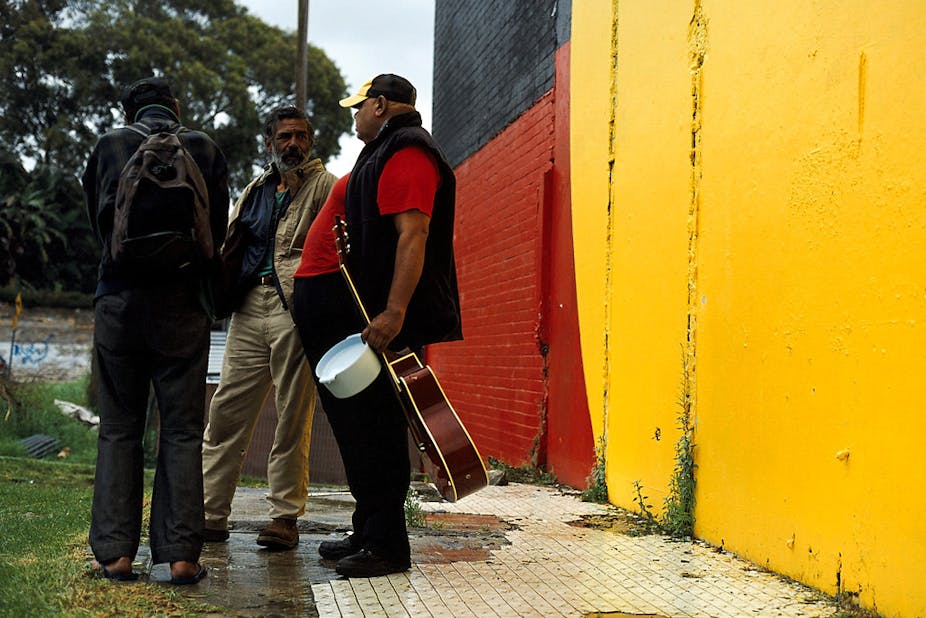
While we do things to people, not with them, Indigenous policy won’t move forward. sidkid/Flickr

AFTER THE INTERVENTION: Chris Sarra from the Queensland University of Technology says white Australia must address its relationship with Indigenous people to truly close the gap.

There has never seriously been a high expectations relationship in which the humanity of Indigenous Australians is acknowledged. From the very outset colonisers assumed we were ‘non existent’ or at the very best, savages. We were considered amongst flora and fauna and our ancestors were driven off our land and many meandered toward a pitiable existence on the fringes of provincial centres. At this time the best response offered was to assume the full bloods would die out and to round up those not of full blood, separating them from their parents, and explicitly teach them how to be less Aboriginal so they could survive in a modern society as assimilated Australians.

Even beyond this time the humanity of Aboriginal people has never seriously been acknowledged. This is why many billions of dollars have been wasted trying to make a difference with such futile efforts. Why is this so fundamentally important?

When we acknowledge the humanity of Aboriginal people we acknowledge the challenges and complexity we face together, and further, we acknowledge a sense of human capacity to rise above such challenges, as well as a sense of worthiness to be afforded an opportunity to rise. The extent to which we have been able to do this remains seriously questionable.

When policy was devised to round Aboriginal people up, place them on missions, make them work, but siphon off their wages into government coffers, this signalled a lack of belief in the capacity of Aboriginal people to spend their own hard earned money in their own interests. Despite being considered capable enough to work, we were not considered capable enough to spend the money we earned. In a sense such policy was fundamental to engineering the impoverishment of Aboriginal Australians, and today’s generations of Aboriginal people are still confronted by its legacy of dysfunction and chaos. What is unfair is that Aboriginal people are readily blamed by those who lead an ignorant existence with no true insight into the realities of Australia’s black history.

Up until the mid 1960’s in remote parts of Australia, Aboriginal stockmen were actively engaged in the economies of remote Australia. They once could be accurately described as proud men, and the backbone of the pastoral industry. This is until the equal wages decision was brought down decreeing that Aboriginal stockman should be paid the same as their white Australian colleagues. The result was many of those proud Aboriginal stockmen, were put out of work and disengaged from that economy that once enabled them to be so proud. Something about white Australia at the time considered Aboriginal people unworthy of receiving equal wages. Again this lack of belief in the worthiness of Aboriginal people played a significant part in engineering the impoverishment that still bears its legacy today.

In subsequent times there has been the rhetoric of self-determination, with Aboriginal people supposedly able to make decisions, but the reality that usually such decisions are only engaged if they are approved by the white people who sit above us. This is a reality even in the loftiest of heights for Aboriginal Australians.

More recently the NT Intervention continued the pattern of signalling a lack of belief in the sense of capacity and worth of Aboriginal Australians, thus failing to acknowledge our humanity. Aboriginal people in communities were considered so worthless that the army had to be sent in from the outside to fix them. This is doing things to people, not with them. This approach signals no belief in Aboriginal humanity.

Australia must be prepared to have a high expectations relationship with Aboriginal Australia, in which our humanity is honoured, and in so doing s our worth and capacity are fully acknowledged. Unfortunately the mainstream blogosphere signals that still too many Australians seemingly lack the capacity to embrace Aboriginal people in a more honourable way. This is the gap that truly needs closing.

I’m certain we share a desire to make a difference in Aboriginal communities. It can only be achieved in a high expectations relationship in which we support and develop each others’ capacity to lift ourselves, while at the same time have the courage to challenge and intervene as we need to.

With a high expectations relationship we truly can transcend today’s complexity.

Join the conversation

Comments (8)

  1. Permalink
    James Doogue

    James Doogue

    (logged in via email @doogue.net)

    While your sentiments are honourable Ken, your solution isn't original and has been tried in varying ways many times with little success. Obviously a collaborative approach would be best, but for varying reasons this has not succeeded in the past. Intervention was a last option measure, and hopefully a temporary one.

    Chris Sarra makes some appropriate points but to produce truly academic work he needs to be more objective and not write from an 'us and them' perspective. Yes non-indigenous need to…

    show full comment

    1. Permalink
      Jason Brailey

      Jason Brailey

      Admin Officer - Research (logged in via email @monash.edu)

      First of all, Chris, I am a big fan and have been following your work for a while now. It is exciting to have an Aboriginal leader who sees things with fresh eyes, who is always constructive and who more importantly says in like it is.

      Now... James.

      While your sentiments are honourable James... you have not engaged with a single point made by Chris and you brush Ken aside with nothing, please offer specifics rather than 'oh we tried that already' reinforcing the truly racist idea that Aboriginal…

      show full comment

      1. Permalink
        James Doogue

        James Doogue

        (logged in via email @doogue.net)

        Regardless of colour, or ancestry, many of us are born into poverty, disadvantage, oppression and dysfunctional families, while others are born into wealth and privilege. I belong to the former not the latter.

        There is no doubt that statistics show that those who form the cohort born into poverty regardless of colour, are more likely to continue to live in poverty and are more likely to suffer poor mental and physical well-being and a shorter life span than the rest of the population. It is not…

        show full comment

        1. Permalink
          Jason Brailey

          Jason Brailey

          Admin Officer - Research (logged in via email @monash.edu)

          Hi James,

          There will always be an Aboriginal and a non-Aboriginal Australia, as there will always be a white and non-white Australia - the issue as Chris Sarra points out is how this is percieved and understood. White Australia MUST learn to respect others and quit using themselves as the yard stick by which 'Australianness' is measured.

          I have absolutely no interest in trying to prove that we are victims pure and simple. I grew up in housing commission area in rural NSW and have seen exactly…

          show full comment

          1. Permalink
            Jason Brailey

            Jason Brailey

            Admin Officer - Research (logged in via email @monash.edu)

            Hi again James. I am enjoying the back and forth. I think that we are getting to the very heart of the matter here. There need not be any reason to be concerned if there are a million Australians - sameness does not help anyone and would make our world a pretty boring place. The main thing I got out of Chris' article was the need for white Australia to respect Aboriginal people and culture enough that people actually expect something more than the worst from us - and I would venture to say that in…

            show full comment

            1. Permalink
              James Doogue

              James Doogue

              (logged in via email @doogue.net)

              I guess I have to accept what you say is true Jason as I can't put myself in your shoes no matter how I may try. So you say the answer is that 'white Australia' respects Aboriginal people and culture. How do we make that happen? You can't mandate respect - not even in the strict military. Also how do we fix the problem of waste and unsuccessful programmes? I'm not really expecting an answer because many people before us have tried and failed - I just wish I knew what it was.

              The Iraqi situation…

              show full comment

          2. Permalink
            James Doogue

            James Doogue

            (logged in via email @doogue.net)

            Hi Jason, I appreciate your response. Unfortunately, I feel sad when I read statements like "There will always be an Aboriginal and a non-Aboriginal Australia, as there will always be a white and non-white Australia". I do not think it is helpful and to me it feels it is a form or reverse racism. I read the two references you provided. The first, about Iraqi interpreters has nothing to do with the topic really unless you are highlighting that those of the same race can always find reasons for prejudice…

            show full comment

  2. Permalink
    Ken Sekiya

    Ken Sekiya

    (logged in via Twitter)

    There's a quote (which I cant find) along the lines of...

    If you want someone to become a Professional, treat them like what you expect of a Professional.
    This is the same philosophy you put on your Students - and the same that can be placed on any other person.

    I feel as if the NT Intervention, and much of the Building projects now, have been leaning more towards giving employment opportunities to everyone other than the Indigenous Community (though some were made for Indigenous Australians) - and pretend to be doing something about the problem.

    If we truly want Indigenous communities to feel pride in their communities - we need them to build their Communities with their own two hands.

    What the Government should be doing, is flying-in Material resources and Mentors/Trainers/Expect advice - to help guide and teach the necessary skills to build their community.
    Not flying-in Builders to build buildings for them.