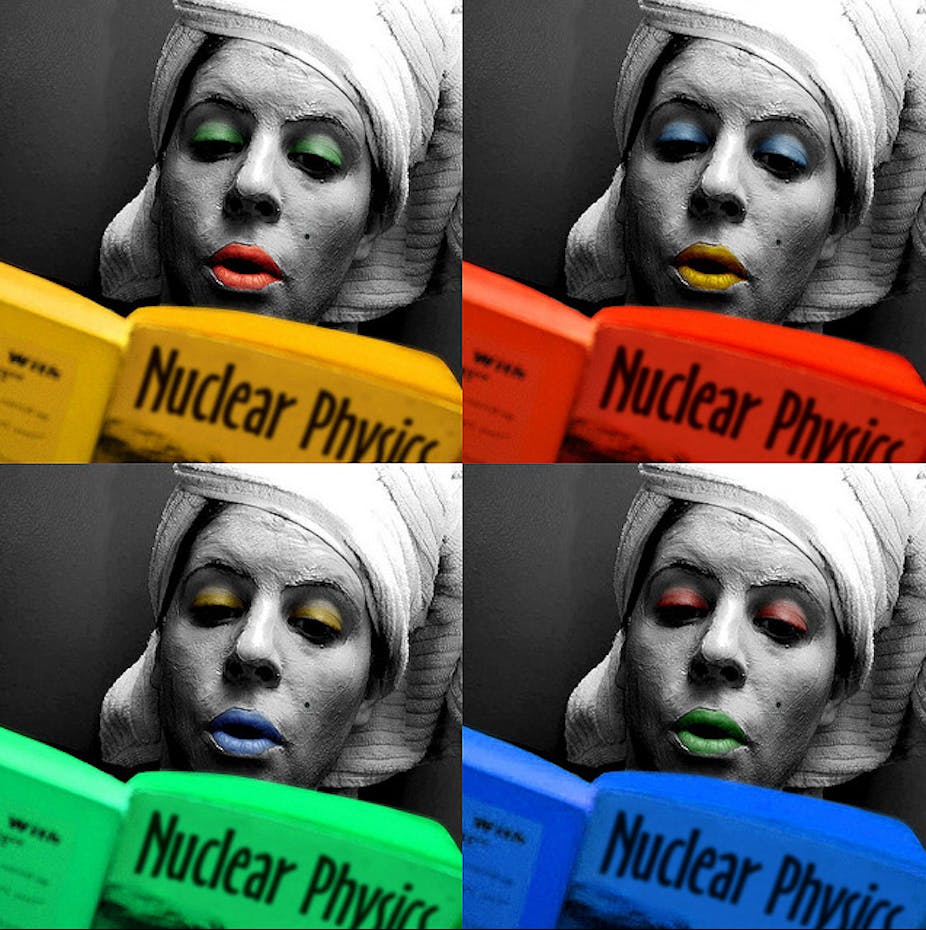
THE STATE OF SCIENCE: Should scientists communicate with the general public? Dr Danny Kingsley makes a case for speaking out.
Scientific articles don’t often feature on beside tables or as bathroom reading. Not because they aren’t important – they are – but most are, frankly, indecipherable.
I teach the plain English writing component of a workshop for PhD students. Before we begin each workshop, at least one participant usually says they don’t see why they need to communicate with the general public. Some of them say they “only want to communicate to other scientists”.
Well, get real.
My stock response to this is that researchers have an obligation to share the findings of their research with people other than their immediate circle.
Senator Kim Carr, Australia’s Minister for Innovation, Industry, Science and Research, said in 2008 that researchers had a “duty” to take on a public role due to the nature of their work and the source of their funding.
Research in Australia is almost exclusively funded by the taxpayer. Think about that for a moment. Many researchers don’t feel it is necessary to communicate with the people who pay for them to be able to do their research.
And research is an expensive business. In 2007, funding for research, research support and research training was around $2.6 billion.
The taxpayer has a right to know how that money is being spent, without feeling they need to complete their own PhD to understand the language.
Get talking, or get walking
Of course, scientists do actually communicate their research all the time. The “currency” in the scientific world is the journal article and conference paper. Scientists can’t escape this. The published output of a researcher directly affects his or her career.
Such papers were not always impenetrable to all but a chosen few. It’s hard to believe now that at the turn of last century scientific articles had the same readability as the New York Times.
And yet over the decades, scientific literature has become more and more inaccessible – partly because of the increasing specialisation of science and the accompanying need for jargon words.

There are examples of journals attempting to address this issue. Science (to name just one) offers a one-line summary of articles in the contents page.
Both Science and Nature include articles that discuss research papers published in their journals. The British Medical Journal (BMJ) includes boxes in its articles titled “What is already known on this topic” and “What this study adds”.
There is a secondary problem. The inaccessibility of language used in scientific papers is coupled with the inaccessibility of the papers themselves.
If you try to click on this link to an article about communicating science and you don’t have a subscription to Nature, you will be asked to pay US$32 to read it. This is not to say Nature is evil – the journal has held debates on open access, and allows authors to post copies of their work in open access repositories such at the ANU Research repository – but this is nevertheless a neat illustration of the problem.
Half way there
There’s an argument that publishing scientific papers is only half the job, not least because on average less than one person reads any given scientific paper.
Communicating more broadly doesn’t just benefit society. There are arguments that the very act of having to explain work in terms that are comprehensible to a non-specialist improves research.
And things, it seems, are starting to change. Very recent developments include the requirement by some journals, such as RNA Biology, to prepare a wiki article, readable by an undergraduate student, to be submitted with a paper for concurrent peer review.
Do or die
My explanation to those students who are uninterested in communicating is that they shouldn’t expect to have much success in their careers.
Given the high specialisation of science, the chances that the promotion committee or grant application reviewers – or indeed any people making crucial decisions about careers or funding – will be in exactly the same speciality are extremely slim.
Decision makers are far more likely to look favourably on a description of work that is understandable than one they have to slog through.
To a highly-specialised researcher almost everyone could be classed as the “general public” – a terrifying thought to some, for sure, but a sobering one, I hope, for many others.
This is the fourth part of The State of Science. To read the other instalments, follow the links below:
-
Part One: Does Australia care about science?
- Part Two: What’s a scientist – a poker or a puffin?
- Part Three: Science can seem like madness, but there’s always method
- Part Five: Science is imperfect – you can be certain of that
- Part Six: Why do people reject science? Here’s why …
- Part Seven: When things don’t add up: statistics, maths and scientific fraud
- Part Eight: Get real: taking science to the next generation of Einsteins
- Part Nine: Critically important: the need for self-criticism in science
- Part Ten: Please, sirs, can we have some more? Aussie scientists need fuel, not gruel
- Part Eleven: Scientists and politicians – the same but different?
- Part Twelve: Tweed or speed … a day in the life of a modern scientist
- Part Thirteen: Selling science: the lure of the dark side
- Part Fourteen: Way off balance: science and the mainstream media
Join the conversation
Comments (18)
David Thompson
(Research Officer In Men's Health at University of Western Sydney)
If a scientist makes a discovery and nobody knows about it, did it ever happen?
The PropheticKleenex
(logged in via Twitter)
If the knights of malta (st. john) don't approve- no it didn't
Other Side Science
(logged in via Twitter)
While I agree that communicating science to the public is good idea and much needed, I dont think changing the writing style of journal papers is the way to do it. Papers are written by scientists for other scientists to read. They're written in a way to explicitly describe an experiment that can be replicated and validated and to make conclusions that are unequivocally clear. Forcing scientists to change their writing style to accommodate a broader audience would probably compromise this.
And not…
show full comment
Grendels
(logged in via Twitter)
I agree with your view about the need for more science communicators and better science communicators, but I disagree with what you say about the written style of many papers.
I am not a scientist and yet in my work I review a lot of papers from several fields and thus have experience in interpreting the findings and making use of these. In recent years I have noticed a curious thing - some are far better written than others, easier to understand and using plain english in place of jargon. This…
show full comment
stephen prowse
(logged in via Twitter)
Scientists have a responsibility to communicate their science to the public, either directly or through science communicators. Science is funded by the public (mostly) and hence the community has a reasonable expectation of more than academic papers. However science communication is not easy and is not resourced very well. Nor is it rewarded although it is rewarding.
Scientists are often not good communicators (myself included) but that is not a good excuse as there are many communication avenues. Lobby your organisation for support.
So get off the high horse and get to it; and don't forget to talk about the scientific process as well. A lack of understanding about the process of discovery has been problematic in debates from GMOs to climate change.
Andrew Glikson
(Earth and paleo-climate scientist at Australian National University)
The article and some of the thread comments are based on false assumptions:
1. As if scientists are not trying to write article for the media.
2. As if their articles are too technical and complex
3. As if writing for peer review scientific journals and for the media/internet is the same thing.
The answers the above:
1. Not true - many scientists have and continue to try - more often than not being blocked for reasons other than the quality of their contributions.
2. This varies with each…
show full comment
Natanya Civjan
scientific publishing consultant (logged in via email @gmail.com)
Although I agree with the overall premise of the article – scientists should be able to communicate their research to all audiences –I find myself criticizing some of the statements.
Kingsley asserts that “scientific articles” are not found on bedside tables. I agree with another comment that plenty of popular science magazines are widely read by the public – and this is what these magazines were founded on, the public interest in science. The continued success of these magazines shows the continued…
show full comment
Andrew Glikson
(Earth and paleo-climate scientist at Australian National University)
There appears to be no lack of science-related pieces in the popular media.
However, many of these pieces are written by science journalists who, in trying to popularize the subject, rather than edit/streamline a scientist's original article in collaboration with the author change the meaning (sometimes not showing proofs of the edited version to the scientist/author).
Which results in major errors.
When it comes to climate science articles:
1. Climate scientists have attempted to communicate…
show full comment
John Lamp
(Senior Lecturer, School of Information Systems at Deakin University)
I think that the issue of what the media does with scientific (or any other) material is beside the point. That is essentially out of the control of academics. The central issue is how well do academics write up their results and to what degree do they as individuals and as a community have a responsibility to do something about it.
You can't hide behind statements like "that's the way scientific papers have to be written." There's over a century of human progress since journals were first established, and you could argue that academia, especially editorial boards, have tried to hide from that fact.
Since then we have a vast expansion of literacy, a major expansion of library facilities, and that's before looking at any of the technological changes. Once those are added in to the context, the argument for change and improvement is overwhelming.
Rajan Venkataraman
Public Servant (logged in via email @hotmail.com)
Of course scientists should be able to communicate with the general public and not only for the purpose of grant applications. If they cannot communicate their research and results, the oportunity for others to benefit from it or build upon it will be lost. The scientists too will lose the opportunity to learn from insights and approaches from a wide range of fields. In relation to the first paragraph of the article, magazines like Scientific American and Popular Mechanics used to be found on people's bedside tables. I think there is much more of an appetite for well-written, well-presented science than you realise. Science is interesting after all!
Chris Harries
(logged in via Facebook)
Some science people are great public communicators. Most are not. Most are far too absorbed in their field of science to be able to see how the unwashed public is able to see the issue. It's a brain function issue.
The profession also has to be cautious by nature, and this renders the language of scientists, in the eyes of the public, as lacking certainty. This problem came to the fore in the climate debate whereby climate sceptics professed absolute certainty whilst the more formal scientific…
show full comment
David
(logged in via Twitter)
Fitting that this article should be published on the anniversary of the birth of one of the great popularisers of science Carl Sagan!
I've been in the communications field all of my working life, but fortunately have retained my childhood fascination, sense of wonder and love of the sciences with their discoveries and theories and attempts to explain this universe in which we live.
Sadly of all the things science does brilliantly, popular communication is not one of them.
If there is one overriding…
show full comment
David Thompson
(Research Officer In Men's Health at University of Western Sydney)
Now this is science in action. This is a timely example of science that can play a part in sustainable solutions. And its inspiration from the beetle is a great story.
http://www.smh.com.au/technology/sci-tech/water-from-thin-air-aussie-eds-airdrop-an-international-hit-20111110-1n8ks.html
Robert Johnson
(PhD Candidate at University of Tasmania)
It's a great thing for scientists to speak about their work to everybody, other scientists, the public, children, politicians, the works. It should be encouraged and applauded.
Unfortunately current trends in hounding, threatening, misquoting and harassing any scientist brave enough to raise their head above the cubical wall is not the most encouraging state of affairs.
Tax payers dollars or not i don't want death threats or to be called a NAZI just for telling people what i found/work on....
http://www.smh.com.au/nsw/upper-house-whip-under-fire-for-nazi-slur-on-scientists-20110601-1fgq0.html
http://theconversation.edu.au/climate-sceptics-steal-the-big-tobacco-playbook-create-doubt-cause-delay-1854
http://theconversation.edu.au/does-australia-care-about-science-4011
Dessislava Mladenova
(logged in via Twitter)
I agree with the article. As a scientist, I feel the responsibility to communicate with the general public about my research, goals, discoveries and the importance of what we do.
Furthermore, I have always believed that some of the best ideas in science may come from someone who does not have a scientific background. Science is something that should be a global and collaborative effort and should not exclude non-scientists. I am a regular blogger for the Garvan institute of Medical Research in Sydney, My blog " This week in the lab" connects the general public with what is happening inside the Garvan lab.
Marina Hurley
(logged in via Twitter)
I think that there are a number of unstated issues so far. Firstly there is no ready currency for a scientist to produce an article for the general public as with the RNA biology example. What avenues do scientists have to send off a general article for publication? Do they know where to send such articles? ie science magazines? Scientists need the same kudos as publishing for the general public as they do for their peers. Otherwise peer-review papers will always get the first priority and effort…
show full comment
terry lockwood
maths teacher (logged in via email @mcmyrtleford.catholic.edu.au)
In the 60s and 70s,I grew up reading articles about football with Lou Richards' by-line that said "as told to Tom Prior". As a kid, I accepted that perhaps this footy legend had ideas that were best coaxed into a coherent form by a professional writer. A journalist. Ya can't be good at everything. There is no shame in having someone carefully edit your work to tailor it for a general audience. In fact, I would like that job. Is it a job? As journos get the axe from newspapers left, right and centre, surely a few get get taken up by the world of science for this purpose.
They may pay for themselves in the long run.
Better that than having to find work as a media advisor for politicians.
David Thompson
(Research Officer In Men's Health at University of Western Sydney)
Yes Terry, you are right and there are good jobs to be had in communicating science. Mostly, scientists themselves are snowed under and need to outsource the communications legwork.
Whether it's through an outside agency or in-house communicators, the best results come from a scientist explaining what makes their work so compelling and then enabling communicators to find creative ways to explain it either through text or visuals.