


Food security and energy security are paramount to the survival and growth of Australia. Food security so that we may feed ourselves (and a hungry world), and energy security for transport, heating, lighting and various other activities that we enjoy at present.
What happens when there is a perceived conflict between these two vital forms of security? Should one give way to the other, can they happily co-exist, or is it the role of the law to create a framework where the interests of both are protected?
It is these difficult questions that the governments of NSW and Queensland are facing at present.
The development of coal seam gas resources in NSW and Queensland is providing Australia with energy security, as well as generating a huge export industry in the form of LNG.
However, many of the coal seam gas deposits occur in areas of high agricultural fertility. This includes the fertile Darling Downs area in Queensland, and the Liverpool Plains in NSW, which comprises only 6% of Australia’s total agricultural area but produces over 22% of its food. This is Australia’s breadbasket.
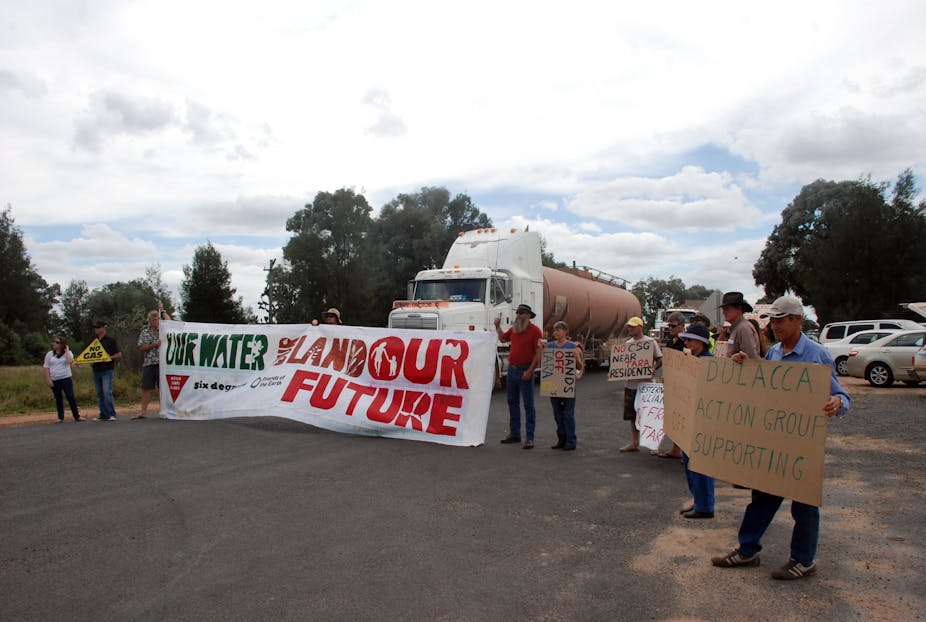
This creates conflict in land use; farmers are understandably reluctant to allow their land to be used for coal seam gas extraction. However, as the law stands at present, even if a farmer owns the land, the State government has the right to grant a licence to an energy company to extract the coal seam gas from under the ground, by drilling wells to extract the gas.
At the heart of this conflict are the methods used to extract coal seam gas. As explained by Dennis Cooke at the Conversation, a major community concern about coal seam gas extraction is the process of fracking.
Under this process, vast amounts of high-pressure water, chemicals and sand are pumped at high pressure down a well to fracture the coal and releases the coal gas. The water is then returned to the surface, along with the naturally occurring salty water from the coal gas seams, and the gas is collected in a pipe and sent off for processing and use.
There are several major concerns with fracking:
the high use of water in agricultural areas
the chemicals and sand used in the water
the amount of water returned to the surface (produced water)
damage to underground water structures (known as aquifers) as a result of the fracking process
the number of wells required to successfully extract the coal seam gas in an agricultural area
the number of trucks and service vehicles that will enter a farmer’s land in order to undertake the fracking process.
Water use in Australia has always been an issue, particularly in agricultural areas. The major concern for farmers, and quite rightly so, is governments’ inconsistent attitude to water conservation and management. If the Federal Government is attempting to restrict water use in the Murray Darling Basin, then why are energy companies able to extract vast amounts of water (which the farmers see as important for agriculture) to undertake commercial enterprises that only profit the companies?
Related to the use of water is the real danger of damage to ground water resources. Unlike in Western Australia, NSW and Queensland are part of the huge underground water resource known as the Great Artesian Basin. The concern is that if the chemicals used in fracking enter the groundwater, there is a likelihood that ground water could be contaminated.
The major cause of contamination of aquifers has been linked to poor fracking well construction and design. This can lead to a well leaking fracking fluids into the surrounding aquifers. Many farmers are concerned that the ground water movement in some areas is little understood, and have called for hydrological studies to map ground water so that potential effects of fracking compounds in the water can be monitored.
In NSW and Queensland contamination is highly likely, since the aquifers are very close to the area being fracked. It is necessary for the government regulating gas extraction to ensure that the well design and construction has multiple barriers to reduce the likelihood of such a contamination.
Contamination can also come from the produced water that is returned to the surface. A major challenge for governments is how this “produced” water, which contains fracking chemicals and compounds, is going to be treated and disposed of. It must be done in a manner that ensures it does not escape to enter surrounding water sources, such as streams, rivers and bores, thus contaminating water sources used for agriculture.
Finally, land access and conflict of land use is of major concern for farmers. This issue has been recognised by the Queensland government, who has declared a 2km exclusion zone on mining activities near towns with over 1000 people. Many farmers are calling for a similar embargo over prime agricultural areas.
Queensland has responded to these concerns by establishing a draft strategic cropping land framework. This is set to lead to new legislation that will protect strategic cropping areas in that state.
Clearly there is a conflict in the use of the same area of land for agricultural purposes and the extraction of coal seam gas. Farmers’ concerns about water use and aquifer contamination are real. Governments are attempting to manage these important land management and technical issues.
However the enormity of the scale of CSG operations (with over 40,000 wells likely to be drilled in Queensland in the next five years) means that governments face many challenges in managing CSG activities in agricultural areas. It is hoped that these two important areas of security can be reconciled.