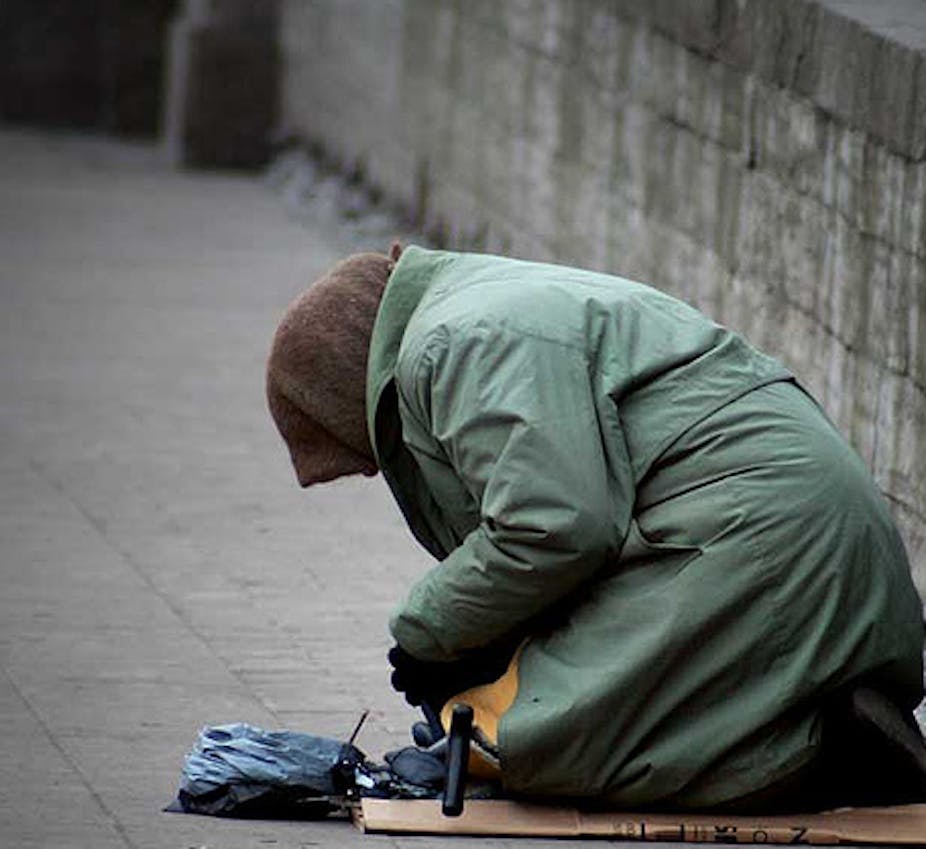
The criminal offence of begging should be abolished.
Criminalising begging is tantamount to criminalising poverty. It perpetuates, rather than alleviates, the marginalisation and disadvantage experienced by people who beg. It also violates the fundamental human rights of some of the most vulnerable in our society.
What is poverty?
The Office of the United Nations High Commissioner for Human Rights has adopted a “capability approach” to define poverty which essentially considers the wellbeing of an individual and their ability to “do or be” certain things.
In addition to the concept of “inadequate command over economic resources”, this approach also involves the identification of “certain basic capabilities” that would be common to all.
These include being “adequately nourished, being adequately clothed and sheltered, preventable morbidity, taking part in the life of a community, and being able to appear in public with dignity.”
An understanding of poverty must address health, shelter, public participation, human dignity and income. The criminalisation of begging fails all of these tests.
What is the law?
Begging is a criminal offence in Victoria pursuant to s 49A of the Summary Offences Act and is also prohibited by various local laws made by local councils under the Local Government Act.
Section 49A states that a “person must not beg or gather alms” or “cause, procure or encourage a child to beg or gather alms” with a penalty of up to 12 months imprisonment.
Similar provisions exist in Queensland, South Australia, Tasmania and the Northern Territory.
The PILCH Homeless Persons’ Legal Clinic undertook a survey of people begging in the Melbourne CBD. The survey revealed the reality of the lives of those who beg. It found that 73% were long-term unemployed, more than 50% had a mental illness, 23% had experienced domestic or family violence; and almost 90% were sleeping rough or in squats, or lived in a men’s refuge or rooming house.
Worrying statistics
Victoria Police statistics show that in 2008/09, 242 people were processed by the police for the alleged offence of begging. 24 of these people were arrested, one was cautioned and 212 were issued with summons.
This was an increase from 2007/2008 in which 188 people were processed, with 27 arrested and 153 issued summons. More recent data about outcomes is not yet available, but the total number of persons processed in 2009/10 increased to 298, and then on initial figures, this has reduced to 206 in 2010/11.
Wrong approach
The use of imprisonment, fines and community-based orders as a response to begging fails to deal with the underlying causes of this behaviour. These punishments, contained in the Summary Offences Act, ignore the reality that people who beg are among the most marginalised and isolated in society.
The current approach disproportionately affects those who circumstance have already denied basic necessities such as food, shelter and health care, and then adds to their disadvantage by denying them even the basic right to communicate and seek to deal with their plight.
Begging is usually a last resort activity, engaged in to supplement income and meet subsistence needs. Fining people for such activity exacerbates the causes that underlie it and may encourage people to engage in other illegal income – supplementing activities such as shoplifting, drug dealing and prostitution.
Incarcerating people for such activity also fails to deal with underlying causes and may further jeopardise often tenuous relationships between the individual, his or her family and friends, and society generally.
What we should be doing
A more effective response to begging is to deal with its causes: alleviate the disadvantage of those who beg, and particularly their need for food, shelter and health care.
A more effective response would deal with the underlying causes of begging in a way that respects human rights. We need to increase the availability of quality, secure, crisis, transitional, supported and low cost accommodation and providing income supplements to people who are homeless.
This includes those who are at risk of homelessness who have had social security payments reduced or who are cut off for reasons associated with homelessness.
We should also be increasing the availability and outreach capabilities of quality drug, alcohol and gambling addiction support services.
Law enforcement officers need to be better trained so they understand the issues underlying homelessness and begging and need to be encouraged, where appropriate, to make referrals to welfare agencies and service providers.
We should also consider a centralised referral centre to facilitate the provision of services to people who are homeless or at risk of homelessness.
In modern Australia, we shouldn’t be punishing people who live in poverty; they should be supported, given opportunities and empowered. If a society is judged by how it treats its vulnerable, then the criminalisation of poverty is begging for change.
Join the conversation
Comments (12)
James Jenkin
EFL Teacher Trainer (logged in via email @gmail.com)
Farrell suggests people only beg to meet subsistence needs.
However, skeptrics would argue any disadvantaged person can receive government assistance.
Could Farrell explain why government assistance is not effective?
That would be a huge boost to his argument.
James Farrell
(Lecturer in Law at Deakin University)
Thanks for your comments James.
People who beg suggest two key problems with this argument, which is (in part) supported by the literature:
(1) social security payments (particularly NewStart) are insufficient to meet basic subsistence needs, particularly where people have higher costs (medical treatment, substance misuse disorders, etc); and
(2) the increasing conditionality of social security payments (esp 'activity' requirements) makes it difficult for this particularly vulnerable group to gain and maintain access to payments.
Any future work in this area will more explicitly explore this idea - thanks for your constructive feedback!
Judith Olney
Ms (logged in via email @bigpond.com)
Anyone who is unemployed, or on a pension, is at risk of becoming homeless. When average rents, (in my town), for 1 bedroom flats, is upwards of $180 per week, is it any wonder that people become homeless. Unemployment benefit is about $234 per week, once the rent is paid, there is not much left for food, transport, utilities, etc. For mature age students it is even more difficult, because for some reason the government does not allow mature age students, on Austudy, to receive rent assistance. Mature age students receive less than the dole, (Newstart), not much of an incentive to retrain or gain skills needed for employment.
When you add illness or disability into the mix, the outcomes are even worse. Its time we stopped punishing people for being ill, disabled or unemployed. Our current social security system is designed to strip people of their dignity, and it does this very effectively. Compassion is a rare virtue in today's Australia.
James Walker
(logged in via Facebook)
housing, food and clothing are expensive - here. There are many 3rd world countries where our social security benefits would allow you to live like a king!
Further, the vast majority of us can read and write.
So the logical move is to arrange for busman's holidays to English speaking 3rd world countries (yes, there are quite a few), allowing pensioners to spend some time overseas, teaching locals to read and write, and enjoying a much higher standard of living while doing so.
Granted, we'd need to be ready to pull them out at a moment's notice to avoid local troubles/treat diseases, but it would still benefit everybody.
Joseph Bernard
Director (logged in via email @parasoft.com.au)
Please excuse this comment "paying more money is unlikely to fix the problem."
Cheap housing, the homeless and/or better education system(s) are something that are improved through good will and design. Supporting a system that continues to fail without making changes will most likely mean more of the same.
what we lack is vision for a better future.
James Jenkin
EFL Teacher Trainer (logged in via email @gmail.com)
Thank you very much for the response James! I know this is an old and idealistic argument, but should we therefore focus on levels of social security payments and conditionality - and our goal should be there's no longer a need to beg?
Joseph Bernard
Director (logged in via email @parasoft.com.au)
Good article,
As the statistics show the issue these people are victims rather than criminals.. And I suspect that they are the more extreme cases of what people are experiencing at many levels. ie Mental Health, Domestic Violence and Education system. nothing new.
The Challenge for our soceities is to develop better systems to heal and educate people rather than punish.. And if we are really on the ball, then we may actually discover ways of preventing this in the first place.. eg Improving the Education model.. please look for 'RSA Animate - Changing Education Paradigms' on youtube for a very good presentation on the subject
Sean Alexander
Jack of all (logged in via email @adelaide.edu.au)
Sad indeed. The true plight of the majority is undermined in some part by those that are just want more money to buy booze, drugs, gamble etc. Without knowing the numbers, I'm guessing that this is a small proportion of the people, but the stereotype is there and it only takes a few "gets money for bus ticket and then gets on bus with a multi-trip/Myki/Metcard ticket" type people to undermine what little confidence is there. Combine that with (IMO) a naturally-suspicious society who'd prefer to donate to a recognised charity with the hope that they'd use the money better, it's little wonder that beggars have little luck.
James Walker
(logged in via Facebook)
Having had a group of thugs loom over me, asking "can you spare some money?" I have seen first hand why begging needs to be a criminal offence: it's essential for dealing with - well, muggers, basically!
Next time a beggar asks for money for 'a cup of coffee'/'big mac'/'bus fare'/'phone call' try offering to *provide* that service: buying them the coffee/food or paying direct to the driver/into the phone.
Odds on, you'll get sworn at. They'll almost certainly decline. I have heard of *one* case of a beggar taking up the offer to have a big mac bought for him - from a friend who has been making this offer to beggars for well over a decade.
Emma Anderson
Independant Researcher and Artist (logged in via email @gmail.com)
It may be useful to consider several possibilities of why a big mac would be rejected
1) It offers almost zero nutritional value. Other food at a similar price is more nutritious
2) The person may have phobias or other concerns associated with going to a fast food restaurant. They may have even been banned from entering one - discrimination. Or perhaps they used to work there, were underpaid, unable to afford their rent, got evicted, and that's why they're on the street in the first place…
show full comment
Jeff Haddrick
field manager (logged in via email @bigpond.com)
I very much agree with the article.
So called social security payments would more aptly be named bureaucratic conformity payments, and as with so many parliamentary responses to real life adverse situations, penalties are imposed rather than facing up to the causes of societal problems. There can only be social security in a truly social society.
Robert Gavin
(logged in via Facebook)
Interesting article. For a start, I never even thought that begging was illegal - that makes little sense, indeed, as the author says, criminalising poverty.
But I was disappointed to not find out what, exactly, begging is (as defined by law). Like James, I have been "annoyed" by young people in the street asking for money for various reasons, none of which look particularly geniune - is that legally defined as begging? What about a person on the side of a road with a sign asking for a job - is that seeking alms?