


The Scottish eat their deer and the South Africans their springbok. Australia’s national icon is gentle on the environment, doesn’t emit methane, is good to eat and could be a great source of income for farmers.
Farmers generally don’t have any background or experience in kangaroo management, and the idea that ‘roos are simply pests to be removed runs deep in the culture. There is an opportunity for farmers to develop kangaroos as a complementary revenue source but this would require a fresh look at how we manage the animal and its ecosystem.
In Australia, we are blessed to have enormously abundant populations of several of our kangaroo species. Not only are they are vital elements in our rangelands and woodlands, they are a valuable resource that can be sustainably harvested. The harvest is well-managed and poses no threat to kangaroo populations, taking only a small number of common species in defined areas of some states.
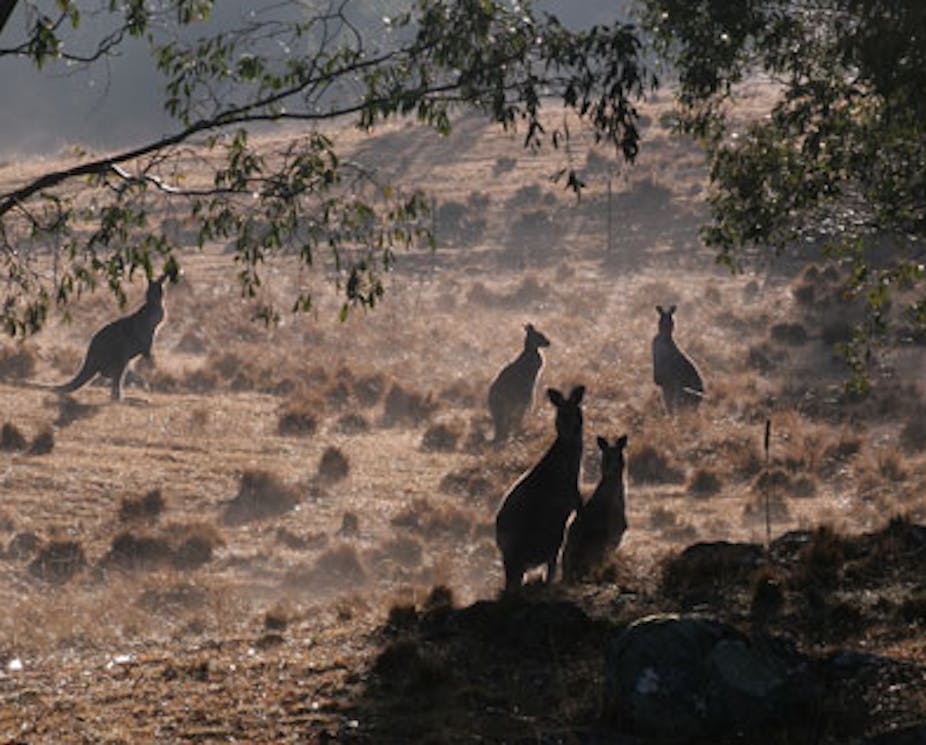
We now have upwards of 40 years of government data on the numbers of harvested kangaroos, and they show a very clear story. Kangaroo populations are robust and abundant. In 2010, for instance, there were an estimated 25 million– among the largest populations in the world of large vertebrates.
The commercial harvest has little apparent influence on trends in their numbers (which fluctuate largely in response to variation in rainfall). This is not surprising, as the level of harvest is set at a percentage (usually about 15%) of the population estimate of the most recent survey, ensuring that when numbers decline (in drought, for instance), so does the level of harvest.
There are many reasons to choose kangaroo as a red meat. Compared to sheep and cattle, kangaroos’ impact on the environment is minimal. Though it takes about one and half kangaroos to provide as much usable meat for human consumption as a sheep (around 12kg from a kangaroo, and around 18kg from a sheep), kangaroos need less feed and water.
Indeed, recent estimates suggest that it takes almost three kangaroos to eat as much as a sheep. Kangaroos’ soft feet mean that “growing” a couple of kilos of kangaroo meat in Australia’s fragile rangelands has much less impact on native vegetation than a couple of kilos of sheep or cattle.
Cows and sheep burp methane, a greenhouse gas at least 25 times more potent than carbon dioxide. These emissions from stock make up a significant proportion of Australia’s annual emissions (10-25%, depending on method). Kangaroo digestion uses a totally different chemical pathway from sheep and cattle, and produces virtually no methane.
Animal welfare issues are also important. While the traditional meat industries are making welcome moves to address many problematic animal welfare issues – from mulesing of sheep to long periods of trucking stock to the slaughterhouse; from feedlotting to the use of hormones as growth promoters – kangaroos come with none of these issues.
Kangaroos live free and wild on a natural diet of native vegetation, and in the vast majority of cases are killed instantly. The environmental and ethical benefits of choosing kangaroo meat (and leather) over sheep and cow are clear.
However, for years conservation researchers have called for ways to change management so that it can contribute even more to conservation. Currently, farmers who manage the land on which stock and kangaroos live derive no benefits from the kangaroos on their land.
Harvesting is done by professional, licensed shooters, who ask the landholders for permission to enter their land. Farmers are generally more than happy to have them do so, seeing them as performing a valuable service.
For most landholders, even those who like kangaroos, kangaroos are a pest – particularly in drought – turning up to eat the feed they would like to see go to their cattle and sheep. Cattle, sheep, goats and kangaroos graze on their land – they sell the cattle, sheep and goats, and give away the kangaroos!
It is clear that “farming” kangaroos is impossible; even if it could be done, most commentators agree it’s a bad idea. It is possible, however, that landholders could actually earn some income from kangaroos harvested on their land.
Kangaroos would be wild-harvested as they are now, but landholders could, for example, work in large-scale collaborative groups with other adjoining landholders and trusted harvesters, sharing the money made from selling kangaroo meat.
There could be advantages to both harvesters and processors from setting up long-term, stable arrangements involving landholders, which could form the basis for developing higher value, specialised kangaroo products. Researchers have been working with farmers to develop management models that work for all parties concerned.
Like cattle and sheep, kangaroos on farmers’ properties could become valuable assets to them, not simply pests. This fundamental shift could pave the way to some potentially important changes.
Landholders could maintain their income levels while reducing the numbers of stock on their properties, thereby reducing impacts from grazing.
Landholders currently often clear patches of remnant native vegetation in part because they harbour pesky kangaroos; if they valued kangaroos, they would hold on to these important wildlife refuges.
If landholders are confident they can control kangaroo populations, they will feel more comfortable introducing progressive, low impact grazing practices such as rotational or cell grazing which can attract the marsupials.
In the long-term, making kangaroos attractive to landholders could be vital for their future in many parts of the country. Because so many farmers see kangaroos as a problem, research effort has been devoted to coming up with an effective means (other than shooting) to reduce their numbers.
As things currently stand, if such a “silver bullet” was developed, landholders will likely be queuing up to use it, and we could see the end of abundant kangaroo populations on grazing land.
There is no need to choose between a thriving kangaroo population and happy, profitable farmers. Good management can mean that Skippy belongs in our native landscapes, in our hearts … and on our plates.
Further reading
THINKK again: getting the facts straight on kangaroo harvesting and conservation
Sharing Skippy: how can landholders be involved in kangaroo production in Australia?