The Conversation
Subscribe
  • Academic rigour, journalistic flair
  • For curious minds
  • Expert news and views
  • Debate and ideas
  • From the curious to the serious

Hot Topics

  1. Gay marriage
  2. Australia in the Asian Century
  3. Convergence review
  4. Federal Budget 2012
  5. War on drugs
  6. Bob Brown
  7. Explainer
  8. Square Kilometre Array
  9. Medical myths
  10. Transparency and medicine

Gangster-nomics: the nasty business of criminalising drugs

Policy making is supposedly influenced by scientific evidence, which in turn leads to better political, social and economic outcomes, depending on the issue at hand. One would like to think that in a moderately progressive Australia, policies are designed to ensure best practice. If an outcome of a…

29z7t56p-1326167508
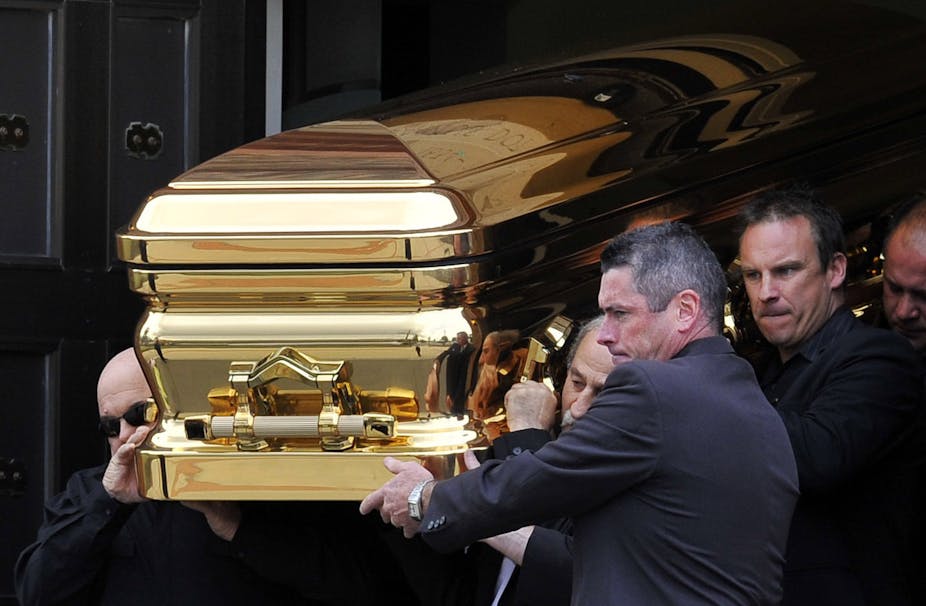
Slain underworld figure Carl Williams, who made a living trafficking illicit drugs, is carried from his 2010 funeral in a gold coffin. AAP

Policy making is supposedly influenced by scientific evidence, which in turn leads to better political, social and economic outcomes, depending on the issue at hand. One would like to think that in a moderately progressive Australia, policies are designed to ensure best practice.

If an outcome of a policy keeps on constantly producing substantial negative results, it stands to reason that policy should be revised according to what the evidence suggests.

There is, however, one policy that has led to a continuing disaster decade after decade: the criminalisation of drugs. This issue has, in large part, underpinned the creation of one of Australia’s most popular television series: Underbelly.

Governments over the world have criminalised the production, allocation and consumption of various substances they deem to be dangerous to public health. We are told that drug prohibition is in our best interest.

Only a casual glance at the statistics shows this policy is a fraud. The Australian government’s own data shows that alcohol was to blame for 1,084 deaths in 2003, and tobacco caused 15,511 deaths. All illicit drugs accounted for 1,705 deaths in the same year. Simply put, alcohol and tobacco, the two most popular legal drugs, kill more Australians every year than all other illicit drugs combined by a factor of nearly 10.

Protection of the public health can’t possibly be the justification for drug criminalisation because it simply moves the problem to the black market, which shows no sign of abating – this is the case everywhere. Australians who want drugs will always get them. Protection of public health is simply the pretext for the real reason: a state-sponsored class war against the public.

The wealthy and professionals are not the intended target of drug criminalisation. They can easily afford highly-priced drugs at a somewhat reasonable quality. If caught, their lawyers can get them off with a slap on the wrist.

Instead, prohibition is designed to control the dangerous rabble: the poor and working class. They lack quality legal representation, are the continual targets of the police, comprise the majority of street-level dealers, and directly suffer from violent disputes between cartels.

It is not difficult to see who benefits from current policy. The state can use the “drug scare” card to advance its agenda of further controlling and interfering in our private lives. Private prisons increase revenue and profit, perversely, as a greater number of people are jailed for mostly victimless drug offenses. Lawyers gain substantially as the judicial system is saturated with drug cases.

The economic and social problems generated by the illegal drug trade are significant: monopolistic pricing, dubious production quality, settling arguments with violence rather than lawyers, street crime, abrogation of individual liberties, foregone tax revenue and the establishment of a bureaucratic and costly law enforcement-lawyer-judicial-prison industrial complex.

Drug cartel profits are known to finance illegal prostitution, terrorism, counterfeiting, money laundering, slavery and assassinations (such as those occurring frequently in northern Mexico).

The problems generated by drugs are not inherent to consumption but rather to their prohibited status. Governments know perfectly well how to solve the drug problem: legalisation.

If drugs are considered exceedingly harmful, as the prohibitionists claim, then it stands to reason that the best way to deal with them is to adopt a tax and regulation approach rather than leaving it to the black market.

Drugs can be produced under quality control and sold on the market as with alcohol and tobacco, with the usual advertising and age restrictions. Substantial sin and externality taxes can be levied to discourage consumption and pay for the costs it produces, including drug treatment and needle exchange programs.

Legalisation will inevitably result in the dismantling of the sectors of the pernicious state bureaucracy and parasitical private sector interests previously involved with the drug black market. This will save taxpayers billions. Sales, sin and externatility taxes will likely yield tens of millions of dollars. Street crime associated with the drug trade will cease to exist.

This is not to say that legalised drugs would cause no problems. Clearly, they would. But they would be nowhere near as dangerous to individuals and society as alcohol and tobacco.

Marijuana consumption has yet to result in a single death and ecstasy produces a handful of deaths per year, cocaine and heroin a few more. Interestingly, junk food consumption and lack of exercise is a major factor contributing to early death, yet no politician would ever dare to consider criminalising junk food and imprisoning people for being fat, or forcing them into health camps.

Many medicines are addictive, for instance, oxycodone and methadone, but the government does not carry out a war against the pharmaceutical corporations – they are taxed and regulated.

Criminalisation of drugs abrogates the fundamental principles of free markets, free trade, consumer sovereignty, individual liberties, small government and limited public expenditure – principles considered conservative. Yet it is the right wing that is most in favor of criminalisation that defiles their professed beliefs.

This is not a contradiction. The mainstream right-wing of today is not conservative, but rather, radical statist reactionaries who believe in a powerful and interventionist state to pursue a vicious class war against the public.

Ironically, the government is the best ally of the drug cartels, as the criminalised status of drugs allows the cartels to rake in enormous profits, all the while the government claims to be tough on drugs. Unfortunately, liberal governments have proved to be too spineless to depart from the party line and change policy.

The only way drug policy can be altered is through substantial activism on part of the public who realise that control of the drug market should not be determined by unaccountable cartels, backed by a government that cares only for perpetuating its own power.

Join the conversation

Comments (43)

  1. Permalink
    Fee Sees

    Fee Sees

    (logged in via Twitter)

    You only need look at Portugal to see what happens when all drugs, including the 'hard ones', are decriminalised.

    Ten years ago their Government made the brave decision to do so while facing high rates of heroin addiction. The result? There are half as many addicts now as there were previously; police are happy because they can focus their time on the real criminals (i.e. organised crime) rather than persecuting those who are in need of society's help (i.e. the addicts); and health professionals…

    show full comment

  2. Permalink
    Jonathon Field

    Jonathon Field

    PHD candidate (logged in via email @utas.edu.au)

    While I appreciate your timely reminder of this issue, I think it is worth noting that several royal commissions and a wide range of analyses over many decades have been ignored. It appears that the labelling of drug takers as deviant and evil has taken an organic foothold. Or is it just easier for politicians to win votes by being tough on drugs. Alternately there is a real fear in Australian society of examining and challenging the role of legal drugs such as alcohol as an integral component of Australian society.

    1. Permalink
      Philip Soos

      Philip Soos

      (Researcher, School of International & Political Studies at Deakin University)

      Yes, the Australian government is not a homogenous leviathan. Some sectors (e.g. public service) will produce worthwhile research and policies, while other sectors (e.g. executive) care only for continuing ridiculous policies.

  3. Permalink
    Dennis Alexander

    Dennis Alexander

    (logged in via LinkedIn)

    I think the class-warfare angle is a bit overdone. I also agree with Mark Fabian that the higher death toll of legal drugs is, at least in part, an artefact of their legal status. And like Chris Plant, while no-one may yet have laid a death directly at marijuana's door, there is more than a little circumstantial evidence of it being involved in road trauma.

    However, as organised crime and movie goers have known at least since Curly's little monologue in Key Largo, prohibition of any consumable…

    show full comment

    1. Permalink
      Philip Soos

      Philip Soos

      (Researcher, School of International & Political Studies at Deakin University)

      By legalizing drugs, it may help to reduce the 'forbidden fruit' tendency, and make drugs boring, especially to young people. Could well reduce demand in the long term.

      I think that young people have picked up on the hypocrisy surrounding the different treatment of alcohol & tobacco consumption, compared with illicit drug consumption.

  4. Permalink
    Robert Gully

    Robert Gully

    retired pharmacist/farmer (logged in via email @dcsi.net.au)

    "Policy making is supposedly influenced by scientific evidence"....not is the case of politics. Ideology overrides all reason. The issue of Climate Change being the classic example.
    You do make a very good observation of the mainstream right-wing however. The so called conservatives of today are now "radical statist reactionaries who believe in a powerful and interventionist state to pursue a vicious class war against the public".Whereas the "freedoms" they aspire to are typically freedom from taxation, environmental protection laws, unions etc etc..that is freedom from all social responsibility.

    1. Permalink
      Philip Soos

      Philip Soos

      (Researcher, School of International & Political Studies at Deakin University)

      All the rights of citizenship, but none of the responsibilities. An upcoming article of mine will show why the rich don't pay a single cent in tax.

  5. Permalink
    Jeff Haddrick

    Jeff Haddrick

    field manager (logged in via email @bigpond.com)

    Criminalising the consumption of drugs seems to be one of society's most sadistic measures. It's equivalent to saying - there's someone who's debilitating themsleves, let's really stuff them up. As you point out there is blatant hypocracy in our drug control regime with tobacco and alcohol getting a 'free run'.
    In the case of alcohol I'd say it's more or less 'here to stay', it's the most common 'social lubricant' and so easy to make that prohibition can't even be contempated. Also the percentage…

    show full comment

    1. Permalink
      Matt Stevens

      Matt Stevens

      Senior Research Fellow/Statistician (logged in via email @gmail.com)

      Economic and rational. What chance have we got of getting politicians to implement such a radical policy change? Maybe though increments.

  6. Permalink
    Rod Lamberts

    Rod Lamberts

    (Deputy Director, Australian National Centre for Public Awareness of Science at Australian National University)

    I find it demoralising that we still have a need to assert / publish the arguments made here in a country like ours. No matter how you frame it, prohibition doesn't 'work'. Evidence for this abounds. All over the world.

    Sigh... Keep it up, Philip!

  7. Permalink
    Tim Dean

    Tim Dean

    (Philosopher at University of New South Wales)

    While this post is a little heavy on the rhetoric and hyperbole, the criminalisation of drugs is an issue that deserves more discussion. However, the Overton window needs to be shifted (incrementally) towards legalisation before any healthy conversation can be had.

    As is stands, there are substantial perceptual and psychological barriers to having any rational discussion on drugs, let alone inspiring the political will to change 'tough on drugs' policies. These need to be addressed before real progress can be made. But we should start that effort soon if we're to one day arrive at a more sensible policy regulating drugs.

  8. Permalink
    Thomas Reuter

    Thomas Reuter

    (ARC Future Fellow at University of Melbourne)

    To all those who still support the ongoing criminalisation of some drugs and not others:

    You surely must be happy to agree, on the basis of your own argument, to the outlawing of alcohol and tobacco and coffee and habit forming painkillers and sedatives. Let's do it now!!!!!

    Or stop the bigotry!
    If you want to be free to chose how to intoxicate yourself, though foolish a choice it may be, then other's should have the same right.

    1. Permalink
      Philip Soos

      Philip Soos

      (Researcher, School of International & Political Studies at Deakin University)

      You are correct, the hypocrisy is appalling and readily evident. As I point out, if one believes in prohibition on grounds of protecting the public health, then it makes logical sense to imprison junk food consumers and force fat people into health camps.

      This would certainly result in benefits but only the truly idiotic would agree with this line of reasoning.

  9. Permalink
    Ben Heard

    Ben Heard

    Director, ThinkClimate Consulting (logged in via email @thinkclimateconsulting.com.au)

    10/10 for running the article, 6/10 for the article itself.

    I agree that the class warfare angle is coming across as a little overblown. The article reads too often as emotive rather than data-based and factual, as the very good opening paragraphs suggest policy in this area should be. I find that off-putting (even though I agree with the author, essentially). Small govt blah blah blah... what are you arguing here? This is a distraction from a very important issue.

    I also think down playing the impacts of MJ is a bad error. It is not a fun drug when abused. Better to be up front about this. Surely the issue is that in a situation of legalisation, those negative consequences can be more readily managed?

    I'd be glad to see more articles taking this issue further in future. Thanks The Conversation.

    1. Permalink
      Philip Soos

      Philip Soos

      (Researcher, School of International & Political Studies at Deakin University)

      The only possible explanation for drug criminalization given the overwhelming evidence to the contrary is a class war by the government, certainly not for protecting the public health or crime prevention.

      The only other explanation is that our enlightened leaders have pursued one of the most harmful policies decade after decade out of ignorance e.g. a bad mistake. Given that the government has access to all the data I have times 100, there is such a wide gulf between the stated claims and outcomes that only a true believer would trust the governments' rhetoric on this topic.

  10. Permalink
    Alvin Stone

    Alvin Stone

    (logged in via Facebook)

    The single biggest concern with legalising drugs - and I think it plays very much into the public subconscious - is what this will mean for our children, particularly young teens.

    Alcohol and cigarettes are not only accessible but are already being used and abused by teenagers. To bring ecstasy, cocaine and heroine into this mix would be truly disturbing.

    That said, criminalising drugs is a lose-lose situation. Organised crime thrives on the profits and there is no quality control of substances…

    show full comment

    1. Permalink
      Donncha Redmond

      Donncha Redmond

      Software Developer (logged in via email @donncha.com)

      I think you'll find that ecstasy is already fairly widespread amongst teenagers.

      Drugs may in fact be criminalised, but they're still everywhere.

    2. Permalink
      Philip Soos

      Philip Soos

      (Researcher, School of International & Political Studies at Deakin University)

      Young people will always find a way to get their hands on drugs, regardless of whether drugs are provided by the black market, decriminalization or legalization. The trick is to minimize harms and costs, while maximizing benefits. We know how to do this.

  11. Permalink
    Colin MacGillivray

    Colin MacGillivray

    Retired architect (logged in via email @gmail.com)

    If Portugal legalized drugs 10 years ago then there is clearly enough time elapsed to answer to every point raised here. Some googling is called for. It may be possible to convince dumb voters if there is a reasonable precedent in another country.

  12. Permalink
    John Apps

    John Apps

    (logged in via LinkedIn)

    One aspect that also needs to be considered is that people using drugs are afraid to be caught and so don't go to the authorities when they are in trouble. I have heard of numerous cases where a teenager has ODed at a party but her friends where to afraid of being caught using to call for an ambulance and so she died.

  13. Permalink
    Mark Fabian

    Mark Fabian

    (Researcher Political Science and International Relations at Australian National University)

    Has the authored considered that the substantially higher death toll of cigarettes and alcohol is commensurate with their legal status? He makes the point that 'those who want drugs will always get them', what about teenagers and others who aren't savvy with the underworld? I certainly wouldn't know where to start looking for heroin, but if it was available at the pharmacy things might be different. I am also a little perplexed as to why he has declined to engage with the argument that alcohol and…

    show full comment

    1. Permalink
      elbatxeb

      elbatxeb

      (logged in via Twitter)

      Mark,
      So you would know where to get heroin if it was at pharmacies - is that the same as getting it? Are you saying that if it was legal and you knew where to get it, you would be joining some queue yourself?! Surely not.
      Arguments re length of use needed to "destroy a person" as you put it, is not really in the scope of the author's article..
      And the "class angle" is that a large number of people across all classes have used illicit substances, but there's one end of the spectrum treated/judged far more harshly.
      Guess which?

      1. Permalink
        Mark Fabian

        Mark Fabian

        (Researcher Political Science and International Relations at Australian National University)

        Good point, though I think that, like most young adults I went through a 'I will try anything once' period which would have seen me take herion had it been legal. Taking heroin once is much more dangerous, as I understand it, that having a drink or sparking a blunt one time. I think the comments made by Fee Sees regarding the need to de-stigmatise addicts and focus in on organised crime are undoubtedly correct, but this is then referring to a more nuanced position than simply ' legalise drugs'. I understand that the author has limited space but my initial comment was essentially that the piece was so ambitious in its scope that it didn't address the obvious criticisms that would be levelled at it or the glaring evidence gaps.

    2. Permalink
      Ken Winter

      Ken Winter

      Consultant (logged in via email @tpg.com.au)

      Mark,

      You may not know where to start looking for Heroin, the first point of call would be to ask your teenage children/ nephews etc.. If not heroin they could certainly point you in the direction of E, ice, K etc

      1. Permalink
        Mark Fabian

        Mark Fabian

        (Researcher Political Science and International Relations at Australian National University)

        That is bollocks. I happen to work part time as a tennis coach with a large number of teenagers and they wouldn't have the first clue where to find hard drugs. I went to a public school near Kings Cross in Sydney and other than standing around on a street corner looking suspicious my peers and I were none the wiser regarding how to get access to hard drugs. Asking a random stranger to buy you a bottle of malibu when you're under age is a far cry from asking a random stranger to buy you a cookie. I am not going to respect these attitudes regarding what nefarious activities our society's teenagers are engaged in until I see some data. What a few teens are doing is no grounds for policy action. I am intrigued by the case of portugal and would appreciate more references to such cases.

        1. Permalink
          Russell Hamilton

          Russell Hamilton

          Librarian (logged in via email @gmail.com)

          Mark - type into Google: War on Drugs Report of the Global Commission on Drug Policy, and go to page 10 in the report - there's a bit about Portugal and references to follow up.

          When Philip Soos writes that:
          "Criminalisation of drugs abrogates the fundamental principles of free markets, free trade, consumer sovereignty, individual liberties, small government and limited public expenditure – principles considered conservative. Yet it is the right wing that is most in favor of criminalisation that…

          show full comment

          1. Permalink
            Philip Soos

            Philip Soos

            (Researcher, School of International & Political Studies at Deakin University)

            No confusion here. The so-called libertarians' (U.S. meaning) philosophy and policies are consistent, whereas with conservatives there is a wide gulf between philosophy and policies.

            Clearly, the pleasure is earned - that's why drugs have a market price.

    3. Permalink
      Ben Heard

      Ben Heard

      Director, ThinkClimate Consulting (logged in via email @thinkclimateconsulting.com.au)

      "Has the authored considered that the substantially higher death toll of cigarettes and alcohol is commensurate with their legal status? "

      Makes me think:
      1/ Would this be the case? Would we we see higher use? Is there evidence? Portugal seems to be the running case study
      2/ Assuming we did, would the higher use still result in net benefit based on quality control of the substances, clearer, simpler mechanisms to minimise harm, and the obvious benefits of removing the great power and money the drug trade provides to scummy crims?

      For example, in a decriminalised world, it would be far more possible for an individual with a substance abuse problem to maintain functioning in other areas of their life e.g. jobs, relationships etc.

      I don't have answers but I think they are the type of questions we should ask.

  14. Permalink
    Chris Plant

    Chris Plant

    Engineer (logged in via email @brisbane.qld.gov.au)

    "Marijuana consumption has yet to result in a single death".

    Ridiculous statement. Many road accidents, work acccidents, and home accidents ( and deaths) are attributable to martijuana. I have been in cars driven by people on marijuana. Lucky to be alive.

    There is also the effect on mental health. I am of the generation taht was told it was a harmless drug. I have personally seen the effects it has had, from low-grade mental health problems to full-blown schizophrenia.

    "But they would…

    show full comment

    1. Permalink
      Rob Chapman ,  Drug and Alcohol worker

      Rob Chapman , Drug and Alcohol worker

      N/A (logged in via email @hotmail.com)

      "Marijuana consumption has yet to result in a single death".

      Chris Plant.....Contrary to your view on this being a ridiculous statement you will find this evidenced in the “Burden of disease’ Australia 2003 (Source ‘The Lancet’), also see The Australian 6/1/12 ‘National burden of our high drug use’ where data is tabled showing that 1,084 people died – (which the writer of this article quoted) - from alcohol consumption and NO deaths from Cannabis consumption. The statement is a fact!

      Regarding…

      show full comment

    2. Permalink
      A Woods

      A Woods

      marketing (logged in via email @tpg.com.au)

      You "...have been in cars driven by people on Marijuana, lucky to be alive"... Really? you knew they were stoned and yet you got into the car? how has that got anything to do with whether marijuana is legal or not? Do you readily get into cars driven by drunks as well?

      The main reason I support legalisation of marijuana is because it makes me happy. I've never been angry whilst being stoned. I don't operate heavy machinery whilst under the influence of it, but the same goes with alcohol. I'm sorry Chris but you seem to be confusing the issue here.

      We keep hearing reports about attacks, fights, brawls, alcohol fuelled violence etc etc... Name one case where a person or group of people have beaten the sh*t out of each other because they were stoned.

      Good luck.

      1. Permalink
        Dennis Alexander

        Dennis Alexander

        (logged in via LinkedIn)

        A Woods,
        I agree that most people cannot name one instance of marijuana fuelled violence. But, without googling, many people probably cannot name one instance of alcohol fuelled violence either. Personally, as a teenager, I have seen stoners dismember a bandicoot alive and laugh about it.

        However, to date, it has been mainly the case that marijuana use has been criminal or "decriminalised" (i.e. use is not a criminal offence, but intoxication is still a charge). This might explain some of…

        show full comment

        1. Permalink
          A Woods

          A Woods

          marketing (logged in via email @tpg.com.au)

          I've been around a lot of stoners and a lot of drunks. I've never seen anyone dismember a animal for fun. Sorry but I think that may just be a case of mental illness in which case neither marijuana nor alcohol would be safe for that person/s to consume.

          Without googling I can name Schoolies, As well as the Irish Backpacker that got king hit about 18mths-2 years ago in Sydney and died. I used to work as a security guard and everyone I worked with in the industry agreed that stoners (and most ecstasy…

          show full comment

  15. Permalink
    Michael Burrows

    Michael Burrows

    Mr (logged in via email @gmail.com)

    "The wealthy and professionals are not the intended target of drug criminalisation. They can easily afford highly-priced drugs at a somewhat reasonable quality."
    Those mentioned may very well be local councillors, state / federal politicians, legal professionals, education instructors, police, tax officers or other public servants. Decisions made during the course of daily of employment will affect the lives of others. Yet the enforcement of civic responsibility towards cabbies, traffic controllers…

    show full comment

  16. Permalink
    Mike Cockburn

    Mike Cockburn

    (logged in via Facebook)

    I'm an agnostic on whether an addictive and harmful drug is legal or not legal.
    The only question I ask is: Given your proposed legal/marketing structure, will the total consumed tonnage of your target drug increase or decrease?
    Worryingly, you want to decriminalise some drugs of addiction, whilst enabling their marketing to the public via the same puny controls and regulations that are in place for alcohol.
    Alcohol per capita is expected to increase by some 1/2 liter per year.
    Despite, all…

    show full comment

  17. Permalink
    Christopher Hayward

    Christopher Hayward

    Self Employed (logged in via email @internode.on.net)

    Well said.

    I propose a constitutional amendment that would prohibit government from making any laws or rules that regulate activities that physically affect only the person doing those activities.

    I don’t care if a guy is standing in his front yard threatening to drive an icepick into his eye. That is his decision to make and, if anything, someone who forcibly intervenes should be the one prosecuted. I don’t care of the guy is drunk, strung out on drugs, or suffering from severe depression…

    show full comment

  18. Permalink
    Grazyna Zajdow

    Grazyna Zajdow

    (Senior Lecturer at Deakin University)

    I realise that I have come in late, but I will make my comments anyway. I agree that criminalisation of many drugs has caused greater problems than would otherwise be the case, but I think people need to step back and consider why alcohol and tobacco are our greatest problems. Drug problems for societies exist because of availability and price. The more available, and the cheaper a mind altering substance is, the greater the problem. That is why alcohol and tobacco are such great health and social…

    show full comment

  19. Permalink
    Raymond Harwood

    Raymond Harwood

    Accountant (logged in via email @hotmail.co.uk)

    The number of times you hear the simple minded argument about the effects of alcohol and tobacco in society causing more damage.
    How much damage depends on how much substances are used, you morons !