
The Conversation
Subscribe
  • Academic rigour, journalistic flair
  • For curious minds
  • Expert news and views
  • Debate and ideas
  • From the curious to the serious

Hot Topics

  1. Gay marriage
  2. Australia in the Asian Century
  3. Convergence review
  4. Federal Budget 2012
  5. War on drugs
  6. Medical myths
  7. Bob Brown
  8. Square Kilometre Array
  9. Explainer
  10. Transparency and medicine

Getting practical with push for zero carbon homes

Australia is moving towards more energy efficient houses. But are we doing enough? We think Australia could be aiming for zero-carbon homes; the tricky bit will be working out how to get there for the lowest possible cost. Australia’s building energy standards are still low: most developed nations push…

Sv9mkp8m-1329185785
How close have we come to zero-carbon homes? Stephen Berry

Australia is moving towards more energy efficient houses. But are we doing enough? We think Australia could be aiming for zero-carbon homes; the tricky bit will be working out how to get there for the lowest possible cost.

Australia’s building energy standards are still low: most developed nations push beyond the equivalent of eight stars (the Building Code of Australia (BCA) aims for six stars). Many countries are moving to net zero energy or net zero carbon. Building codes across Europe, the UK, US, and Asia are being modified to approach a net zero carbon standard as early as 2016-2020.

Here in Australia, the Prime Minister’s Task Group on Energy Efficiency asked whether the future of our housing regulation should move in a similar direction. We are investigating whether net zero carbon homes are technically feasible and economically rational in Australian climates.

Our research into the feasibility of net zero carbon homes will form part of the work program for a new a Cooperative Research Centre for Low Carbon Living.

Wouldn't it be nice if this wasn't at the other end of the light switch. Flickr/marinal

What is a zero carbon home?

What do we mean by net zero carbon homes? For the past few decades engineers and architects have been creating homes such as the Freiburg Solar House in Germany or larger residential developments such as BedZED in the UK that have a net lower impact on the environment.

Zero energy homes, zero carbon homes, zero emission homes, carbon neutral or positive homes, hybrid homes and autonomous homes are just a few of the terms used to describe the same basic concept. All are talking about super energy efficient houses, designed to work in harmony with the local climate. They are full of energy efficient appliances and equipment, and generate electricity on or near the building with renewable technologies.

How do we define a zero carbon home? There are a few important issues that help us communicate what we mean. For example: should we measure performance in energy or carbon terms; should the calculation be on an annual basis or for the life of the building; and should the building be self sufficient or connected to the local electricity grid?

Building standards can be prescriptive or performance based. Prescriptive codes might say “install no less than R3 insulation in the ceiling”, whilst a performance based code might say “reach 6 star performance” – thus allowing the builder to innovate to achieve the right performance. Any definition used within a performance-based regulation such as the Building Code of Australia is limited by three key characteristics:

  • Targets must be quantified.
  • Performance must be verifiable using a simple test methodology.
  • Assessments must be certifiable, that is, readily and repeatedly calculable by a suitably qualified person.

This means that for our research we have used the definition:

A net zero carbon home generates sufficient renewable energy on-site over the course of a year to supply all expected on-site energy services for the household.

This is a very practical definition because: the calculation is based on the energy which would be measured at the meter box; the renewable energy technologies can be verified by the building certifier at the building site; the measurement is annual; and the standard is based on expected energy needs for an average household in the region – which allows climatic differences to be included.

Critics of our definition may argue that a full life-cycle assessment (LCA) approach, which means calculating all the energy used to build, operate and deconstruct the home, would give us the best idea of a house’s environmental impact. But currently there are no nationally or internationally agreed libraries of LCA assessments, or rigorously tested LCA assessment tools, to allow the use of a full life-cycle approach in building regulation. So if we are talking about a definition that can be used for building regulation today, the definition is limited to the energy used to operate the house.

Twenty-three centuries before the first electric refrigerator, Persians engineered cold storage units that made ice available year-round even through scorching desert summers. Flickr/davehighbury

Lochiel Park Green Village

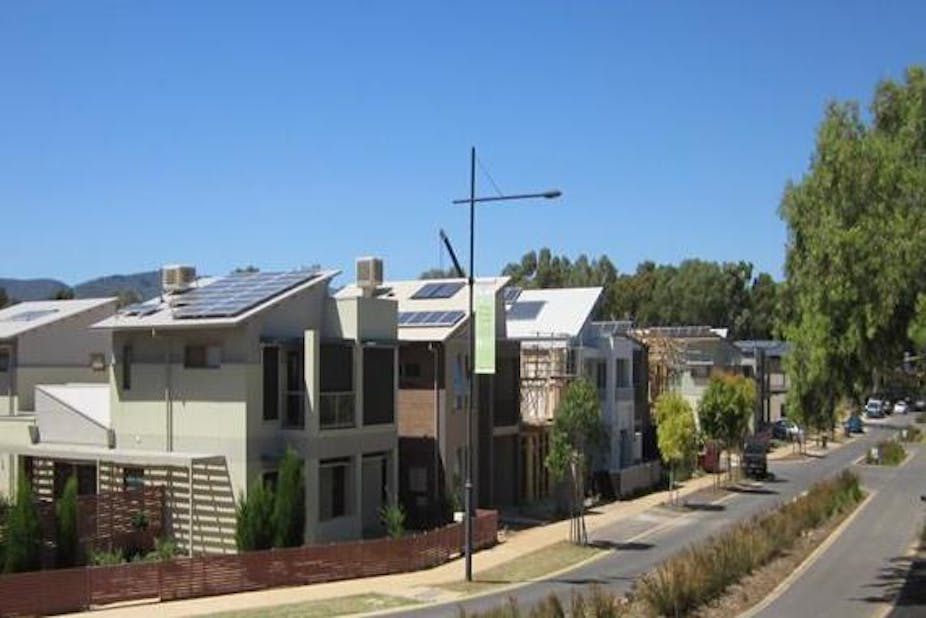
To test the concept of net zero carbon building standards we have based our research on detailed energy monitoring of homes at the Lochiel Park Green Village in Adelaide. When completed, this suburb-scale development will accomodate 106 households in a variety of building types, sizes and ownership arrangements.

All the buildings follow stringent Urban Design Guidelines, a set of performance requirements designed to create near-zero carbon homes in a near-zero carbon development. The guidelines set minimum requirements such as:

  • 7.5 Stars
  • solar hot water, gas boosted
  • 1.0 kW peak photovoltaic array for each 100m² of habitable floor area
  • high energy and water rated appliances
  • low energy lighting (CFLs & LEDs)
  • ceiling fans
  • rainwater harvesting
  • greywater harvesting.

We have been recording the energy and water consumption, and separately measuring the energy used for heating and cooling, lighting, water heating, refrigeration, kitchen, laundry, and the electricity generated by the photovoltaic panels.

For the first time in Australia, this level of monitoring for such a large number of homes will allow us to truly understand where and when energy is used by present-day households. Because there are many different technologies installed across the large sample of homes, and many different household types and sizes, the research will provide ground-breaking insights into the efficiency of various systems and the behaviour of contemporary households.

Our research will quantify the real impact of high star rating building design, high efficiency appliances and renewable energy systems on the demand profile of households during periods of peak summer demand. This insight will allow peak load savings to be incorporated into the economic tests that underpin Australia’s building standards, increasing the economic feasibility of higher standards.

Amazing what people can think of when there's no switch to flick: by incorporating wind towers, Iranian architects from a millennium ago dropped interior temperatures several degrees. Flickr/nomenklatura

So how zero carbon is a zero carbon house?

While the monitoring exercise is only two years into a planned nine-year program, we are already seeing strong trends. For example, the energy used in homes in Lochiel Park is significantly less than the average South Australian home, and amounts to only a third of that used to operate equivalent new homes. This is a significant saving to Lochiel Park households.

The energy performance in periods of peak summer heatwaves is outstanding. Electricity demand in Lochiel Park homes is not only appreciably less but – due to the excellent level of thermal comfort – the demand peaks later in the day, helping to flatten the Adelaide-wide electricity load profile.

Due to the production of renewable electricity by the solar photovoltaic panels, many homes at Lochiel Park are operating at or near the performance expected by net zero carbon homes. Detailed monitoring will help us to understand which elements of the guidelines could be improved to deliver, on average, a cost effective net zero carbon standard for all new residential construction.

Further information about high performance housing is available in the book Creating Sustainable Communities in a Changing World from the Barbara Hardy Institute at the University of South Australia.

Professor Wasim Saman of the University of South Australia also contributed to this article.

Comments welcome below.

Join the conversation

Comments (28)

  1. Permalink
    Stephen Pritchard

    Stephen Pritchard

    Student, cognitive science (logged in via email @gmail.com)

    There is a lot that is great about this research - the commitment to actual measurement over such a long time frame is truly outstanding, and will be valuable data.

    I have some questions and comments.

    You dismiss life-cycle assessment on the grounds that there is a lack of data. This is not a great justification, this data needs to be gathered. It is reasonable to expect there to be some correlation between increased thermal comfort and increased embodied energy (light-weight, uncomfortable…

    show full comment

  2. Permalink
    Derek Bolton

    Derek Bolton

    Retired s/w engineer (logged in via email @gmail.com)

    This is excellent work. One thing bothers me, though. The delayed peak demand puts it even further out of alignment with supply from solar. So reducing the energy demand might make it even harder to switch the supply to renewables.
    The ideal would be not only to lower the peak demand but bring it forwards. To the extent that some AC is still needed, maybe this could be done by precooling, perhaps using a phase-change material.

  3. Permalink
    Michael Brown

    Michael Brown

    Professional, academic, company director (logged in via email @bigpond.com)

    This is important research. The lack of increased death rates in Adelaide heat waves
    (http://www.mja.com.au/public/issues/187_11_031207/nit10385_fm.html) is probably due to the ready availability of air-conditioning. With power prices likley to increase considerably with the carbon tax, it is important that people have access to affordable air conditioning and the benefits of good house design.

  4. Permalink
    Geoff Crosby

    Geoff Crosby

    (logged in via Facebook)

    I am an architect in Castlemaine and recently won a competition to design a 10 Star house for Melbourne, I have since been engaged to design a similar house in Hobart, which hopefully will be constructed. I have also just applied for a planning permit for a 6 dwelling development in Castlemaine with ratings averaging 9 Stars.

    The article brought up a lot of issues that I have been confronting in regard the usefulness of the rating system, especially at these high numbers. The development I am…

    show full comment

  5. Permalink
    Bernie Masters

    Bernie Masters

    environmental consultant (logged in via email @iinet.net.au)

    Geoff: it's pleasing to see an architect grappling with issues which other members of his or her profession seem to have avoided for the last 20 or 30 years. Good luck; the issues of embedded energy and whole-of-life sustainability assessment are of paramount importance.
    The other issue is cost: there's little point in designing a zero carbon home if it's so expensive that only 1% of the population can afford to buy it. For example, recycled bricks may seem like a good material to use but the cost…

    show full comment

  6. Permalink
    Lorna Jarrett

    Lorna Jarrett

    PhD candidate, science education; Physics teacher (logged in via email @diment.org)

    Interesting article Stephen. I am hoping to have designed and built a house by the end of the year - so a topic of great interest to me!

    I'd be interested to know how you calculate the star rating of a house in the design stage.

  7. Permalink
    Bernie Masters

    Bernie Masters

    environmental consultant (logged in via email @iinet.net.au)

    Useful and interesting article, Stephen. In essence, you're talking about sustainable homes rather than just zero carbon homes, so it's important to remember that sustainability doesn't have an easily defined end-point: it's a journey where one strives for continual improvement to find the most sustainable way to live on our planet. In turn, this raises some difficult questions, such as how 'sustainable' is the burning of firewood gathered from renewable native forests to heat a home? So the whole point of the exercise is to ask difficult questions - to journey down the sustainability path - and see if an evidence-based consensus can be reached.

  8. Permalink
    Chris Riedy

    Chris Riedy

    (Associate Professor at University of Technology, Sydney)

    Interesting article Stephen. We did some work last year for the Australian Sustainable Built Environment Council on definitions of zero carbon for buildings, which you can find at http://www.asbec.asn.au/files/ASBEC_Zero_Carbon_Definitions_Final_Report_Release_Version_15112011_0.pdf.

    My concern with the definition you are using for a net zero carbon home is that it is based on on-site energy use only. In practice, this means installing solar panels on the roof to generate the extra energy you…

    show full comment

  9. Permalink
    Peter Lang

    Peter Lang

    Retired geologist and engineer (logged in via email @netspeed.com.au)

    Your definition is:

    "A net zero carbon home generates sufficient renewable energy on-site over the course of a year to supply all expected on-site energy services for the household."

    But let's face it, to call that a zero carbon home is misleading and dishonest. It is a lie. It is unethical. It is intentionally misleading the public to believe such twaddle.

    It is just as dishonest as saying wind farms can power x homes. That is a lie too. No amount of wind farms can power any homes…

    show full comment

    1. Permalink
      Anthony Muscio

      Anthony Muscio

      Senior Solutions Designer ICT (logged in via email @gmail.com)

      Is it fair to readers to allow this Nuclear Power campaigner to keep posting against any and every Climate Change or Sustainability item ? Sure Nuclear Power should be discussed and Peter Lang has something to contribute on this subject however he posts lengthy texts all over the place - Except that his name alerted me to the inevitable attempt to redirect the discussion, I had to read it first to see if he was making a useful contribution.

      Peters claim that "But let's face it, to call that a…

      show full comment

      1. Permalink
        Peter Lang

        Peter Lang

        Retired geologist and engineer (logged in via email @netspeed.com.au)

        How ridiculous. Is it fair to have only the Left comentariate allowed to push their repulsive ideology?

        Is it fair that only the renewable energy ideologuers be alloweed to propgate theit irrational propoganda. Pushing a belief in an ideology that seriously damages our economy for no gain whatsoever?

        Move to Russia or China if you think all the media and allopinion should be passed through the Left's censors.

        1. Permalink
          Mike Hansen

          Mike Hansen

          Mr (logged in via email @gmail.com)

          Peter keep on posting.

          You are like a broken record but your angry and increasingly irrational rants against renewable energy and against climate science do more to discredit your position than anything I can add.

          1. Permalink
            Peter Lang

            Peter Lang

            Retired geologist and engineer (logged in via email @netspeed.com.au)

            Mike Hansen,

            " irrational rants against renewable energy"

            You might think so, but others don't. To most people, irrational means advocating economically irrational policies like renewable energy - which seriously damage our economy for absolutely no gain.

            But then, died in the wool ideologues have their minds locked shut and wont dare to read what doesn't support their ideology.

            I realise you wont read this, but some might:
            http://bravenewclimate.com/2012/02/09/100-renewable-electricity-for-australia-the-cost/#comment-150529

            1. Permalink
              Mike Hansen

              Mike Hansen

              Mr (logged in via email @gmail.com)

              Peter - do not forget your irrational rants against climate science. Elsewhere on The Conversation you have referred to climate science as a "scam" and accused anyone who accepts the science of being a leftist. Do you now deny this?

              It is logical for you to claim that there is "no gain" in renewable energy if you do not accept that CO2 emissions are warming the planet.

              Like the bulk of the science community, I am convinced by the AGW science. So I also see the need for us to decarbonise our economy rapidly.

              It is AGW which is going to seriously damage our economy if we continue business as usual.

              The work of Stephen Berry and also BZE are important contributions to helping us understand the best way to do that.

              1. Permalink
                Mike Hansen

                Mike Hansen

                Mr (logged in via email @gmail.com)

                Peter - I should also add that I do follow bnc and have read your reports.

                I have also read David McKay's book "Sustainable Energy - Without The Hot Air" I am not a starry eyed novitiate and I do not underestimate the difficulties in deploying large scale renewables. But in my experience most people who participate in the discussion are the same and they argue the issues in good faith.

                The problem is that you have appear to have an almost pathological hatred of renewables - perhaps because of your background in the fossil fuel industry.

                Getting you to cost renewables is like getting Clubs Australia to cost mandatory precomittment of pokies or the tobacco industry to cost the effects of plain paper packaging.

                1. Permalink
                  Peter Lang

                  Peter Lang

                  Retired geologist and engineer (logged in via email @netspeed.com.au)

                  Mike Hansen.

                  "perhaps because of your background in the fossil fuel industry."

                  I beg your pardon? Please fill me in on that. That is the sort of wild baseless, wrong, misleading, statement that leads me to respond to the Lefties with disdain. Such rudeness and dishonesty is common on the Leftie web sites. You and many others, make such statements, while at the same time trying to tell me what I should and shuld not say. You are a hypocrite.

                  "The problem is that you have appear to have…

                  show full comment

                  1. Permalink
                    Mike Hansen

                    Mike Hansen

                    Mr (logged in via email @gmail.com)

                    From your bio at bnc.

                    "Peter is a retired geologist and engineer with 40 years experience on a wide range of energy projects throughout the world, including managing energy R&D and providing policy advice for government and opposition. His experience includes: hydro, geothermal, nuclear, coal, oil, and gas plants ..."

                    You say "trying to tell me what I should and shuld not say".

                    Peter - say what you like. Please say it more. I am not trying to shut you down. On the contrary I want you to keep going.

                    In fact Peter - tell us more about how climate science is a "scam". Tell us again about how it is all a lefty plot.

                      1. Permalink
                        Peter Lang

                        Peter Lang

                        Retired geologist and engineer (logged in via email @netspeed.com.au)

                        Correction. Yes, I have worked for the fossil fule industry. It's part of my broad experience.

                    1. Permalink
                      Mike Hansen

                      Mike Hansen

                      Mr (logged in via email @gmail.com)

                      You also say "The fact that people will not do the cost calculations ..."

                      In fact that is what organisations like BZE are doing.

                      1. Permalink
                        Peter Lang

                        Peter Lang

                        Retired geologist and engineer (logged in via email @netspeed.com.au)

                        Mike Hansen said:

                        "Getting you to cost renewables is like getting Clubs Australia to cost mandatory precomittment of pokies or the tobacco industry to cost the effects of plain paper packaging."

                        So you are happy to accept total nonsense costings as long as they are produce by the Renewable energy advocates, (despite the BZE cost estimates being utter nonsense), but don't like estimates that are not, eh? So that is what you call authoritative and reliable do you. Now who's sinking in their pathological hatred (of fossil fuel industry, Republicans, clubs, what else?)?

                        Here is one of the many critiques of the completely incompetent, ideologically driven work by BZE:
                        http://bravenewclimate.com/2010/08/12/zca2020-critique/

                        So is the sort of nonsense Mike Hansen believes and feels its justified to tell me what I should and should not say. I expect many others who want to believe in renewables despite the costs also like the BZE work.

                        1. Permalink
                          Mike Hansen

                          Mike Hansen

                          Mr (logged in via email @gmail.com)

                          My point Peter is that I am not going to accept costings of renewables from a self-confessed climate change denier.

                          What I do support however is projects like that described by Stephen Berry above. It may not be perfect as other commenters have pointed out (without I might add resorting to your abusive comments of Stephen) but learning by doing is going to be an important part of developing and costing a decarbonised society.

                          You also say again "Mike Hansen believes and feels its justified to tell me what I should and should not say".

                          LOL. Peter - my post is just above. People can actually read what I said. You need to refine your lying skills.

                2. Permalink
                  Peter Lang

                  Peter Lang

                  Retired geologist and engineer (logged in via email @netspeed.com.au)

                  Mike Hansen,

                  Just to put some figures to waht concerns me (for other readers if these don't mean anything to you), don't you think people would be concerned if they realised:

                  The wholesale cost of electricity for a renewable electric system for the Australian eastern states would be seven times more than now, with an abatement cost that is 13 times the starting price of the Australian carbon tax and 30 times the European carbon price.

                  Any renewable system is high and ahs negligible effect on emissions.

                  Supporting that is irrational. It is also irresponsible.

        2. Permalink
          Anthony Muscio

          Anthony Muscio

          Senior Solutions Designer ICT (logged in via email @gmail.com)

          Peter,

          How dare you jump in and over generalise and accuse me of fitting into certain categories you may seem to think I belong to and that are by your turn of phrase seem to be used as insults, then you summarily tell me where to go.

          Just like we should prize people with "open minds", we should be careful that our open minds are not so open everything falls out. You should review your insistence on freedom of speech to such a degree you think freedom of speech justifies vitriol and bullsh…

          show full comment

        3. Permalink
          Shirley Birney

          Shirley Birney

          retiree (logged in via email @tpg.com.au)

          @ Peter Lang: "Is it fair that only the renewable energy ideologuers (sic) be alloweed (sic) to propgate (sic) theit (sic) irrational propoganda (sic)."

          The giant fish blending, thermal polluting, ozone depleting, water guzzling, corrupt, disgracefully managed, leaking radioactive nuclear behemoth is neither cheap or friendly. Same mangy dog as coal, different haircut.