


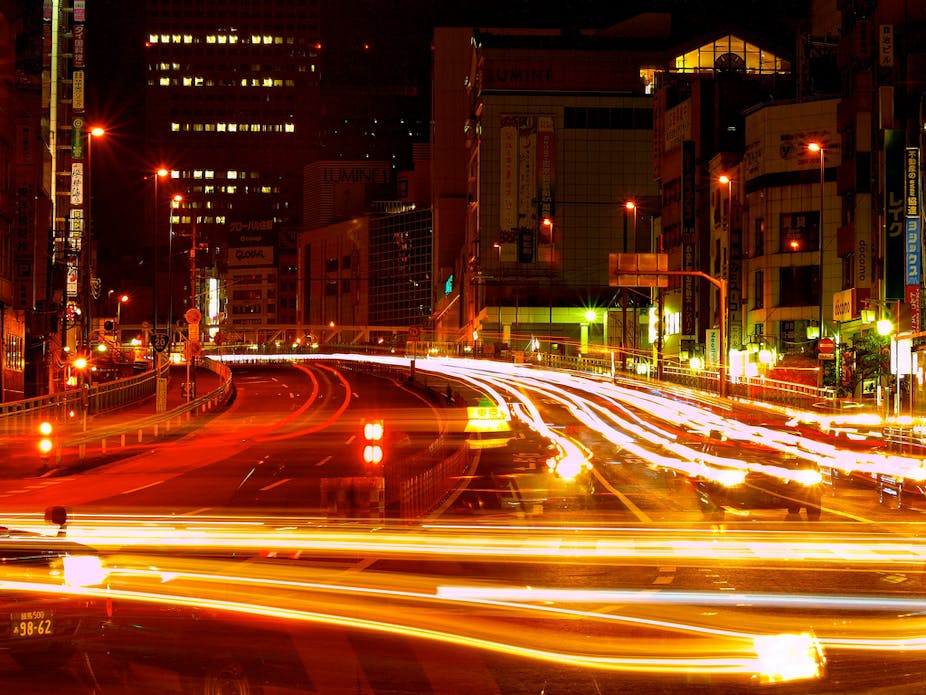
If you’ve ever been caught in a traffic jam – and who hasn’t? – you’ll know Australia’s urban road networks are fast approaching full capacity. With the holiday season not far away, traffic jams and road safety will again be high on the public agenda.
In addition to the social costs, motorised traffic also has a significant environmental impact. Developing strategies to reduce traffic congestion in a cost-effective and sustainable manner is therefore a significant challenge.
For decades now, governments and road authorities in Australia (and around the world) have been trying to find answers to these complex and difficult questions. One of the main problems faced by road authorities is the lack of opportunity for real-world experimentation with traffic management. For this reason, road authorities rely heavily on engineer insight and experience, and intensive computer simulations.
Unfortunately, the main existing simulation software packages require significant resources to set up and calibrate. What then are tomorrow’s practical alternatives?
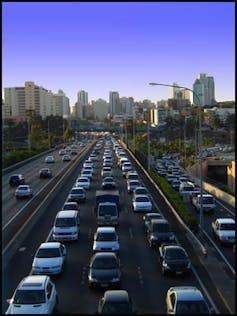
One solution to this problem may lie in “stochastic” (or probability-based) modelling of traffic – a method used in a branch of mathematical physics called statistical mechanics.
It may not seem obvious but traffic flow has a lot of similarities with other more fundamental physics systems. In a mathematical sense, there is a great deal of similarity between, say, the phase transition that turns water into ice and the phase transition that occurs when a road network goes from flowing freely to being gridlocked.
In a collaboration with traffic engineers at VicRoads which began in 2008, our group – including Joyce (Lele) Zhang from the Centre of Excellence for Mathematics and Statistics of Complex Systems – has developed a new way to model traffic flow on urban road networks, based on the theory of “cellular automata” (CA).
The idea of a cellular automata model is to divide up space into discrete cells, and allow particles to hop from one cell to another. In the case of CA road networks, the interacting particles are cars, and the discrete cells are sections of roads. The particles interact with each other via simple local rules, but the collection of a large number of such interacting particles can produce macroscopic behaviour that is not evident from the form of the individual particles themselves.
Similar phenomena frequently occur in nature, in the formation of schools of fish or flocks of birds to name a couple of instances. It is currently fashionable to refer to this phenomenon as “emergent behaviour”, but this is simply a mathematical statement of the idea that the sum is greater than its parts.
This kind of physicist’s approach to traffic modelling has been used since the 1990s for freeways, but several groups around the world are now working to extend these ideas to general road networks. In essence, this involves extending current models from one spatial dimension (a straight line; or freeway in this case) to two spatial dimensions (a plane; or road network in this case).
The model developed by our group was specifically designed to be able to quickly and easily test any conceivable algorithm for controlling traffic signals. By designing novel algorithms which more efficiently control the traffic signals on the existing network, we can reduce traffic congestion without the need to build more roads.
As a driver, you might have been at an intersection where the lights in front of you were green but you weren’t able to move due to cars blocking the intersection. More efficient traffic light cycles would eliminate this “green-light waste” and help end traffic jams.
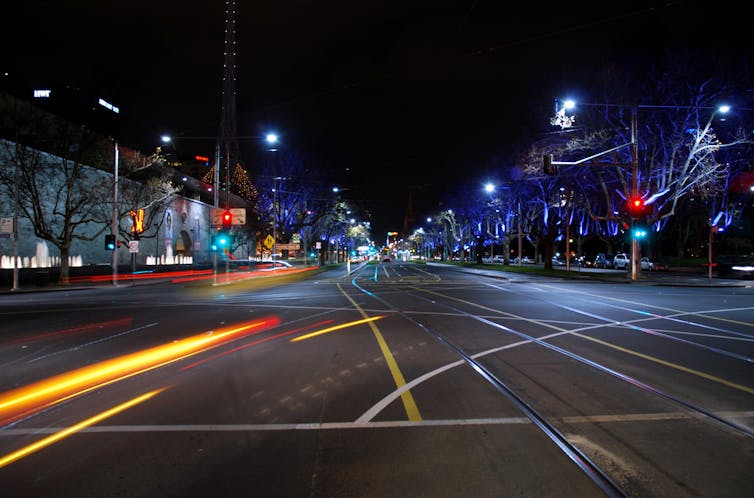
One interesting observation arising from our models is that the macroscopic rules governing road networks tend to have a certain “memory” – a phenomenon known as hysteresis. In the context of traffic, this basically means it is much easier to clog up a network than to unclog it.
While this in itself may not be surprising, the real value of our modelling is that it allows us to study ways of improving the recovery from gridlocked networks to free-flowing ones.
One possibly counter-intuitive result we found is that by using a particular type of highly adaptive traffic signal system – which we call “self-organising traffic lights” – the traffic signals end up behaving seemingly randomly.
But the gain you get is that the fluctuations in traffic behavior (travel times, throughput, network density) become extremely small – much smaller than when one uses the sort of predictable traffic signals currently in use.
In other words, our modelling suggests that if you are willing to live with unpredictable traffic signals, the benefit is that travel times will become much more reliable.
Join the conversation
Comments (12)
Jan De Gier
(Associate Professor, Faculty of Science, Department of Mathematics and Statistics at University of Melbourne)
Proper traffic light phasing is complex and difficult in particular when (unpredictable) pedestrians are involved. Road authorities do spend time and sources on phasing, but the main hurdle has been the unknown impact of one intersection's phasing on the whole network. You may optimize phasing for one intersection but thereby create havoc elsewhere. We hope to assist here by simulating alternative phasing scenarios, green waves etc., and measuring their impact on the whole network.
Paul Regis
Business Analyst (logged in via email @live.com)
I agree with you. I have seen other work on this topic using fluid dynamics, although that may not account for people's unpredictable behaviour as much as this approach.
However, I do think that the current designs actually encourage dangerous behaviour and unpredictability. As much as modelling that is interesting, I would want to design to minimise those factors because it improves road safety.
Much as it may be a complex science, there are definitely intersections where it is not complex at all, and yet improvements are visibly absent.
Jan De Gier
(Associate Professor, Faculty of Science, Department of Mathematics and Statistics at University of Melbourne)
The road safety debate is a very delicate one, and we should have an informed discussion about it. Our primary goal is to first establish facts about traffic light design for improving network traffic flow, or rather people flow as we certainly aim to include all modes of transport. You are right, predictable traffic leads to safer roads, but predictable traffic is not necessarily a consequence of predictable rules and regulations, especially not if these are poorly designed.
Kevin Cox
(Adjunct Associate Professor at University of Canberra)
One of the ways to overcome the problem of unpredictable signalling is to give extra visual cues so that road users can predict what will happen next. One example is the use of seconds till change indicators.
Another way is to be unpredictable in a predictable way:) By that I mean switch from one predictable sequence to another predictable sequence and to signal the change before it happens.
Can you write an article on how the algorithms are tested in real traffic intersections?
Jan De Gier
(Associate Professor, Faculty of Science, Department of Mathematics and Statistics at University of Melbourne)
It's too early yet to test in real traffic intersections, this requires a high level of confidence. Adjustments to the current algorithms could be made to a fairly large extent without adding new hardware. However some new algorithms would require actual traffic information which is not provided by the current set of detectors. Several groups look into such questions: what sort of detectors are needed and where do you put them? It is expected that GPS will play a major role in the future.
Adrian Palmer
Consultant (logged in via email @gmail.com)
It strikes me that we put in traffic lights when traffic density gets to a particular level where it is deemed unsafe for the junction to be self managed. This seems usually based on the peak loading. Hence, for a large amount of time, particularly at night, traffic lights are counterproductive. We all know the frustration of waiting at an interminable set of lights when there is no traffic within miles. As an interim step, before the levels of sophistication mentioned in the article are realised, would it be sensible to change lights to a flashing red (stop before proceeding) or flashing amber (right of way but proceed with caution) once traffic density at that time falls below the perceived danger/inefficient level?
Jan De Gier
(Associate Professor, Faculty of Science, Department of Mathematics and Statistics at University of Melbourne)
Not bad ideas, but this is up to road authorities and governments. Our research focuses on peak hour traffic.
Paul Regis
Business Analyst (logged in via email @live.com)
The traffic lights in the Sydney region of NSW are some of the worst I have seen. Pedestrian lights seem unconnected to car/people flows as well (e.g. walk down Harris Street in Sydney).
The very long amber aspect encourages drivers to jump lights, and inappropriate pedestrian lights give incentive for people to ignore them completely. $m were spent building Bus T-Ways, yet the traffic lights controlling ingress/egress do not seem to notice buses. Should a bus wait 10 minutes (I timed it) to cross a main road because of a set of badly phased lights?
There are problems with cascading green/red, so that traffic only moves one junction at a time.
It is tempting for politicians and others to support high cost infrastructure projects, when really the answer may be staring us all in the face, every time we stop. Perhaps the town planners need to graduate from their 1980s ways of thinking and take a walk down the streets they have created?
Rahmi Akcelik
Director, SIDRA SOLUTIONS (logged in via email @sidrasolutions.com)
In the 1970s, driver confusion became a big concern when "group controllers" with varying signal sequences were used in practice. They were quickly replaced by controllers with predictable signal sequences. Apart from safety concerns, driver hesitation may mean reduced saturation flow rates, and reduced capacities may lead to different conclusions. Did your research model any variation in driver behaviour, e.g. change in driver response time in starting up during queue discharge which may result from uncertainty in signal sequences?
Jan De Gier
(Associate Professor, Faculty of Science, Department of Mathematics and Statistics at University of Melbourne)
You raise an important and interesting point, are you aware of any publications on this issue? No, we did not (yet) include variations in driver behaviour, mainly due to lack of time so far. Of course, roundabouts are somewhat similar to varying signal sequences.
Kevin Cox
(logged in via LinkedIn)
One of the things we do with online computer systems is to build in measuring tools into our interfaces. This should apply to a traffic light computer system.
The traffic control system should have measurements that see if driver behaviour is as predicted. Are people running lights, do they hesitate, do they behave differently? While we could run experiments why not build the experiments into the system and run them continuously. You never know what may change driver behaviour. Do double demerit days change things? Is there a change due to the design of new gadgets in cars or in better viewing? Having continuous experimentation as part of the system enables the system to adapt to change and continuously improve.
Scott Younker EIT
(logged in via LinkedIn)
We use Synchro for developing coordinated signal timing; which requires basic imputs to create and calibrate.