


Australia’s educational system must be one of the most over-reviewed in the OECD.
Hundreds of Select Committees – Federal and State, Upper and Lower House in the past 20 years have reviewed teacher quality and student outcomes. And we still haven’t got it right.
Now we have the Gonski Review into funding arrangements, in which Mr Gonski looks forward to an education system premised on ensuring “educational outcomes are not the result of differences in wealth, income, power or possessions”.
The case for reform
But there is something seriously amiss with our public education system in Australia. Schools are being forced to “cheat” on NAPLAN tests, nationwide testing is failing to improve the results children from disadvantaged communities and these tests are having a detrimental impact on children and families. Teach for Australia “associates” are not ready to teach and are not staying in schools for longer than two years.
More than 18% of graduate teachers are unable to obtain on-going teaching jobs. Principals and teachers refuse to participate in a so-called “performance” bonus system. And probably most concerning, children face inequitable outcomes based on their postcode or social class.
Children from the richest 2% of all households are twice as likely as average to go to university. Students from disadvantaged communities still have extremely low literacy and numeracy achievements. This is especially so for many indigenous children.
It’s (not) your fault Ms!
There are many factors contributing to these and other problems in our public education system. Too often the first to be blamed is the classroom teacher. Nothing could be further from the truth. While there are certainly teachers in our schools who should not be there, there is no evidence from any research indicating that schools have any more such “duds” as hospitals have doctors or nurses who shouldn’t be treating patients, engineers who shouldn’t be building bridges or lawyers defending clients.
Teachers in our public schools are educated (not trained) in the same faculties of education as their private school counterparts, and research shows high performing graduates from these institutions equally take up positions in private and public schools.
First principles
So where can we look for any enlightenment about the origin of our education systems’ many problems? A good place to start is with policy. This is made by ministers, hopefully on the basis of advice from education bureaucrats. These in turn should be designing their advice on peer-reviewed research and successful practice in the field.
But when we start to investigate the origin and source of the policies that are driving our public education system today what do find? Policies like mandatory national testing, publication of league tables, publishing comparative school data on MySchool, Teach for Australia, performance pay for teachers, contract teaching and so on. All these are imported from the failed education systems of the USA and England.
While there is substantial and very credible research evidence from some of the most significant educationalists in the world that these imported polices can do more damage than good, they have been adopted here in Australia often against the advice of our most eminent educators and researchers.
Former Assistant Secretary of Education in the USA, Professor Diane Ravitch, previously one of these policies’ strongest supporters, has joined in such criticism. She provocatively asks “Do politicians know anything about schools and education? Anything?”
The Australian context
So which policies should we be adopting here in Australia? Well it wouldn’t hurt to look for a change beyond our so-called cultural heritage countries to those performing well on the OECD rankings.
Australia ranks in the top ten in the world in mathematics, science and literacy. Yet our results also show a very wide disparity between the highest and lowest achievers – what is called a very long “tail” where the difference can be up to three full years of education.
In the highest performing countries, South Korea, Hong Kong, Singapore and Finland, there is a more overall evenness of achievement between students. While there are many things we could learn from Asian countries, their cultures, values and history are very different to ours with an emphasis on authoritarianism, collective obedience and submission of the individual to the state.
Finland, on the other hand, is much more like Australia with a tradition of social welfare and egalitarian values, a history of migration and has more recently become a country that has adopted multicultural communities.
Finland
So what are the policies that have made Finland a successful education system, in which the vast majority of all students complete 12 years of schooling and all those who want to can attend tertiary education?
Finnish school children start two years later than in Australia and spend fewer hours at school. Finland has no standardised tests.

In Finland teachers are respected and well paid. Teachers typically spend about four hours a day in the classroom, and are paid to spend two hours a week on professional development. At the University of Helsinki, 2,400 people competed last year for 120 slots. Unlike Australia it’s more difficult to get into teacher education than law or medicine.
I recently spent time in Finland and spoke with a number of school principals, teachers, education policy makers and university researchers. Their first principle has been how to achieve equitable outcomes for children from disadvantaged backgrounds. This means that while there are “private” schools in Finland, if they wish to receive public funding support they are unable to charge fees.
In this way the growing student achievement gap that is so well documented between Australian public and private schools does not exist.
All Finnish schools are funded on an equitable per student basis with more funds going to schools and students that need it most – schools serving poorer communities, those with large numbers of non-native speakers and refugees, indigenous students and students who are less abled.
When students have difficulties with learning they are immediately attended to by qualified remediation teachers either in the class or in a special unit. Students may require only short time for extra assistance and then return to their normal studies. They do not fall behind and become failures to be discarded and left behind as they are in Australia.
Subsidising the wealthy?
In Australia on the other hand, we have elite schools like Geelong Grammar receiving more than AUD$6m in federal support in 2011, plus AUD$1.3m from the Building the Education Revolution Funding.
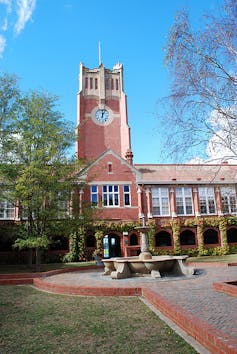
It also holds assets valued at AUD$109m, as well as more than AUD$13m in their foundation, has an annual disclosed fee income of some $57m, while spending more than AUD$20,000 per annum on each student. This compares to government spending an average AUD$13,500 per student in public schools and AUD$6800 per student in private schools. GGS’ teaching staff student ratio is an enviable six students for every teacher across all years P-12 and one support staff for every two teachers.
This compares to a staff student ratio of 1:14 in public schools. Yet only 5% of its student enrolment come from the lower 50% of the socio-economic advantage scale. It should therefore come as no surprise that Geelong Grammar has an average ATAR of 83.15, which means the top 50% of students were in the top 16.85% of the State. In fact, Geelong Grammar’s annual profit exceeds that of its well known neighbour down the road, the Ford Motor Company.
While the federal Opposition defends the public funds directed to ensure Geelong Grammar makes a profit, it has expressed reservations about public funding of the struggling car industry.
Funding matters
While many commentators argue that class size doesn’t make a difference to student outcomes one has to ask why all the most expensive independent schools proudly proclaim their emphasis on small classes and at the same time have the temerity to suggest that if government support to their schools was reduced their parents would have to pay more for school fees.
Yet these very same schools continue to increase their fees despite continued government funding at rate far in excess of cost of living or inflation. Professor Richard Teese recently wrote, “the work of public education is to end failure—to disconnect success from social origins”.
Thirty years ago, Finland’s education system was a mess. It was quite mediocre, very inequitable. It had a lot of features that are at the core of our problems in Australia: top-down testing, extensive tracking, highly variable teachers.
Pasi Sahlberg, director of the Finnish Ministry of Education’s Center for International Mobility and author of the new book Finnish Lessons: What Can the World Learn from Educational Change in Finland always makes the point in any interview he gives: “There are no private schools in Finland.”
Australia will never be Finland, and private schools may be a part of our education system for some time yet. But unless we effect responsible, progressive, equitable policies we will continue to lag behind the rest of the world.