


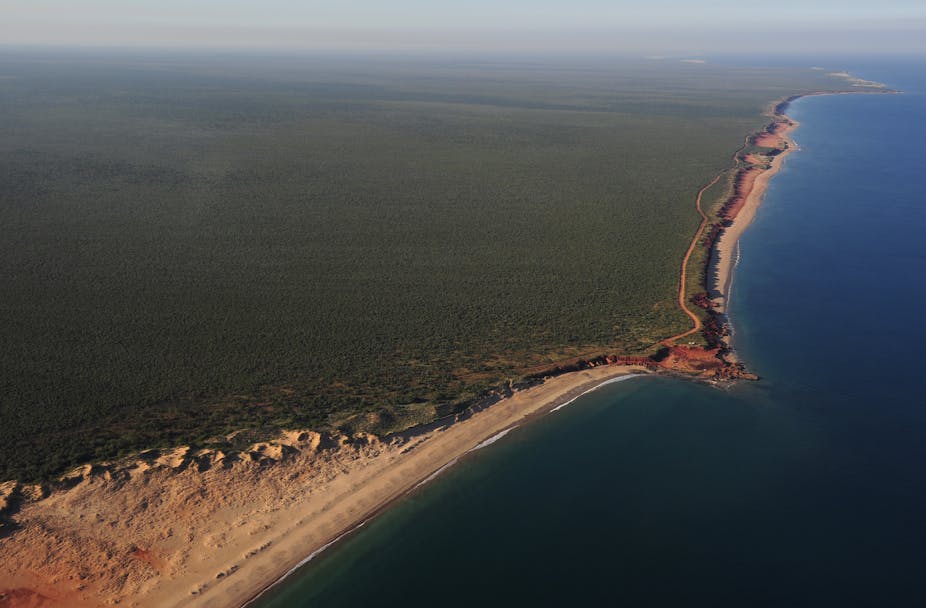
Conflict between Indigenous (“Black”) and environmental (“Green”) groups is a growing feature of Australia’s political landscape. This has been highlighted by very public disputes over Wild Rivers legislation in Queensland and the proposed Liquefied Natural Gas processing precinct (LNG Precinct) at James Price Point north of Broome.
Aboriginal leaders such as the Kimberley’s Wayne Bergmann and Cape York’s Noel Pearson say Green groups’ determination to maintain “wilderness” areas - distant from the comfortable suburbs in which most of their supporters live - are depriving Indigenous people of the economic opportunities they need to end poverty and social marginalisation.
Some environmentalists have accused Aboriginal people supportive of major resource projects of selling out their culture and the environment for short-term financial gains
Conflict reached a new and unprecedented level in late September. Opponents of the LNG Precinct circulated a newsletter containing blatantly racist attacks on Kimberley Aboriginal leaders who supported the Precinct. This led to the resignation of one of those attacked: Australia’s only female Indigenous member of parliament, Carol Martin.
Many environmental groups and their members would deplore these attacks. Yet they are a manifestation, albeit extreme, of a deepening rift between Green and Black interests in relation to development in Australia’s resource-rich regions.
Shared interests?
For decades there has been a widespread assumption in Australia that Black and Green groups are natural allies. It was assumed they share a commitment to looking after the environment, and in particular to stopping development in areas of high environmental and cultural significance such as Kakadu National Park and the Pilbara’s Burrup Peninsula.
These groups have joined together in a number of campaigns to stop high-profile projects. Black-Green cooperation was critical, for example, in forcing the abandonment of the Jabiluka uranium project in Kakadu in 2005.

So what explains the growing tensions and conflict between Indigenous and environmental groups? Is the assumption that the two share underlying interests unwarranted?
What is the prognosis for the future? Will conflict continue to escalate or can a new accommodation of interests be found?
The history of the Kimberley LNG Precinct casts some light on these questions.
The Kimberley LNG Precinct
The Browse Basin lies some 250 km off the Kimberley coast and contains about 25% of Australia’s known reserves of natural gas.
During 2005-2007 developers were looking for sites to process gas. The Labor State Government wanted to avoid development along the whole Kimberley Coast. It established a Northern Development Taskforce (NDT) to identify a single site where Browse gas would be processed, to minimise impact.
The WA Government also declared that development would only occur with the “informed consent and full economic participation” of Aboriginal Traditional Owners. The WA Government funded the Kimberley Land Council (KLC) and Kimberley coastal native title groups to participate in the site selection process run by the NDT.
As the site selection process proceeded, native title groups removed eight locations from a short list of possible sites established by the NDT because of their environmental and cultural values.
However, in September 2008 the newly-elected Barnett Liberal-National Party Government indicated that it would not continue the previous policy of only allowing development with Traditional Owner consent. It terminated funding for Traditional Owner participation in the site selection process.
In December, the Premier announced that James Price Point, 60 km north of Broome, was the WA Government’s preferred site. Unless its Traditional Owners reached agreement for the LNG Precinct to be built there, the Government would compulsorily acquire it.
Faced with this threat, in April 2009 the Goolarabooloo Jabirr-Jabirr native title claim group, who had not removed James Price Point from the short list of possible sites, instructed the KLC to enter a “Heads of Agreement” (HoA) .
They provided consented to the grant of tenures required for the Precinct in return for economic and other benefits for the claim group and affected Kimberley Aboriginal people. These benefits include substantial new investments in education, training, housing, health and land management, and are valued at a minimum of $1.5 billion. They also obtained a commitment by WA not to allow LNG processing at any other site on the Kimberley Coast without Traditional Owner consent.
On June 30 2011, a binding agreement was made between the KLC, the native title claimants, WA and Woodside Energy Ltd, the lead commercial proponent for the LNG Precinct. The KLC and Traditional Owners will not give final approval until they are convinced the area will be managed to minimise environmental and social impacts.

The Goolarabooloo Jabirr Jabirr native title claim groups is not unanimous in its support for the LNG Precinct. One part of it took court action (unsuccessfully) in a bid to challenge the validity of the meeting that approved the HofA.
Growing tensions
During the site selection process, engagement between environmental groups and the KLC and Traditional Owners was largely positive. A Joint Position Statement was signed in December 2007, calling for high environmental standards and for Kimberley Traditional Owners to have a central role in decision making.
Since James Price Point was selected as the LNG Precinct site, Green groups’ opposition has increased. So has tension between them and Aboriginal people prepared to support the development.
The Wilderness Society has launched a public campaign to oppose gas development on the Kimberley coast. The Greens leader, Bob Brown has visited James Price Point and vowed to fight the development. The Australian Conservation Foundation last month issued an “investor alert” urging potential investors in the Kimberley LNG Precinct not to proceed with the project.
Aboriginal people who support the project say failure to develop it would deny Kimberley Aboriginal people a unique opportunity to improve their lives.
The need for such improvement is starkly illustrated by an Aboriginal Social Impact Assessment conducted as part of the Strategic Assessment. It shows that only one in four indigenous people in Broome and one in five in Dampier Peninsula communities had completed high school.
Indigenous people account for about 30% of the population in Broome and the Dampier Peninsula, but for 85% of criminal offences in 2008-2009. Of 64 houses in one affected community, only 7 are in good repair.
Aboriginal people may agree with Green groups who say no Australian citizen should have to live in such circumstances. Government should address these conditions whether LNG is developed or not.
But the reality is that these circumstances have persisted for decades. There is no reason to believe they will change significantly unless Aboriginal people themselves can deploy substantial resources to deal with them.
Some Green groups have given their support to members of the claim group who oppose the Precinct, increasing Green-Black conflict. This is in a context where both the LNG Precinct HoA and final agreements were supported by substantial majorities in the claim group meetings held to consider them.
Underlying issues
Many Aboriginal people believe the only way they can end their marginalisation in Australian society is by using their rights under the Native Title Act to secure active economic participation. Yet the groups with the greatest capacity to use native title this way live in the few places the Greens regard as relatively environmentally intact. These include the Kimberley and Cape York.

At the same time, Aboriginal determination to control what happens on their traditional country is being bolstered by growing international recognition of Indigenous rights.
For example the UN Declaration on the Rights of Indigenous Peoples asserts that Indigenous people should control whether development occurs on their traditional estates and what form any development should take.
The growing power of Indigenous people is apparent from the history of the LNG Precinct. Though the Barnett Government might threaten compulsory acquisition, it is difficult to conceive of a US$30 billion project that includes companies such as Shell and BP going ahead in the face of concerted opposition from Aboriginal traditional owners.
This reality helps to explain the unprecedented commitment by the WA Government that it will not allow further LNG development on the Kimberley coast without the consent of Traditional Owners.
It is easy for environmental groups to support the principle that Indigenous people should control what happens on their traditional lands when control is used to prevent or limit development. If it is used to approve major industrial projects, accepting Indigenous control may be a different matter.
There is nothing in the history of the LNG Precinct to suggest Indigenous commitment to protect the environment is wavering. Kimberley Traditional Owners refused to contemplate LNG development at multiple sites because of their environmental and cultural sensitivity.
Despite the unprecedented benefits they have been able to negotiate, the KLC and the Traditional Owners of James Price Point are refusing to agree to its development except under stringent environmental conditions.
This discussion suggests two quite different scenarios in terms of future relations between Green and Black groups. If Green groups accept ultimate Indigenous control, it is easy to envisage them working with Indigenous groups to ensure that development will only occur if it is subject to stringent management of environmental and cultural values.
If Green groups join with much of the mining industry and many state governments in refusing to accept the right of Indigenous people to make the final decision about development on their lands, the conflict over Wild Rivers and the LNG Precinct is likely to be just a taste of what is to come.