The Conversation
Subscribe
  • Academic rigour, journalistic flair
  • For curious minds
  • Expert news and views
  • Debate and ideas
  • From the curious to the serious

Hot Topics

  1. Gay marriage
  2. Australia in the Asian Century
  3. Convergence review
  4. Federal Budget 2012
  5. War on drugs
  6. Medical myths
  7. Bob Brown
  8. Square Kilometre Array
  9. Explainer
  10. Transparency and medicine

Has the use-by date gone past its prime?

Picture this: you arrive home from work feeling a bit peckish. Sliced mango and a dollop of yoghurt should ease the cravings until dinner, you think. You open the fridge door and, horror, no yoghurt. Not the yoghurt you bought four weeks ago, nor the yoghurt you bought three weeks ago, nor the yoghurt…

Brixton
Consumers need more useful information about assessing the freshness and safety of food products.

Picture this: you arrive home from work feeling a bit peckish. Sliced mango and a dollop of yoghurt should ease the cravings until dinner, you think. You open the fridge door and, horror, no yoghurt. Not the yoghurt you bought four weeks ago, nor the yoghurt you bought three weeks ago, nor the yoghurt on sale that you bought last week.

“Darling, where’s the yoghurt?” you ask.

“Past its expiry date. I threw it out to keep us safe.”

Was the yoghurt off?

Did it have mould? Nope. Furry bits round the edges? Not a bit. Did it smell off? Certainly not. Did it taste off? Absolutely not. Was it actually off?

All available evidence indicated a product that was perfectly safe to eat. Yet the “use-by” date stated that this product was past its prime, bad, unsafe; dangerous to eat. Somehow the product, natural yoghurt, had magically transformed from safe yesterday to off today in response to the warning date stamped on the side of the pack.

But was it, actually, off? Would a close look, a cautious sniff and a careful taste have proven that it was safe to eat?

You might assume that use-by dates have played an important role in protecting the community from food borne pathogens. After all, this simple date stamped on the packaging provides consumers with a clear directive to devour or discard the item. Just in case you were in doubt, the messages from government or quasi-government authorities is loud and clear; beyond the use-by, don’t chance it.

In fact, the Victorian Government urges you not to eat anything past its use-by, “even if it looks and smells okay”. The New South Wales Government uses the fear factor to put you off by explaining that bacteria have been multiplying to such an extent that overnight the food has become unsafe to eat.

In a poetic turn, Food Standards Australia and New Zealand provide a natty video and the catchy phrase, “if in doubt, throw it out”. It’s a handy chant to dull the thud as the food is lobbed into the kitchen bin.

Indeed, according to the recent Labelling Logic report, Australia sees 5.4 million cases of food-borne illnesses each year, costing us annually around $1.2 billion. Yet importantly, the report also suggests that “use-by” and “best-before” information is not well understood by the public despite initiatives to educate and inform.

Though use-by dates have played a role in protecting us from food-borne pathogens, it is crucial to recognise that they also contribute to a range of problems. Use-by dates are:

  • economically wasteful – costing the community billions of dollars in food waste
  • environmentally unsound – increasing the ecological footprint of our food
  • dangerous – taking away our need or desire to understand food spoilage and storage.

In the UK, the concern over the estimated £12 billion worth of food discarded every year – much of it edible – prompted the former Environment Minister, Mr Hilary Benn, to make the claim that the use-by date was nothing more than a stock control measure for the retailer. Indeed, earlier this year, the UK Government scrapped the “sell-by” date.

In the US, questions about the authority of the use-by date and the growing need to reduce waste have prompted the start of a most useful website, Shelf Life Advice. Ethel, the Shelf Life Guru, provides advice to “help you keep the food in your kitchen safe … and to help you cut food bills by avoiding waste …”.

The website also provides a link to a USDA fact sheet on Food Labelling, which says that the use-by date merely indicates when a food is at its “peak quality” and that it is not a safety date at all.
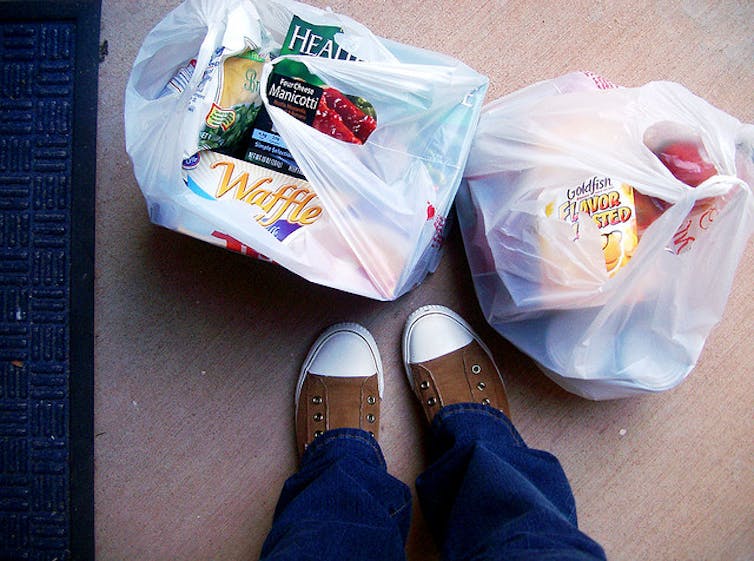
The UK Government has abandoned sell-by dates. Flickr/Esther17

But back in Australia; let’s look at the dangers of date stamping with a familiar story.

One warm day in summer, Patrick heads off to do the shopping. Patrick and Jo are hosting an afternoon party for a few friends the next day, so supplies are needed.

Supermarket first – that gets the tedious shopping out of the way. A gallop up and down the aisles takes 20 minutes plus a further five minutes at the checkout. During that time, Patrick’s trolley’s been host to four pre-packaged trays of chicken thighs and chicken breasts.

Offloading the groceries into the boot of the car, cool in the undercover car park, Patrick heads to the bottle shop (15 minutes), the newsagent (five minutes), the fruit and veggie shop (15 minutes) then grabs a quick cappuccino at the deli (15 minutes), where he also picks up cold meats and cheeses for the party.

By the time Patrick gets home (30 minutes – bad traffic) the chicken pieces have been out of the fridge for nearly two hours, the cold meat and cheese considerably less. He dumps the groceries on the kitchen counter and asks his son to pack away the food. Forty-five minutes later, Jason (age 16) emerges from his room and reluctantly packs the food in the fridge.

The next day, Jo rushes to the fish markets for prawns – best buy fresh – while Patrick prepares the marinated chicken. One tray of thighs is a bit whiffy, he thinks. The use-by is late next week so they must be okay. He washes them thoroughly and steeps the chicken strips in garlic, ginger, chilli, soy and mirin. That afternoon, Patrick puts the covered bowl of marinated chicken beside the barbecue while he gets the grill hot, about an hour.

The party was fun, the company good but that night, most of the guests are horribly ill.

So what’s happened? The problem here is the reliance we all place on the authority of the use-by date, a growing lack of understanding about food spoilage, and a dwindling belief in our own commonsense. Ethel of Shelf Life Advice could provide some good advice, as could When Food Goes Bad, which does a great job explaining how temperature and time work together in a dastardly conspiracy to turn food off.

But the underlying message is this – the use-by date has passed its prime.

So what is the solution? Do we return to the days when we as consumers must make all the decisions about whether or not something should be eaten? Do we scrap the use-by date and allow retailers to dupe us with pre-packaged foods that are just a bit older than they should be? Or do we modify the use-by date system in a way that can help us assess the freshness and eatability of our food?

Our suggestion? We need to provide a more informative label alongside the use-by date that can reinstate our own wisdom for assessing freshness. Instead of a simple magical date, we need to let consumers know when a product is at its peak, for how long it may be safe to eat, and, crucially, how to assess when it’s gone bad.

Take eggs, for example, a beautifully packaged product that can last weeks beyond stated use-by dates. Alongside a “peak-quality” date, a colour-coded “use your judgement” bar could indicate some simple tests to gauge freshness.

Were the eggs kept in the fridge? (Good.) Do the eggs bob around on the surface of a bowl of water (bad) or sink to the bottom (good)? Or do the eggs pong like, well, like rotten eggs when cracked into a bowl? (Really bad.)

If the product is cheese or hard fruits and veggies, Choice provides a 1cm rule. This wonderful rule reduces waste by advising consumers to cut visible mould off a wedge of cheese or slightly old rockmelon. Then, for safety, cut a further 1cm off to protect you from the growing things that you can’t see. Of course you should do a taste test, too.

We need to learn again the signs that demonstrate food health and to understand safe handling and transport rules to minimise waste. We need to trust our own judgement in assessing food, and we need to be supported in this via more informative food quality labels.

Join the conversation

Comments (13)

  1. Permalink
    Marcus Godinho

    Marcus Godinho

    CEO (logged in via email @fareshare.net.au)

    People interested in this issue may be interested in reading about the work of a Victorian food charity called FareShare - www.fareshare.net.au. Ten years ago FareShare successfully lobbied for Australia's first Good Samaritan law to provide protection to businesses with surplus quality food that were willing to donate it to charities. Similar legislation is now in almost every state and territory and has enabled the rapid escalation of food rescue. FareShare is now cooking nearly 500,000 meals a year from rescued and donated food - a lot of which is close to code - for over 300 Victorian charities.

  2. Permalink
    Anthony Kaye

    Anthony Kaye

    Retired Vet. Surgeon (logged in via email @hotmail.com)

    Of course your chicken story applies to Oz, but only once or twice a year in the UK!. I believe that here Salmonella poisoning has been virtually eliminated by chicken vaccination. Does that apply to you?.
    Also Listeria poisoning from cheese is rarely heard of nowadays, but I'm not sure why-I look forward to being enlightened.

  3. Permalink
    Lydia Buchtmann

    Lydia Buchtmann

    Communication Adviser, Food Standards Australia New Zealand (logged in via email @foodstandards.gov.au)

    Penny - you ask why some yoghurts have use by and some best before dates.The Food Standards Code requires the food manufacturer to choose whether the use a use by or best before date and the length of the period. This is because the manufacturer best understands the food technology of their product and how long it lasts, for example they know how much preservative, salt, sugar and fat it contains all of which affects the period the food will last.

    1. Permalink
      Penny Wilson

      Penny Wilson

      (PhD Researcher at Australian National University)

      Thanks, Lydia.

      It's interesting that my natural yoghurt is consistently good for several weeks after the use by date yet my partner's fruit based yoghurt can deteriorate and turn 'fizzy' well before the use by.

  4. Permalink
    Lydia Buchtmann

    Lydia Buchtmann

    Communication Adviser, Food Standards Australia New Zealand (logged in via email @foodstandards.gov.au)

    Food may look and smell fine but it can still give you a nasty case of food poisoning so don’t take health risks for yourself or your family by ignoring use by dates. There has been debate in the UK about their ‘sell by’ dates and food wastage but they are proposing to remedy this by using our system of ‘use by’ and ‘best before’ dates. As a few people have already pointed out, most packaged foods use ‘best before’ dates which means they can still be safely eaten and legally sold after that date…

    show full comment

  5. Permalink
    Bob Liddelow

    Bob Liddelow

    No title (logged in via email @zip.com.au)

    IIRC, "Use By" carries a legislative requirement that food which is so marked not be sold after this date. "Best Before" is intended as a guide but there is no direct implication that food should not be consumed before "Best Before". Food with a shelf life of 2 years or more is no longer required to be date stamped.

    On the other hand, "Use By" can be misread by some people who decide that the food will last that long after it has been opened. Some foods deal with this by having a note on the label that after opening it should be properly stored and consumed within a certain time. It is highly desirable that any food bearing a Use By should carry this information.

    It is also useful to know the Picked On or Packed On date, depending on the food item.

  6. Permalink
    Sally Chamberlain

    Sally Chamberlain

    Food Safety Advisor (logged in via email @hotmail.com)

    The current date coding system is widely misunderstood by consumers. To clarify…
    • the ‘use-by’ date is the date at which the manufacturer says the product is SAFE to consume (as long as storage instructions have been followed). After this date the food should not be eaten for safety reasons.
    • the ‘best-before’ is an indicator of QUALITY, you can expect a food to retain all of its quality attributes (eg colour, taste, flavour etc), provided it has been stored according to any stated storage conditions…

    show full comment

    1. Permalink
      Penny Wilson

      Penny Wilson

      (PhD Researcher at Australian National University)

      Thanks Sally.

      The reason for the story about Patrick was to illustrate the gap in knowledge between the use by date and the importance of safe handling practices. Despite the information on the packaging about storing at or below a certain temperature, consumers often forget that transporting and preparing food can provide a perfect temperature for rampaging bacteria and effectively render the use by obsolete.

      When food is stored properly, foods such as yoghurt, eggs and even unopened cryovacced meats won’t go off a day or a week over the use by date. I’m not suggesting that we eat slimy ham or the grey mince that’s been pushed to the back of the fridge, or drink tea with floaty bits from the sour milk. But just perhaps we can save the cereal that’s a week old and that will crisp up nicely after 10 minutes in a hot oven.

      1. Permalink
        Sally Chamberlain

        Sally Chamberlain

        Food Safety Advisor (logged in via email @hotmail.com)

        Some foods do become dangerous, these are the ones that carry the 'use-by' date, including food like cryovacced meats. These provide the ideal breeding ground for many bacteria, including listeria, which grows well at low temperatures and at low pH, has death rate of around 30%, and causes spontaneous abortion. cryovacced meat like ham could well be unsafe past its 'use-by'.

        Items with a 'best-before' like cereal and yoghurt can be consumed past the 'best-before' date but may not taste as good or…

        show full comment

        1. Permalink
          Penny Wilson

          Penny Wilson

          (PhD Researcher at Australian National University)

          I notice that you mention that yoghurt is marked with a best before date and that the yoghurt example given on the FZANZ website is also marked with a best before. However all the yoghurt in my fridge has a use by date. I wonder if there’s a lack of consistency in the marking guidelines.

          I mention cryovacced meat as an example from my local farmers market. The meat sellers say that their meat is always good for at least two weeks beyond the use by as the leeway they provide with their date stamping…

          show full comment

  7. Permalink
    Sarah Officer

    Sarah Officer

    Nutritionist, PhD student (logged in via email @hotmail.com)

    I think the story used actually proves the opposite and illustrates just why it's better to have a policy with a built-in safety margin that favours wasting food over wasting people. The story of 'Pat' shows how, in spite of the best precautions that the government takes, people frequently fail to exercise common sense when it comes to food safety and so need all the help they can get. Most peoples' judgement is pretty, erm, 'average', in spite of the guidelines and access to information such as…

    show full comment

  8. Permalink
    John Harland

    John Harland

    bicycle technician (logged in via email @gmail.com)

    "the reliance we all place on the authority of the use-by date"

    All of us? The "use by" date has always been a joke, particularly for foods like milk.

    A "sell by" date should remain. Retailers handle goods in ways that are generally consistent with best practice so the "sell-by" date should be a reasonably reliable guide. A business also works better with a clear go/no-go system than requiring the expertise and worktime to assess each product individually.

    1. Permalink
      Penny Wilson

      Penny Wilson

      (PhD Researcher at Australian National University)

      That’s just it, though. Too many people don’t think the use by date is a joke and either toss perfectly good produce or fail to realise that poor handling, on their part, has caused the food to spoil. We don’t have sell by date in Australia; we have a ‘use by’,’ best before’ and a ‘baked for’ or ‘baked on’ for bread. The sell by date in the UK forced retailers to throw out food which was essentially still fresh.

      The use by may well be used by retailers as a stock control mechanism but let’s make sure that the consumer can safely move and store food, can feel confident about using food that’s still fresh and can assess whether food has spoiled before the magic date stamped on the packaging.