

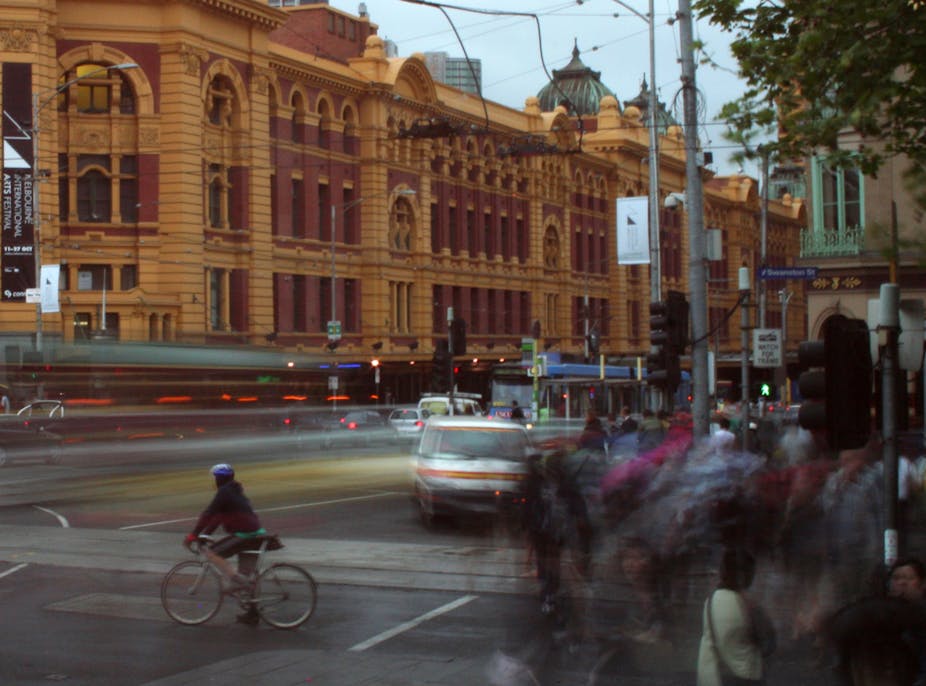
CYCLING IN AUSTRALIA: Every year, dozens of cyclists are killed and thousands are injured while riding on Australian roads.
Statistics such as these, coupled with all-too-frequent horror stories about big-city riding, have made cycling an unappealing prospect for many.
In fact, a recent survey of 1,000 people found unsafe road conditions to be the single largest deterrent for would-be cyclists.
So how can we make our roads safer for our cyclists?
One method is to analyse the last few seconds before a cycling crash occurs. Finding out what happens in those final seconds was the main objective of my recent study of cyclists’ experiences on Melbourne roads.
In my study, a compact video camera was attached to the helmets of commuter cyclists, recording their trips to and from work for a four-week period. The footage captured the cyclists’ point-of-view as they rode along, and what they saw when they turned their heads, including:
- vehicles to their right
- vehicles parked to their left
- distractions, such as signs, shopfronts and people they perved on.
The footage captured the experiences of 13 riders over 127 hours and in that time, 54 “events” were identified – two crashes, six near-crashes and 46 “incidents”.
(An “incident” was similar to a near-crash, where one road user needed to take some evasive action. However, these incidents were less severe than near-crash events.)
We’ve since analysed each of those events, frame-by-frame.
In 87% of the events captured, the driver was responsible for the action that preceded the event. In 74% of those events, the driver cut the cyclist off, turning in front of the cyclist without either:
- providing enough space
- indicating effectively
- a head check.
The footage showed that, rather than being focused on the cyclist they had just cut off, drivers were instead focused on other vehicles on the road.
If you take cyclists out of the equation, the behaviour of the recorded drivers was safe. Large-enough gaps were selected when entering and exiting parallel parking bays, lane changes were done safely, turns were done safely, and car doors were opened without endangering other road users.
Unfortunately, none of these behaviours were safe for cyclists.
The role of driver behaviour in cyclist safety was found to be more significant than previously thought. Previously, the emphasis was on how cyclists needed to improve their behaviour to improve their safety.
While cyclists certainly need to obey road rules and be courteous to other road users, my study shows that cyclists’ behaviour alone is not the answer.
In essence, drivers need to be more aware of cyclists on the road. It is essential for cyclist safety that drivers look for cyclists before they change their direction of travel, particularly when turning left.
How can drivers improve cyclists' safety? Here are a few ways:
- Always do a head check before turning left.
- Always indicate for five seconds before turning.
- Always allow one metre when overtaking a cyclist.
- Allow cyclists to travel across an intersection rather than turning in front of them.
Most cyclists ride defensively and assume drivers have not seen them. This behaviour was seen in the footage, and cyclists’ evasive behaviour was the main reason near-crashes did not become actual crashes.
But there are a number of ways cyclists can improve their safety. One of the most effective methods is to stay out of a driver’s blind spot, particularly when travelling near 4WDs and commercial vehicles.
This can be done by staying either in front of or behind any vehicle that might be in an adjacent lane. Another effective safeguard is for cyclists to make eye contact with nearby drivers.
But cyclist safety isn’t just dependent on how cyclists and drivers approach one another – changes to roads are also needed.
All levels of government can contribute to ensure all roads are cyclist-inclusive and intuitive for cyclists and drivers. This can be achieved by:
- introducing continuous, connected bike lanes that do not end unexpectedly in preference for vehicle lanes
- maintaining curbside road surfaces
- removing ambiguous road markings, such as on-road bike lanes painted across parallel parking bays.
Of course, a bucket of paint and a bike symbol stencil is not enough to create safe spaces for cyclists on the road: drivers need to know how to use the space.
Education for new and existing drivers about cycling-related markings and infrastructure is essential in ensuring a safe space is available to cyclists.
So, what happens in the last few seconds before a cyclist crash occurs? A wide range of behaviours and reactions: reactions to other road users, to the road space and to the environment. Each of these factors needs to be addressed, independently and interdependently to improve cyclist safety on our roads.
We’re on the road to safe cycling; we just need to make sure everyone gets there safely.
Read the rest of Cycling in Australia.
Join the conversation
Comments (13)
Tim Churches
(logged in via email @gmail.com)
This is an excellent study which points the way to a relatively cheap and sustainable way to continuous improvement of cycling safety, leveraging the Internet and possibly crowd-sourcing to both provide the footage and to analyse it.
However, I was bemused to read in the article that:
"The footage captured the cyclists’ point-of-view as they rode along, and what they saw when they turned their heads, including: vehicles to their right; vehicles parked to their left; and distractions, such as signs, shopfronts and people they perved on."
I can assure you that I have never perved on anyone while riding to work! I promise!
Etienne de Briquenel
(logged in via Twitter)
This is a great study Marilyn. In terms of Australian road safety, the onus of responsibilty has for too long been weighed down upon the shoulders of vulnerable road users. Your results highlight that defensive riding techniques are an excellent form of risk mitigation for cyclists, but are clearly not enough when the odds are so badly stacked against them.
Changing the culture of all motorists may take a long time, perhaps even a generation, but the practical measures you have outlined are certainly achievable in the short term.
Richard Monfries
(logged in via Twitter)
Hi Marilyn
Good advice and analysis overall, and the one thing - that I agree with you - that cyclists can do for themselves is to make eye contact as much as possible with the vehicles closest to them (the vehicles that are likely to do the greatest damage to a cyclist if they don't 'see' the cyclist).
I'm now 52, and I've been riding for most of the last 40-something years. I've had three prangs. None of them as a result of coming off second best to a motor vehicle. All my own fault.
However…
show full comment
Glen Turner
Network Engineer (logged in via email @gdt.id.au)
"The role of driver behaviour in cyclist safety was found to be more significant than previously thought. Previously, the emphasis was on how cyclists needed to improve their behaviour to improve their safety."
Previously thought by whom? The accepted philosophy of cyclists has long been that motorists are responsible for most accidents. We even have a standard set of cycling responses to common traffic scenarios where the key to safety is to use the road position of the bike to control the motorist…
show full comment
Paul Richards
All good points for drivers and riders.
"a bucket of paint and a bike symbol stencil is not enough to create safe spaces for cyclists on the road: drivers need to know how to use the space"
On the paint issue I feel you overlooked the Netherlands approach of using paint to separate cyclists. - Cyclist > Parked Cars > Car Traffic Lane - It's simply a lateral view of space allocation, a simple easy to use solution.
http://youtu.be/XuBdf9jYj7o
Darrel Gill
(logged in via LinkedIn)
I've been commuting into Melbourne from the Western Suburbs every day for the last 3 years, several months ago I started recording every ride due to the high number of near incidents I was having (especially Collins Street and Taxis') thankfully I no longer need to use Collins St.
I find off road cycle paths are sometimes more dangerous than riding on the road, Footscray Rd Cycle/groat path for instance, mostly due to incompetent design or lack of care by the contractors building them.
I post all incidents on you tube - I guess one day this will be my memorial site as sometimes I feel it's only a matter of time (my biggest fear is getting hit from behind by a mobile phone using driver, I see them all the time).
http://www.youtube.com/user/dazagill
Mel Nicholls
(logged in via Facebook)
Hi Darrell, I was just wondering if these videos would be able to be used by police to book drivers doing the wrong thing? A couple of hits to the hip pocket may make them watch out...
Matt de Neef
(Editor, The Conversation)
Hi Darrel. Wow, those videos are hard to watch. As a commuter cyclist myself, I see these incidents all too often. Good job on recording them and posting online!
Paul Richards
I have been reflecting on this article since it came out and have to admit it might be useful for me to do this routinely. Video is cheap now, an iPhone on record on a good mount and your'e in business.
http://www.ram-mount.com/
Mathew Ashton
Manager (logged in via email @me.com)
The study provides excellent food for thought and further justification for improved road user education.
The best thing I have ever done to improve my Driving skills was to become a motorcyclist. It makes one so much more aware of positioning and conditions. It is simply too easy to get a road users' licence in Australia. Re-testing every 5 years would also improve our behaviour.
Mark Capps
(logged in via LinkedIn)
Great article - it's awesome to see facts, as opposed to preconceived ideas and prejudice, being applied. The more this happens, the more likely Australia will solve this problem.
One point that resonates with my cycling experience is being sure to do the quick and easy things first. It's great that millions are being spent on cycling in Sydney, I just wish they'd spend money first on the quick wins. Having cycled in London it's bemusing to see Sydney not learning from cities that have already solved some of the problems.
What is the best way to inform government about stupid things? Look at this pic - twitpic.com/768ho2 - the sign clearly contradicts the pavement painting. One should change! Please can someone advise who I should tell and how.
Mark
Paul Richards
28/10/011
$1.78 MILLION BOOST FOR INNER-CITY BIKE RIDERS (VIC)
People living in inner Melbourne will soon have more reasons to jump on
their bikes and embrace an active lifestyle, Minister for Roads Terry
Mulder said today. Announcing $1.78 million to improve cycling
facilities in the cities of Yarra and Melbourne, Mr Mulder said that
improving access and safety for cyclists is an important priority for
the Victorian Coalition Government.
Source- CCH Parliament - subscription
Bruce Gray
(logged in via Facebook)
Why don't senior public servants spend some time on the roads, or even ask Tony Abbott about his experiences....or are they too important to cycle?
From the general verbal abuse projected at cyclists, it is obvious the primary problem is not cyclist behavior but motorist ignorance of the road rules and a normalized sense of righteousness to torment cyclists, reinforced by high profile Australians like Magda, Shane-o, and several dip stick radio personalities, including those in the employ of public broadcasters.