

The Conversation
Subscribe
  • Academic rigour, journalistic flair
  • For curious minds
  • Expert news and views
  • Debate and ideas
  • From the curious to the serious

Hot Topics

  1. Gay marriage
  2. Australia in the Asian Century
  3. Convergence review
  4. Federal Budget 2012
  5. War on drugs
  6. Bob Brown
  7. Explainer
  8. Square Kilometre Array
  9. Medical myths
  10. Transparency and medicine

High-end bikes for sale … but what are you really buying?

CYCLING IN AUSTRALIA: What are you paying for when you buy a new bike? Materials … sure. Design … without doubt. Manufacture … yes, of course. But beyond that, what’s going on? Why can these objects, beautiful as they are, vary so wildly in price, from a couple of hundred dollars to multiple thousands…

Aapone-20110724000333650864-france_cycling_tour_de_france_2011-original
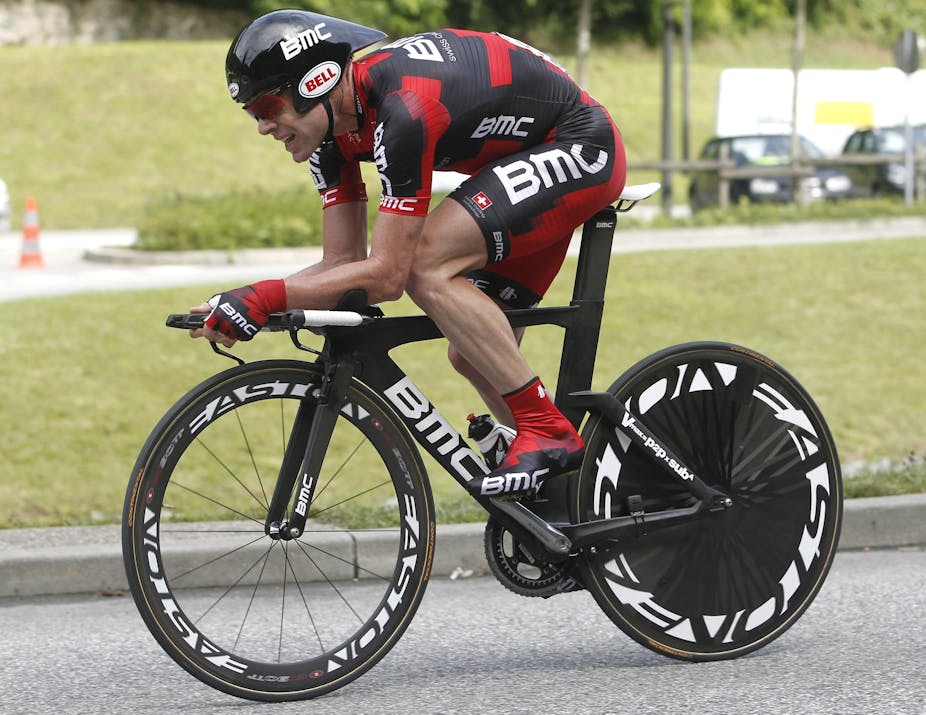
Much science goes into the creation of the perfect bike frame. Guillaume Horcajuelo/EPA

CYCLING IN AUSTRALIA: What are you paying for when you buy a new bike? Materials … sure. Design … without doubt. Manufacture … yes, of course.

But beyond that, what’s going on? Why can these objects, beautiful as they are, vary so wildly in price, from a couple of hundred dollars to multiple thousands? Are those more expensive, high-end bikes worth it? Well, let’s consider what goes into them.

The international cycling union (UCI) defines rules that determine the fundamental characteristics of the bikes that are used during cycling competitions. The two main rules are the following:

1) Cyclists have to ride bikes that are available on the market.
2) The minimum total weight of the bike as well as the shape and dimensions of the frame elements are constrained.
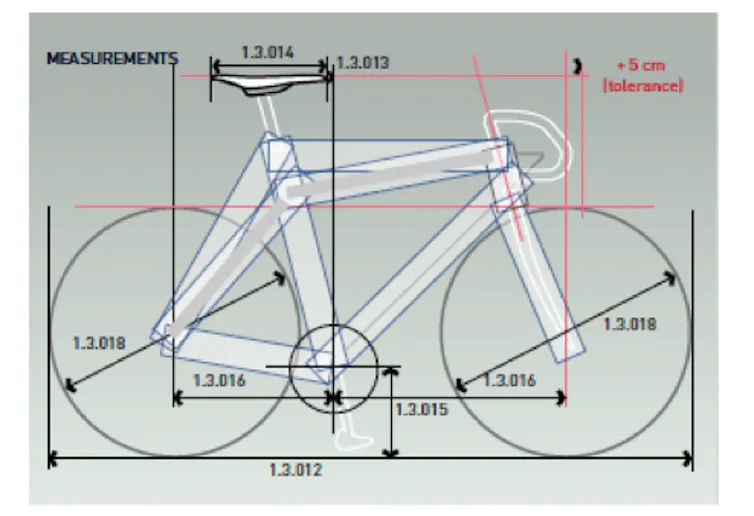
The geometry, shape and dimensions of road bikes are constrained by UCI rules. From UCI official document.

The “commercially-available” rule was created so that any cyclist can buy the bike that Cadel Evans (BMC Team Machine SLR01 for approximately $13,500) used to win the Tour de France 2011.

The weight rule was defined in January 2000 to ensure the safety of the riders and avoid a technology “arms race”.

It has been defined according to the continuous reduction of the density of the material used to make bike components.

Holding back the years

In the 1980s, a typical high-performance racing bike frame was made of steel tubing. The frame weighed about 1.6kg and the fork weighed about 0.75kg, for a total bicycle weight of about 9.5kg. In the 1990s, aluminium alloy material was introduced, leading to a reduction of the weight to about 1.2kg for the frame, 0.6kg for the forks, and about 8kg for the total bike.

Since the 2000s, spectacular weight reductions have been possible thanks to the introduction of carbon composite material, with bike frame weight reaching as little as 0.8kg and the fork 0.3kg, with a complete bicycle weight of about 6.5kg.

In order to avoid any reduction in bike weights that could compromise the level of safety for cyclists, the UCI currently forbids bicycles lighter than 6.8kgs.

High or low?

Before investing in a $10,000 bike, it’s necessary to understand what the differences are between top-end performance bikes and the more budget-oriented models.

The high-end performance bicycle has mechanical characteristics that provide cyclists with the ultimate level of performance and comfort required by professional cyclists.

A high level of engineering is applied to optimise the bike’s design to satisfy the performance and comfort demands of the best cyclists while respecting the rules defined by the UCI.

“Comfort” is one of the most frequently encountered words during discussions among cyclists, and it’s a crucial aspect for professional cyclists taking part in multistage races such as Le Tour de France.

The mechanical responses of the different components of the bike to the excitation of the road (holes, bumps, etc.) strongly influence the comfort perceived by the cyclists.

From a mechanical point of view, the level of comfort on a bike depends on the energy transmitted by the bike from the road to the cyclist.

To optimise comfort, bicycle frames and forks are made of carbon composite materials that have anisotropic mechanical properties (they do not behave the same way in all directions).

These materials offer an opportunity for bike designers to manipulate a few key areas:

  • the tensile strength (i.e. maximum stress that a material can withstand while being stretched or pulled)
  • stiffness (i.e. Young’s modulus – a measure of the stiffness of an elastic material)
  • the damping properties (i.e. absorption of the vibrations caused by the excitation of the road) of the different frame elements in the various axis or planes, while respecting the dimension and shape rules.

Bike designers optimise the structural characteristics of different bike frame elements by carefully selecting the type of carbon fibers and adjusting their orientation within the bike frame element.

A large number of carbon fibres offering different mechanical properties can be used and combined by the bike designers to optimize the mechanical responses of the bicycle.

Because of the high specific strength (i.e. force-per-unit area at failure) offered by carbon composite materials, it has become possible to build safe bikes lighter than 6.8kgs, so that additional weights are often used in the form of ballast (usually located as low as possible in the frame) to satisfy the minimum weight rule.

Virtual design

The optimisation process is generally completed by combining computer models (e.g. 3D Computer Aided Design model) in conjunction with Finite Element Analysis (FEA).

This approach allows the structural characteristics of different bike frame elements to be created and its mechanical responses under loading condition to be virtually evaluated.

Finite Element Model showing ply-by-ply failure analysis of the head tube area of a composite frame.

Using this approach, bike designers can refine the characteristics of different bike components before the first bike is assembled. The shape of the different bike frame elements can also be fine-tuned in order to optimise the aerodynamic properties of the bike frame and wheels to reduce air resistance.

Using engineering tools such as Computational Fluid Dynamics (CFD) and wind tunnels, this approach has been mainly applied to optimise the air flow-related performance in cycling (see video below).

The cyclists’ body creates most of the aerodynamic resistance.

Power transfer

The most advanced engineering methods are employed by bike designers to optimise the structure of the bike components so that the power transfer between the cyclist and the bike is maximised (performance) while the vibrations generated by the road surface are absorbed (comfort). The shape of bike components is also maximised to reduce the aerodynamic resistances (performance).

Today’s bicycles provide a scientific combination of lightness, strength, stiffness, aerodynamics and damping in order to optimise the transfer of the cyclist’s efforts into bicycle speed while maximising perceived comfort.

All this engineering takes time and costs money, which contributes to the higher cost of top machines. While this technology trickles down the product chain to the lower-end products, compromises are inevitably made, such as using different grade materials and manufacturing methods to maintain the lower costs.

You get what you pay for, in other words, although bikes are getting better for everyone.

This article was co-authored by Raoul Luescher, Director of Luescher Teknik.

Read the rest of Cycling in Australia.

Join the conversation

Comments (14)

  1. Permalink
    Roger Dargaville

    Roger Dargaville

    (Research Fellow, Energy Research Institute at University of Melbourne)

    For the top end professional cyclists I can see why they invests 10s of thousands of dollars on their bikes. But for the rest of us it is hard to justify the expensive - especially when we might be a couple of kilos overweight ourselves! Taking a month off work and doing some serious training might be a better investment.

    1. Permalink
      Tim Paton

      Tim Paton

      Automotive Engineer (logged in via email @timpaton.net)

      For the rest of us, it's hard to justify professional-quality running shoes. Cameras. Golf clubs. Stereo systems. Premium quality wristwatches. Exotic automobiles.

      Whether or not it makes any sense, people like owning and using the best. Of course, it's 99.9% vanity. But for a middle-aged accountant or dentist, a $12k bike is much more affordable than a $2M sports car... and inevitably healthier.

      For me, I'm happy to sit by and wait for the inevitable upgrades and updates, collecting barely used parts to build my own fleet of bikes up to a performance level that I would never have afforded new (far better than my own meagre performance level). The trickle-down effect operates in many ways.

  2. Permalink
    Paul Martin

    Paul Martin

    (logged in via email @me.com)

    Most people buy such bikes as 'commuters' or weekend toys which is rather ridiculous. However, if that's what makes you happy then so be it, just don't complain about it when it is clearly not meant for the task.

    I have such a bike but it is reserved for racing events only. Training is done on a heavier & cheaper bike.

    It must be made clear that these are racing bikes, sporting machinery - like a high end porsche - and not the everyday bikes we need to see more of in this country for getting from A to B. Just have a look at the sort of bikes the Dutch & Danish ride.

    You don't buy a Ferrari for the school run or to buy the groceries so why do we do it with bikes? It's all about business....

  3. Permalink
    Richard Monfries

    Richard Monfries

    (logged in via Twitter)

    Isn't there an almost ludicrous irony - especially apropos Tim's comment - that any young cyclist attending the AIS is not in a position to buy anything like a 'top-end' bike; he or she will need sponsorship, and a short working life spent on the product endorsement hamster wheel: yet the person who can afford a 'top-end' bike is maybe into fitness, and probably accrues objects d'sport to satisfy a rampant ego.

    On the other hand, when I observe The Bike as we now know it - the diamond-framed 2-wheeled Machine that exists in a plethora of materials, styles, colours, and weights, it is a Machine that serves the primary purpose of transport and health.

    If, with said Machine, it is a 'green bike', so much the better: http://bit.ly/green_bike

    But that's just my opinion, and I might be alone in that.

    David, interesting article, but it's a lugged steel frame for me.

    All the best

    Richard

  4. Permalink
    ZathrasSquared

    ZathrasSquared

    (logged in via Twitter)

    I'm going to stick to my MTB that was purchased in 1993. Still going strong. I also have two other MTBs of similar vintage and a single-speed Malvern Star upright, all of which are in the 'rehabilitate and repair queue'.
    Just need a trailer, and I'll rarely need to drive the car again. :)

  5. Permalink
    John Harland

    John Harland

    bicycle technician (logged in via email @gmail.com)

    Sorry, second typo for the day: not "mixed-start" but mass-start racing.

    Recumbents are raced separately and that should remain the case.

    1. Permalink
      Thomas Marshall

      Thomas Marshall

      Architectural Assistant (logged in via email @gmail.com)

      Recumbent bicycles are dangerous. No-one can see you, and you can't even see that well yourself. Do you lay down when you drive a car?

      1. Permalink
        Tim Paton

        Tim Paton

        Automotive Engineer (logged in via email @timpaton.net)

        Do you stoop forward when driving a car, craning your neck up in order to see forward?

        Visibility from a typical recumbent is better than from a conventional bike. Extreme low-racer recumbent styles are rarely used on the road, and still have no worse visibility than an extreme flat-back time-trial race bike... as Cadel is pictured riding at the top of this page.

        1. Permalink
          Meika Samorzewski

          Meika Samorzewski

          (logged in via Facebook)

          I've had a recumbent for 3 weeks now, its on 600mm wheels, it's not a low-racer, nor a low recumbent trike, nor super laid back, more relaxed than in a couch yes, and, the lumber support is magnificent.

          Generally you can see more, both earlier and much more widely. The only time you see less is when some larger vehicle is in the way. Being Eye to eye with drivers who are also seated in a similar position is fantastic.

          So much so that a few days ago I had a SUV driver yell at me "You didn't look…

          show full comment

      2. Permalink
        Paul Martin

        Paul Martin

        (logged in via email @me.com)

        Utter nonsense. Do you have a recumbent, Thomas?

        My recumbent (I have many different bikes) is no lower than a Lamborghini and it is much higher than the painted white lines on the road - both of which motorists are expected to be able to see...

        My only rule on my recumbent is that I don't lane split or hide in those dangerous 'green lanes' at intersections. I receive more attention and greater respect from motorists in the recumbent than on any of my other bikes, and that's a fact.

  6. Permalink
    John Harland

    John Harland

    bicycle technician (logged in via email @gmail.com)

    It is not only AIS cyclists who cannot afford top-end bikes.

    At his retirement after winning several Tours de France Miguel Indurain went into his local bikeshop to find that he could not afford a bike of the type he had been racing.

    Paul Martin does imply an interesting point about recumbents. We don't have a linguistic distinction in English between sit-down bikes and lie-down bikes. On a sit-down recumbent you may well be eye-to-eye with drivers, which is not a bad place to be.

    I would be horrified to see a car driver in a Grand Prix recumbent position. It would make clear that their primary goal is to drive fast, rather than interactively with other road users.

    Is it any more appropriate on a pedal cycle? Riding on the road is a social interaction and lying down is no way to be interacting with the broader community.

    1. Permalink
      Paul Martin

      Paul Martin

      (logged in via email @me.com)

      "I would be horrified to see a car driver in a Grand Prix recumbent position."

      You have obviously not sat in a Ferrari, Lamborghini, Lotus, Porsche, or... etc.

  7. Permalink
    John Harland

    John Harland

    bicycle technician (logged in via email @gmail.com)

    A key essential with marketing any commodity is that you have "better" versions higher up the price range. Few people buy these but many aspire to them.

    Can we please give the recumbent issue a rest. By 1937 all but one of Faure's records had been beaten by riders on conventional bikes. Nor was Faure a second-rate rider. He came to Australia in 1937 as a celebrity of conventional track riding.

    There is no place for mixing recumbents with conventional bikes in mixed-start racing, even without fairings.