The Conversation
Subscribe
  • Academic rigour, journalistic flair
  • For curious minds
  • Expert news and views
  • Debate and ideas
  • From the curious to the serious

Hot Topics

  1. Gay marriage
  2. Australia in the Asian Century
  3. Convergence review
  4. Federal Budget 2012
  5. War on drugs
  6. Bob Brown
  7. Explainer
  8. Square Kilometre Array
  9. Medical myths
  10. Transparency and medicine

Jury still out on whether cats are killers, but prison is on the cards

In “The Tragedy of Pudd’nhead Wilson”, Mark Twain equated keeping a cat to domestic bliss: When there was room on the ledge outside of the pots and boxes for a cat, the cat was there – in sunny weather – stretched at full length, asleep and blissful, with her furry belly to the sun and a paw curved…

Rz4mnqfj-1327032667
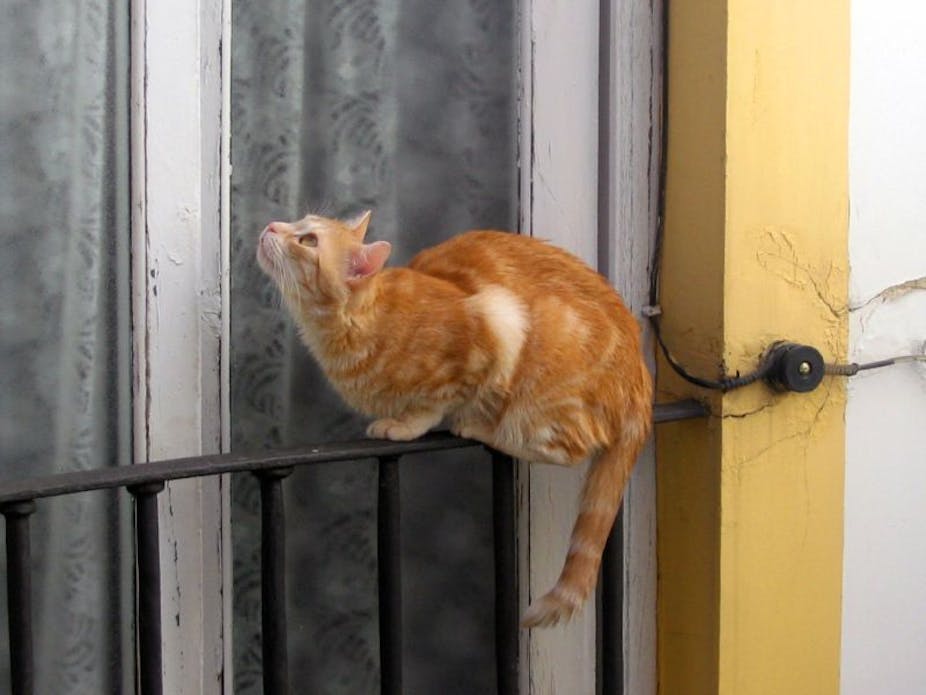
Pet cats are single-minded hunters, but are they wiping out native species? bolg/Flickr

In “The Tragedy of Pudd’nhead Wilson”, Mark Twain equated keeping a cat to domestic bliss:

When there was room on the ledge outside of the pots and boxes for a cat, the cat was there – in sunny weather – stretched at full length, asleep and blissful, with her furry belly to the sun and a paw curved over her nose. Then that house was complete, and its contentment and peace were made manifest to the world by this symbol, whose testimony is infallible. A home without a cat – and a well-fed, well-petted and properly revered cat – may be a perfect home, perhaps, but how can it prove title?

But not all pet cats sleep innocently in the sun all day. Many are accomplished hunters at some point in their lives. The cumulative effect of their occasional hunting is substantial wildlife mortality.
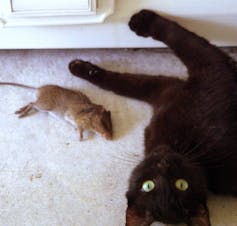
By bringing their prey home, cats make their hunting behaviour easier to research. Cult Gigolo/Flickr

Cats are renowned for bringing their prey home to their owners. Researchers have exploited this habit, using it to calculate predation mortality in local communities. By extrapolating the results, they calculated mortalities at a national level. These rough estimates suggest that pet cats kill 29.2 million birds and 57.4 million mammals annually in the UK, and 100 million birds annually in the USA.

In Australia, the type and number of prey taken vary with location. In warmer climates lizards are common prey, while elsewhere mammals and birds predominate. In large urban centres the prey are mainly introduced species such as house mice, starlings and sparrows, but rural cats or those with access to native bushland catch more native species.

Many people in the community are concerned and want to regulate cat ownership to reduce wildlife deaths. Others argue that mortality estimates are inflated or that pet cats take prey that would otherwise have died of other causes, deflecting attention from more serious causes of wildlife decline, especially habitat destruction.
In warmer climates, lizards are common prey. dsbnola/Flickr

Proponents of cat regulation point to the increasing importance of urban environments for wildlife conservation and the need to reduce mortality of the wildlife they contain. In the highly urbanised UK, for example, domestic gardens cover a greater area than the country’s wildlife reserves. They include around a quarter of all the trees outside woodlands.

In Australia, gardens and bushland reserves in built-up areas are important habitat for threatened species susceptible to cat predation; these include the legless lizard Delma impar, in suburban Canberra, and the eastern barred bandicoot in Hamilton, Victoria.

However, it is also true that pet cats generally take common vertebrates, and these persist in cities despite predation (although more serious problems may arise near remnant native vegetation and on urban fringes). Furthermore, studies attributing wildlife population declines to pet cats also identify larger mortalities from other factors such as road traffic, or acknowledge that cat predation may be removing animals that would otherwise perish from different causes. There is also the possibility that pet cats hold rodents in check, preventing them from preying on bird eggs and nestlings.
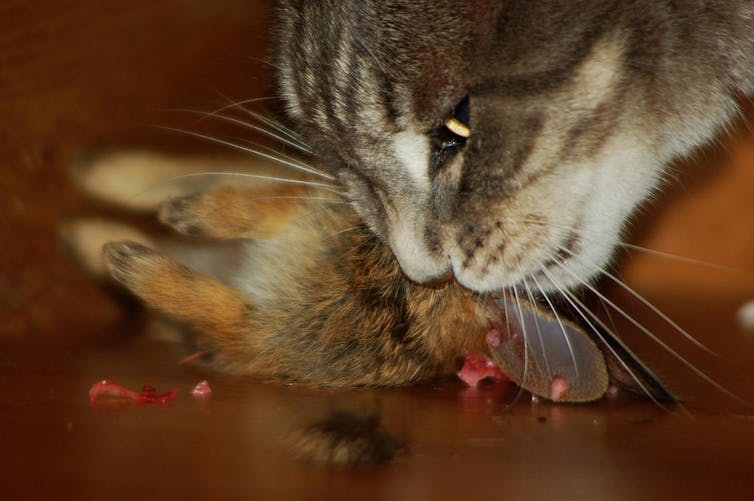
Cats may kill species that threaten other species. MotoWebMistress/Flickr

To further complicate interpretation, wildlife may respond differently to pet cats in different localities. For example, there is concern about declines in starlings in the UK because of heavy predation by pet cats, whereas in eastern Australia starlings thrive despite being common prey of pet cats.

Regardless of the controversy, owners who wish to reduce predation by their cats have plenty of options. Collar-worn predation deterrents may be the solution for free-roaming pet cats. They include the old staple of a bell on the collar, electronic devices that chime at short intervals or when a cat pounces, coloured ruffs around the collar that warn birds away and flaps of material called pounce protectors that interfere with paw-eye coordination when the cat pounces.

Despite scepticism from some owners, controlled experiments demonstrate that many of these devices work. They don’t always stop an individual cat from hunting altogether, but they often reduce the number of prey captured.
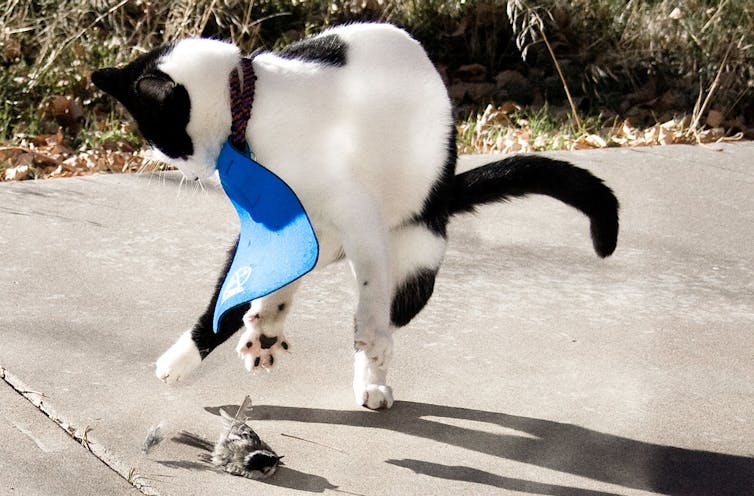
Pounce protectors may not stop a cat hunting, but they reduce its success. feverblue/Flickr

Confining cats at night reduces predation on nocturnal fauna, although birds and many lizards are vulnerable by day. Day-time curfews may be a solution for owners concerned about native birds and reptiles, especially if they live in areas where the only local small mammals are introduced ones like mice and rats.

Keeping cats confined at all times protects all fauna, but is unpopular with owners. Nevertheless, it protects cats from the serious risks of road accidents and fighting injuries that are major causes of cat illness and death.

We await definitive experiments that will tell us if predation by pet cats reduces wildlife populations. But we believe that the increasing importance of urban environments for wildlife conservation and the undeniable fact that many pet cats hunt warrants precautionary action. Owners can use predation deterrents or consider partial or total confinement of their cats.

Join the conversation

Comments (17)

  1. Permalink
    Bernie Masters

    Bernie Masters

    environmental consultant (logged in via email @iinet.net.au)

    To Upsilon Arts: thanks for the comment but, unless you live in the Notofagus forests of inland Tasmania or in a rainforest remnant of coastal Queensland, your reference to a 'deciduous tree' next door suggests that most of the birds around your house are, like the tree, exotic and hence unlikely to be of conservation significance. Conversely, the grasshoppers, cicadas and skinks (and maybe the cockroaches) are most likely to be native species and, while not of conservation significance, their consumption…

    show full comment

  2. Permalink
    Albert Schmidt

    Albert Schmidt

    Researcher (logged in via email @gmail.com)

    TNR-Advocates and their programs are making absolute fools out of each and every one of you that they con with their lies and highly deceptive nonsense -- while also violating all invasive-species laws in existence. (Cats being listed in the TOP 100 WORST invasive-species OF THE WORLD in the "Global Invasive-Species Database".)

    If you do the research, as I did using data from the most "successful" TNR programs, you'll easily find that no TNR program has EVER trapped more than 0.4% of existing…

    show full comment

    1. Permalink
      Redmond Fox

      Redmond Fox

      Professional Feral Animal Control Manager (logged in via email @hotmail.com)

      I agree with you Albert, I fail to see how TNR is that effective in stopping a cat from choosing to kill native animals if it so desires, it may stop it from conceiving more cats but that's it. It can still live a long time during which it has ample opportunity to hunt all sorts of native species as it so desires.

      Cat owners need to face reality and do the right thing by all and build runs for their cats so they can be controlled and to reduce the incidents of these indecriminent kills whether…

      show full comment

  3. Permalink
    Albert Schmidt

    Albert Schmidt

    Researcher (logged in via email @gmail.com)

    I found out another interesting aspect to this invasive-species-cat-predator and native-wildlife relationship that none were aware of. When some local wildlife LITERALLY came to my door in the middle of the day, dragging her two starving cubs to my door because she couldn't even make enough milk to feed her offspring (all her food supplies DESTROYED BY CATS), I started out on a venture to try to assist all the local native wildlife. In the hopes that if I increased the populations of the few remaining…

    show full comment

  4. Permalink
    Mark Merritt

    Mark Merritt

    Company Director (logged in via email @hotmail.com)

    The problem of invasive species is a major issue in the Australian Bush.

    Go to http://sn104w.snt104.mail.live.com/default.aspx#n=930528249&fid=7cdd5d41f6e84fcda338c4eb3b257a79&mid=6fb67585-46f1-11e1-bb0d-00215ad9a7a6&fv=1

    As a member of the Feral Cat Extermination Brigades (FCEB), I have despatched hundreds of cats in the bush. I believe that cats make great pets, but cats without human carers should be dropped where they stand.

    Many years ago NSW parks service trapped a feral cat near Moree weighing 14.1 kg. Don't ever stand between that cat and a bucket of KFC!

    Too bad young Australians have been made to be afraid of guns, they are the best tool for controlling many feral species.

    1. Permalink
      Sandra Kwa

      Sandra Kwa

      student (logged in via email @exemail.com.au)

      There are many reasons to be "afraid of guns". A local "young Australian" in our community was shot dead by his friend in an accident whilst out shooting deer. Reduction in gun numbers generally correlate with reduction in gun-related violence, statistically, don't they?

      Unless a habitat is confined, like on an island where you can eradicate a whole population, aren't individual animals simply replaced by other individuals when they are "dropped where they stand"? The species occupies a niche…

      show full comment

      1. Permalink
        Redmond Fox

        Redmond Fox

        Professional Feral Animal Control Manager (logged in via email @hotmail.com)

        From my experience with feral animal control, I have definately seen a large increase in cat numbers whilst out controlling other feral animals. I now dispatch on average 1 or 2 each trip now, where as before it was 1 every now and again.

        There are a lot more young kittens etc being seen also so they are definately breeding in the areas that I work in.

        As for guns being dangerous - anything can be dangerous if used incorrectly, cars are a classic example that those who have an irrational fear…

        show full comment

      2. Permalink
        Albert Schmidt

        Albert Schmidt

        Researcher (logged in via email @gmail.com)

        People have accidents with guns because they haven't been educated properly. Children with knives and not being educated in the proper use of them will also cut themselves.

        And to further remove your ignorance, by using a laser-sight and good illuminated-reticle scope with a large aperture (for use during dusk to dawn while cats are most active) this affords a precision and humane kill every time. Not ONE of the hundreds of cats that I was forced to shoot even had enough time to make a sound…

        show full comment

  5. Permalink
    Albert Schmidt

    Albert Schmidt

    Researcher (logged in via email @gmail.com)

    Here's a little information to help you understand the behaviors of "cat-lovers" and their cats. Something I discovered when local "cat-lovers" (an oxymoron if there ever was one) were using cats to overtake my land and woods, eventually even by moving my property markers when using their cats had failed -- failed because I got the legal go-ahead to shoot them all on my land. (An expensive many $1000s lesson for these property-thieves, surveyors are not cheap.) I often wondered why they kept releasing…

    show full comment

  6. Permalink
    Bernie Masters

    Bernie Masters

    environmental consultant (logged in via email @iinet.net.au)

    There are 25,900 hits when Google Scholar is used to search for articles on 'cat predation'. I'm unsure why the authors seem happy to ignore these thousands of scientific reports on the negative impacts of cats on wildlife when the jury is certainly not out but has returned a guilty verdict on so many occasions and over a long period of time.
    Maybe the authors need to get away from their desks and computers and get out into the real world for a change. In particular, they should talk to any of the vets operating in the Busselton area and ask them what evidence they see of cats predating the southern brown bandicoot and the threatened western ring-tail possum, two species that are still surviving around the edges of urbanisation.

  7. Permalink
    Bernie Masters

    Bernie Masters

    environmental consultant (logged in via email @iinet.net.au)

    Sorry, Albert, I'm on Upsilon Arts' side in relation to the content of the comments that you've been making about this article. I think you need to see a professional who can work with you to moderate your tone so that you can better manage your strongly-held feelings. This will allow you to reply to people using moderation in your words and showing tolerance and respect for their views, even if do not agree with them.

    1. Permalink
      Albert Schmidt

      Albert Schmidt

      Researcher (logged in via email @gmail.com)

      You can agree with IT as much as you want about anything you want. It's not going to solve your cat problem for you. Someone who releases an INVASIVE-SPECIES to destroy all the native wildlife and lets it destroy their neighbors' property and animals has already, unequivocally, shown that they have NO RESPECT WHATSOEVER FOR ANYTHING ANYWHERE.

      They deserve NO RESPECT IN RETURN.

      I solved the cat problem on my land. ALL native wildlife is now returning to normal. This was done by showing cat-lovers…

      show full comment

  8. Permalink
    Upsilon Arts

    Upsilon Arts

    (logged in via Facebook)

    I live in the centre of town and still there are a lot of birds around (owing to a beautiful deciduous tree in the next door neighbours yard). My cats have never caught a bird both are nearly 4 years old. They will catch grasshoppers, cicadas, skinks and on the odd occasion mice and cockroaches. The skinks I will relieve them of and let go if I can, but my girls wouldn't know what to do with a bird if they caught it. I think this is because my cats are trained and have only 'supervised' outside…

    show full comment

    1. Permalink
      Dustin Welbourne

      Dustin Welbourne

      (PhD Candidate Evolutionary Ecology, Biogeography + Science Communicator at University of New South Wales)

      UpsilonArts, you certainly have not helped your position with the following contradictory statements:
      "my cats are trained and have only 'supervised' outside time" followed in the very next sentence by: "sit outside with them for a while, do some housework and then anytime between 8pm and 10pm I'll sing out and they'll come inside"

      Thus, your cats are not supervised outside, you have no idea what they are doing. All you can attest to is that you are not seeing them bring home animals. Speak…

      show full comment

    2. Permalink
      Albert Schmidt

      Albert Schmidt

      Researcher (logged in via email @gmail.com)

      You have absolutely NO idea how many animals your cats have destroyed. And how many native animals that died of starvation from your cats eating their ONLY food sources. It is also WELL DOCUMENTED that a well-fed cat tortures to death MORE native wildlife than a starving one. A healthy cat is a hunting cat. They don't stop finding things to disembowel and rip the skins off of them just because they are no longer hungry.

      Why don't you just go to pet stores and buy hamsters and canaries and throw them at your cat so it can rip them to shreds for a play-toy? It would be no different than what you are doing by letting your cat outside to "play".

      Maybe then you can see up close and personal what your cat is doing when you're not looking.

      1. Permalink
        Upsilon Arts

        Upsilon Arts

        (logged in via Facebook)

        I have no problem with this discussion, in fact I'm finding it very interesting and am now looking into some sort of 'cat run' for my house as opposed to actual outside time. But what I do have a problem with is Albert Schmidts abusive and derogatory postings... If you will actually take the time to read my entire post you will see that I am in support of measures to reduce the numbers of cats that are 'unleashed' on the native fauna population. I was merely commenting that through a regime with…

        show full comment

        1. Permalink
          Albert Schmidt

          Albert Schmidt

          Researcher (logged in via email @gmail.com)

          And you know what I have a problem with? Someone who CLEARLY is abusive and derogatory to all life on this planet because they are so criminally irresponsible as to let their human-engineered invasive-species cat destroy even ONE native insect.

          Rather than waste even more key-presses, here's my standard 1-click pasted reply for things like you.

          Moral of the Story:

          I wasted 15 YEARS of my life arguing with demented cat-lovers. During which time THEIR _INVASIVE_SPECIES_ CATS DESTROYED ALL…

          show full comment