


According to the Wall Street Journal, camera manufacturer Kodak is preparing to file for Chapter 11 bankruptcy, following a long struggle to maintain any sort of viable business.
The announcement has prompted some commentators to claim that Kodak’s near-demise has been brought on by:
- a failure to innovate, or
- a failure to anticipate the shift from analogue to digital cameras, or
- a failure to compete with the rise of cameras in mobile phones.
Actually, none of these claims are true. Where Kodak did fail is in not understanding what people take photographs for, and what they do with photos once they have taken them.
Before looking at what people actually take photos for, and how Kodak got it wrong, let’s look at the two reasons others have given for Kodak’s failure: that the camera in phones has replaced the stand-alone camera, and that Kodak failed to innovate.
‘The dedicated camera is dead’
In an article for ReadWriteWeb tech columnist John Paul Titlow claims Kodak is failing because of the dominance of camera phones.
In the article, Titlow uses a graph (see below) from photo sharing site Flickr, showing the growth in popularity of the iPhone camera over several digital single-lens reflex (SLR) cameras.
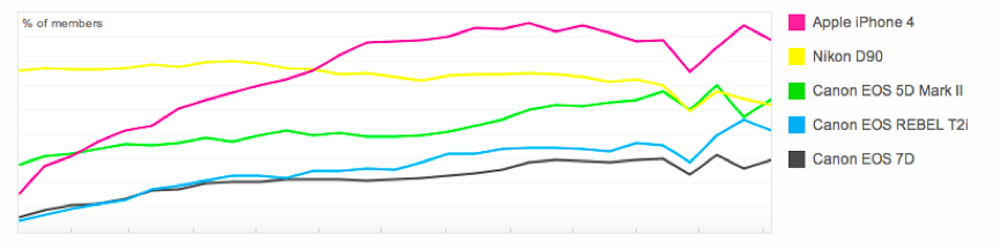
Unfortunately this graph doesn’t tell the whole story.
I downloaded Flickr data and analysed the number of items uploaded to Flickr over the past year for several popular camera and phone manufacturers.
The charts below show that images taken with camera phones only represent approximately 3% of the total. The actual number may be a little higher because Flickr can’t always identify the type of camera that has taken the image, but it’s still a very small percentage of the overall whole.
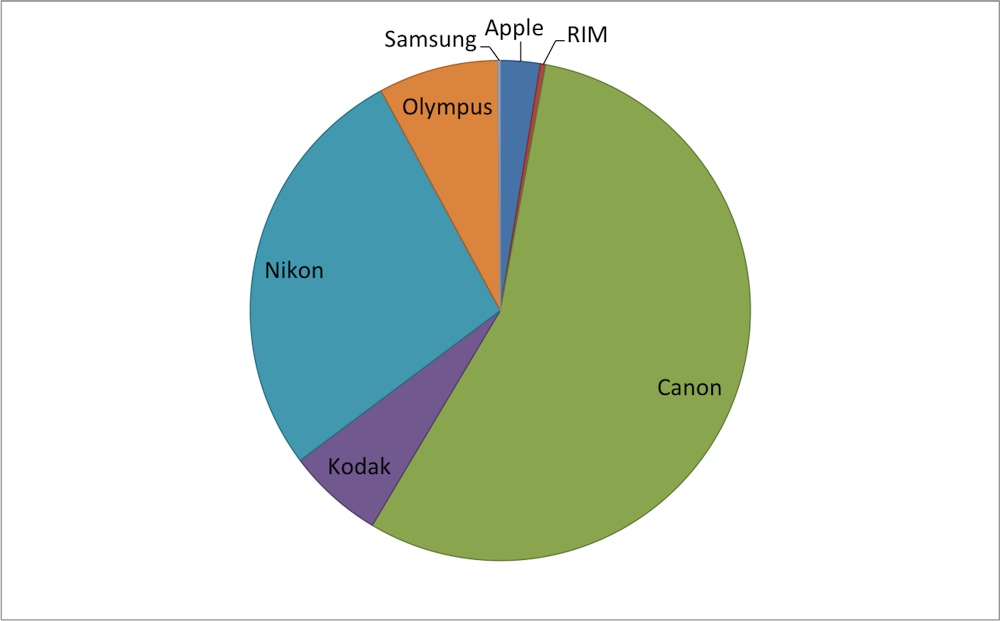
The other thing to note is that Kodak cameras are only responsible for 6% of images overall and that Canon and Nikon are by far the most dominant players in this market.
(Admittedly, the number of images on Flickr is about 5% of that on Facebook. It would be interesting to repeat this analysis using Facebook data, but there is no reason to believe the results would be substantially different.)

‘Kodak failed to innovate’
Kodak’s financial problems aren’t necessarily due to a failure to innovate, or a failure to recognise the shift from print to digital photography. In fact, Kodak has been involved in the rise of digital cameras at virtually every step:
- Kodak electrical engineer, Steve Sasson, actually “invented” the digital camera in 1975.
- Kodak partnered with Nikon in 1991 to produce a professional-grade digital camera with a whopping 1.3 Megapixels (you can buy 12 Megapixel cameras for under $100 now).
- In 1995, Kodak released their first “point-and-shoot” camera.
One of Kodak’s chief assets is its collection of patents, which company executives have been trying to sell. Kodak has also been pursuing other companies – including phone manufacturers Apple and Research in Motion – for infringing their patents on the ability to preview photos on their phones.

Why people take photographs and what they do with them
Where Kodak got it wrong was its perception that people were still taking photographs which they would then print.
But this is increasingly no longer the case.
From dedicated photo print shops to automated kiosks, Kodak persisted with this notion for longer than it should have. A large part of the company’s more recent business strategy has focused on printers and ink. But here, as with their digital cameras, Kodak only holds a small market share – roughly 2.6%.
In the days of film cameras, personal photography was principally about holding on to personal memories, with photos usually ending up in a shoebox.

But recent research by anthropologists, sociologists and psychologists suggests personal photography has moved from being mostly a tool for remembering, to one of emphasising communication and our individual identities.
As with most change, researchers have noted this switch most prominently in teenagers and young adults.
This shift has been supported by the changes in underlying technology and the advent of “frictionless” sharing of photos and video via social network platforms. In the context of photography, “frictionless sharing” means minimising the number of steps between taking a photo and sharing it via a social network platform.
But in terms of technology, the real shift came when camera phones (in particular) reached a certain quality.
Many of the cameras found on today’s phones are at least five Megapixels. For people making a decision between using their phone and bringing along a dedicated point-and-click camera, this five Megapixel resolution probably represents the tipping point in favour of the phone.
But as we have seen with the data from Flickr, the move to the camera phone is still gathering momentum and other digital cameras are still popular.
Frictionless photo sharing
The real accelerator for frictionless sharing of photos has been the ability to instantly upload photographs to social networking platforms such as Facebook and Twitter, and to blog software such as Posterous and Tumblr. The iPhone, in particular, has popularised specialised photo sharing apps such as Instagram and Hipstamatic.

Sharing a photo in this way is more about communication and less about remembering. The photo usually has some commentary (“Miserable in New York today.”) and is “liked” and commented on by friends and others with whom it is shared.
Another important part of photography’s shift from memory tool to communication medium is that the photos are purposely temporary. The sheer volume of photographs taken and uploaded by individuals limits the shelf-life of these photos.
Of course this may change with features such as Facebook’s timeline, which attempts to make it much easier to access photos for the purpose of remembering.
(It’s worth noting that in 2011, approximately 70 billion photographs were uploaded to Facebook, with some estimates putting that figure closer to 100 billion photographs. Either way, Facebook is the largest photo sharing site by a considerable margin.)
It is hard to see a role for Kodak in all of this. Even with a company restructure, they would still be competing with companies such as Nikon and Canon; companies which are much stronger in the hardware and technology markets.
The real value in photography today is the software and platforms used for sharing and distribution. Kodak would need to pull off a miracle to become a major player in this space.
In all likelihood, Kodak’s moment might have passed.
Join the conversation
Comments (24)
Stewart Johnson
(logged in via LinkedIn)
"It would be interesting to repeat this analysis using Facebook data, but there is no reason to believe the results would be substantially different."
I think there are reasons to think it would be different -- Facebook ranks number 1 in percentage of people's time spent on the internet, and is not a dedicated photography site like Flickr. I don't have numbers, but I would expect that the proportion of phone camera photos on Facebook would be much higher than Flickr.
David Glance
(Director, Centre for Software Practice at University of Western Australia)
Hi Stewart, yes I certainly thought that initially - that Flickr was a more specialised site - but I think the reasons and decision to save photos to Flickr of Facebook - for the purpose of saving them - would remain the same. But it would be good to see the data.
Mark Devlin
(logged in via Facebook)
Results using Facebook would be VERY different. Flickr is well known as a site for semi-pro photographers. Of all of my Facebook friends only two use Flickr, both of them have pro-level cameras and would consider themselves to be "photographers". Everyone else uses Facebook with 90% of the photos taken with their phones and about 20% of those filtered with Instagram.
Mark Harrigan
Dr (logged in via email @tpg.com.au)
I worked for Kodak for a number of years in the 80's and early 90's. First in their R&D labs and then in technology marketing (with a focus on digital and electronic technology). They were a great company to work for and in their heyday were a world leader.
This article and the analysis as to the reasons for Kodak's demise is interesting - but not I think entirely accurate. In fact the future demise was obvious to many of us within the company, especially those of us who were in the technology…
show full comment
John ED Barker
(Adjunct Professor at Murdoch University)
A very valuable contribution, Mark. It's often very difficult to get an objective inside story about a large company in decline- most players want to blame, deny or move on quietly.
Your comment: "The "old guard" continued to focus (for understandable reasons) on preserving film and print for as long as possible - and indeed did pretty well in innovating to maximise the linkages between digital (which has superior capture-convenience, storage, management and sharing capabilities but lower capture…
show full comment
Clayton Esterson
(logged in via LinkedIn)
Hi Steve,
A good, insightful article. I worked with Intel and Kodak when they were partnered to develop a digital camera in the late 90's. Although the outcome was these digital kiosks, much could be written about what went wrong in that relationship.
In the early days, Kodak was a leader in the digital camera business. They were the #1 digital camera maker and sold excellent digital cameras and lost money on every consumer camera they sold. As you indicated, Kodak badly over-estimated the…
show full comment
Walter Dufresne
commercial photographer (logged in via email @wd-p.com)
"Kodak saw ... the death of film, but was unable to transition ... ."
Hear, hear and amen. While more than a few Eastman Kodak ad campaigns from the late 20th Century focused on using photography to make memories, Eastman's revenues and profits came from selling expendable supplies: silver-salt films and papers and their processing chemicals.
The new digital sensors (complimentary metal oxide semiconductors and charged coupled devices) destroyed the market for the thing Kodak made and sold, silver-salt films and papers.
A sensor that a photographer can expose only once is now an anachronism.
David Glance
(Director, Centre for Software Practice at University of Western Australia)
Hi Clayton - I passed a drug store in the city yesterday and I must admit to being surprised that they even still offered the print kiosk service - but you are right - they were all Fuji - the dedicated kodak shop in our town went last year
Jane Rawson
(Editor, The Conversation)
Hi David
given everyone's enthusiasm for seamless sharing, do you have any idea why no cameras (as far as I can tell) give you the ability to directly upload your photos to the internet (without going via a computer)?
Grendels
(logged in via Twitter)
Jane, There are indeed several models of camera that upload directly to the internet - the first of these was in fact produced by Kodak. Nikon, Canon, Sony and Panasonic all have cameras with at least WiFi capability. The main reason that most cameras don't have direct upload capability seems to be the bandwidth required if you were to enable this over 3g networks using a camera capable of producing high resolution images. It can be done, and it is done, but it is not yet a common feature. Given the size of some image files it may be a while before 3g or more likely 4g networks can manage to do this quickly.
There is a company that sells SD cards with geo tagging and wifi capability built in to the card allowing potentially any camera that uses that type of card to directly upload images.
Jane Rawson
(Editor, The Conversation)
Thanks Grendels, this is good to know. Unsurprising that my premise was not founded in fact!
David Glance
(Director, Centre for Software Practice at University of Western Australia)
Hi Jane - in fact there were new point-and-click cameras from Samsung announced at CES supposedly "unweirding" the wireless connection process and providing cloud storage of photos
M Cline
Good Guy (logged in via email @georgetown.edu)
While this data is interesting, I think you are making the wrong conclusion. For the past 25 years or so, Kodak had made most of their money from the sale of film and items relating to developing film (sellilng the machines, chemicals and running a wholesale developing business). They had long ago ceded the building of cameras themselves to other companies (such as Nikon, Canon, etc)
The problem for them is that the part of the value chain that they were in doesn't exist anymore. The closest…
show full comment
Glen Fuller
(logged in via Twitter)
Hi David, are you familiar with histories of Kodak? Specifically, the role of Kodak in being a central actor in producing the concept of photographic biography/memory as a marketing exercise to sell more cameras. See, for example, Kamal A. Munir and Nelson Phillips (2005) “The Birth of the ‘Kodak Moment’: Institutional Entrepreneurship and the Adoption of New Technologies” http://oss.sagepub.com/content/26/11/1665.short
If this history is accurate, then there seems to have been a failure in the corporate culture at kodak to properly produce new markets.
Mark Harrigan
Dr (logged in via email @tpg.com.au)
Glen - I've not read the history - but it sounds like bunk to me.
There was never that much money in cameras per se - for a long time all the Kodak branded cameras will manufactured (OEM) by Chinon and then Kodak branded.
While money was made from that effort, that was not the point.
It's pretty much the gillette strategy (who actually derived it from Kodak) - we sold Cameras as a vehicle to sell film - not the other way around
In consumer land we never cared much about selling more Cameras EXCEPT as a means to sell more film. We knew that, on average, the amount of film put through a camera (or amount of shots taken) was maximised in the first few weeks/months of the camera's life. A real Pareto effect where 80% of the photos taken occur in the first 20% of the camera's life
Glen Fuller
(logged in via Twitter)
Mark, the histories discussed in the article to which I linked above go back to the early 20th century.
The article discusses the way Kodak marketing was central to the process of transforming photography from a specialised and professional practice into something that belonged to anyone who could afford the consumer-based technologies. The article is interesting in the way it argues that entrepreneurial activity is, in part, the production of new markets.
The best example of the photography/memory assemblage is the 'photo album', which according to the article was created and popularised by Kodak's marketing department.
Mark Harrigan
Dr (logged in via email @tpg.com.au)
Interesting Glenn - I guess it illustrates how things change over time. Whilst the concept of "memories" is interesting in terms of consumer popularisation 100 years ago it had become redundant by the 70's/80's. As I indicated Kodak well understood then the "problem" of the "shoebox" - where most photos finished up never to be view again.
We understood quite well that the main purpose of photo prints was to "share" with loved ones, friends etc - albeit the method of sharing pre-digital was via…
show full comment
David Glance
(Director, Centre for Software Practice at University of Western Australia)
Interesting article Glen - certainly one's ability to set the agenda when you have a dominant hold in the market is going to be different to when that time has passed.
Coincidentally there is an article about 7 habits of unsuccessful CEOs - one of which is to rely on what worked in the past http://www.forbes.com/sites/ericjackson/2012/01/02/the-seven-habits-of-spectacularly-unsuccessful-executives/3/
Steve Hill
Management consultant (logged in via email @gmail.com)
The initial assertions of this article feel pretty weak:
1) The % of photos uploaded from a dedicated camera to flickr is a *worse* indicator of the success or otherwise of dedicated cameras than the % of flickr members using dedicated cameras. The latter gives you some indication of commercial success; the former just tells you about how heavily cameras are used.
2) Flickr has large numbers of serious users -- amateur and professional -- who upload very large numbers of photos from dedicated kit. It has a wildly different userbase, using the site for wildly different purposes (e.g., showcasing their artistic abilities), to facebook, which is dominated by people taking quick snaps and sharing them with friends.
David Glance
(Director, Centre for Software Practice at University of Western Australia)
Hi Steve,
Actually if you look at world camera market share, the data is equivalent - Canon is 20% of the market, Nikon 13% and Kodak 7% http://www.1001noisycameras.com/2011/04/year-in-review-5-global-2010-digital-camera-market-share-according-to-idc-japan.html
The point of using Flickr data was that it had been used by a journalist to assert that everyone was using iPhones instead of dedicated cameras and that clearly wash't the case on Flickr.
As for Facebook - we don't know - whilst yes, people take a lot of photos of themselves, parties etc - they also still use and take a lot of photos with dedicated cameras and still upload them to Facebook - partly because it is more convenient to store photos in Facebook - even from iPhoto for example than anywhere else and there are no limits - whereas on Flickr there are.
But we would need to look at the data to tell
John ED Barker
(Adjunct Professor at Murdoch University)
An interesting and thought provoking article, David.
Although the discussion on Kodak's relative share on Flickr and Facebook provokes the question as to what are most people doing with their photographic images, I'm not sure that it directly relates to the question as to why Kodak is tanking. A large market share is nice, but not necessary for success: a good example is Apple Computer, which, before the iPod, iPhone and IPad, only had a single-figure share of the laptop and desktop computer market…
show full comment
David Glance
(Director, Centre for Software Practice at University of Western Australia)
Thanks for your insights John - I will read the Mendes article. One of my particular interests in technology is how it fits in with social and cultural trends. This made Glen's article and the van Dijck article I mentioned particularly interesting approaches to viewing how photography fits in with our lives and how much of that is shaped and/or misinterpreted by companies Whilst you are probably right about the details of the business failures, all of those decisions by Kodak were made by people sticking to their view of the world - so perhaps this is why they would have so badly overestimated the volume of print as Clayton mentioned?
John ED Barker
(Adjunct Professor at Murdoch University)
I certainly agree with your main point, David- in marketing terms that's 'customer focus'.
Mendes refers to this in the context of Ted Levitt's legendary 1960 HBR paper 'Marketing Myopia' (see http://en.wikipedia.org/wiki/Marketing_myopia and www.casadogalo.com/marketingmyopia.pdf for a download). In Levitt's terms 'what business is/was Kodak in?'- it claimed to be in the permanent image (memories) business when it was mainly in the chemicals and paper business.
It's an interesting question…
show full comment
tinny-medi
(logged in via Twitter)
great article Dave, certainly the most clear-headed and insightful discussion of the "Death of Kodak" i have read to date.
one thing that struck me early in the article was your critique of the Titlow analysis. i was intrigued that his breakdown compared the "extremes" only; a handful of popular DSLRs vs only one make and model of camera-phone. it's just a hunch on my part, but inclusion of point-and-shoots might have told a more interesting story. that said, i think that your brand-based pie…
show full comment