


A seemingly harmless interview with a journalist in the lead-up to a public lecture has unleashed a torrent of abuse about my view of one aspect of raising infants.
I take some responsibility as my use of language may not have been as guarded as it should’ve been – an outcome of believing that the majority of journalists mean no harm.
It all started a couple of months ago when I was asked to participate in the UTS Speaks program and talk about raising babies.
I’ve always been a committed parent-educator because I believe parents want factual information about how best to raise their children.
My lecture on Tuesday night focused on the importance of the development of self-regulation, parents’ important role in this crucial task in early childhood and the importance of understanding infant experience.
During the lecture, I showed a 90-second video as an example of what an infant in an outward facing pouch might experience in a shopping mall. It was not a very pleasant experience.
The lecture also explored infant states of consciousness, infant cues and early brain development.
There is a wealth of rich and trustworthy research from neuroscience about early brain development, the impact of stress on the developing brain and infant-parent attachment.
There was also some interesting relevant research completed in the United Kingdom by a researcher at the University of Dundee.
All this work formed the foundation of my discussion.
Research on prams
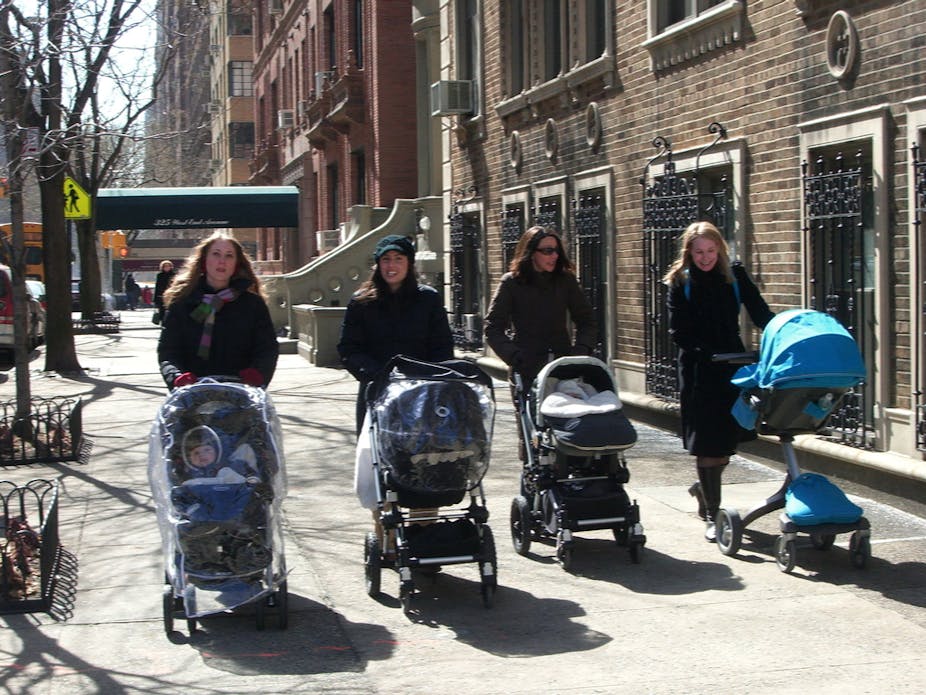
In 2008, Dr Susan Zeedyk and her assistants completed 2722 infant observations in 54 UK sites.
This study and another involving 20 extended observations showed – not surprisingly – that using outward-facing prams led to reduced talking to the infant by the parent.
The researchers also found that infants in parent-facing prams were more likely to fall asleep, which was interpreted as a tentative measure of lowered stress levels.
What’s more, babies and their parents in parent-facing prams were more likely to laugh.
And babies were found to be unable to effectively seek their parent’s attention if they were facing away from them.
This research suggests that it’s more isolating for babies to face outwards than parents or researchers had previously realized.
In the smaller study, mothers with prams that had infants facing away were given the opportunity to use parent-facing prams.
The majority felt it greatly improved their interaction with their infant and was much more enjoyable and fun.
The lecture was very well received with overwhelmingly positive feedback and a discussion about why this information is not readily available to parents.
One of the suggestions was that the media should ensure this rich, evidence-based and interesting information about parenting and infants is featured in reports.
The role of the media
In the lead-up to the lecture, I was interviewed by a journalist from the Sunday Telegraph, who I thought was interested in the content of my lecture.
I spoke to her about the importance of parents understanding the infant experience, told her about my video, as an illustration, and discussed why we should rethink the use of some baby equipment.
I also emphasised the need to be sensitive with the story as my intent was not to make parents feel guilty. I think I was far too trusting in assuming that everyone had the best interest of infants at heart.
So I was disappointed and concerned when the article was published last Sunday because it focused only on the example I had given, failed to provide all the facts and was written in extremely emotive language.
Much of what I had said was taken out of context.
The article included counter views and one of the researchers quoted has since rung and given me her support as she was equally appalled about the focus of the story and the lack of facts.
I felt that I’d been set-up by the journalist.
The aftermath
In the days since the article was published, I have received hate emails, had unpleasant notices placed on cars around my workplace and had a flurry of media contacts.
Some of the media interviews ended with, “of course that makes sense”. Some journalists even cancelled the interview because they thought it was a non-story.
I decided not to ignore the emails and am pleased I responded by laying out research findings. I have received numerous apologies from these people.
The wonderful thing about this experience has been the emails and phone calls of support I have received from my colleagues and the general public who understand that the health of our infants is paramount.
Clearing the air
Please understand that I’ve never suggested parents rush out to buy a new pram. What they could do instead is to become more aware of their infants, regularly talk to them and touch them.
And, in all honesty, I would love to see baby equipment producers become more sensitive to infant developmental needs.
The most disturbing thing for me is that a suggestion that infants like to and need to see their parents and interact with them has caused so much anger.
My intention has never been to make parents feel guilty – I am a parent myself and know how difficult it can be to make decisions about parenting.
Sadly, other health professionals have allowed themselves to be caught up in this on-going attack on my integrity and I question their motives.
But I know now why many of my colleagues are reluctant to talk to the media.
This is a loss for the whole community and the call at the end of my lecture about the media taking up the role of linking people with evidence-based and interesting information about parenting remains unheeded.
The most positive thing about this experience is that a conversation about infant care has started.
Rather than attacking me, maybe we can, as a community, start to focus on our most precious and vulnerable citizens, our infants.