
The Conversation
Subscribe
  • Academic rigour, journalistic flair
  • For curious minds
  • Expert news and views
  • Debate and ideas
  • From the curious to the serious

Hot Topics

  1. Gay marriage
  2. Australia in the Asian Century
  3. Convergence review
  4. Federal Budget 2012
  5. War on drugs
  6. Bob Brown
  7. Explainer
  8. Square Kilometre Array
  9. Medical myths
  10. Transparency and medicine

New South Wales puts the screws on political funding … but who benefits?

Since 2010, New South Wales has had the most regulated political finance system in Australian history. This includes caps on expenditure in the six month period before an election and low annual limits on donations to parties ($5000) and candidates ($2000). And at midnight on Wednesday, the Liberal…

Gkzcydt7-1329447722
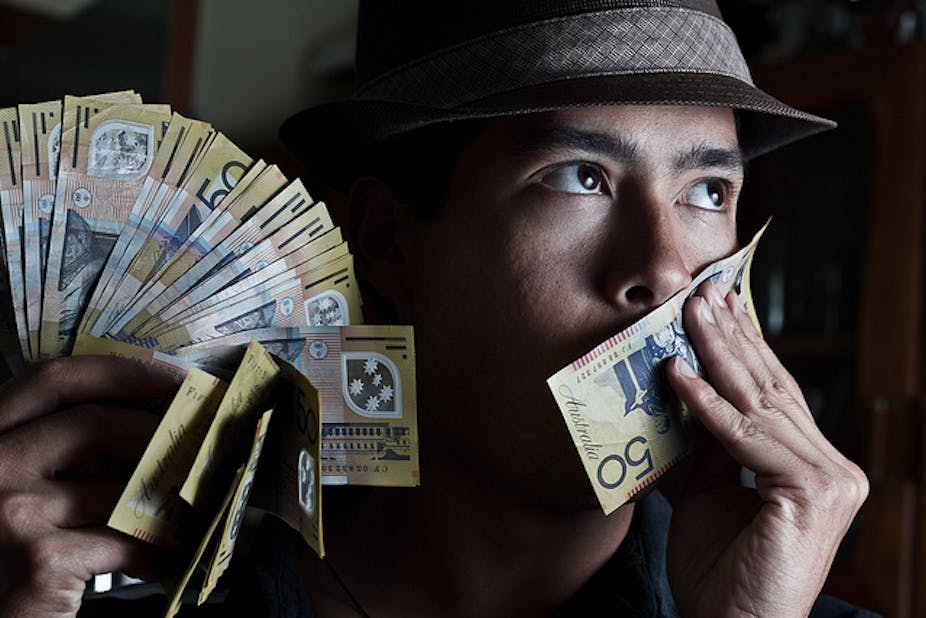
Individuals can give thousands of dollars to political parties in NSW, but corporations can’t. Rgs_

Since 2010, New South Wales has had the most regulated political finance system in Australian history. This includes caps on expenditure in the six month period before an election and low annual limits on donations to parties ($5000) and candidates ($2000).

And at midnight on Wednesday, the Liberal-National government, with Greens support, screwed the system even tighter.

Sadly, it did so with an unfortunate partisanship, steamrolling over a multi-party report released only that day. And it did so with such haste that elements of the new rules are constitutionally suspect.

Banning organisational donations

The new law does three things. The first is to prohibit anyone but New South Wales voters from making donations. Even small corporate donations are now banned. This adopts the individualistic approach to politics seen in US and Canadian law.

Reasonable minds differ on the desirability of this. The American approach, for over a century, was to assume all direct corporate donations to parties or candidates were corrupting, and to treat union money as the same. Also, as a basic legal principle, only individuals can vote.

In contrast, as Joo-Cheong Tham has argued, politics is not just about the interests of individual electors. Wealthy New South Wales electors will be able to donate $5000 a year to their favoured party, but what of poorer folk who rely on collective voices? And what of permanent residents, who are denied the vote but have interests deserving representation?

The most significant effect of the new law is that unions now cannot pay affiliation fees to New South Wales Labor. The multi-party report recommended limiting such fees to a few dollars per member, and requiring a union ballot. This would have lessened the burden of the law on the freedom of association.

Nobbling the union-ALP link

The second change is to count any spending by a body affiliated with a party as spending by that party. This “aggregation” rule is blatantly anti-Labor. The report had recommended that only “co-ordinated” campaigns be counted.

The combination of banning union contributions to Labor, and treating union electioneering as if it were Labor’s, is a heavy interference with freedom of association. I very much doubt this is constitutional.

Interest groups

The third major effect, which the government has not deeply thought through, is on interest groups.

A wealthy business like BHP (or a union) is still permitted to use its own money to run a campaign during an election period. A group such as Get Up! can continue to rely on its individual donors, but will have to be careful about any union money it accepts.

But a collection of not-for-profits would have been banned from pooling their money to run an effective campaign in the six month “election period”. Andrew Norton has argued that such laws risk stymieing interest group campaigning.

To alleviate this unfairness, the government introduced a last-minute amendment, seeking to exclude “issue advertising” from the regime. Only the cost of advertising with a “dominant purpose” of influencing voting is now regulated.

A loophole for “issue advertising”?

“Issue advertising” is an inevitably fuzzy concept. If the AMA campaigns for tighter anti-smoking policy in the election period, that surely is “issue advertising”. But what if it is supporting plain cigarette packaging – a Labor government measure opposed by the Coalition? The effect is partisan, but we have to guess as to the purpose.

In the US in the past, money flowed to front groups to take advantage of “issue advertising” loopholes. We don’t want that sort of sneaky politicking here, and hopefully our culture is more robust.

But regulating money anywhere can be like flattening a bump in a water bed. The risk is that big business interests (and union money) will flow into unlimited and cleverly designed “issue advertising' with an underlying partisan purpose.

National implications

In the bigger picture, we can see that New South Wales, and Queensland with its 2011 reforms, are moving well ahead of the Commonwealth, which is proving timorous about capping donations or expenditure.

But such differentiation risks confusion between different levels of government. This confusion is exacerbated because politics is fluid. It is not always easy to pigeonhole affairs as “state” rather than “national”.

On the upside, these reforms remind us that in a federation, experimentation and leadership come from the states as much as the centre. But whoever legislates, especially in a sensitive area like political rights, they ought hasten slowly and build cross-party consensus, something that seems to have been lacking in NSW.

Join the conversation

Comments (8)

  1. Permalink
    Gavin Moodie

    Gavin Moodie

    Principal Policy Adviser (logged in via email @telstra.com)

    Yes, I do mean that making a misleading or deceptive political statement should be an offence. It is of course an offence in trade or commerce and I think politics is as important as business.

  2. Permalink
    Gavin Moodie

    Gavin Moodie

    Principal Policy Adviser (logged in via email @telstra.com)

    Thanx for this, which I found most informative.

    As I recall, voting eligibility and electoral districts were subject to partisan changes between the left and the right in the first decades of the federation, but eventually a neutral position was accepted by both sides. While the Howard Government changed voter eligibility for partisan advantage, fortunately Labor returned rules back to neutral rather than sought to bias them left.

    Hopefully political funding and spending laws will reach a sensible neutral position rather sooner. Perhaps Australia may need an Australian political funding and spending commission.

  3. Permalink
    James Walker

    James Walker

    (logged in via Facebook)

    We don't vote on parties or premiers, we vote for local representatives. Political advertising is such a nightmare because we don't have easy access to the candidates that we are actually able to vote for, so have to rely on the drivel in the media. If AEC hosted a site, where you logged on and got to see 2-5 minute presentations by each candidate in your electorate, we could easily vote in an informed fashion, and thus destroy the current power of advertising.

  4. Permalink
    Tim Benham

    Tim Benham

    Student (logged in via email @uqconnect.edu.au)

    I suggest a radical alternative to state control over the quantum of political speech. I call "free speech". Under free speech, each individual, union, corporation, and indeed entity of sort, would be free to say whatever they like (and spend as much as they were willing to say it), subject to minimally intrusive restrictions on defamation, fraud, incitement to violence, and false utterances likely to cause imminent harm. These restrictions would be enforced by post facto prosecution rather than prior restraint.

    Could such a system work?

  5. Permalink
    Gavin Moodie

    Gavin Moodie

    Principal Policy Adviser (logged in via email @telstra.com)

    There are 2 problems with 'free speech' which caps on political funding and expenditure seek to fix. First, the person or group with the most money is able to buy most exposure for their views and thus disproportionate political influence.

    Secondly, recognising the power of advertisements, political parties seek to increase their revenue which leads them to sell access, influence and perhaps even votes to the highest bidder.

    I would make it an offence to make any political statement that is misleading or deceptive or with the intention to mislead or deceive.

  6. Permalink
    Graeme Orr

    Graeme Orr

    (University of Queensland)

    Touché Tim: that's the US system and still the one we have federally (but definitely not the one we inherited from the Brits in the 1880s). I do query the word 'willing' to spend: why not just let those 'willing' to buy as many votes as they like? Like shares in a big co-operative corporation.

    James, that's as nice a deliberative democratic suggestion as I've seen. (Indeed it's akin to what a lot of organizational elections do, with even handed candidate statements. General elections are more complex though, issue-wise).

    Gavin: do you strictly mean an 'offence'? (But after being skeptical of the concept of 'truth' in political and social advertising, I'm coming around to your way of thinking, for deliberative reasons).

  7. Permalink
    Graeme Orr

    Graeme Orr

    (University of Queensland)

    Gavin I was overreading you. ('Offence' often means criminal penalties, but you can have civil fines, consequences for election or future candidature). Yes, there would need to be civil sanctions.