
The Conversation
Subscribe
  • Academic rigour, journalistic flair
  • For curious minds
  • Expert news and views
  • Debate and ideas
  • From the curious to the serious

Hot Topics

  1. Gay marriage
  2. Australia in the Asian Century
  3. Convergence review
  4. Federal Budget 2012
  5. War on drugs
  6. Bob Brown
  7. Explainer
  8. Square Kilometre Array
  9. Medical myths
  10. Transparency and medicine

Nobel Prize win tells us the universe is accelerating … what does that mean?

Occasionally, very occasionally, a discovery comes along that reshapes our view of the universe. Some discoveries teach us about ourselves; some teach us how to better interact with the world around us; some teach us how much we yet have to learn and, by revealing our ignorance, teach us humility…

Hs-1996-38-b-web-1317958126
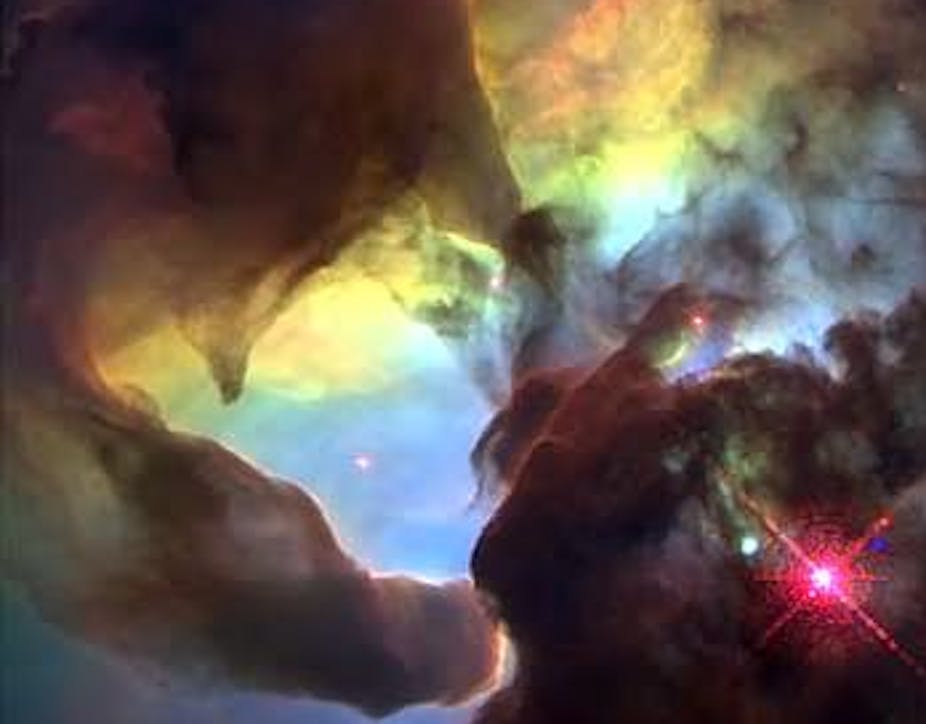
Our understanding of the universe has been changed for ever. A. Caulet (ST-ECF, ESA)/NASA

Occasionally, very occasionally, a discovery comes along that reshapes our view of the universe.

Some discoveries teach us about ourselves; some teach us how to better interact with the world around us; some teach us how much we yet have to learn and, by revealing our ignorance, teach us humility.

The research that won this year’s Nobel Prize in physics falls into the last category.

As you’ll no doubt know by now, two teams of astrophysicists studying distant supernovae, discovered something very strange: the expansion of the universe is speeding up, contrary to everything we thought we knew about gravity.

The oddness of that discovery is profound.

It’s as though you threw a ball in the air expecting to catch it again in a moment, but instead watched in amazement as it accelerated off into space.

Hubble's greatest hits. NASA

According to this finding, gravity appears to work backwards when looking at distant galaxies.

Hubble’s 1920’s discovery that galaxies existed beyond our own Milky Way reshaped our view of our place in the cosmos.

It vastly expanded the known universe and made us realise how small and how special we really are.

The subsequent discovery that those galaxies are moving away from us, and that the universe itself was expanding, was another jolt to the system. Scientific evidence that the universe actually had a beginning. Truly amazing.

No matter how profound both of those discoveries were, though, they could both still fit within our standard laws of physics.

In fact, realising the universe was expanding fixed a problem with Einstein’s theory of relativity, which actually predicts the universe must expand or contract because stars can’t just sit still with all that gravity around to pull things together.

Big questions

The 1998 discovery by our newest Nobel Laureates in Physics, that the universe is accelerating, seemingly does the opposite.

It breaks the laws of physics. The hole it leaves in our understanding of the cosmos has yet to be filled.

This has happened before. Newton’s theory of gravity works great for calculating the motion of a cricket ball or when building a bridge.

But at the turn of last century, there were observational hints that something about Newton’s theory was broken – the orbit of Mercury, for example, was not quite right.

Astronomers even postulated the existence of an extra undiscovered planet was disturbing Mercury’s orbit.

Then Einstein came along with a new theory of gravity and showed there was no extra planet, Newton’s theory just needed revision.

These days, Einstein’s theory of gravity is in everyday use, for example in the global positioning system (GPS) so many of us now use from our phones.

The discovery of the acceleration of the universe’s expansion has put us in a similar situation: something is not quite right.

Some postulate a “dark energy” is causing the acceleration; others claim we need a new theory of gravity.

As yet, we don’t know the answer. What is obvious is that the finding has opened the way for new knowledge, and shifted the entire direction of theoretical physics research.

X-ray: NASA/CXC/SAO, Infrared: NASA/JPL-Caltech; Optical: MPIA, Calar Alto, O.Krause

Why do we care? Where might this knowledge take us?

We don’t yet know.

Discoveries are made on the fringe.

As researchers, we dance with ignorance and often spin into the unknown. Once in a while, someone finds a solid handhold and the rest of us clamber to catch on. These Nobel Prize winners have discovered a handhold, but we can’t yet understand the fundamental physics behind it.

That opens up a whole new world of possibility.

Using the dark side

The leading explanation is that the universe is brimming with some unknown stuff that has anti-gravity (let’s call it dark energy).

We hadn’t noticed it before because it doesn’t clump, so when you’re hanging out on a big clump of matter like the Earth, the effect of dark energy is dwarfed by the gravitational effect of normal matter.

If dark energy really is out there, then perhaps we can learn how to harness it.

Hover-boards? New propulsion systems? Floating cities? Cheap, clean energy?

Frivolous or fundamental, there’s no doubt the ability to manipulate gravity would drastically change our world, and technology as we know it.

There’s no indication yet that any such manipulation of dark energy is possible, so those applications are currently speculation.

But that’s one reason why these discoveries are of such import. It’s an exiting time for physics, and an exciting area to research, and I for one am happy to dedicate my days and nights to trying to figure out what the dark energy might be, and how to fix our understanding of gravity.

Thanks Brian, Adam, and Saul, for the inspiration.

Join the conversation

Comments (6)

  1. Permalink
    Tamara Davis

    Tamara Davis

    (Astrophysicist at the School of Mathematics and Physics. at University of Queensland)

    Hi Stuart,
    The universe doesn't have to be expanding into anything. I attempted to explain about that and some other cosmic conundrums in an article I wrote for Scientific American a while back. You can grab it from http://www.physics.uq.edu.au/download/tamarad .

    The question you ask about the age of the universe is an interesting one. Before the acceleration was discovered there had been a longstanding conundrum in astrophysics because the universe seemed to be younger than the stars it contained…

    show full comment

  2. Permalink
    Rob Attrill

    Rob Attrill

    retired (logged in via email @gmail.com)

    two problems occurred to me when I first started to get my head around this, and I admit I speak as a total non-scientist. The first was the obvious one that Ms Davis talks about here: the implication of a counter force to gravity. The second is when does the acceleration itself become the issue? We now have scientists tell us that neutrinos may be able to travel faster than light. What will happen to the acceleration of the universe as it begins to approach any such interesting speed?

    1. Permalink
      Tim Connors

      Tim Connors

      System Administrator (logged in via email @gmail.com)

      As Michael said, but don't be worried that individual objects are traveling away from each other faster than the speed of light, contrary to Special Relativity.. It's not the objects moving per se, it's more than space itself is expanding. Also, the "ban" on going faster the speed of light is really a ban on transmitting any sort of information faster than the speed of light. Something over the horizon can't transmit any information to you, so it's not going to violate the laws of Special Relativity.

      I didn't read the story, but I did see a hint that one possible explanation for the faster-than-light neutrinos was that the researchers may not have taken into account that gravity was different between the two sites. General Relativity causes gravity to bend space, so the geodesic path between the two sites was ~60ns shorter than what they were assuming. I just like the idea of General Rel coming in to rescue Special Rel.

    2. Permalink
      Michael J. I. Brown

      Michael J. I. Brown

      (ARC Future Fellow and Senior Lecturer at Monash University)

      There is an introduction to the possible fate of the Universe at http://en.wikipedia.org/wiki/Future_of_an_expanding_universe. Essentially what begins to happen when the expansion rate becomes exceptionally fast is the most distant objects progressively disappear from view.

      Exactly what is causing the acceleration of the expansion of the Universe is not understood. Possibilities include the a modification of gravity or vacuum energy analogous to the Casimir effect (http://en.wikipedia.org/wiki/Casimir_effect).

      The recent claim that neutrinos could travel faster than the speed of light is viewed with some scepticism by physicists. For a start, the claim is made very cautiously by the researchers in question. Also, many scientists quickly realised that the estimated speed of the neutrinos was inconsistent with the speed of the neutrinos that arrived from supernova 1987A.

  3. Permalink
    Stuart Smith

    Stuart Smith

    (logged in via Facebook)

    What is it expanding into though? Is the space beyond space of lesser density or is the dark energy also on the outside of the universe and drawing it outwards? Also, what does this mean for dating the universe? If the universe is moving outwards at an accelerating rate does that mean it would take even longer for light to reach us and therefore the universe is older (or younger) that we first thought?