The Conversation
Subscribe
  • Academic rigour, journalistic flair
  • For curious minds
  • Expert news and views
  • Debate and ideas
  • From the curious to the serious

Hot Topics

  1. Gay marriage
  2. Australia in the Asian Century
  3. Convergence review
  4. Federal Budget 2012
  5. War on drugs
  6. Bob Brown
  7. Explainer
  8. Square Kilometre Array
  9. Medical myths
  10. Transparency and medicine

Oakeshott’s call for wood-powered electricity means more logging

We are poised at a pivotal moment for native forests, the wood products industry and climate change. Australia is moving away from a damaging native forestry industry – and a damaging conflict over its future – to a plantation industry with broad-based support. Rob Oakeshott’s push this week to promote…

Ym83nk6h-1329262961
There are dark days ahead for Australian forests if renewable energy plan gets the nod. jwbenwell/Flickr

We are poised at a pivotal moment for native forests, the wood products industry and climate change. Australia is moving away from a damaging native forestry industry – and a damaging conflict over its future – to a plantation industry with broad-based support. Rob Oakeshott’s push this week to promote burning native-forest wood for electricity production could kick off more logging, and more conflict.

Rob Oakeshott and Tony Windsor, together with all other members of the Multi-Party Climate Change Committee, agreed in July 2011 to exclude native forest wood from being subsidised as a renewable energy resource. This decision put in place a crucial backstop to see the end of Australia’s forest wars. But now Oakeshott has changed his position.

The Multi-Party Climate Change Committee, chaired by PM Gillard and including the Greens and Independents Tony Windsor and Rob Oakeshott, agreed to amend the Renewable Energy Target regulations. Native forest biomass would no longer be regarded as “renewable” when burnt to generate electricity.

Forestry policy making has rarely been so thorough: the exclusion included products, by-products, and waste associated with or produced from, clearing or harvesting of native forests, subject to appropriate transitional arrangements for existing accredited power stations. The Committee’s decision was an environmentally sensible policy correction for a forestry industry that is exiting native forest wood resourcing.

Oakeshott's change of heart betrays a misunderstanding of Australia's forest industry. AAP

The removal meant that native forest electricity producers could still produce electricity but they would not receive Renewable Energy Certificates (RECs). The government created the RECs market to achieve its Renewable Energy Target: wholesale electricity retailers and some generators must source at least 20% of their electricity from renewable sources backed by RECs.

For native-forest-based energy projects, the RECs could constitute up to 50% of the project’s income.

Having signed the multi-party agreement in July, in late October 2011 Rob Oakeshott had second thoughts. With the exposure draft of the Renewable Energy Target regulations in hand and what appears to be some local business lobbying, Oakeshott asked “local residents to have their say on new rules which ban the use of native forest waste as an accredited RET energy source.”

A month later, Oakeshott appears to have turned from seeking comments to becoming a native forestry lobbyist. He said that “[b]usinesses with potential investment projects using wood waste for biomass energy should use this time [before moving his disallowance motion] to make detailed representations to the federal government and MPs who represent electorates with viable commercial forestry contracts and processing mills.”

Oakeshott’s hope from this lobbying was that “all MPs seek best policy”. From his statement, “best policy” refers to the local abattoir wanting to use some local sawmill offcuts for power. There is nothing in the regulations stopping the abattoir from using the offcuts for power. What the regulations aim to do is prevent the revenue from the RECs market opening a new and very large market for native forest wood around Australia.
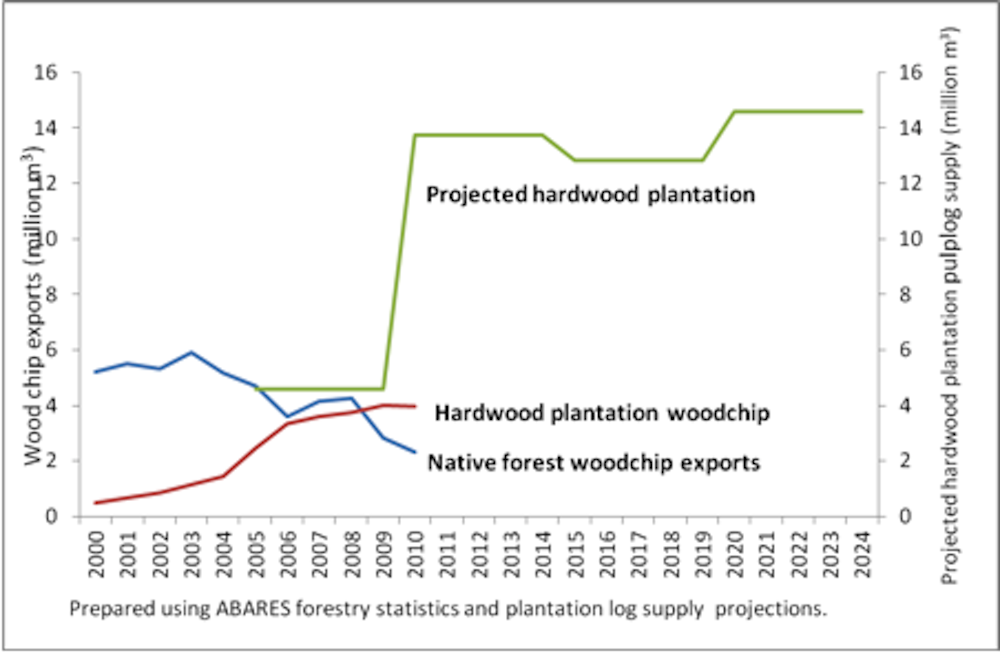
Hardwood chip exports – Australia’s opportunity to end the conflict Judith Ajani/ABARES statistics

This is not a local or peripheral issue. It is nationally important. On Friday 10 February, Oakeshott wrote to Members of Parliament explaining his move to disallow the regulations. He stated that with all aspects of the Agreement having been introduced, he has honoured the Multi-Party Climate Change Committee Agreement and is now free to vote against the agreement as expressed in a bill or regulation.

Oakeshott’s letter conveys no understanding of the Australian forestry industry situation and outlook. He states that sawn timber and paper (including woodchip exports) drives native forest logging, with energy being a sensible use of “waste”.

Missing from his account is Australia’s plantation competition: sawn timber stopped driving Australia’s native forest logging in the 1980s and woodchip exports are no longer driving native forest logging. And so evaporates the “waste”. Opening native forest wood to the energy market will turn the economically and environmentally desirable trend decline in native forest logging into increasing logging levels.

Australia’s plantation industry is about to completely displace native forest wood from the major commodity markets of sawn timber, paper and woodchip exports. Today, between 85 and 90% of Australia’s production of sawn timber and wood panels is plantation based.

As the native forest sector lost these markets to the softwood plantation competition, it became more dependent on export markets for woodchips. Now, Australia’s hardwood plantations are displacing, with ferocious speed, native forest chip exports (see figure above). In the very near future we can expect very little commodity-based logging of Australia’s native forests, as long as governments resist engineering new commercial opportunities for native forest wood.

As members of the House of Representatives decide whether to support Oakeshott’s disallowance motion they should reflect on 40 years of conflict over native forest woodchipping. If native forests are opened to burning for “renewable energy”, Australia’s forest wars will rage for many more decades.

Join the conversation

Comments (65)

  1. Permalink
    Shirley Birney

    Shirley Birney

    retiree (logged in via email @tpg.com.au)

    Burning anything produces hazardous unintended by-products leading to a deterioration in air quality and is simply 21st century lunacy promulgated by yesterday's gentlemen.

    1. Permalink
      Matthew Thredgold

      Matthew Thredgold

      Software Engineer/Secondary Teacher (logged in via email @xtra.co.nz)

      I completely concur with you Shirley. Burning wood for energy or warmth is simply outdated dirty technology. We need to eliminate woodburning altogether (as domestic heating, as rubbish burnoffs) for health, safety and environment reasons. Wood smoke is incredibly toxic and it is not something we should be dumping into the atmosphere at all (and definitely not in our towns, suburbs and denser settled rural areas). The Independent MP's call shows he does not understand the air quality issues and he needs to go back to the drawing board.

      1. Permalink
        James Szabadics

        James Szabadics

        Technical Development and R&D Manager, Plantation Timber Industry (logged in via email @technologist.com)

        It has similar emissions to burning coal - perhaps unsurprisingly. The difference is that if the wood is from a plantation it will take up the CO2 from the atmosphere again when the next cycle grows. I think that to have a viable sawmill producing natural and renewable wood products from plantations that sequester carbon in our houses and in our furnishings you must have a market for the sawmill byproducts of sawdust and chip.

        Whenever you convert an irregular approximately cylindrical object…

        show full comment

        1. Permalink
          Alex Cannara

          Alex Cannara

          (logged in via Facebook)

          When you drive trucks & tools in, cut, truck out, process, burn, and repeat. It's unsustainable -- nutrient loss, erosion, species loss, direct atmospheric warming, and fuel expenditures all around.

          It's as wasteful an idea as anyone could imagine.

        2. Permalink
          James Szabadics

          James Szabadics

          Technical Development and R&D Manager, Plantation Timber Industry (logged in via email @technologist.com)

          The article also seems to talk about pure conversion of forest into burning biomass as the primary product. This is not really viable without massive public subsidy. Given the costs of harvesting, haulage and chipping and the amount of embodied energy in the stuff, the capital cost of the land etc you would go broke quickly if you converted a log that costs approx $100 per cubic meter at an efficiency of say 30% into electricity then use half of that energy to run the chipping for a final efficiency of 15% and even less when you consider the energy from harvesting and haulage. This is why you need sawmills to value add and only use the unavoidable byproduct can be used for biomass. Its a question of the best thing you can do with an unavoidable byproduct.

  2. Permalink
    Peter Davies

    Peter Davies

    Bio-refinery technology developer (logged in via email @gmail.com)

    By all means do away with large scale clear cutting which is a abomination, but don't have the arrogance or ignorance to assume no management is somehow a panacea.

    My wife and I have been involved in sustainable management of native forest for several decades. Oakeshott has made the right decision, the choice to exclude native forest is an ideological one made for political expediency, not good science.

    All the competent and objective forest scientists we have known have been progressively…

    show full comment

  3. Permalink
    Mark Graham

    Mark Graham

    Ecologist (logged in via email @yahoo.com.au)

    Bernie Masters writes:
    "The economic reality is that, if the timber industry can make higher profits from the logs currently harvested from native forests, then the increased profitability will allow them to pay higher royalties to state governments who in turn will be better able to manage the entire native forest estate (of which only a small proportion is available for logging)."

    The economic reality is not how you report it. Around Australia native forestry operations on public lands are…

    show full comment

    1. Permalink
      Bernie Masters

      Bernie Masters

      environmental consultant (logged in via email @iinet.net.au)

      The old furphy that taxpayers subsidise the native forests timber industry being sufficient justification to close it down needs to be put to bed once and for all. There are precious few government activities that aren't subsidised by the taxpayer: defense, education, health, housing, Aboriginal affairs, etc. If timber was the only output from our native forests, then maybe we shouldn't subsidise it, but in fact we get honey, water, nature conservation, recreation, fire protection and a host of other benefits from our forests that deserve some level of taxpayer support.

      So the issue is not whether taxpayer subsidy is good or bad - it's good - or necessary or unnecessary - it's undoubtedly necessary - but the debate should be about how much subsidy we should pay to maintain the many benefits coming from our forests.

      1. Permalink
        Mark Graham

        Mark Graham

        Ecologist (logged in via email @yahoo.com.au)

        Bernie

        Are you suggesting that our education, health, housing and Aboriginal affairs agencies are profit making enterprises where private companies make a quid? Because that is what happens with our public forests. Government Forestry agencies shovel tens of millions of dollars into their operations so that large private companies such as Boral can profit from the extraction of a publicly owned resource.

        All the benefits that public forests provide that you raise above are provided without the input of tens of millions of dollars of taxpayer funds . In fact most of them cost the taxpayer nothing (eg. honey, water).

        The only furphy getting about is the one where burning native forests to generate electricity is in any way sustainable or renewable. This gross misrepresentation needs to be put to bed once and for all.

        1. Permalink
          Mark Graham

          Mark Graham

          Ecologist (logged in via email @yahoo.com.au)

          Bernie

          To my post above I add the following facts. If public native forests are not logged then they provide our society with considerably more water, honey and biodiversity than if they are. The reduction in water flowing from logged catchments compared to unlogged is well-quantified, as is the loss of biodiversity, particularly for our numerous hollow-dependent species.

          1. Permalink
            Bernie Masters

            Bernie Masters

            environmental consultant (logged in via email @iinet.net.au)

            I can only speak for the south west WA forests that I know well. Climate change is resulting in a massive reduction in water yield to our catchment dams, with forest thinning being trialed to see if it has merit. Phythopthora dieback disease was introduced into WA by fruit growers in the Perth hills in the 1920s and continues to spread through our native forests. Feral pigs, foxes and cats (and more recently deer) are causing serious environmental damage. People in 4WD vehicles and off-road motorbikes…

            show full comment

            1. Permalink
              Mark Graham

              Mark Graham

              Ecologist (logged in via email @yahoo.com.au)

              Hello Bernie

              You write:
              "regardless of what the timber industry has done to our forests over the last 180 years"
              If we are to look objectively at our public forests and their health we cannot disregard what logging has done to them.
              Because of logging phytophthora has become much worse. You rightly suggest that 4wds and trail bikes spread the fungus, but fail to mention that logging machinery moves lots of infected soil.
              Because of logging biodiversity has declined.
              Because of logging water…

              show full comment

              1. Permalink
                Bernie Masters

                Bernie Masters

                environmental consultant (logged in via email @iinet.net.au)

                Mark, you say "You might well feel that everything is rosy in our public forests" but I encourage you to read my previous post again as it states the complete opposite: that most things are pretty bad in our forests. But I also go on to imply that burning sawmill residue is essentially of little environmental importance when compared to everything else that's happening in our forests.

                Let's try to see the wood for the trees on this issue. Oakeshott should not be the target; instead it should be the federal government which is proposing this measure. And it is the state governments who should be severely criticised for under-funding their forest management agencies.

                1. Permalink
                  Mark Graham

                  Mark Graham

                  Ecologist (logged in via email @yahoo.com.au)

                  Dear Bernie,

                  I encourage you to actually READ Dr Ajani's article above and to get your facts straight. In case you still can't find it, Dr Ajani wrote above:
                  "Rob Oakeshott and Tony Windsor, together with all other members of the Multi-Party Climate Change Committee, agreed in July 2011 to exclude native forest wood from being subsidised as a renewable energy resource. This decision put in place a crucial backstop to see the end of Australia’s forest wars. But now Oakeshott has changed his position…

                  show full comment

                  1. Permalink
                    Bernie Masters

                    Bernie Masters

                    environmental consultant (logged in via email @iinet.net.au)

                    If the federal government wasn't supporting this measure, it would be dead in the water as it wouldn't pass through Parliament. Oakeshott is a player in this game as the government needs his vote in the lower house, but it is still the government's legislation and their MPs outnumber Oakeshott by 60 or 70 to one, so green anger should be directed against Gillard and company.

                    Is the timber industry sustainable? That's not the issue being discussed in Ajani's article which is about using timber residue to produce electricity. I don't support taking logging waste out of the forest to burn in power plants but I do support burning sawmill waste for this purpose which is far more sustainable than just burning it.

  4. Permalink
    Tim Hollo

    Tim Hollo

    Political adviser (logged in via email @aph.gov.au)

    Except, Troy, there is nothing renewable about logging native forests and burning them, is there? "Renewable" has a clear meaning and this doesn't meet it. It was always a logging industry rort to have it in the scheme in the first place.

    1. Permalink
      Troy Barry

      Troy Barry

      Mechanical Engineer (logged in via email @gmail.com)

      Of course native forests are renewable. That doesn't mean they should be cut down, but the reason for preserving them isn't the lack of renewability. It's poor policy and poor legislation to confuse woodland (the discussion applies as much to mulga scrub as to forest) conservation and renewable energy.

      Oakeshott's point is correct - using logging waste for generation is renewable and should be classed as such. Burning humpback whales, bilbies and the Endeavour replica is also renewable and shouldn't be specifically excluded in renewable energy legislation, because like native forests these things are already protected by other legislation.

      1. Permalink
        Tim Scanlon

        Tim Scanlon

        (Climate and Agronomic Extension at Department of Agriculture and Food - Western Australia)

        It isn't renewable at all. Logging doesn't take out trees, it takes out a forest. Forests are ecosystems. You can't replicate them nor transplant them. If you are lucky they might recover if left alone.

        Burning woods for energy is not a renewable energy and it is definitely not a carbon neutral activity. I outlined why this is the case in a previous article's comments:
        https://theconversation.edu.au/see-you-in-court-solving-aviation-emissions-is-an-international-mess-5183#comment_21827
        https://theconversation.edu.au/see-you-in-court-solving-aviation-emissions-is-an-international-mess-5183#comment_21944

        1. Permalink
          Troy Barry

          Troy Barry

          Mechanical Engineer (logged in via email @gmail.com)

          You are apparently assuming clear felling. Again, REC regulation isn't the appropriate legislation to restrict or control unsustainable forestry, forestry leglislation and control is.

          The arguments in your linked comments are not convincing and again confuse the issues. So what if fossil fuels are used in the timber industry? Nobody is suggesting the mineral diesel will be eligible for RECs. Any clear head can appreciate that wood is without a doubt a renewable energy source.

          1. Permalink
            Tim Scanlon

            Tim Scanlon

            (Climate and Agronomic Extension at Department of Agriculture and Food - Western Australia)

            *sigh* My point is that biomass energy is not carbon neutral and in any sense of the environment it is not renewable. Biomass being burnt is an emission, which causes rises in GHGs. The sequestering argument is void because our normal carbon cycle is no longer functioning as per normal, so any emission creates an issue.

            In terms of renewablility, if we were talking tree plantations, then I could see a (small) case, but any forest is a non-renewable entity due to the biodiversity factor. The ecosystem involved in a forest cannot be easily replaced, even mining companies recognise this when they store top soil, seeds and remnant stands.

            My arguments are not confused. You are blinkered by an idealogue of logging as harvesting. All logging disturbs the forest, clear fell being the worst example.

            You are also taking minor points I made (i.e. creating a straw man) to dismiss my larger points of the spurious nature of burning wood as an energy source.

            1. Permalink
              Troy Barry

              Troy Barry

              Mechanical Engineer (logged in via email @gmail.com)

              Again, you still seem to assume clear felling when you talk about the removal of forests. And the loss of topsoil and biodiversity. There are already restrictions and controls on that, so there is no need to add additional restrictions via excluding timber waste from REC eligibility.

              You also confuse zero-emission generation with renewable energy. Of course timber waste combustion is carbon emitting, and there is a rather well-known government policy to deal with emissions. How that is considered is another matter and ought to consider what would happen to the carbon if the timber waste was not combusted for generation. But that also has no bearing on whether or not forests and woodlands and scrub are renewable.

              It is exactly this sort of confusion which is found in the article and in the committee outcome - conflation of all our concerns about forests being brought to bear here, when they are adequately and better addressed elsewhere.

            2. Permalink
              James Szabadics

              James Szabadics

              Technical Development and R&D Manager, Plantation Timber Industry (logged in via email @technologist.com)

              Hi Again Tim,

              The discussion in the other articles was about biofuels which comes in many forms - not just wood.

              Let's consider a plantation forest - before you can harvest it, it must grow. To grow it must take carbon from the atmosphere. So to get to the point of harvest you had to reduce atmospheric CO2. Next you have to harvest it and will probably use diesel powered machinery - that adds CO2 to the atmosphere. If you sawmill the logs and make houses and things from the wood then the…

              show full comment

              1. Permalink
                Alex Cannara

                Alex Cannara

                (logged in via Facebook)

                Yes, wood structures that last "lock up" carbon. However, cutting forests not only disturbs soil & species, it increases erosion & nutrient loss, and it engages the fallacy that planting new trees somehow makes up for removal of old.

                A mature broadleaf tree is a 50kW cooling machine. A seedling isn't. The bare or grassy ground around the seedling converts sunlight to heat, directly adding to global warming. That's why glider pilots look for open fields rather that dense forest groves when…

                show full comment

                1. Permalink
                  James Szabadics

                  James Szabadics

                  Technical Development and R&D Manager, Plantation Timber Industry (logged in via email @technologist.com)

                  Alex - don't tell the vegetarians that green photosynthesis plants aren't there for humans to get energy! I mean its not as if the foodchain of life on earth depends on photosynthesis based plant life forms.

                  Seedlings are net carbon absorbers, mature trees are carbon neutral. Shade is cooling - cant argue with that. There would be some energy conversion to infra-red by trees and more by bare ground for the first year with increasing shade till say year 5 of the trees life when the trees mature enough to give good shade. Nutrients is interesting - some plants are nitrogen fixing in the soil. Plantations are less biodiverse than mature old growth forests, but they can be established on ex- farmland which will have significant fertiliser due the history - usually at depths too deep for traditional food crops so can be good in a rotation.

                  1. Permalink
                    Alex Cannara

                    Alex Cannara

                    (logged in via Facebook)

                    James, I don't tell vegetarians anything! And vegans? Forget any communication.

                    So let me get your drift -- you don't recognize the very complex net of organisms and inorganic chemistry going on in natural lands, specifically forests?

                    So you're perfectly comfortable, in not knowing that, to drive in, cut, haul out, mechanically prep & burn trees for power?

                    Do I have that right?

                    And yes, Ma Nature didn't design photosynthesis to be predated upon by us or cows. So, what we've spent thousands of years doing is breeding, to get what we want, that Ma Nature never thought to give us.

                    1. Permalink
                      Bernie Masters

                      Bernie Masters

                      environmental consultant (logged in via email @iinet.net.au)

                      Alex, your aggressive comments beg aggressive responses, none of which are appropriate in what should be a rational and patient discussion on complex issues.

                      Without trying to be aggressive, can I respectfully point out that Ma Nature didn't design anything for anyone; nature (of which we are part) is the end result of evolution and our forests evolved over millions (not thousands) of years to create a diverse, stable but complex array of ecosystems that could best exploit whatever resources…

                      show full comment

                        1. Permalink
                          Bernie Masters

                          Bernie Masters

                          environmental consultant (logged in via email @iinet.net.au)

                          My point is that your 'Ma Nature' reply is scientifically incorrect and hence at least one of your arguments against burning sawmill residue from native forest logging is lacking credibility.

                    2. Permalink
                      James Szabadics

                      James Szabadics

                      Technical Development and R&D Manager, Plantation Timber Industry (logged in via email @technologist.com)

                      Alex, your understanding of what I have said is pretty much wrong on all counts. Please take me to task on a specific statement that I actually have made. Say your piece which expresses your own opinion and let my words express my opinions please. If you disagree with something I said then say what it is that i said that you disagree with.

                      Re your statement that plants don't exist to be eaten by humans or cows, I think you should consider that the planet's biosphere has many ways to recycle…

                      show full comment

                      1. Permalink
                        Alex Cannara

                        Alex Cannara

                        (logged in via Facebook)

                        James, wasn't I clear that your saying: "don't tell the vegetarians that green photosynthesis plants aren't there for humans to get energy! I mean its not as if the foodchain of life on earth depends on photosynthesis based plant life forms." -- was incorrect, if facetious?

                        Ans I kinda let this go by: "Nutrients is interesting - some plants are nitrogen fixing in the soil. Plantations are less biodiverse than mature old growth forests, but they can be established on ex- farmland which will have…

                        show full comment

                        1. Permalink
                          James Szabadics

                          James Szabadics

                          Technical Development and R&D Manager, Plantation Timber Industry (logged in via email @technologist.com)

                          Alex, I dont see how you are making the leaps between my statements and yours. You appear to believe that no argument from me implies ignorance. If somebody says chocolate milk is sweet it does not imply that they are ignorant of the existence of strawberry milk. I agree that trace elements are critical to healthy plant growth and i have never said anything differently to that.

                          I stand by the statement that land based lifeforms foodchain is critically dependant on plants and photosynthesis. My delivery was tongue in cheek mainly because of the ridiculous notion put forward that plants are not here to be eaten by animals, in many cases seed spreading and germination is dependant on plants being eaten by birds and animals who in turn produce fertiliser.

  5. Permalink
    Troy Barry

    Troy Barry

    Mechanical Engineer (logged in via email @gmail.com)

    It seems to me that disallowing RECs for native forest waste is a kludge. If it is a renewable energy source, it should be eligible for RECs. For clarity and simplicity, let the renewable energy regulation take care of renewable energy and not involve itself with forestry, and let forestry regulation take care of native forest logging and not concern itself itself with renewable energy. As long as the separate regulations don't contradict there is no reason to overlap.

    1. Permalink
      Lorna Jarrett

      Lorna Jarrett

      PhD candidate, science education; Physics teacher (logged in via email @diment.org)

      Troy - see Tim Scanlon's comment above on why native forests are not a renewable energy resource.

      However, Tim might have painted too optimistic a picture. He didn't mention the damage to soils from logging forests - oxidation of soil carbon and associated loss of structure (as well as significant CO2 release) to say nothing of erosion. Take a trip down the Sekonyer River in Kalimantan and ask yourself why the water isn't the famous colour of black tea anymore. Or walk over the bare rock plains of Iceland - didn't the Viking settlers get a surprise when they cut down the trees and all the volcanic soil just blew away?

      Soil erosion is essentially an irreversible process, as is loss of soil carbon because of how long the stable carbon-containing molecules take to form.

      1. Permalink
        Tim Scanlon

        Tim Scanlon

        (Climate and Agronomic Extension at Department of Agriculture and Food - Western Australia)

        Yes, I did skip a few of the points to focus on the emissiona and ecology. You're spot on about the other impacts. Forests are a complex system and any encroachment takes years, if not decades to overcome.

        From my own experience, understorey and lower storey vegetation take between 5-8 years to compensate for a cleared path in a medium rainfall environment (south-west Western Australia). You don't start to see the larger trees fully establishing until after a decade has passed. This is for a path…

        show full comment

        1. Permalink
          Lorna Jarrett

          Lorna Jarrett

          PhD candidate, science education; Physics teacher (logged in via email @diment.org)

          Soil scientists deserve all the credit for my knowledge of this topic - next time you see one, give her my regards :)

  6. Permalink
    Peter Davies

    Peter Davies

    Bio-refinery technology developer (logged in via email @gmail.com)

    Apologies for the truncated earlier post (repeat after me: thou shalt not type directly into a web page field on a live connection with clumsy fingers…)

    The cost of harvesting and collecting native forest biomass is in the order $45-60 per green tonne which would have a conversion factor to electricity of at best 0.75MW/tonne or $60-80/MW. Operation & maintenance will add another $20/MW and then there is the cost of capital itself for the power plant calculated from $2-4 million per MW installed…

    show full comment

  7. Permalink
    Peter Davies

    Peter Davies

    Bio-refinery technology developer (logged in via email @gmail.com)

    Caroline & others,
    We have seen first hand good, bad and “lock it up” forest management, the latter has an important role in the good forest management toolbox, but applied wholesale is only marginally better than the bad practices it seeks to supplant.

    One thing is certain, to just “lock forests up” means the only management applied will be to burn them periodically to reduce the fire hazard (an increasingly legislated requirement). Keeping many of these forests in a perpetual stunted and…

    show full comment

  8. Permalink
    Peter Davies

    Peter Davies

    Bio-refinery technology developer (logged in via email @gmail.com)

    Dear Caroline Copley,
    You are quite right about some in the timber industry, we have watched repeatedly as individual players “re-invent” themselves after commercial failure and go on to win new State Government timber rights on a regular basis, which they then squander, leave a large debt to all and sundry then on sell these rights at the 11th hour to others who don’t have any public scrutiny.

    Competing often community based groups with local knowledge and expertise, do not get a look in…

    show full comment

  9. Permalink
    Anthony Amis

    Anthony Amis

    Land Use Researcher (logged in via email @hotmail.com)

    Interesting discussion. I don't support burning of native forests for electricity but neither am I too enthusiastic about people promoting plantation monocultures as if they are a complete panacea to logging native forests. Barely any of the monoculture advocates are prepared to even discuss the downsides of plantations and barely do these concerns ever get discussed in no native forest logging forums.

    An interesting case study would be plantations located in close proximity to water supply reservoirs…

    show full comment

  10. Permalink
    Matthew John Bailey

    Matthew John Bailey

    Ecologist (logged in via email @bolwarra.com)

    From reading these posts these is a substantial gap between what many imagine is happening on the ground and the effect of the forestry codes and what is actually happening on the ground in our (public forests). Many of the posters need to come to Oakeschotts electorate and take a look for themselves at how harvesting is occurring in the state forests between Comboyne and Kew on the mid north coast. You will see coups that for all intents and purposes are in fact clear felled. These extremely productive…

    show full comment

    1. Permalink
      Mark Graham

      Mark Graham

      Ecologist (logged in via email @yahoo.com.au)

      Thank you for posting Matthew

      I have seen the forests near Kew that you refer to, and many similar across the NSW North Coast. What were recently productive and highly biodiverse forests have become ecological wastelands. I look forward to seeing you in your part of the world sometime soon (I am sorry for not managing to get there a few years ago!!!)

      best wishes

  11. Permalink
    Alex Cannara

    Alex Cannara

    (logged in via Facebook)

    Shirley, Tim, and any others wisely saying burning wood is dumb, are exactly right, Visit Grants Pass Oregon on a cold winter;s night about 20 years ago -- no breathing within a 20-mile radius.

    Driving cutting/transport gear into a forest to cut , remove, transport & chip firewood is about as silly and energetically inefficient a thing as one could think of. Corn ethanol here in the US is one of the few dumber ideas -- netting <1% efficiency in converting sunlight to toque at combustion vehicle…

    show full comment

    1. Permalink
      Dale Bloom

      Dale Bloom

      Laboratory analyst (logged in via email @mail.com)

      Alex
      The issue is what can be done with waste products from a sawmill. I looked at this some years ago when a local sawmill offered us sawdust and off-cuts, and the best we could do with it was use some as a bulking agent in a composting operation, and burn the rest in a boiler as a part of co-generation (it was a sugar mill)

      Apart from that, the sawdust and off-cuts had such a high lignin content and were available in such small quantities, there was not much else that could be economically done with it.

        1. Permalink
          James Szabadics

          James Szabadics

          Technical Development and R&D Manager, Plantation Timber Industry (logged in via email @technologist.com)

          Precisely guys! I believe this may have been what Oakshott has in mind with the idea of exemption from carbon tax. It would have been good if the author talked directly with Oakshott to gauge his meaning and intent but perhaps thats asking too much. I dont hink he advocates chopping down entire forests just to burn them. It would not be a viable enterprise.

  12. Permalink
    Bernie Masters

    Bernie Masters

    environmental consultant (logged in via email @iinet.net.au)

    The dishonesty of this article is quite amazing. First, it is the federal government proposing to allow residues from native forest logging to be burnt to produce electricity and gain carbon credits, not Rob Oakeshott. If Ms Ajani wishes to direct her barbs against anyone, it should be against the federal government ministers responsible for the timber industry and climate change.

    Second, there are virtually no hardwood plantations in Australia that are being grown for sawlog production. Overwhelmingly…

    show full comment

  13. Permalink
    Caroline Copley

    Caroline Copley

    student (logged in via email @yahoo.com.au)

    I agree that this is probably not a sound investment, and will probably not pay. However from my experience the industry does not seem to run on profits and is heavily subsidised. The industry in Tasmania wanted to keep running regardless when the federal leader to be offered them $600 million in buyouts. Now the industry is not making enough money even to keep the lie going, and in Tasmania they are being offered much less to get out. They want to keep logging old growth forests at all costs…

    show full comment

  14. Permalink
    Ev Cricket

    Ev Cricket

    Energy Nerd (logged in via email @gmail.com)

    Hmmm. I feel this article, and much of the discussion of this policy has been unhelpfully coarse.

    "Native forest" is a pretty ambiguous term. Sure, it's designed to capture Old Growth/secondary forests. But does this term include tree crowns from approved plantation operations? What about mallee coppricing operations? They are native, and trees.

    While a staunch conservationist, I see no value to the environment in excluding all native forestry products. Mallee coppricing offers farmers a new revenue stream, reduces atmospheric CO2, can rehabilitate land and in some cases will defer significant coal use in existing power stations. I would be happy to see the REC laws clarified and softened around this.

    1. Permalink
      Mark Graham

      Mark Graham

      Ecologist (logged in via email @yahoo.com.au)

      Ev Cricket,
      Native Forest is not an ambiguous term. It does not include tree crowns from plantations, nor does it include mallee woodlands. It is worth noting that mallee ecosystems have relatively low productivity due to climatic limitations.

  15. Permalink
    Andrew Lang

    Andrew Lang

    director SMARTimbers cooperative (logged in via email @bigpond.com)

    I am intrigued by the diverse comments to this article. I suggest that the actual article is so full of errors, unqualified value judgements, use of emotive verbs and adjectives, presumptions that it should not be carried in this newsletter as it is not a fair and balanced discussion on the issue. Ms Adjani vilifies Rob Oakeshott as a lobbyist while she clearly is one herself.
    Within every paragraph there are examples of this incontinent use of language thatis more redolent of the press releases…

    show full comment

    1. Permalink
      Mark Graham

      Mark Graham

      Ecologist (logged in via email @yahoo.com.au)

      Andrew

      Your criticism of the article seems to emanate from an industry (vested) position if your job title is anything to go by. How about clearly identifying the "errors and unqualified value judgements" in Dr Ajani's article?

      Your use of Northern European examples is troubling. There are practically no old growth forests left in Europe. Australian forests are substantially more diverse, sensitive, ancient and carbon rich than anything that has ever existed in Europe.

  16. Permalink
    Peter Davies

    Peter Davies

    Bio-refinery technology developer (logged in via email @gmail.com)

    As this article was written by an economist making the claim that increased logging will occur, I thought a little real world economics might be in order.

    The cost of harvesting and collecting native forest biomass is in the order $45-60 per green tonne which would have a conversion factor to electricity of at best 0.75MW/tonne or

  17. Permalink
    john mills

    john mills

    artist (logged in via email @msn.com)

    Anything this government says is very suspect for a starter, a desalination plant that we just never needed and should have been spent on dams to save the water that was always coming, not the water that wasn't, pink bats that killed,an NBN thats almost outdated and was before it started, a set top box costing three times a new digital TV,etc . I wonder if the sun and the wind can make electricity urrrm, der, no!! lets have red neck logging.

    1. Permalink
      Lorna Jarrett

      Lorna Jarrett

      PhD candidate, science education; Physics teacher (logged in via email @diment.org)

      Sorry John but can you clarify *which* government? As I recall the desal plant was the decision of the NSW State government - the insulation scheme was Federal.

      Also - "pink batts" don't kill. The deaths were associated with foil insulation and electrical wiring. One of the most damaging things the Opposition did was to beat up the story in an oversimplified and inaccurate way. Houses desperately NEED insulation - and now millions of Australians have got the message that they're better off without it.

      As for "set top box" and "TV" - can't comment. Don't have either.

  18. Permalink
    john mills

    john mills

    artist (logged in via email @msn.com)

    Hi Lorna, Do you really think it matters?, federal or state, i should have said politicians,point taken on the pink bats though, and a fair statement,but most people know government contractors are ripping us off, give them the pink bats and a grand to get a proper contractor, job done.no come back. 650 dollars plus for a set top box that costs 20 that you plug in and it sets itself, or a new tv with digital costs 200, myki when they just needed ticket machines on the trains, a federal and state government that allows psychiatrists to poison our temporary troubled and drug effected kids,Ive got a list if you like, just look at what they give private schools(30%) 36bil, to public(70%) 26bil something like that, if thats not corrupt what is.

  19. Permalink
    Caroline Copley

    Caroline Copley

    student (logged in via email @yahoo.com.au)

    Two parts: response to Peter's post and Alex's misbehaving, and then discussion of separation of RET and old growth.
    Peter, please don't think I was being personal, unlike Alex (sweet as he is) who has had fun with Shirley and previously with me on another issue (!), I don't believe in personal attacks to win an argument (especially about my capabilities as a biologist Alex!). However I AM being indirectly accusational to many as explained below.
    Also FSC still has a long way to go after so…

    show full comment

    1. Permalink
      Bernie Masters

      Bernie Masters

      environmental consultant (logged in via email @iinet.net.au)

      I don't know your affiliations, Caroline, but I have a real problem with your overt racism as is often displayed by many anti-logging activists. The fact that woodchips are going to Japan and that Japanese companies are involved is not relevant to this debate. Too often I have seen Japan being mentioned in a deliberate attempt to incite racially-based opposition to things that Australian (not Japanese) governments are allowing to happen in our forests.

      You raise 13 points and I don't have the…

      show full comment

      1. Permalink
        Mark Graham

        Mark Graham

        Ecologist (logged in via email @yahoo.com.au)

        Bernie

        The comments you make above are totally wrong. Most of the RFAs are a total failure. They have failed to ensure sustainable supply of timber or maintenance of biodiversity. There is abundant evidence that both are critically declining.

        Are you such a big supporter of RFAs because you were a Liberal MP?

        Publicly owned old growth forest is being logged in NSW, Victoria and Tasmania - in the case of the latter two these are the most carbon rich forests on our planet.

        1. Permalink
          Bernie Masters

          Bernie Masters

          environmental consultant (logged in via email @iinet.net.au)

          Mark: In WA, the RFA was a huge success as old growth logging was stopped and almost certainly won't restart until the forests senesce to such an extent that their natural values begin to degrade. In WA, there is no loss of biodiversity from logging but the situation may be very different in the east.

          Yes, I was a state (then independent) LIberal MP who was happy to support the federal ALP initiative we refer to as the RFA.

  20. Permalink
    Peter Volker

    Peter Volker

    Professional forester (logged in via email @gmail.com)

    The graph of hardwood plantation area is quite misleading and I'm sure the author would know this. A number of now failed MIS companies were responsible for a large increase in hardwood plantation area, much of it on marginal, leased farm land. It is now apparent that nearly 50% of the area will not be replanted after harvesting but will return to agricultural activities (cropping and grazing).

    It is not economic to grow plantations for energy, again the author should know this. Energy from…

    show full comment

    1. Permalink
      Mark Graham

      Mark Graham

      Ecologist (logged in via email @yahoo.com.au)

      Peter,
      You make a series of sweeping assertions for which you provide no evidence and some which are completely incorrect:
      1. "All the worlds leading conservation organisations have recognised that sustainable harvesting of native forests is the best way to provide for human needs for timber, fibre and energy."
      Please provide evidence of this assertion.
      2. "Most forest loss in Australia is now due to clearing for urban development."
      This statement is wrong.
      According to the Commonwealth Government…

      show full comment

      1. Permalink
        Peter Volker

        Peter Volker

        Professional forester (logged in via email @gmail.com)

        1. See the forests program of IUCN, WWF forestry policy, IPCC statement on forests. In 2004 WWF put together a Blueprint for Tasmanian forestry. the main objectives of that document have been achieved.
        2. You assert that there is clearance for forestry. I assume this is a typo and you meant agriculture. In peri-urban areas the distinction between clearing for human habitation or agriculture is moot point. The issue is that forest clearance is not due to forestry but land use change.
        3. I argue…

        show full comment