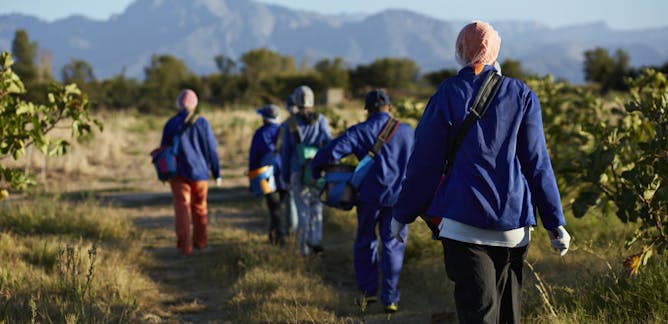
Food is an emotional topic. Everyone cares about what they eat. Food often has a strong cultural, religious or even political meaning attached to it. Organic food is no different in that respect. People…
Serious, interconnected risks are closing in on the globalised community, from climate change to anarchy. Are we heeding the warnings?
AAP/EPA/Daniel Deme
In that world of peripheral vision, essential for business, social and political leaders, it is surprising that the World Economic Forum’s report, Global Risks 2012 has not received greater publicity or…
Reaping the benefits of the Asian Century starts with food security.
Parker Michael Knight
AUSTRALIA IN THE ASIAN CENTURY – A series examining Australia’s role in the rapidly transforming Asian region. Delivered in partnership with the Australian government.
Here, Dr Peter Batt looks at Australia…
In Ethiopia, the short food supply chain has enabled consumers and food growers to have a direct relationship with each other.
Benjamin Shepherd
Poverty is definitely not some bucolic ideal that we should romanticise. It is ugly, brutal and should be fought against. But there are lessons from the poor that we, in affluent (and frequently complacent…
Chocolate supply can't keep up with demand and smallholder farmers and the environment are losing out.
Nestle
Chocolate – from the humble confectionery bar to single-origin gourmet dark chocolate – is enjoyed by most Australians as a readily available treat. However, chocolate manufacturers are worried that cocoa…
2012 is the Australian Year of the Farmer. This initiative aims to increase knowledge and understanding of the role Australian agribusiness plays in food security, technological innovation and the nation…
Honeybees are important pollinators, but not the only ones.
BugMan50
In many countries there has been concern about a decline in honeybees. You may have even heard that honeybees face dangers so dire that their imminent decline threatens world food production, with potential…
The carpet of sludge and debris left by 2011's tsunami wreaked havoc on paddyfields.
AAP
By Darren Plett, Australian Centre for Plant Functional Genomics
Japan’s tsunami of March 11 2011 brought a wall of water laden with debris up to 5 kilometres inland from the sea. After the surge receded, the surrounding farming area was left covered in debris and…
Manure is a great source of phosphorus, but we've largely removed it from agriculture.
Flickr/Amy Alana Star
By Stuart White, University of Technology, Sydney and Dana Cordell, University of Technology, Sydney
Without phosphorus we cannot produce food. Yet even as pressure mounts on this critical non-renewable resource, there is a startling lack of global governance of its use and supply. If no one takes responsibility…
The not-for-profit Foodbank Australia represents one of the largest distributors of food to hungry Australians. But what is the role of government?

AAP
Globally, more than 800 million people are chronically undernourished. And some of these people live in Australia.
Of course, these people do not live in desperate refugee camps; and most do not endure…
We take for granted cheap and plentiful fruit and vegetables and "forget" about shortages.
AAP
How should we consider the potential broader ramifications of Coles’ recent promise to reduce by 50% the price of fresh fruit and vegetables?
In the face of cheap fruit and vegetables, it is hard to take…
We need to think about the benefits of locally grown food before signing off on suburban sprawl.
avlxyz/Flickr
In 1947 the Sydney Basin produced “three quarters of the State’s lettuces, half of the spinach, a third of the cabbages and a quarter of the beans; seventy percent of the State’s poultry farms were in…
The "prices are down and staying down" mentality doesn't support sustainable agriculture.
Kolya
There is no doubt that the greatest challenge currently facing agriculture is our capacity to feed an anticipated population of 9 billion by 2050.
Not only is there an increasing demand for food, but…
A Green Climate Fund could help African livestock farmers.
International Livestock Research Institute
DURBAN CLIMATE CHANGE CONFERENCE: With a backdrop of global financial woes and the European Union’s debt crisis, the Conference of the Parties at Durban convened with lower expectations but high stakes…
Farm yields in Australia rely on phosphorus, but we could be using it more efficiently.
p3anut
Phosphorus fertiliser might not spring to mind as highly important to our everyday lives in Australia, but it is critical for our grazing and cropping farms. This is because the majority of Australian…
Increasing population and climate change will make it even harder for the world to feed itself.
Gates Foundation
The world’s population has just hit seven billion and nearly one billion people do not get enough to eat. Agricultural land is being degraded at the rate of 12 million hectares a year and the world faces…
First step: address under-investment in agricultural research and development.
AAP
CHOGM: As the leaders of Commonwealth nations meet in Perth, The Conversation is examining the role of the biennial Commonwealth Heads of Government (CHOGM) Meeting.
Daniel Rodriguez from the University…
Canola is one of two GM crops approved in Australia.
Ngarkat
The Conversation recently published an article looking at the myths about genetic modification. This article is a rejoinder to that piece, and a contribution to the ongoing debate about whether there is…
Can we continue to grow while still protecting our natural heritage?
jayspost
When my children are my age they will be living in a country with an economy that’s three times larger, and a population that’s twice as large as today.
And, on current trends, my children will be living…
Could more CO₂ in the atmosphere mean faster-growing crops?
Jose Cabezas/AFP
Life is woven out of air by light – Jacob Moleschott
Before starting to write this article, I asked my eight-year-old boy what he knew about how plants grow.
He answered: “Plants take food from the air…
Feeding the world's poor may not really be the main concern of companies that take out gene patents on crops.
AAP
Michael Gilbert’s article starts with a title that poses a question – Will patenting crops help feed the hungry? Fair enough, except he then proceeds to provide an answer, which as the posted comments…
Iron-rich rice helps feed the poor: could we do it without patenting?
Jane Rawson
By Michael Gilbert, Australian Centre for Plant Functional Genomics
Rice is the primary source of food for roughly half the world’s population. But it falls well short of providing enough iron, zinc and pro-vitamin A to meet daily nutritional requirements.
Iron deficiency…
GM crops are used in Australia to thwart pests such as the Cotton Bollworm (which also destroys corn).
AAP/University of Melbourne
A recent report in the Wall Street Journal spoke of rootworms in the US state of Iowa that had evolved resistance to a strain of genetically modified (GM) corn developed especially to thwart those rootworms…
Filling bellies is about far more than just supply and demand.
hypertornado
We need to stop thinking about food security as an economic problem.
Food security is largely discussed in terms of increasing demand pressures and worsening constraints on supply. These discussions miss…
In India, species decline when they have to share land with agriculture.
flickrPrince
So, we have to feed an extra 2.5 billion people by 2050. For those of us interested in the future of biodiversity on this planet, this poses an uncomfortable challenge. It is also the topic of a recent…
We can't run away from it: we need food, and we need biodiversity.
buiversonian
Our planet is on the precipice of a sixth mass extinction event.
But unlike the five previous mass extinctions, this one is man-made: a global biodiversity crisis in which species are disappearing three…
Your cafe breakfast was brought to you by phosphorus, but we're running out.
caccamo/Flickr
By Dana Cordell, University of Technology, Sydney; Stuart White, University of Technology, Sydney, and Tim Prior, University of Technology, Sydney
Take a moment to think about your next meal. It will contain phosphorus. You contain phosphorus. In fact, you can’t survive without phosphorus: it’s in our DNA and our cell membranes. Nothing can survive…
Farmers are worried about their land and water, but governments want their gas.
AAP
Food security and energy security are paramount to the survival and growth of Australia. Food security so that we may feed ourselves (and a hungry world), and energy security for transport, heating, lighting…
Look up! There could be vegetables above you.
Lufa Farms
With 87% of the Australian population living in urban areas, Australia is considered a highly urbanised country. Feeding all these people is becoming more fraught, but city buildings could be part of the…
Funding for agricultural research and development has to come from somewhere.
AAP
Food security is on the agenda for Australia. I wrote on this recently, pointing out that while we currently grow enough to feed 60m people, we are not immune to food security pressures.
Wealthier nations…
Smaller farmers face increasing competition and struggle to break into institutional markets.
AAP
Agriculture in Australia is at the crossroads. Not only must smallholder farmers contend with the adverse impacts of global climate change, a strong Australian dollar and greater deregulation in the market…
So-called "humane" industry slaughter practices need to be investigated more carefully.
AAP
One of the more welcome results from the furore around Australia’s involvement in live animal exports is that some Australians appear to have started rethinking their food choices.
Last month, The Age…
Greens leader Bob Brown’s concern over acquisitions by China’s Shenhua Watermark Coal of farms on NSW’s Liverpool Plains is but the latest flurry in a gathering storm of controversy over mining developments…
Why shouldn't our public spaces be productive?
KayVee.INC/flickr
Food. It is the great unifier of place and race, the common ground sustaining our very existence. Why then, does food production feature so minimally in public space and urban design?
Under the weight…
G20 ministers failed to deliver tangible outcomes to offset food price volatility.
AAP
Food policy experts hoping for tangible outcomes to address an escalating food crisis among developing countries have been disappointed by the outcomes of last week’s first-ever meeting of G20 agriculture…
Compared to countries like France, Australia's food is expensive - but why?
AAP
I am fortunate to have recently returned from a holiday in France. While there I couldn’t help noticing the much lower price of many foods.
Croissants and brioches retail for around $1.35 (1 euro) or…
Is our appetite or distaste for GM food palatable?
iklash
The debate between proponents of the use of genetically modified crops and opponents is not about the choice of the best available technologies to ensure food sufficiency in the developing world: it’s…
She'll be apples - or will she?
flickr/Andy Polaine
Victoria now has a Minister for Food Security and the Federal coalition too has rebranded its shadow minister Minister for Agriculture and Food Security.
Food security is a notion that over the last three…
We need to preserve and conserve our soils to protect our food supply.
NateLove on Flickr
FOOD SECURITY – Soils can help us solve two of the most pressing problems of the coming decades: climate change and food shortage.
There is more fresh water in the world’s soils than in all its lakes…
Weeds can reduce wheat production by a third
Flickr/wombalano
FOOD SECURITY – With a global population tipped to exceed 9.2 billion by 2050, the security of the world’s food supplies is more fraught now than ever. But can we do more to protect the food we have…
FOOD SECURITY – Agriculture is one of the few industries in the world in which emissions must rise.
The carbon footprint of farming will become larger over the next 40 years as we feed a rapidly growing…
The world's population will be 9 billion by 2100. How will we feed ourselves?
Herry Lawford/Wikimedia Commons
FOOD SECURITY – Here’s how things stand.
More than 500 million farmers produce crops and livestock that can feed nearly 7 billion people, and yet 1 billion still go hungry.
It’s estimated that the world…
FOOD SECURITY – The World Bank has warned rising food prices have risen 36% in the last year, reaching dangerous levels and pushing millions into poverty.
The unrest in the Middle East, Africa and Haiti…