The Conversation
Subscribe
  • Academic rigour, journalistic flair
  • For curious minds
  • Expert news and views
  • Debate and ideas
  • From the curious to the serious

Hot Topics

  1. Gay marriage
  2. Australia in the Asian Century
  3. Convergence review
  4. Federal Budget 2012
  5. War on drugs
  6. Bob Brown
  7. Explainer
  8. Square Kilometre Array
  9. Medical myths
  10. Transparency and medicine

Public transport – collateral damage of our new carbon price

Transport accounts for 14% of Australia’s greenhouse gas (GHG) emissions and has one of the fastest emission growth rates. Cutting our national emissions might, therefore, be expected to shine a blowtorch on transport fuels, right? Well, partly right. For public transport, the news isn’t good. What…

Bus_melbourne_dale_gillard
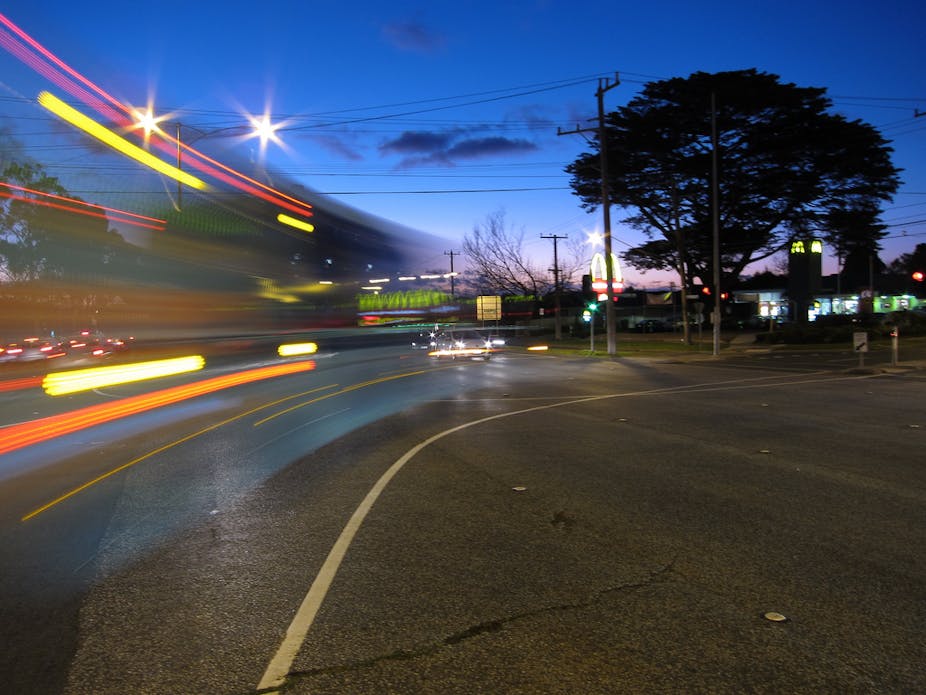
Counterintuitively, the carbon tax may make it harder to get a bus. Dale Gillard/Flickr

Transport accounts for 14% of Australia’s greenhouse gas (GHG) emissions and has one of the fastest emission growth rates. Cutting our national emissions might, therefore, be expected to shine a blowtorch on transport fuels, right?

Well, partly right. For public transport, the news isn’t good.

What’s in, what’s out

The new carbon pricing regime announced this week by the Prime Minister exempts petrol and gives heavy vehicles (greater than 4.5 tonnes gross vehicle mass) a two year moratorium until 2014.

For me, the highlight of the package is the 80% emissions reduction target for 2050. Achieving that target will inevitably require all transport fuels to eventually become subject to a carbon price.

More importantly, it will require a wide range of complementary measures to deliver large and lasting emissions reductions.

Where do all these emissions come from?

The Department of Climate Change and Energy Efficiency’s December 2010, publication, Transport emissions projections 2010, estimates Australian annual transport GHG emissions at an average 85 Mt for the 2008-12 Kyoto Period.

Land transport is the major contributor to transport GHG emissions. Within the 85Mt total, cars account for 41Mt, light commercial vehicles (LCVs) 12 Mt, trucks 18Mt, buses 1.7Mt and rail 2.5 Mt.

The fastest growth in emissions to 2020 is projected to be from trucks (+4Mt). Cars (+3Mt), light commercial vehicles (+2Mt), buses (+0.3Mt) and rail (+0.5Mt) are also projected by DCCEE to show growth.

A major reason for including heavy vehicles within the carbon pricing regime is the high growth rate in truck emissions.

Exempting fuel means less revenue

If the simple assumption is made that trucks and buses run on diesel and that light commercial vehicles use petrol, the direct revenue at $23/t on about 20Mt of heavy vehicle emissions and 2.5Mt of rail emissions is about $500 million annually.

This will increase as the carbon price rises and fossil fuel use increases but reduce marginally as the effect of higher fuel prices from carbon pricing reduces freight volumes. The latter impact is expected to be small, because of low fuel price elasticities.

Exempting petrol means that about $1.2 billion in revenue is foregone (20,000mL of petrol used at ~6c/L carbon price, or 53Mt of GHG emissions at $23/t – both suggest about $1.2 billion revenue forgone annually by exempting petrol). There will also be indirect impacts of carbon pricing on inputs to transport, which need input-output models for their assessment.

Public transport users pay more under a carbon tax

Governments around Australia are all seeking to grow public transport patronage because it can combat the costs of road congestion, reduce high and growing transport greenhouse gas emissions, support social inclusion, improve air quality and lower the road toll.

Putting a price on carbon should support this aim. However, it fails this test when petrol is excluded from the carbon price.

The decision to exempt petrol is understandable in political terms but produces exactly the wrong outcome in terms of giving efficient price signals to travellers. At a time when road users need to be more fully confronted with the costs of their travel choices, an important opportunity has been missed.

Public transport users have been hit from 2014 instead.

Take bus travel in our cities as an example. A carbon price of $23 per tonne will add about 6 cents a litre to diesel prices. Most route buses use diesel.

Route buses in Melbourne travel about 100 million kilometres a year and use about 40mL of diesel. The new carbon price will add about $2.4 million in direct costs, plus additional indirect costs (through the carbon content of inputs).

The total might amount to perhaps $3 million a year. Nationally, buses will be up for about $40 million annually in direct costs (from 1.7Mt emissions).

The end result: fewer bus routes

The way route bus contracts work around Australia, the carbon price on government-contracted (and government provided) route bus services will be passed through to the state government, as a result of the carbon pricing change.

A state may decide to increase public transport fares faster than would otherwise happen, to partly offset this revenue impost. This will mean a loss of public transport patronage and further increases in the costs of road use noted above (such as congestion and greenhouse gas emissions).

It is more likely, however, that a state will forgo future investment in public transport, to compensate for the extra costs of current services because of carbon pricing. This means missing opportunities to not only cut GHG emissions but also to cut congestion costs, lower the road toll and continue to clean our air.

Pay up for public transport

The Federal Government needs to do more to support public transport infrastructure investment. It is necessary to offset the adverse sustainability impact of its decision to exempt petrol but hit public transport (after 2014) with the carbon price.

Longer term, the real answer for reducing land transport GHG emissions is an integrated set of policy measures that:

• reduce the need to travel

• achieve a modal shift to low impact modes and

• ensure that all people have reasonable opportunities for travel.

This set of measures will not only score GHG goals but will also reduce congestion, improve transport health and safety, be better for the environment and promote social inclusion.

Join the conversation

Comments (11)

  1. Permalink
    Troy Barry

    Troy Barry

    Mechanical Engineer (logged in via email @gmail.com)

    It's not just diesel buses. At the moment I catch the electric train to work rather than driving my car for around the same cost per journey. When the price of electricity goes up and petrol doesn't, catching the train will be a relatively more expensive option than it is now. Ditto for car versus air travel - the car has twice the carbon emissions but there's not going to be any price signal to reflect this.

  2. Permalink
    Kevin Cox

    Kevin Cox

    (logged in via LinkedIn)

    A Carbon Tax is not going to give a cure for cancer. Why should we expect it to address the issue of public transport? If we want to get more people to use public transport then we invest in building an infrastructure that people will want to use rather than use private transport. Making private transport more expensive does not cause people to switch to public transport if it is not there. The concept of using prices to drive investment just does not work in practise when it comes to long lasting assets like public transport. That is markets and prices are good a good mechanism to get the best value choices for existing products and goods. They are not an appropriate mechanism to drive the development and construction of new assets.

    1. Permalink
      Stuart Mackenzie

      Stuart Mackenzie

      (logged in via email @gmail.com)

      Price is only an effective driver of consumer choice if the alternatives available are interchangeable and offer roughly the same amount of utility and convenience in the consumer's view. Therefore, it is only in locations where public transport offers the same convenience as private cars that pricing mechanisms will be effective in changing consumer behaviour. In Australia, locations meeting this criteria only exist in state capitals and other large cities, so a better approach would be to tax fuel for private vehicle use in cities, but not in rural areas.
      An alternative approach would be to levy a charge on private vehicle owners for using their cars in metropolitan areas where efficient public transport is readily available, as is done in several overseas cities e.g. London.
      Neither of these approaches is rocket science or difficult to administer - it just needs some political backbone to stand up to the private car lobby.

    2. Permalink
      Felix MacNeill

      Felix MacNeill

      Felix MacNeill (logged in via email @grapevine.com.au)

      Thanks Kevin - I'm already beginning to notice criticisms of this 'imperfect-but-still-best-available' policy along the lines you suggest. For example, while it involves a few significant and very intelligent tax reforms it doesn't solve all our taxation dilemmas and work will be still needed on wider tax reform in other times and places. But this doesn't diminish its usefulness. As you say, it doesn't give a cure for cancer but, then, nor does all our medical science to date and we don't use that as an excuse to decry its usefulness!
      I think there's a place for a bit of 'stick' in driving behaviour change - some price pressure on fuel and more limited provision of urban parking need to be part of the total process but, as you say, it won't do a damned thing if the public transport isn't there. And the only way to create good public transport is for governments to regain the courage to take on big, expensive projects with long pay-back times.

      1. Permalink
        Kevin Cox

        Kevin Cox

        (logged in via LinkedIn)

        Felix I agree that a tax may help but we should not put too much hope on it. The important part of the package is the 11billion dollar investment fund. That will make a difference. However, we must set up sensible investment strategies based around equity investment for the masses rather than using interest bearing loans borrowed from overseas. That leads to unsustainable and expensive debt obligations.

  3. Permalink
    Bob Constable

    Bob Constable

    (logged in via Facebook)

    Sorry didn't read it all "Ensure that all people have reasonable opportunities to travel" How does that work with "reduce the need to travel" mutually exclusive if you ask me!

    1. Permalink
      Jane Rawson

      Jane Rawson

      (Editor, The Conversation)

      Hi Bob,
      responding as an interested person here, and not in my "official capacity": I think reducing the need to travel generally means providing the services and opportunities people need closer to their homes. For example, making sure there are jobs all over the city, not just in the CBD; that people have a local shopping centre they can walk to rather than having to travel long distances to a mall; that there are health and education services within a short distance of most homes. A lot of state governments have been working on ways to do this (though not with huge success yet as far as I can see) - they usually call it building 'activity centres' or sometimes 'transport-oriented developments'.
      It can also mean providing more services online, and making it easier for people to work from home etc, so they don't need to travel as much.

  4. Permalink
    David White

    David White

    (Postdoctoral Research Fellow at University of New South Wales)

    I agree here - the exclusion of petrol is a glaring inconsistency and weakens the coalitions claim that they want a greener future. Sometimes being socially just is not popular, but the stance is cowardly - to reduce emissions people have to be discouraged from using their cars when it is not necessary. Concessions should only be made to those in rural areas where public transport is not widely available.

  5. Permalink
    John Stanley

    John Stanley

    (Adjunct Professor, Institute of Transport and Logistics Studies, The Business School at University of Sydney)

    Bob,

    Thanks for your observation, which is insightful. Jane is right. The 'reduce' part of my suggested policy directions is about better arrangement of land uses, so we do not need to travel as much to engage in activities. The bit about ensuring travel opportunities are available for all is about supporting social inclusion, which can be affected by poor mobility options. There is certainly a trade-off here and getting the balance right is important, so we don't have too much travel.

  6. Permalink
    Alan Davies

    Alan Davies

    (logged in via email @bigpond.net.au)

    No, there isn't a 6c per litre carbon tax on diesel but it's worth noting there's already a 38c per litre excise tax on diesel. There's no comparable tax on coal.