
The Conversation
Subscribe
  • Academic rigour, journalistic flair
  • For curious minds
  • Expert news and views
  • Debate and ideas
  • From the curious to the serious

Hot Topics

  1. Gay marriage
  2. Australia in the Asian Century
  3. Convergence review
  4. Federal Budget 2012
  5. War on drugs
  6. Bob Brown
  7. Explainer
  8. Square Kilometre Array
  9. Medical myths
  10. Transparency and medicine

Real climate debates: a report from the IUGG General Assembly

In 2100, will sea level be one metre higher than now, or only 50cm? The Thames Barrage is designed to protect London from flooding by storm surges in up to one in a thousand year events. With 50cm higher seas this becomes one in a hundred years. At one meter above present it is one in ten years. This…

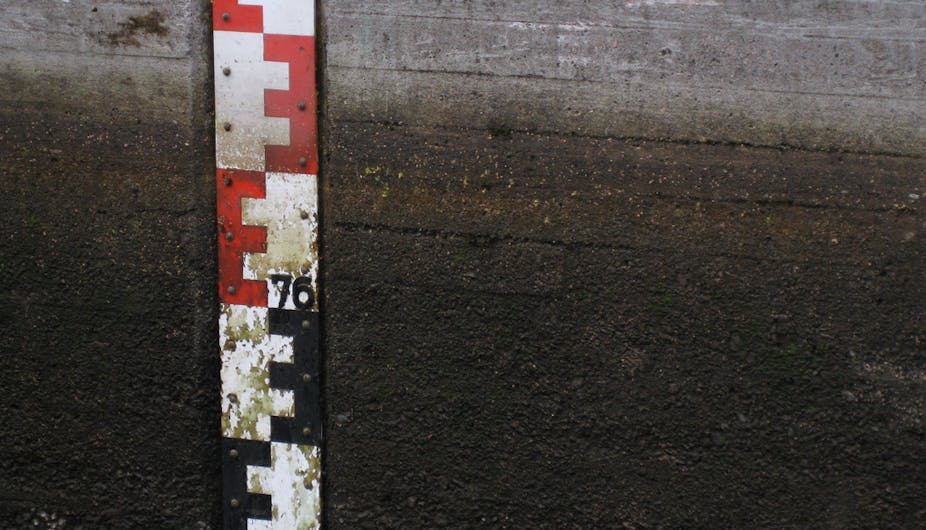
Water_level_matti_mattila-1310101689
Scientific debate isn’t about ‘if’, but about ‘when’ and ‘how much’. Matti Mattila/Flickr

In 2100, will sea level be one metre higher than now, or only 50cm? The Thames Barrage is designed to protect London from flooding by storm surges in up to one in a thousand year events. With 50cm higher seas this becomes one in a hundred years. At one meter above present it is one in ten years. This stuff matters.

That was the message from David Vaughan of the British Antarctic Survey, given as a plenary talk at the 25th General Assembly of the International Union of Geodesy and Geophysics.

Over nine days, more than 3200 scientists from 92 countries have gathered in Melbourne, with 3200 talks in 198 symposia and almost 2000 posters.

With the theme: “Earth on the edge”, the IUGG assembly has had a focus on both the natural hazards of earthquakes and tsunamis, as well as natural and anthropogenic climate change.

This rich and lively interaction between scientists provides stark contrast to typical media coverage, and raised the question: what are some of the real debates in climate science?

Presentations at large meetings like the IUGG Assembly span a range of forms that illustrate the progression of scientific debates. At plenary sessions, world leading scientists give overviews of the well-established science, augmented with descriptions of the real debates and often concluding with tentative ideas of where the field might go in the future.

Keynote talks present more formal views targeted at specialists, but give others a chance to see the state of field other than their own. Other talks and posters present work at less advanced stages, from the recently published, through to initial summaries of ideas and work in progress. These include technical talks where one can watch “rivals” question each other.

This is where real debates in science often take shape, before moving on to the peer-reviewed literature. Overall these meetings capture:

  • What is known?

  • What is not known?

  • Within the unknown, what are the possibilities?

  • What information do we have or need that might resolve the unknowns?

Saying that debate about climate is closed is a rather silly way of describing what has really happened: debate has moved on as old debates have died. This doesn’t mean that old debates can’t be revived if new evidence is found, but for the core science of the greenhouse effect, this has not yet happened.

What is the impact of the sun?

A series of sessions explored solar variability and its effects on climate, and implicitly whether solar changes could be causing recent temperature trends. An invited keynote talk by Werner Schmutz describes the radiative energy from the sun: total solar iradiance or TSI.

He concluded that the “data do not support a TSI trend between 1996 and 2008” (from one solar min to the next); other presentations explored details.

Solar cycle 24 is building up after a longer-than-normal solar minimum, and some are asking if this cycle is abnormal. Probably no, according to several presentations although this will only be settled by what the sun does over the next decade.

However, if the cycles turns out be abnormal and the sun heads into something like the Maunder minimum of Little Ice Age times, how much would it reduce the warming from greenhouse gas emissions? Not much, according to the presentation by G. Feulner.

At the exploratory end, Renata Lukianova asked whether a solar spike in 2004 had a discernible impact on atmospheric temperatures. Schmutz proposed a new classification of solar states that redefined the use of isotopes for reconstructing past solar variability. This increases the estimates of change in radiative forcing since the Maunder minimum (but gives little change over the 20th century).

Where to for wind and water?

Debates about stronger hurricanes in a warmer world are no longer about “if” but more about “how”.

Debate is over the details of the process of intensification with time (for example, from category 1 to 4). In particular, scientists are asking whether the wind-speed dependence of surface evaporation rate is crucial to how a hurricane strengthens.

The plenary by Anny Cazenave reviewed 20th century sea level changes. The century average was 1.7 mm/year, but it increased to 3.3 mm/year over the period since satellite measurements began.

Previously, roughly equal contributions came from thermal expansion, glacier melt and loss from the the Greenland ice cap. Since 2004, with slower ocean warming, the proportion has changed (without the total rate changing much), and now most sea-level rise is driven by ice-melt.

Debate about future rises in sea-level hinges on debates about the stability of the Greenland and Antarctic ice-sheets. It is here that resolving debates about past behaviour of ice sheets can contribute.

Questions that are still under debate include:

  • What caused the change in ice age cycles about a million years ago from a 41,000-year cycle to a larger and longer 100,000-year cycle?

  • What set the limits to the deglaciation at the end of the ice ages?

  • Why did the most recent deglaciation stop with temperatures lower and sea level lower than about 100,000 years ago in the Eamean period?

David Vaughan’s conclusion was that by 2100, sea-level rise would be not much less than 50 cm: this is locked in from the effects of past emissions. At the upper end he found it hard to conceive of more than 1.5 metres, as this would imply ice melting faster than during the last deglaciation. He believes 1 metre is a more likely upper estimate.

Within the 0.5 to 1.0 metre range, the debate continues.

Join the conversation

Comments (8)

  1. Permalink
    Marc Hendrickx

    Marc Hendrickx

    (Geologist)

    Ian, Did you catch the plenary address by Demetris Koutsoyiannis, or did you just attend the talks that fitted your paradigm?

    1. Permalink
      Ian Enting

      Ian Enting

      (Professorial Fellow, ARC Centre of Excellence for Mathematics and Statistics of Complex Systems at University of Melbourne)

      Thanks for the link. For me, a lot of the talk covered the sort of ground introduced in Mandelbrot's 1977 book: Fractals, Form Chance and Dimension. There has been a lot of penetration of these ideas onto earth sciences, but this was a great plenary to have at IUGG, to keep these concepts to the forefront.
      For me, the interesting slide was number 29 on climate variability. There were a few things that struck me as odd. Firstly the annual cycle must have been removed, secondly it was surprising to see a discrepancy between CRU and NSSTC, since CRU data contain and ENSO signal in (see for example David Thompson,or in a simpler analysis McLean et al).
      The other worry that I have is that each of the short period estimates comes off the most recent end of the variation used for the longer period estimates. I haven't thought through how much this would matter.

    2. Permalink
      Ian Enting

      Ian Enting

      (Professorial Fellow, ARC Centre of Excellence for Mathematics and Statistics of Complex Systems at University of Melbourne)

      I caught Demetris' plenary and his shorter talk. My take is that the longer talk was about fractals and power laws and the shorter talk was about entropy methods. What was disappointing was that he didn't have time at the end of the plenary to explain the link. Having talked to him, my next step is to read his papers.
      If you look at my publication list; you'll see that I was working on power law stuff in statistical physics well before Mandelbrot's book came out.
      We explored this sort of direction in the CSIRO Complex Systems emerging science activity and this is one of the reasons I am now in MASCOS. So to imply that Demitris' stuff "doesn't fit my paradigm" is way off the mark.
      The editors of the conversation were keen to have me comment on Demetris' talks, but I figured that, if I could do it at all, it would need an article of its own ( and that maybe The Conversation is the wrong place).

  2. Permalink
    Ian Enting

    Ian Enting

    (Professorial Fellow, ARC Centre of Excellence for Mathematics and Statistics of Complex Systems at University of Melbourne)

    A plot of the satellite data for sea-level can be found at
    http://www.cmar.csiro.au/sealevel/sl_hist_last_15.html
    and it tends to show dips during La Nina times. Since we are
    just coming out of (or maybe still in) a very strong La Nina event,
    I think any suggestion that 3.1 or 3.2 can't be sustained is exceedingly optimistic. But on this basis we won't have to wait 20 years to see -
    in the past, as the La Nina conditions pass the long-term growth
    continues.

    1. Permalink
      James Szabadics

      James Szabadics

      Technical Development and R&D Manager, Plantation Timber Industry (logged in via email @technologist.com)

      Ian,

      The recent La-Nina event doesnt make much difference to the decelleration that started in 2005. If you plot sea level from Mid 2005 to Mid 2010 (prior to start of recent La-Nina) you see 2.31mm/yr for that 5 years. Data here:
      http://sealevel.colorado.edu/files/current/sl_ib_ns_global.txt

      If you then add La-Nina period and recalculate to present day the sea level trend we get from mid 2005 is 2.2mm/yr. The recent La Nina has ended for now, it may relapse.

      It would be wrong to say that the recent La-Nina is the reason sea level rise has decellerated below 3.1mm/yr. But decellerate it has and the decelleration has continued to May 2012. It may accellerate again in the future but 3.1mm/y has not been sustained in last 6 years.

  3. Permalink
    James Szabadics

    James Szabadics

    Technical Development and R&D Manager, Plantation Timber Industry (logged in via email @technologist.com)

    This is a balanced article by Ian and is good information.

    The only time we should expect the sea level trend to change to negative in a sustained sense (>10 years) would be during a period of glaciation like the LIA or descent into an ice age where it may be sustained for a thousand years.

    The rate of melt during an interglacial will be visible in sea level change but the models projecting 1m seem to rely on enhanced greenhouse effects. Currrently the rate is about 3.1mm/yr or 31cm in 100 years. In the last 5 years it is only 2.1mm/yr or 21cm in 100 years, it appears that sea level change at 390ppm CO2 is unable to sustain 3.1mm/yr but lets see what happens over the next 20 years.