The Conversation
Subscribe
  • Academic rigour, journalistic flair
  • For curious minds
  • Expert news and views
  • Debate and ideas
  • From the curious to the serious

Hot Topics

  1. Gay marriage
  2. Australia in the Asian Century
  3. Convergence review
  4. Federal Budget 2012
  5. War on drugs
  6. Bob Brown
  7. Explainer
  8. Square Kilometre Array
  9. Medical myths
  10. Transparency and medicine

Safe, zero-carbon and proven: is fourth-generation nuclear the energy solution?

The world is searching for a “holy grail”: zero-carbon electricity provided safely and reliably, 24 hours a day, in any given location and in quantities that matter for a world that is heading for 10 billion people. World electricity generation by source (click for larger image). World Nuclear Association…

Fastreactor4
What used to be waste can now be fuel.

The world is searching for a “holy grail”: zero-carbon electricity provided safely and reliably, 24 hours a day, in any given location and in quantities that matter for a world that is heading for 10 billion people.
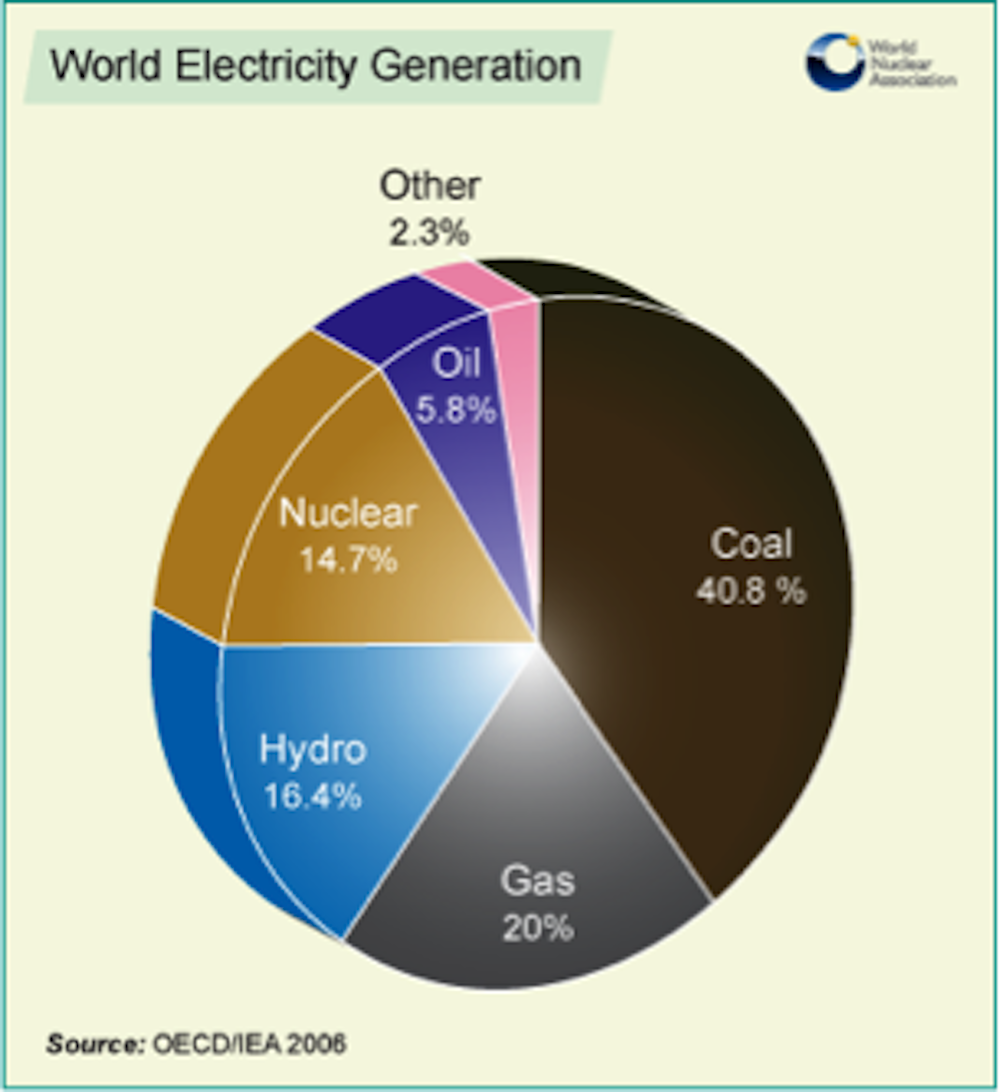
World electricity generation by source (click for larger image). World Nuclear Association

We are told to expect a “portfolio” of solutions, but this is a little deceptive. Right now, just five basic sources (coal, gas, hydro, nuclear and oil) provide over 97% of global electricity, with the fossil fuels making up 67%. And time is against us.

What technologies can step up, take the place of that 67% and the growth to come? What technologies are capable of doing the heavy lifting?

Some say the time has truly arrived for nuclear power, which is already providing 15% of global electricity. But nuclear expansion has been hamstrung by concerns that, while having basis in fact, are blown out of proportion.

The main concerns are:

  • operational safety (for example, meltdown)
  • high-level waste
  • uranium mining
  • availability of fuel
  • proliferation of fissile material.

Some nuclear bashing is pure myth. Can nuclear generators get insurance? Yes, it’s an easily checkable fact. Do they produce high greenhouse gas across the full life cycle? No, current reactors are about equivalent in this regard to wind and solar; advanced reactor systems will beat both of them.

On other matters, nuclear is serially deprived of context, and so painted a villain. Despite being way safer than coal, gas, and hydro, we only hear that nuclear is dangerous.

Nuclear power captures and contains operational waste. Fossil fuels dump greenhouse gas, heavy metals, particulates and other nasties into the environment all day, every day. But two million deaths per year from air pollution, with fossil fuels a major contributor, are apparently a non-issue when trying to keep people scared of radiation.

Uranium’s energy density is about 20,000 times higher than coal using current light water reactors. That means much less of what we don’t like (energy mining impacts) for what we need (energy). In the real world, that’s called responsible decision making. In anti-nuclear campaigning, it’s called “cognitive dissonance”.

Australian Geographic & Heathgate Resources

The tiny Beverley Uranium Mine (top) produces approximately four times as much energy per year as the huge Leigh Creek Coal Mine (bottom). The negative impacts for the positive returns are vastly smaller for uranium.

Reasonable or not, these concerns hold sway. But they are about to disappear thanks to an amazing Generation IV reactor design: the Integral Fast Reactor (IFR).

Here’s how it works. The spent fuel from current light water reactors, that we know as high level waste, is about 93% uranium, 2% plutonium and 5% fission products (the true waste)¹. The uranium is almost entirely the more plentiful and heavier isotope U-238 which, unlike the rarer U-235, is mostly left unused in today’s commercial reactors.

The IFR consumes it all, and all the plutonium, converting it into energy. That increases the energy density of uranium about 150 times.
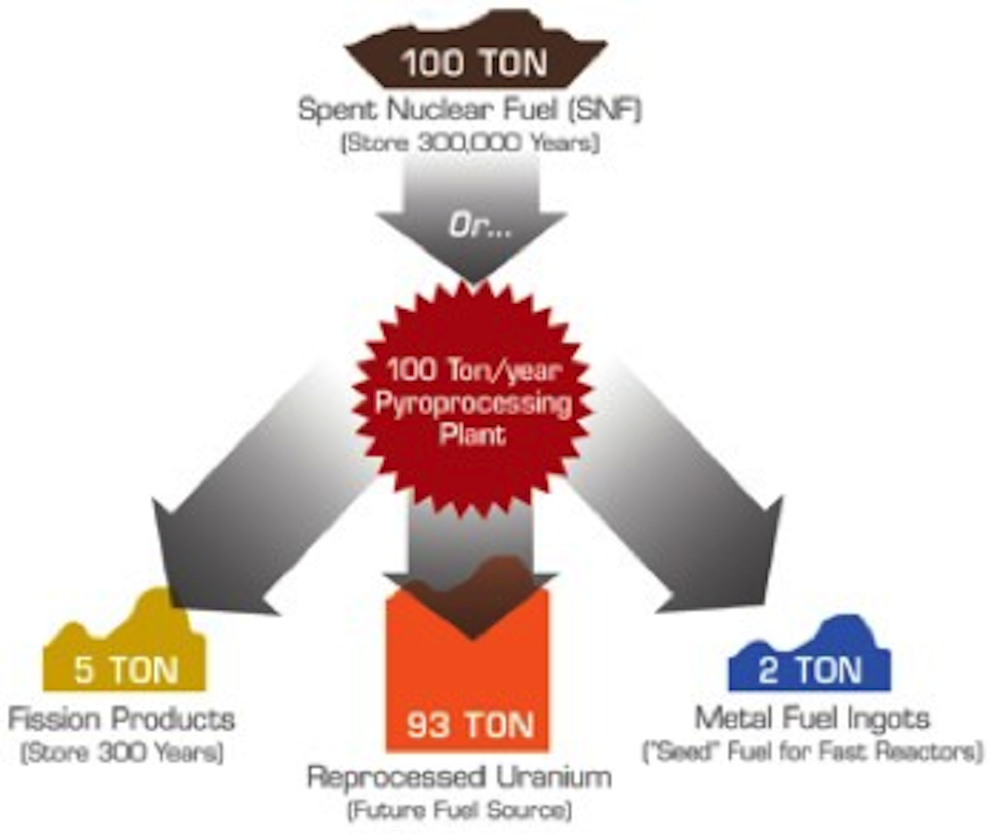
The smart solution for spent nuclear fuel (click for larger image). Tom Blees

The flow of implications is astonishing. There is no longer any need to worry about fuel availability. In spent fuel and depleted uranium from enrichment, we have inadvertently stockpiled enough fuel to power a fully developed planet for over 500 years². With IFR, just a golf ball of depleted uranium contains enough energy to meet your every need for your whole life, with plenty of wiggle room.

What’s more, the amount of existing waste (now fuel) starts reducing over time.

After a transition, uranium mining will end. In fact, energy mining as a whole will end, including the far more dangerous and harmful mining of coal, oil and gas. We won’t need it.

These new generators are highly resistant to accidents, including meltdown. The fuel is not a ceramic (metal oxide) like in today’s reactors, it’s a metal alloy. With overheating, metal fuel expands. The expansion causes neutron leakage and this kills the chain reaction. So with metal fuel, you get automatic shutdown, based on physics.

The coolant in the process is a robustly contained liquid metal, sodium. It runs at atmospheric pressure, boils at an extremely high temperature, and does not generate hydrogen, which makes it safer than water as a coolant. This also means that passive safety is possible, with no power required to circulate or pressurise the coolant.

In addition, the sodium that is exposed to the radioactive fuel is isolated from the heat exchange water by double-walled secondary circuit. It’s simple, robust, and safe.
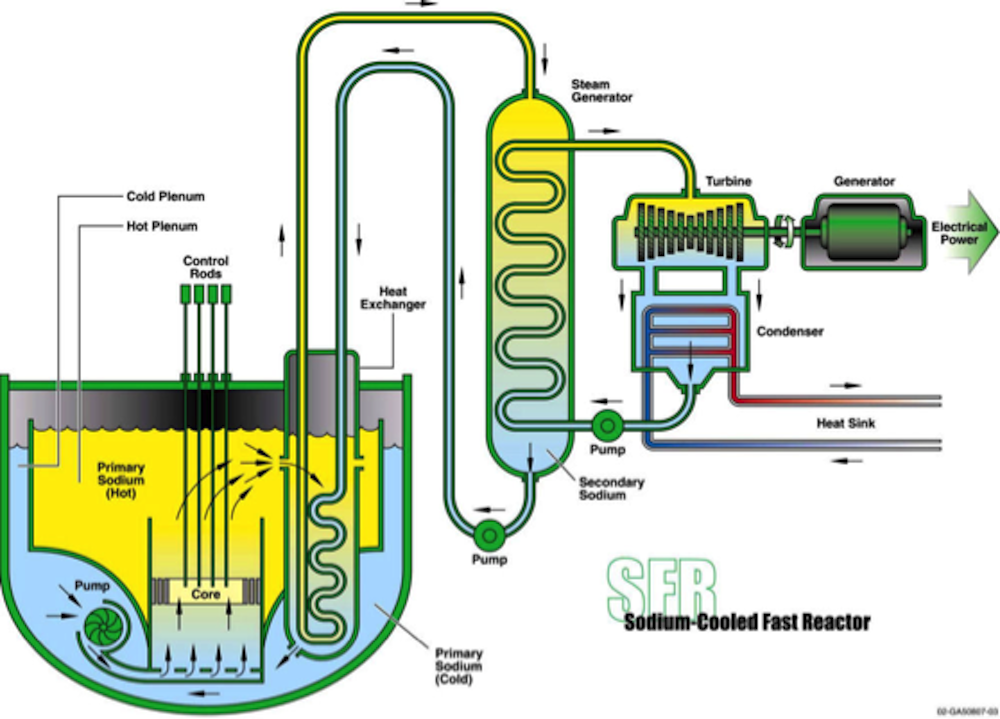
A sodium-cooled fast reactor, the power generating part of the IFR (click for larger image). US Government

Pairs of IFR units are used to assemble a large (1.8 GWe) power plant, which would include a small on-site pyro-processing facility. The fuel cycles from power production, through reprocessing, to more power production. It never leaves the site until only fission products remain. This is one more proliferation safeguard.

The Science Council for Global Initiatives is working on a framework for international cooperation and standardised designs. Finally, it seems we have a solution to climate and energy that is a match for the problem.

This isn’t science fiction. Argonne National Laboratories in Idaho perfected this technology with the Experimental Breeder Reactor II and ran it for 30 years until the mid-nineties. After being killed by anti-nuclear political expediency, reality is bringing it back to centre stage.

The Experimental Breeder Reactor in Idaho, prototype for the IFR. Barry Brook

My aim is for broad nuclear acceptance, with help from IFR and other advanced technologies. We can build excellent Generation III+ plants like the AP 1000 that already incorporate passive safety, and reap the huge benefits of getting off fossil fuels right now. We can do so with confidence that the solution to our residual nuclear concerns is on the commercialisation pathway.

In the face of climate change, delayed action in decarbonisation is not a responsible course. It’s time to get excited, learn about IFR and get ourselves ready for a new age. The energy end game has begun.

Thanks to Tom Blees and Barry Brook for technical edits.

The Conversation

Comments (269)

Comments on this article are now closed.

  1. Permalink
    Marion Brook

    Marion Brook

    Student (logged in via email @gcom.net.au)

    “Nuclear power captures and contains operational waste. Fossil fuels dump greenhouse gas, heavy metals, particulates and other nasties into the environment all day, every day.”

    This is an important point. Fossil fuels, of course, cover coal, gas and oil, transport, stationary power, home and industrial applications. The cheap, abundant, zero-carbon power that nuclear generators provide, and IFR's especially, could conceivably help replace most, if not all of these current sources of pollution by…

    show full comment

  2. Permalink
    Wil B

    Wil B

    Environmental Planner (logged in via email @gmail.com)

    To really simplify the issue, once you accept that fossil fuel emissions are doing very bad things to the planet and can no longer be afforded, what is the cheapest, safest, most realistic way of generating electricity?

    Sun, wind, tidal, geothermal sources are all welcome, and nobody says they wont play some part, but could they possibly meet all of our generating needs within the next 20-30 years? Highly doubtful.

    So that leaves nuclear, which is far far less risky than its opponents claim. Yes it can be expensive, but not necessarily, not always. China built the Quinshan CANDU-6 reactors in four years and for less than $2bn.

    Basically, if you want to keep a society that looks and acts generally like ours does in terms of energy profile (which is debatable, sure), without CO2 emissions, nuclear energy really has to be part of the mix.

    1. Permalink
      Michael Rynn

      Michael Rynn

      unemployed generalist (logged in via email @optusnet.com.au)

      First of all you have to refute the Beyond Zero Emissions Zero Carbon Australia Station Energy plan, which shows that 100% renewable is possible on Wind and Solar Thermal with storage. And with increasing our electricity demands. Add to it a Transport and Industrial plans (electrification), a Buildings efficiency plan, Agricultural and Industrial plans. http://beyondzeroemissions.org/ This shows that all sectors of economy need to be considered and integrated. The BZE plan uses currently proven as working technology. Show me an IFR currently working as advertised.

      1. Permalink
        Ben Heard

        Ben Heard

        Director, ThinkClimate Consulting (logged in via email @thinkclimateconsulting.com.au)

        Michael, I don't think there is any need to refute the report. Apart from the fact that Trainer, Nicholson and Lang have done so in amazing detail (which, to date, I believe BZE are yet to make a response), I reject the very premise of it. Why attempt to decarbonise using some, not all, available means? Is that the plan of people who really think we are in an emergency? Or is the work that stems from ideological affection for a small subsection of available technology? It is, at best, a useful visioning exercise. But many key assumptions are so incredibly off that it is certainly not a plan, and the arbitrary exclusion of the second largest source of zero-carbon energy in the world reeks of a great insincerity regarding their opinion that we are in a crisis. I reject that in favour of assessing and deploying all energy solutions as appropriate. In a country addicted to fossil fuels, that means there is a role for nuclear.

      2. Permalink
        Wil B

        Wil B

        Environmental Planner (logged in via email @gmail.com)

        Here you go Michael:

        http://bravenewclimate.com/2010/09/09/trainer-zca-2020-critique/

        http://bravenewclimate.com/2010/08/12/zca2020-critique/

        http://bravenewclimate.com/2010/07/14/zca2020/

        Although these are all hosted on the same website, they are not 'group-think', they are by different (academic) authors (and the last one is more of a brainstorm session).

        The BZE plan requires heroic assumptions, such as a reduction in energy use (despite a growing population), and that wind can provide 40% of power (despite not blowing constantly enough).

        1. Permalink
          Michael Rynn

          Michael Rynn

          unemployed generalist (logged in via email @optusnet.com.au)

          You have not read the BZE station energy plan carefully. Wind is 40 percent of rated generating capacity. The grid is upgraded to support a distributed system, to take advantage of Australias spread across time zones. All the engineering assumptions are published and were deliberately erred on the conservative side. The planned system was simulated using current electricity demand patterns scaled to future demand levels, using real insolation and wind data. There is an allowance for biomass firing in the middle of winter, when both low wind and minimum solar may combine.

          1. Permalink
            Wil B

            Wil B

            Environmental Planner (logged in via email @gmail.com)

            Michael, you may be interested in the following graph:
            http://windfarmperformance.info/documents/analysis/annual/2010/wind_capacity_factor_demand_2010.pdf

            Look at what happens last July, and on 21 May. This is data for all of Australia. From time to time, the wind just doesn't blow for days on end. And this can be during solar minimums. What would we do then, all stay home with the lights off? It doesn't matter how many wind turbines you build, at what cost to the landscape, when the wind doesn't blow it just doesn't blow.

            1. Permalink
              Michael Rynn

              Michael Rynn

              unemployed generalist (logged in via email @optusnet.com.au)

              The wind capacity factor demand looks just like the one used in the BZE simulations. Thats why the BZE plan calls for 60% of generatring capacity solar thermal towers with 15 hours of molten salt heat storage, which provide on demand power for slack wind times. I read the bze critiques months ago. What the critique seems to say is that all change is "Politically unacceptable". We need to change our energy and economic practices to meet the challenges of accelarating global warming which is brought…

              show full comment

              1. Permalink
                Wil B

                Wil B

                Environmental Planner (logged in via email @gmail.com)

                Michael, 15 hours of storage in winter simply doesn't cut it. It does not work, politically, economically, socially. The sort of social re-engineering you're imagining is off the planet.

                If you think the critiques of the BZE plan are based on political will rather than on hard numbers, I don't think you've read them. The BZE plan is rather more than a bit short of perfection.

                These solar thermal towers with molten salt storage are no further advanced, are just as speculative and expensive, if not moreso, than Generation IV nuclear power. Meanwhile, Generation 3+ nuclear reactors are being built around the world, as we speak.

                Don't get me wrong, I'm not against renewable energy, it can and will be a part of the mix. I personally have both PV panels and solar hot water.

                But what is your actual objection to nuclear power, why do you refuse to consider it?

                1. Permalink
                  Michael Rynn

                  Michael Rynn

                  unemployed generalist (logged in via email @optusnet.com.au)

                  Is this speculation? http://cleantechnica.com/2011/10/08/spains-gemasolar-247-power-plant-video/ Torresol Gemasolar in spain. More and bigger are being built right now. It scales well. The bigger they are, the cheaper the kWh generating cost. The more they build, with mirror mass production, the cheaper they get. No waste problems. No de-commisioning issues. Visit it today and walk through without protective clothing. I call that advanced.

                  I haven't objected to nuclear power. I object to the nuclear waste build up, and nuclear weapons proliferation, and the nuclear plant unit cost and risks. Now thats politically unacceptable.

                  1. Permalink
                    Tom Keen

                    Tom Keen

                    BSc (logged in via email @gmail.com)

                    Michael,

                    Perhaps Mark Diesendorf's comments on the viability of BZE's plans will resonate more with you:

                    http://www.ecosmagazine.com/?paper=EC10024

                    http://www.climatespectator.com.au/commentary/cheaper-path-100-renewables

                    The bottom line? BZE's modelling is based on commercially and technologically unproven CST, and it's likely to be far more expensive than they claim.

                    It's also telling, to me, that BZE haven't responded (or won't respond) to their critics.

                    1. Permalink
                      Tom Keen

                      Tom Keen

                      BSc (logged in via email @gmail.com)

                      Also, Gemasolar cost US$420 million for less than 20 MWe. No one, not even rich Australia, can afford to decarbonise their current electricity system with technology this expensive. Much less provide much MORE energy for electric vehicle fleets which will be required in a low carbon future.

                  2. Permalink
                    Ben Heard

                    Ben Heard

                    Director, ThinkClimate Consulting (logged in via email @thinkclimateconsulting.com.au)

                    Michael, I would be just tickled pink if a Government in Australia commissioned a study to examine the value for money of all potential zero carbon baseload (which, presently, is solar thermal and nuclear for Australia).

                  3. Permalink
                    Michael Rynn

                    Michael Rynn

                    unemployed generalist (logged in via email @optusnet.com.au)

                    Costs are expected to fall, as a design is replicated, and construction and operation learning curves and mass production apply. This is factored into the BZE plans. Unfortunately this does not seem to have happened to the nuclear power industry.

                    1. Permalink
                      Tom Blees

                      Tom Blees

                      Author, consultant (logged in via email @gmail.com)

                      Tell it to the Chinese, Michael. They expect to get their nuclear costs down to a cool $1,000 (USD) per kW with the AP1000. Japan even managed to build the very first two ABWR reactors for about $1600/kW in the Nineties, and they did it in 36 and 39 months. Both the cost and time to build are coming down with the AP1000 (and with the soon-to-come ESBWR by GE). IFRs, for a host of reasons, can be expected to keep costs down and likely even beat those numbers: modular construction (with smaller modules…

                      show full comment

      3. Permalink
        John Morgan

        John Morgan

        Engineering R&D Manager (logged in via email @gmail.com)

        As well as the critiques given by Wil B, even renewables advocate Mark Diesendorf has critiqued the BZE plan, rejecting BZE's strident assertions that solar thermal with storage can provide baseload power, and their unrealistic timescales.

        http://www.climatespectator.com.au/commentary/cheaper-path-100-renewables

        Diesendorf's, Trainer's, and Nicholson & Lang's critiques are all well founded.

        1. Permalink
          Ben Heard

          Ben Heard

          Director, ThinkClimate Consulting (logged in via email @thinkclimateconsulting.com.au)

          Err... wow. If I had written a love story to renewables that even Diesendorf says is fanciful in about five different ways, I would be feeling a little sheepish.

          What the UNSW and BZE reports have in common is that the exclusion of nuclear is arbitrary.

  3. Permalink
    Theo van den Berg

    Theo van den Berg

    IT Consultant (logged in via email @hotmail.com)

    Nice (exiting & inspiring) article on Gen IV. Don't worry Ben, y-our day will come. We live in a world of energy junkies and soon enough, they will come flocking to nuclear power. We will keep breeding and we all want more, so eventually, all the other methods will fall short. I suggest that we don't waste any more time making them safer or even making them cheaper, just concentrate on making them "work" even better. Suggest that a lot more efford should go to Gen V. I believe that these will feed on anything, once they are warmed up. Could be the best way to finally clean up our mess and stop being stuck in this energy phase. Unlimited energy is what we want. Also we are meant to conquer the stars (cause we need the real Estate) and we are not going to do that with solar power.

    1. Permalink
      Ben Heard

      Ben Heard

      Director, ThinkClimate Consulting (logged in via email @thinkclimateconsulting.com.au)

      Well Theo, I used the expression "End Game" advisedly. A mature, Gen IV world means essentially limitless clean energy. It's an exciting idea.

      1. Permalink
        David Arthur

        David Arthur

        n/a (logged in via email @fastel.com.au)

        Gday Ben, I initially misread your comment as "A mature, Gen IV WOULD means essentially limitless clean energy", instead of "A mature, Gen IV WORLD means essentially limitless clean energy."

        That is, I thought you were writing that it would be great IF we had Gen IV power on tap, rather than your statement that we already DO have Gen IV nuclear power on tap. It's a shame, then, that TEPCO weren't quicker in replacing their Gen II Fukushima plant with Gen IV, isn't it? I mean, it's readily affordable, isn't it?

        1. Permalink
          Ben Heard

          Ben Heard

          Director, ThinkClimate Consulting (logged in via email @thinkclimateconsulting.com.au)

          Actually, your misreading was closer to the truth of my meaning. We do not have a mature, Gen IV world right now. In 50 years, with determination, we could, starting right now in Britain with the GE proposal, and the situation getting better every single year from there. I was casting my mind to the future, based on some thing that can be started now.

          Yes, a shame indeed, but retirement of the Gen II for a Gen III would have had the same safety result. Note Fukushima Daini, the one we stopped hearing about after a week, had less than 10 years of design improvement on Daichi (i.e. it was only very slightly more modern), was hit but the same force, and had nothing like the cascade of problems of Daichi, mainly because the better design had more of the essential systems within robust protective containment.

          1. Permalink
            David Arthur

            David Arthur

            n/a (logged in via email @fastel.com.au)

            I expect that in 50 years' time, there will be no fossil fuel use.

            Such is our predicament wrt atmospheric CO2, I sincerely hope there will be no fossil fuel use in 20 years' time.

            Biofuels may be acceptable because they are not adding to the problem, and Gen IV will be a technology whose time has come. Such is the take-up of distributed power generation in Australia that we may not see Gen IV here.

            It would well be a suitable technology for cold, mountainous nations with higher population densities such as Japan and Iran.

  4. Permalink
    Drew Ringsmuth

    Drew Ringsmuth

    (PhD Candidate (Biophysics) at University of Queensland)

    This is an interesting piece. Thanks. No doubt, Gen IV will play an important role in the 2050 energy mix.

    I have a question, wrapped in a constructive criticism. Like many discussions of cutting-edge energy technologies, this one is focused on electricity. According to the IEA, electricity currently supplies less than 20% of global energy demand. Most is still supplied directly by chemical fuels. Overall (including via electricity generation), fossil fuels supply something on the order of 85…

    show full comment

    1. Permalink
      Tom Blees

      Tom Blees

      Author, consultant (logged in via email @gmail.com)

      Drew, you may note that in a comment I made here a few moments ago I describe how building sufficient IFR capacity to meet peak demand would provide about double energy for alternate uses. Generating hydrogen is an obvious choice, with excess electricity simply being used for electrolysis. That hydrogen can then be combined with nitrogen from the air to make ammonia (NH3), which can itself be used as fuel in internal-combustion engines. Other types of fuels can also be created using syngas (CO plus…

      show full comment

    2. Permalink
      Ben Heard

      Ben Heard

      Director, ThinkClimate Consulting (logged in via email @thinkclimateconsulting.com.au)

      Cheers, and awesome question Drew, got your finger on the pulse there mate.

      Yes, the people I follow who actually think intelligently about this stuff are coming to uniform conclusions, increased electrification as you say and the need for syn-fuels made with zero carbon (such as nuclear) electricity.

      Two good examples are, again, Prescription for the Planet which lays out a great case for the use of powdered Boron (believe it or not) as a dense energy carrier for transport. The other I am seeing discussed quite a lot lately is ammonia, and there was a post on this recently at Brave New Climate, where you are always assured a good discussion. See here http://bravenewclimate.com/2011/10/04/np-nh3-killer-app/

      If you liked the article, please come and subscribe at Decarbonise SA, I would love to have you join "the conversation" we are maintaining on nuclear over there.

  5. Permalink
    George Crisp

    George Crisp

    Medical Practitioner (logged in via email @westnet.com.au)

    Is it really "safe zero-carbon and proven" ? Answer no. Its safety is not known, it is speculative. It is certainly not "zero-carbon" as the mining, processing, re-processing, plant construction and decomissioning are all energy intensive. Is it proven ? Well, where is the commerically deployable reactor?

    ...but notice the sleight of hand. The author calims this technology has been "perfected", then in the next paragraph, states:

    "We can build excellent Generation III+ plants like the AP 1000 that already incorporate passive safety, and reap the huge benefits of getting off fossil fuels right now"

    Woah, generation III+ ! That's not a radically different generation IV but an incremental improvement on Gen II. This is plainly disingenuous. Gen III reactors do not have the aspirational benefits that Ben Heard claims.

    We need to start reducing our emissions within 5 years at most. We do not have 20 - 30 years to commercialize a new technology.

    1. Permalink
      Tom Blees

      Tom Blees

      Author, consultant (logged in via email @gmail.com)

      George writes: Is it really "safe zero-carbon and proven" ? Answer no. Its safety is not known, it is speculative. It is certainly not "zero-carbon" as the mining, processing, re-processing, plant construction and decomissioning are all energy intensive. Is it proven ? Well, where is the commerically deployable reactor?

      The safety of any reactor—or any industrial enterprise, to various extents—is speculative. Probabilistic risk assessments are used for nuclear power plants to guage their…

      show full comment

      1. Permalink
        George Crisp

        George Crisp

        Medical Practitioner (logged in via email @westnet.com.au)

        Thanks for your reply. There are still a conflict here.

        If the gen IV is ready to go, as you say, and it has advantages as described, then there is no place for any further gen III reactor construction, we should immediately switch. But if the gen IV is not yet ready for commercialization, then we are stuck with rapid and large scale building revolution of 2 or 3 thousand gen III reactors ( at least ) in the next 2 -3 decades to replace much of our fossil fuel based energy generation. But then…

        show full comment

        1. Permalink
          Ben Heard

          Ben Heard

          Director, ThinkClimate Consulting (logged in via email @thinkclimateconsulting.com.au)

          George, I am not really clear on what outcome you are driving for. I'll take another shot at clarifying my position.

          My first, urgent priority is the cessation of coal expansion wherever this is happening and replacement of coal generation wherever it is found, at the earliest possible opportunity. This risk I am desperate to avoid is Gen IV being used as yet another reason not to rapidly cut emissions with currently commercial technology that is, by any measure, highly effective and very, very…

          show full comment

          1. Permalink
            George Crisp

            George Crisp

            Medical Practitioner (logged in via email @westnet.com.au)

            Hi Ben, I will look at your link later.

            We are "driving" for the same outcome. A rapid and deep reduction in greenhouse gas emissions as per the advice of climate scientists ( eg Meinshausen, Allen ). There is a carbon budget of about 1Gt CO2 until 2050 to give us a 75% chance of remaining < 2deg. and we have used 30%.

            That means starting within 5 years ( IEA Nov 2011 ).

            We will need a global "contraction and convergence" to have any equitable and acceptable way of coming close. That really…

            show full comment

            1. Permalink
              Ben Heard

              Ben Heard

              Director, ThinkClimate Consulting (logged in via email @thinkclimateconsulting.com.au)

              Well, one of the things that troubles me about renewable arguments is that with any serious interrogation they seem to also demand a degree of depowering that is about as popular as rabies, they struggle to convince people that power can be provided reliable, and these issues only serve to push most people away from supporting serious climate action. Does that help?

              "With regards to gen III, there are problems, not least its political and popular acceptability. You can dispute this as much as you…

              show full comment

    2. Permalink
      Ben Heard

      Ben Heard

      Director, ThinkClimate Consulting (logged in via email @thinkclimateconsulting.com.au)

      Hi George,

      The matter of life cycle emissions is covered explicitly in the article. "Zero Carbon" will forever be a euphemism because no matter what you choose (nuclear, wind, solar), there will be emissions in the process somewhere until the whole globe is 100% decarbonised. It's a fallacious attack on nuclear. For reference sake I use zero carbon as shorthand for anything under about 80-100g per kWh, which currently takes in solar, wind, and nuclear.

      Over 14,000 reactor years of operations and…

      show full comment

      1. Permalink
        George Crisp

        George Crisp

        Medical Practitioner (logged in via email @westnet.com.au)

        HI Ben,

        Also, I still have an issue with the blurring of technologies. Your article focuses on Gen IV and the potential advantages this really does not have anything to do with Gen III.

        I agree that if Gen IV is as good as you claim, we should bypass Gen II reactors immediately and we can also stop mining Uranium. ( Not sure that Toro would appreciate that though ).

        But you are actually promoting new Gen III reactors - that appears inconsistent.

        1. Permalink
          Ben Heard

          Ben Heard

          Director, ThinkClimate Consulting (logged in via email @thinkclimateconsulting.com.au)

          I am, and always do, promote the most rapid path to deep decarbonisation. That would involve further deployment of Generation III+ where baseload must be replaced or constructed soon (Playford for example), and every effort to hasten Gen IV. I was asked to write and article introducing Gen IV to readers. That's what I have done, and then been honest in stating my opinion that we still need what is commercial today.

        1. Permalink
          George Crisp

          George Crisp

          Medical Practitioner (logged in via email @westnet.com.au)

          Thanks for clarifying, and I agree it is difficult to write that brief. However, I still think you moving goalposts. Using "zero carbon as short hand for anything under 80 -100 g per kWh" would seem rather inexact and arbitrary, not to mention convenient.

          Nuclear power life-cycle emissions are ~ 66 g/kWh or more. Renewables are generally well below that ( Solar PV depends on where you are - in Aus is less than 35g/kwh ) come in at below that and wind well under 10 g/kwh ( even offshore < 10 g/kwh ).

          But there is also the payback time to consider. Wind and Solar CSP generally less than 3 years whereas nuclear is ~ 8 after completion of plant.

          So calling nuclear "zero emissions" would seem a bit economical with the truth.

          1. Permalink
            Ben Heard

            Ben Heard

            Director, ThinkClimate Consulting (logged in via email @thinkclimateconsulting.com.au)

            Well George, the study by University of Sydney, referenced in the report, actually has best estimate of solar being 106 (range 53-207), wind 21 (13-40), and light water nuclear 60 (10-130). That was a meta review study followed by original analysis for Australian conditions. If anything, I have been a little kind to solar. Since coal is greater than 1,000 I think we are arguing over nothing, but, again, it is a fallacious attack on nuclear, and I do resent the suggestion of being economical with the truth. Zero carbon is a necessary short hand, and renewable advocates use it in exactly the same way I do.

            Please reference the source for the payback period for me? On that matter, nuclear produces a lot of electricity and wind and solar very little. As energy sources they do not make a very worthwhile comparison, but all have a role in moving away from fossil.

          2. Permalink
            John Morgan

            John Morgan

            Engineering R&D Manager (logged in via email @gmail.com)

            Beyond "Zero Emissions" released their "Zero Carbon" Australia 2020 plan to much discussion last year. In none of it did I see them accused of being "economical with the truth". George, are you volunteering to be the first?

    3. Permalink
      Ben Heard

      Ben Heard

      Director, ThinkClimate Consulting (logged in via email @thinkclimateconsulting.com.au)

      I might also add that there is an important difference between "proven" and "commercially available". It is the SCGI mentioned in the article that are working to hasten this proven and demonstrated technology to commercialisation and widespread deployment. They deserve our support.

  6. Permalink
    Gavin Fialkowski

    Gavin Fialkowski

    Mr (logged in via email @abvconsultants.com.au)

    Hi Ben

    sounds really good, but i just dont get why if it has been proven over several decades in Idaho - why hasnt it been taken up by one of the countries that do have nuclear power like japan etc? has it been kept under wraps for some reason?

    Anyhow - if it is as you say it is - i really hope this gen 4 reactor goes full steam ahead. Who needs fusion power with this?

    1. Permalink
      Ben Heard

      Ben Heard

      Director, ThinkClimate Consulting (logged in via email @thinkclimateconsulting.com.au)

      Hi Gavin,

      The sad story can be read in a book called Prescription for the Planet. In short, in the mid-90's the Clinton administration was so politically keen to appear anti nuclear that they killed and gagged a very good program.

      If you visit the Science Council for Global Initiatives site you will see that one of the board members is Charles Till, the leader of the development team who is in the photo above, as well as leading climate scientist James Hansen. They are working hard and at the highest levels to achieve just what you have said.

      I agree , there is not much need for fusion in this case, or at least we have as long as we need to work it out (or improve renewable technologies for that matter).

      1. Permalink
        Chris McGrath

        Chris McGrath

        (Senior Lecturer at University of Queensland)

        Thanks for an interesting article Ben.

        One thing that I don't understand though is why there aren't at least a few commercial-scale IFR plants operating around the world. Why doesn't France use IFR as their government undoubtedly supports nuclear power and they must have one of the largest stockpiles of spent nuclear fuel to work with? What are the reasons for the holdup and when can we expect to see IFR widely deployed?

        1. Permalink
          Tom Blees

          Tom Blees

          Author, consultant (logged in via email @gmail.com)

          Chris, Ben's suggestion that France might be inclined to stick with current technology because of what they've got invested in it is absolutely correct. This is also the reason why they push so hard to make their reprocessing system the global standard, even though it's ridiculously inefficient and expensive (it increases the utilization of uranium's potential energy from 0.6% to 0.8%, versus virtually 100% for IFRs). The French Phenix fast reactor, by the way, operated very well for over 30 years…

          show full comment

        2. Permalink
          Ben Heard

          Ben Heard

          Director, ThinkClimate Consulting (logged in via email @thinkclimateconsulting.com.au)

          Tom has provided a pretty sound answer to that Chris, in this case the culprit truly was mid 90's American politics that took this successful design out of circulation. The French efforts to develop the technology independently were somewhat less successful see here (http://en.wikipedia.org/wiki/Superph%C3%A9nix ) (French, Russians, Japanese have all had forays. It was the Americans at Argonne that really nailed an excellent, successful and reliable design in the EBR II that became the IFR).

          Then…

          show full comment

          1. Permalink
            Gavin Fialkowski

            Gavin Fialkowski

            Mr (logged in via email @abvconsultants.com.au)

            I see. Rereading your article this paragraph caught my eye:

            "After a transition, uranium mining will end. In fact, energy mining as a whole will end, including the far more dangerous and harmful mining of coal, oil and gas. We won’t need it."

            So i can imagine the uranium mining industry, on top of coal etc, would be none too keen about Gen IV reactors as it makes them obsolete.

            Do you expect any trouble from the Uranium mining industry towards efforts to promote Gen IV reactor development?

            1. Permalink
              Ben Heard

              Ben Heard

              Director, ThinkClimate Consulting (logged in via email @thinkclimateconsulting.com.au)

              Yes, possibly, but probably not for a while. In the short term the general level of understanding of nuclear technology as a whole that interest in Gen IV generates probably works in their favour. Even with a fast deployment schedule for Gen IV, uranium mining probably has at least one full generation of mining left in it to meet demand for existing commercial designs which will (and in my opinion should), continue to be built until Gen IV comes on line and then for a little while after as one technology gives way to the next. I imagine it is on the radar of the current Chief Execs as something that perhaps two levels of leadership succession will need to confront in earnest. The schedule growth in energy from now to 2050 is so incredibly large that I expect they feel ok for the time being.

        3. Permalink
          Tom Keen

          Tom Keen

          BSc (logged in via email @gmail.com)

          Hi Chris,

          Tom Blees' (the President of the Science Council for Global Initiatives) book "Prescription For The Planet" goes into this in some detail.

          The first chapter can be read for free here: http://prescriptionfortheplanet.com/

          As is all too common, the reason for the lack of IFR deployment is political, not technologicial.

    2. Permalink
      Michael Rynn

      Michael Rynn

      unemployed generalist (logged in via email @optusnet.com.au)

      Japan did recognize the need for IFR for fuel processing, spent billions building a reactor, and its attempts have met with disaster. See http://www.nytimes.com/2011/06/18/world/asia/18japan.html?_r=1 . IFR and fuel reprocessing is not as easy as it is made out here. Other attempts at breeder reactors, have succeeded in making a growing stockpile of plutonium, So far fuel reprocessing technology has succeeded in multiplying and spreading the waste. See http://www.foe.org.au/anti-nuclear/issues/nfc/waste. If their was a a viable solution it should have already been used as a god send by the nuclear industry

      1. Permalink
        Tom Blees

        Tom Blees

        Author, consultant (logged in via email @gmail.com)

        That article you cite is complete scare-mongering. "It was shuttered for 14 years after a devastating fire in 1995, one of Japan’s most serious nuclear accidents before this year’s crisis at the Fukushima Daiichi Nuclear Power Station." Yeah, that "devastating fire" was so serious that a few guys with brooms and shovels cleaned it up and figured they could just not report it to avoid the hassle. There was no radioactivity involved, at all—zero. Sodium leaked out and had its typical cool flame/lots…

        show full comment

  7. Permalink
    Rachel Bailey

    Rachel Bailey

    (logged in via Facebook)

    Wow Ben, once again you have summarized the issues concisely. Perhaps much of the concern with the article so far is related to the fact that you didn't have much room to explain some very difficult conundrums.

    When I first heard about Generation 4 technologies, I let out a sigh of relief. Then Fukashima happened and proponents of Nuclear were back in the firing line. The problem I have is that you haven't separated Generation 3, from Generation 4 technologies clearly enough in your article. This as I stated above may have been due to word count constraints, but it has led to a muddying of the waters. Reports of Generation 4 reactors sound fantastically promising, but until we can see a truly commercial operating model paying its way I have doubts that many people will be convinced. Can you comment on how far away this scenario might be?

    1. Permalink
      Ben Heard

      Ben Heard

      Director, ThinkClimate Consulting (logged in via email @thinkclimateconsulting.com.au)

      Not used to having people just say I did something well... thanks Rachel, I appreciate that!

      Yes it was tough to make the technology distinction, but the last thing I wanted to do was misrepresent my own position. I firmly DO NOT believe Gen IV should be used as yet another reason to delay the cessation of fossil expansion and the replacement of decrepit plants with new zero carbon generation (including for example Gen III+. Barry Brook and I have an article devoted to nuclear safety in the upcoming…

      show full comment

      1. Permalink
        Rachel Bailey

        Rachel Bailey

        (logged in via Facebook)

        Thanks Ben. It is always good to hear good news in all the doom and gloom. Will keep a watching eye on developments. Whether or not its the solution I am not sure, but it is good to know there are forums like this one where scenarios can be placed on the table and discussed. I think this is the way forward. It is only through discussion of scenarios away from the sound bites of politicians that we get the full story.

  8. Permalink
    David Arthur

    David Arthur

    n/a (logged in via email @fastel.com.au)

    My only major problem with nuclear power in Australia is the location of its installation; all non-coastal locations would imply use of fresh water for cooling.

    Given that the major limiting factor on Australia's development is its relative lack of water, this is not wise. New power plants should be installed adjacent to the coast in order to employ sea water cooling.

    This implies that, as and when old power plants are retired, the water that they were using becomes available for other purposes, such as agriculture and environmental flows.

    1. Permalink
      Ben Heard

      Ben Heard

      Director, ThinkClimate Consulting (logged in via email @thinkclimateconsulting.com.au)

      You bet David. Wouldn't that be amazing? In an article at Decarbonise SA called "What about water?" I show that Loy Yang Power are currently using the equivalent of 10% of the residential water consumption of Melbourne in fresh, potable water from three sources, including a reservoir!!! Insanity. Coastal nuclear gives all that back to us.

      1. Permalink
        David Arthur

        David Arthur

        n/a (logged in via email @fastel.com.au)

        Coastal nuclear does indeed give all that back to us.

        However, nuclear plants would need to be sited adjacent to open coasts such as the Nullarbor coast west of Ceduna, rather than on semi-enclosed embayments such as Spencer Gulf. Otherwise, the temperature rise due to discharged cooling water may be detrimental to local marine life.

        The same holds for desalination plants, which is my major problem with a desalination plant at Port Augusta. In another forum, ("Nuclear - too hot to handle…

        show full comment

        1. Permalink
          Ben Heard

          Ben Heard

          Director, ThinkClimate Consulting (logged in via email @thinkclimateconsulting.com.au)

          Too tired for a long one, David, but I'm not clear on why the location need be different than existing thermal plant like coal. It does the same thing. A matter of preferable outcome rather than necessity perhaps?

          That said, I think the overall vision for the advantages of that location is an interesting one.

          1. Permalink
            David Arthur

            David Arthur

            n/a (logged in via email @fastel.com.au)

            Gday Ben. Thermal coal plants extract water that could be used for environmental flows in rivers, or could be used for agriculture, and evaporate it up the spouts of cooling towers.

            That is, Australia's coal-fired power stations remove water from Australian landscapes. Australia is the driest inhabitated continent, so wasting fresh water like that is counter-productive. [According to a Parliamentary Library briefing note I saw a couple of years ago, installed nuclear power stations worldwide evaporate more water per megawatt than thermal coal.]

            A changeover to nuclear should take this into account.

  9. Permalink
    Luke Tilly

    Luke Tilly

    Ecologist (logged in via email @gmail.com)

    Hi Ben,

    Excellent article, I had no idea this technology was even on the drawing board! Many thanks for introducing me to it :)

    I was wondering if you could comment on the water usage in nuclear reactors that use sodium rather than water as a coolant? Is there much water loss from driving the turbines? How is the turbine's water usually cooled?

    My understanding was that traditional nuclear reactors were water hungry because they were open systems (in one end, out the other), with the water used to cool the core going directly back into the environment.

    If these reactors have minimal water requirements, you could potentially place them in the arid zone- away from anyone's backyard!

    Thanks again for the article!

    1. Permalink
      Ben Heard

      Ben Heard

      Director, ThinkClimate Consulting (logged in via email @thinkclimateconsulting.com.au)

      Hi Luke,

      Thanks for the compliments, welcome to a very exciting new world!

      So, in the current reactors the water circulates to the hot core to make steam, then steam dragged through the turbine by temperature gradient toward the condenser, re-condenses to liquid and back to core i.e. basically closed. It's the water on the other side of the condenser that is used in large quantities in an open system, common with all thermal generation.

      If the coolant is liquid metal sodium... mate bloody good…

      show full comment

      1. Permalink
        Tom Blees

        Tom Blees

        Author, consultant (logged in via email @gmail.com)

        Right, Ben. Cooling systems are woefully misunderstood and nuclear is often mischaracterized as needing way more cooling than other thermal systems. Not so.

        Look at it this way: If you're running steam turbines you have to use distilled water, because any minerals would build up on turbines and mess them up. So the steam generator has to be on a closed loop, meaning that you create the steam, then cool it to condense it back into water. That cooling is done by a heat exchanger of some kind, usually…

        show full comment

  10. Permalink
    Michael Rynn

    Michael Rynn

    unemployed generalist (logged in via email @optusnet.com.au)

    So the argument is that G4 SFR (http://en.wikipedia.org/wiki/Generation_IV_reactor) can process existing nuclear waste and power the entire current world electricity consumption for 500 years. No further uranium mining required. And the technology has been available for 50 years.
    Too bad the engineering safety records of reactors of this type is not good. Japan has had an expensive bad record with one, which became un-operational even before Fukishima. Liquid sodium is explosive on contact with…

    show full comment

    1. Permalink
      Tom Blees

      Tom Blees

      Author, consultant (logged in via email @gmail.com)

      Michael Rynn: The Japanese Monju reactor that you allude to had a minor incident with non-radioactive sodium, and the only reason the plant got closed because of it was because the company operating it tried to cover it up and got caught. Sodium's characteristic volatility with water is easy to deal with via simple engineering. Industries have been using it for over a century. As for radiation leaking into the operating environment until it's beyond safety limits, have you ever heard of a nuclear…

      show full comment

    2. Permalink
      Ben Heard

      Ben Heard

      Director, ThinkClimate Consulting (logged in via email @thinkclimateconsulting.com.au)

      Michael, it is interesting that people like to refer to examples of this technology that did not go so well in the development, rather than the EBR II/ IFR from Argonne that I have discussed which worked just beautifully for a very long time until it's political closure. I'm not sure I get it; have you something against good news?

      "For Australian baseload power, the lifetime price per kWh may favour the much easier to run big solar thermal with storage, as their capital costs are expected to fall…

      show full comment

    3. Permalink
      Tom Bammann

      Tom Bammann

      Electrical Engineer (logged in via email @gmail.com)

      Michael, I don't think that you should claim newer nuclear technology to have more risks without addressing all of the various forms of newer nuclear technology. Having 'more' risks is also a misleading statement, because if all of these extra 'risks' are a combination of less catastrophic, or more catastrophic but less likely, then overall it can be less of a 'risk'. How many people have died in coal mines due to explosive gases in relatively uncontrolled environments, and how would this compare…

      show full comment

      1. Permalink
        George Crisp

        George Crisp

        Medical Practitioner (logged in via email @westnet.com.au)

        Risk = probability x consequence.

        It is quite appropriate to speculate about the "high risk " related to nuclear power, because even if catastrophic failure is rare ( ie low probability ) the consequences are / can be colossal.

        Yes, you are right about coal. The risks are higher, in as much as the probability of adverse effects from coal is close to 100% (!!) in that it a) contirbutes to climate change and b) results in significant air pollution with significant human and environmental consequences.

        However, the risks from renewables ( with the exception of hydro ) is negligible, as both probability and consequence are very, very low.

        1. Permalink
          John Morgan

          John Morgan

          Engineering R&D Manager (logged in via email @gmail.com)

          The risks from renewables are very high, if nuclear is excluded. The real technological risk is that they do not work and we continue on a high emissions path for as long as we have coal and gas to burn, to a six degree-plus temperature rise, devastation of the natural world and many gigadeaths in the human world.

          This consequence is far more severe than the worst plausible nuclear disaster. And the probability is very high - nowhere in the world has (non-hydro) renewable energy displaced a significant…

          show full comment

        2. Permalink
          Mark Duffett

          Mark Duffett

          (logged in via Facebook)

          "...the risks from renewables ( with the exception of hydro ) is negligible, as both probability and consequence are very, very low"

          I'm none too sure about that. I submit that a wind turbine fire (http://www.victorharbortimes.com.au/news/local/news/general/cant-fight-the-fire/1987235.aspx?storypage=0) multiplied by Black Saturday conditions is neither low probability nor low consequence.

          1. Permalink
            George Crisp

            George Crisp

            Medical Practitioner (logged in via email @westnet.com.au)

            How many "turbine fires" have occurred ( rare )? How many turbines are sited in bushfire prone locations ( very few ) ? What is the likelihood of the two occurring simultaneously ( unlikely ) ? And even then a wind turbine fire will not necessarily result in a bushfire at all let alone a major one. I think you will agree the probability is exceedingly low if not "negligible".

            Compare this to ( the albeit rare ) nuclear power station failure. There have been 4 events I know of. Long Island was contained…

            show full comment

            1. Permalink
              Mark Duffett

              Mark Duffett

              (logged in via Facebook)

              No, I do not agree that the probability is 'exceedingly low', especially not if turbines are erected in the numbers required to make a significant difference. Simply googling 'wind turbine fires' tells you that they're not that uncommon. Certainly much less rare than the sort of 'black swan' events that are regularly put up as reasons to oppose nuclear power, such as reactors being crashed into by jet aircraft (which modern designs would actually withstand, but anyway).

              And given Black Saturday conditions (which it's increasingly reasonable to assume will occur over a large area at least once annually), pretty much everywhere in Australia is 'bushfire prone', not to mention that fires can jump distances of several kilometres from less to more vulnerable areas in minutes.

              1. Permalink
                George Crisp

                George Crisp

                Medical Practitioner (logged in via email @westnet.com.au)

                There have been 4 recorded turbine fires in Aus. Of which 2 I understand involve redundant technologies. None resulted in fire spreading from the turbine. Because of the height of the turbine these fires are problematic to extinguish. That does not mean that fire crews cannot stand guard and extinguish downwind fires should they occur.
                Newer technologies are less likely to suffer mechanical failures. And I stated earlier - turbines are erected in clear rather than heavily vegetated areas.

                Compared to fires started from cigarettes, hay bail combustion, pole top fires, car exhaust , back burning and other deliberately lit fires ..many of which occur in far higher risk locations, wind turbines would be several orders of magnitude lower risk.

            2. Permalink
              Tom Bammann

              Tom Bammann

              Electrical Engineer (logged in via email @gmail.com)

              George,
              I was at a proposed wind farm site last week in Victoria, doing some preliminary test work. I saw a tree that had been struck by lightning, which 24 hours later was still smouldering after the landholder extinguished it first thing in the morning (he heard the crack during the night). Lightning along ridge tops (where turbines are typically located) causes a lot of spot fires, and property owners do a lot of work slashing grass and weeds to prevent fire disasters. It is a really big concern…

              show full comment

              1. Permalink
                George Crisp

                George Crisp

                Medical Practitioner (logged in via email @westnet.com.au)

                Pole top fires result largely from poor maintenance. I doubt that wind farms would use the same low level telegraph pole type infrastructure that has been typically responsible for pole-top fires / bushfires.

                Similarly as a proportion of overhead lines, it would be a tiny proportion compared to domestic rural and regional lines.

                I think your focus on this concern is out of proportion to the real risk and what is involved here. The risks of renewable energy are indeed negligible compared to fossil fuels.

                1. Permalink
                  Ben Heard

                  Ben Heard

                  Director, ThinkClimate Consulting (logged in via email @thinkclimateconsulting.com.au)

                  As it is with nuclear, I think you agreed with this point above. Given that in terms of the quantity of replacement energy required nuclear is a perfect fit technology and renewable is a very poor fit indeed, I think the role for both ought be assured for anyone who actually means what they say when they use expressions like "climate crisis".

                  1. Permalink
                    George Crisp

                    George Crisp

                    Medical Practitioner (logged in via email @westnet.com.au)

                    Nuclear is a good fit if you want relatively inflexible, baseload, centralised, water hungry, and state run electricity.

                    Renewable energy is a better fit if you want localised, privatised, diversified, rapidly deployable, modular solutions. Albeit with challenges which include upgrading grids ( which is needed anyway ) and indeterminacy ( which already occurs on the demand side and is managed already ).

                    Renewable energy is decreasing in price and will continue to do so with maturation and efficincies of scale. Nuclear power is not getting cheaper and new designs are not likely to be either cheaper to build, insure of finance.

                    1. Permalink
                      Mark Duffett

                      Mark Duffett

                      (logged in via Facebook)

                      What I want is to replace coal. Which is currently, in the main, 'relatively inflexible, baseload, centralised, water hungry, and state run electricity'. So nuclear is a perfect fit.

                      And just by the way, the water demands of solar thermal are considerable.

                      1. Permalink
                        Michael Rynn

                        Michael Rynn

                        unemployed generalist (logged in via email @optusnet.com.au)

                        Just by the way, water is only used in BZE Solar themal plants as the final means of taking the heat to run conventional steam turbines for electricity generations. In this it differs not one bit from nuclear or coal plants. The nuclear plants are just a round about way to boil water. Solar thermal with storage takes and stores concentrated heat, at about 565 C. The BZE plan specifies the use of air cooled condensers for recycling the steam, to minimize water usage, as major solar centres will be on semi-arid marginal land. The large air cooling fans use some parasitic energy off the plant.

                        1. Permalink
                          Tom Blees

                          Tom Blees

                          Author, consultant (logged in via email @gmail.com)

                          Nuclear plants can use air cooling too, if one wishes to make the investment. The reason air cooling is proposed for solar plants is because the cost of building them is only a fraction of what they would cost for a nuclear plant, and the reason for that cost differential is clear: the solar plants produce only a fraction the energy of a nuclear plant. Either way, you're using the heat exchanger (whether water or air) to simply recondense steam into water in a closed-loop system to run turbines. The amount of cooling required per kWh produced is going to be about the same however you do it.

                      2. Permalink
                        George Crisp

                        George Crisp

                        Medical Practitioner (logged in via email @westnet.com.au)

                        Agree with your comments, but not necessarily your conclusion. We actually need load-following power, not base-load. Changes on the supply side, infrastructure and demand side are necessary to achieve that.

                        We need to find more water efficient ways of harnessing the sun that current solar thermal technology.

                        1. Permalink
                          Tom Bammann

                          Tom Bammann

                          Electrical Engineer (logged in via email @gmail.com)

                          I disagree that we need load following. What we need, is to heavily reduce carbon footprint, and do so as cheap and practical as possible, with as minimal reliance on fossil fuels as possible.

                          To get there we can use nuclear, or we can not. Whether the particular nuclear technology used is load following or not is irrelevant (and there are nuclear reactors that are). If energy becomes wasted this is irrelevant (although how much really would be, particularly if we still have wind and solar generation to accompany nuclear). What really counts is how to best replace our existing fossil fuel dependent generation.

                        2. Permalink
                          Ben Heard

                          Ben Heard

                          Director, ThinkClimate Consulting (logged in via email @thinkclimateconsulting.com.au)

                          Nuclear power can load follow to a very significant degree. That is a common misunderstanding, one does not just fire it up and stand up. A nuclear powered submarine does not just go at one speed all day long!!! And as per Mark Duffet, nuclear is the fit for what we need to get rid of.

                          "We need to find more water efficient ways of harnessing the sun that current solar thermal technology."

                          You are very right, what we have at present is not the technology that will do it. so that will take time…

                          show full comment

                        3. Permalink
                          Tom Blees

                          Tom Blees

                          Author, consultant (logged in via email @gmail.com)

                          Nuclear power plants, especially newer ones, are perfectly capable of load following. But if you're setting them up to desalinate water or produce hydrogen with their excess power, it doesn't matter a bit. You can run them at full power 24/7 and just use the excess for those uses. The fuel is essentially free, so that's not an issue when it comes to EROI.

                    2. Permalink
                      Tom Bammann

                      Tom Bammann

                      Electrical Engineer (logged in via email @gmail.com)

                      "water hungry"

                      Regardless of how much water is required for a nuclear reactor (I don't actually know, so won't argue there) - if we have nuclear power generation, then this opens up the possibilities to very large scale water desalanisation which we're already starting to require anyway. So thinking of it holistically, it is actually a very water friendly option! With very large amounts of energy production, without having to transmit over long distances, we open up the door to many new possibilities of cheap water supply to Australia.

                      1. Permalink
                        George Crisp

                        George Crisp

                        Medical Practitioner (logged in via email @westnet.com.au)

                        Water is a problem nuclear power uses more water than coal fired power stations - which are also prodigious users.

                        Inland, the supply is a security problem ( as well as an environmental problem due to temperature of discharge ) and has already resulted in the shut down of reactors in USA and France ( most notably during the 2003 European heatwave that was responsible for at least 40,000 deaths ) due to shortage or high water temperatures.

                        Building on the coast also has problems as we know. Plus sea level rise of how much this century ?

                        Desalination has significant environmental consequences likely to be compounded by climate change and ocean acidification. It is also very untidy to suggest we need to desalinate water ( which is very energy intensive ) to provide cooling for power stations that will provide that same energy. It reduces EROI and therefore increases CO2e / kwh and cost.

                        1. Permalink
                          John Morgan

                          John Morgan

                          Engineering R&D Manager (logged in via email @gmail.com)

                          Nuclear power plants use about the same amount of water as a solar thermal plant or a coal plant of the same size. If you want to produce, say, 1 GW of power from boiling water, it takes about the same amount of cooling water whether the heat came from combustion, the sun, or a fission reaction.

                          So if our ambition is to replace the coal burners with climate friendly nuclear power, to a first approximation our water consumption remains unchanged in a switch to nuclear.

                          And we don't have to use water at all if we don't want to. The steam turbine can be air cooled. In fact, the largest coal power plant in Australia, the 750 MW coal reactor in Kogan, QLD, is air cooled. If water is a constraint then exactly the same technology can be used to configure an air cooled nuclear power plant.

                          Water is just not the issue people make it out to be with nuclear, either in a comparative or an absolute sense.

                        2. Permalink
                          Tom Blees

                          Tom Blees

                          Author, consultant (logged in via email @gmail.com)

                          George Crisp: The amount of water that a thermal power plant uses to recondense its closed loop from steam into water is a function of the number of kWh of electricity that's being produced. It doesn't matter if it's a coal or natural gas or nuclear power plant. Those who complain about how nuclear plants use so much more water than other types of generating plants simply don't understand how power plant cooling systems work.

                          One reason that some power plants (nuclear or others) have a problem when…

                          show full comment

                          1. Permalink
                            Barry W. Brook

                            Barry W. Brook

                            Professor of Climate Science, ARC Future Fellow (logged in via email @adelaide.edu.au)

                            I have written on cooling water requirements for coal and nuclear here: TCASE 6: Cooling water and thermal power plants.

                            As noted by others here, Australia's coal-fired power stations are clustered in regions such as the Latrobe and Hunter Valleys. Why? Because that way, they’re located right on top of the coal seams. When you have to feed 4 million tonnes of this black rock into a 1 GWe plant each year, it makes a lot of sense to avoid…

                            show full comment

                        3. Permalink
                          Tom Bammann

                          Tom Bammann

                          Electrical Engineer (logged in via email @gmail.com)

                          I agree that desalinating water is terrible. We should be recycling water. But Australian's haven't adopted this recycled water idea yet, and instead we are desalinating water. And there will be plenty more desalinating regardless of whether a nuclear power plant is installed or not. With growing population, our water demands are growing.

                          I think you're crunching the numbers wrong. You could say that it reduces EROI - but if the result of the reduced EROI is that we have free water, then…

                          show full comment

                          1. Permalink
                            Tom Blees

                            Tom Blees

                            Author, consultant (logged in via email @gmail.com)

                            Tom Bammann, why do you think that desalinating water is terrible? Do you know how much water we're going to have to desalinate to provide the water necessary for another 3 billion people by mid-century? Desalination is going to be a lifesaving process that can green areas that are today unsuitable for agriculture. Not only is it not terrible, it's absolutely necessary, and on a scale like we've never seen before. As for tsunami danger, you look at elevation, not distance inland from the coast. It's simply not a problem with even a modicum of foresight (which, alas, was absent at Fukushima).

                            We have all the water we need, and then some. Build the IFRs to desalinate it (with virtually zero emissions—see my prior comment about IFR carbon life cycle) and get down to business.

                            1. Permalink
                              Tom Bammann

                              Tom Bammann

                              Electrical Engineer (logged in via email @gmail.com)

                              I don't, really - just that in terms of energy usage, wouldn't we be better to be recycling water like Singapore before desalinating? Can't have recycled water everywhere though I guess, it would only be useful where there is fresh water to be recycled. Is that what you're saying?

                              1. Permalink
                                Tom Blees

                                Tom Blees

                                Author, consultant (logged in via email @gmail.com)

                                Sure, recycling water is entirely sensible, but of course the needs of another 3 billion people will require far more. That brings to mind a story about recycled water that might amuse you:

                                There's a nuclear power plant in Arizona (a very dry state) that uses recycled water from sewage treatment plants for cooling water. As with all nuclear power plants, they monitor the radiation of all their systems very carefully. Thus they were flummoxed to discover radioactive iodine in their cooling water, and couldn't figure out how the heck it was getting in there. Not only that but the amounts varied from day to day.

                                After much head scratching and investigation they finally located the source: urine from people who were having thyroid diagnostic tests and treatments that use radioactive iodine tracers. The iodine was coming INTO the power plant in the cooling water. The power plant was essentially being contaminated with radioactivity from outside.

                          2. Permalink
                            George Crisp

                            George Crisp

                            Medical Practitioner (logged in via email @westnet.com.au)

                            We do not have "free water'. Freshwater can be viewed in terms of embodied energy ie energy involved in pumping / desalinating . My point is that the more energy that is required to run the processes the less 'energy surplus'. This impacts the financial costs and emissions.

                2. Permalink
                  Mark Duffett

                  Mark Duffett

                  (logged in via Facebook)

                  "The risks of renewable energy are indeed negligible compared to fossil fuels." No kidding. But the original article was about nuclear technology. You don't need to tell nuclear advocates about 'concerns that are out of proportion to the real risks'!

                  1. Permalink
                    George Crisp

                    George Crisp

                    Medical Practitioner (logged in via email @westnet.com.au)

                    It only takes 3 or 4 nuclear failures over 50+ years to cause a mess big enough to make that a very difficult argument to prosecute.

                    1. Permalink
                      Ben Heard

                      Ben Heard

                      Director, ThinkClimate Consulting (logged in via email @thinkclimateconsulting.com.au)

                      Yeah, George, what is with that argument? In the public minds eye perhaps, but certainly, not even remotely in fact, when considering the data.

                3. Permalink
                  Tom Bammann

                  Tom Bammann

                  Electrical Engineer (logged in via email @gmail.com)

                  George, wind farm medium voltages are generally all underground to the collector substation. The distribution and transmission networks are not maintained by the wind farm operators, so they are the same standards in use today. Wooden poles are still being erected in 2012. Wind farm operators have no control in the distribution and transmission networks. Regardless, I didn't even mention pole top fires - I was purely talking about vegetation clearance issues alone.

  11. Permalink
    John Browne

    John Browne

    Surveyor (logged in via email @hotmail.com)

    Good article Ben. But getting back to the water use problem.
    This was identified in the 60s with the proposed reactor foundations at Jervis Bay.
    My understanding is that you can only site nuclear power generation on the coast due to its high water demands, and this will always lead to the the response: "not on MY part of the coast!".

    1. Permalink
      Ben Heard

      Ben Heard

      Director, ThinkClimate Consulting (logged in via email @thinkclimateconsulting.com.au)

      You need a source of cooling water to be sure. In Australia that will pretty much need to be coastal, or at least, that would be preferable because it would free up all the potable water currently being wasted in inland coal plants that need to sit next door to the resource (e.g. LYP in La Trobe Valley burns 60,000 t of coal PER DAY. There is no economic way of moving that so where do you put the plant? Next door! What water do you use? Rivers, reservoirs and groundwater! Good idea in a drought prone nation? No!!!).

      NIMBY problems? Undoubtedly. When we get that far, which we eventually will, I will be thrilled. At the moment most politicians simply will not touch it.

    2. Permalink
      Tom Bammann

      Tom Bammann

      Electrical Engineer (logged in via email @gmail.com)

      John,
      That is a good point. Wherever a nuclear plant is proposed it would experience heavy objections. Personally although I advocate for it, it'd be hard to accept a plant being built next to my house for example because ultimately it would reduce property value - no denying that. However financial compensation generally addresses this problem pretty well with wind farms. Did you know that land holders get paid somewhere around $5k to $10k per turbine per year, generally for at least 10 years…

      show full comment

  12. Permalink
    Ben Heard

    Ben Heard

    Director, ThinkClimate Consulting (logged in via email @thinkclimateconsulting.com.au)

    Can I just bring to the attention of readers that the Tom Blees making comments on this thread is the Founder and Chair of the Science Council for Global Initiatives, author of "Prescription for the Planet" and probably more responsible than anyone else in the world for raising awareness of Gen IV nuclear and IFR. He's the guy on the far left in the photo of the EBR II reactor. If you have questions, this is a truly excellent opportunity to have them answered by a global authority on this subject. Go for it!

  13. Permalink
    wilma western

    wilma western

    (logged in via email @bigpond.com)

    This has been a fascinating and informative conversation .Ben's sales pitch for Gen IV nuclear gradually lost quite a bit of its gloss however. ..As George Crisp pointed out several times, the claim that gen IV is the answer to all our problems but since it's not quite clear what sort of Gen IV is the best, to state that everyone should get going pronto on GenIII+ despite its disadvantages by comparison verges on the disingenuous. If the only problem in the US was Clinton's ban - well why didn't…

    show full comment

    1. Permalink
      Tom Blees

      Tom Blees

      Author, consultant (logged in via email @gmail.com)

      Wilma, Gen III+ reactors can be, and are being, built relatively quickly now. Their risk factors are far lower than any reactors currently in use, and since Gen IV reactors will take care of their spent fuel longevity, why on earth should we NOT build Gen III+ reactors now? If you believe that climate change is something we need to address with great urgency, it makes sense to build what zero-carbon energy sources we have available right now, while moving ahead as rapidly as possible with even better…

      show full comment

    2. Permalink
      Marion Brook

      Marion Brook

      Student (logged in via email @gcom.net.au)

      Hi Wilma,

      You seem to be arguing that it is disingenuous to champion R&D in technology X and then point out that since the technology is still requires some development to bring it to commercial scale we should continue to use less effective but commercially available technology Y. Is that right?

      What of those who would champion R&D in molten salt storage for solar thermal plants and then point out that since the technology is still in the small scale, trial and development stage we should continue to use less effective, but commercially available solar-thermal-without-storage? Would that be disingenuous... or simply good advice?

  14. Permalink
    wilma western

    wilma western

    (logged in via email @bigpond.com)

    Pointing the finger at SA because they've built gas generators and not shut their small coal-fired plants despite extensive wind farms is childish and ignores the export of SA generated green energy interstate and the fact they've now had to build a desal plant due to lack of potable Murray water. To get political support for even one new nuclear plant for electricity in Australia would require a lot of patient explanation and lobbying....and much braver politicians.

    1. Permalink
      Marion Brook

      Marion Brook

      Student (logged in via email @gcom.net.au)

      “Pointing the finger at SA because they've built gas generators and not shut their small coal-fired plants despite extensive wind farms is [unreasonable*] ... ”

      Really! Why? If we are seeking to eliminate fossil fuels in time to prevent dangerous climate change, why it is unreasonable to expect that, at minimum, all new generators should be zero-carbon? (In fact, if this was the accepted minimum response around the world, dangerous climate change would be inevitable. We are already putting too…

      show full comment

      1. Permalink
        Marion Brook

        Marion Brook

        Student (logged in via email @gcom.net.au)

        Sorry, a few mistakes in there. Only this one warrants correction though:

        'You must raise your expectations (not exceptions) Wilma – we all must.'

  15. Permalink
    David Arthur

    David Arthur

    n/a (logged in via email @fastel.com.au)

    There's an interesting article over at Climate Spectator that is pertinent to Ben Heard's article, by Zero Carbon Australia exec director Matthew Wright.

    In "China's path to renewable superpower", http://www.climatespectator.com.au/commentary/china-s-path-renewable-superpower, Mr Wright compares the fortunes of China's nuclear and renewable energy sectors.

    According to Mr Wright, wind generator installation is expanding exponentially, well ahead of even upbeat official forecasts; nuclear power…

    show full comment

    1. Permalink
      Ben Heard

      Ben Heard

      Director, ThinkClimate Consulting (logged in via email @thinkclimateconsulting.com.au)

      David, may I comment briefly.

      Firstly, I don't like the approach of attacking the man much, but I will make an exception here. My respect for Matthew Wright continues to diminish the more I hear about him from many and varied sources. The ZCA report is a very attractively written piece of propaganda that the critiques of Peter Lang and also Ted Trainer does not so much challenge as completely demolish. He is yet to respond to these critiques. Much of what is discussed in those critiques means that…

      show full comment

  16. Permalink
    David Arthur

    David Arthur

    n/a (logged in via email @fastel.com.au)

    There's an interesting article over on Climate Spectator, ("It's time for a smarter grid", Giles Parkinson, http://www.climatespectator.com.au/commentary/its-time-smarter-grid), that reports on a QUT thought study into what a network manager could do right now (ie before Australia gets its share of unlimited Gen IV nuclear power).

    The study asks whether it would be better to invest in network upgrades to address rising peak electricity demand, or spend a comparable amount on solar power and energy…

    show full comment

  17. Permalink
    wilma western

    wilma western

    (logged in via email @bigpond.com)

    My doubts were triggered when the sweeping claims in the original article got modified during responses to people expressing reasonable scepticism.The original sell was over the top,we were told that extensive deployment was urgent and should start now - then it was admitted that if you start now it's not with the best option which is still in development . If huge investments are made in an inferior technology those plants will be around for a long time so that the investors can recoup their money…

    show full comment

    1. Permalink
      Ben Heard

      Ben Heard

      Director, ThinkClimate Consulting (logged in via email @thinkclimateconsulting.com.au)

      "My doubts were triggered when the sweeping claims in the original article got modified during responses to people expressing reasonable scepticism.The original sell was over the top,we were told that extensive deployment was urgent and should start now - then it was admitted that if you start now it's not with the best option which is still in development ."

      This really annoys me Wilma. If you want a long conversation, great, use the threads, or by all means come over to my site. But for heavens…

      show full comment

    2. Permalink
      Tom Blees

      Tom Blees

      Author, consultant (logged in via email @gmail.com)

      Wilma, if you believe that climate change is at a crisis point then extensive deployment of low-carbon technologies is most definitely urgent. Gen III+ nuclear reactors are orders of magnitude safer than previous designs, and since we know that the IFR will quickly be able to recycle all their spent fuel there is every reason to encourage rapid deployment of them, and of IFRs. The Chinese are already building four AP-1000 modular reactors, and intend to develop a mass-production supply chain to build…

      show full comment

  18. Permalink
    Shirley Birney

    Shirley Birney

    retiree (logged in via email @tpg.com.au)

    An egregious history of the Oyster Creek nuclear reactor:

    https://pincdn.s3.amazonaws.com/assets/KZm0xSdWkz6VpO9kLnxkAA/Oyster_Creek.pdf

    2008: Thermal plume documented by infra-red flyovers by the EPA, and extends from the mouth of Oyster Creek to across the entire width of Barnegat Bay, a distance of over four miles:

    http://www.youtube.com/watch?v=HNVLr01dEeI

    Nuclear industry continues to sabotage reform:

    http://www.peer.org/news/news_id.php?row_id=1436

    AP1000s and other ‘new’ reactor designs are under construction next to inland rivers and oceans in China.

    One of the developers of China’s atomic bomb, physicist He Zuoxiu, has compared the headlong rush to build nuclear plants to Chairman Mao’s Great Leap Forward, a disastrous attempt to rapidly industrialize the agrarian country from 1958 to 1961. “Are we really ready for this kind of giddy speed?” he wrote in the Chinese journal Science Times in May: “We’re seriously under-prepared, especially on the safety front.”

    1. Permalink
      Ben Heard

      Ben Heard

      Director, ThinkClimate Consulting (logged in via email @thinkclimateconsulting.com.au)

      Seriously, Shirley, is this the bit where I put in the link about the Chinese villagers storming the nuclear power plant factory in protest over the air and water pollution that was making them sick and killing the local fish? Sorry, did I say nuclear? My mistake, they were making solar panels.

  19. Permalink
    Shirley Birney

    Shirley Birney

    retiree (logged in via email @tpg.com.au)

    “Safe, zero-carbon and proven?” The heading is indeed premature if not misleading considering the Gen. IV project (initiated in 2000) remains in R&D.

    The US DOE, on behalf of the Generation IV International Forum (GIF) advised this year that the Forum's research and development results will be incorporated into near-term prototype and demonstration projects. However they estimate that Gen. IV nuclear power plants will not be available for commercial deployment until “post-2030.” So what…

    show full comment

    1. Permalink
      Ben Heard

      Ben Heard

      Director, ThinkClimate Consulting (logged in via email @thinkclimateconsulting.com.au)

      The icing on that particular cake is that the flagship nuclear cost overrun in Finland:
      1) Still completely trounces any other large zero carbon energy project on value for money http://bravenewclimate.com/2011/10/21/tcase15/ and
      2) When complete, will provide more zero carbon electricity, reliably, than the entire German solar power sector that took 20 years and has cost them more than $70 bn .

      But when you move to a position of "anti-nuclear" as opposed to actually trying to solve problems and make the world a better place, that information is best ignored.

      PS: Making an argument that about 3/100ths the quantity of waste from a reactor, waste that then requires orders of magnitude less storage time, by reactors that use old waste as fuel is "three steps back"? You didn't really think that one through Shirley.

    2. Permalink
      Tom Blees

      Tom Blees

      Author, consultant (logged in via email @gmail.com)

      Sharon, the Gen IV forum is not the same thing as the IFR project, which came to a premature end in 1994. The Gen IV forum encompasses all sorts of different technologies, and as such is quite unfocused and includes reactor systems that are far from ready for deployment. You can quote people all day who talk about Gen IV systems as technologies of the distant future, but what about the quote from the Argonne guy who says, "...though some designs could be available within a decade." That's the PRISM…

      show full comment

      1. Permalink
        Shirley Birney

        Shirley Birney

        retiree (logged in via email @tpg.com.au)

        @ Tom Blees: “As for the 400 year waste (usually it's considered 300 years, but I'll go with your predictable exaggeration),”

        Tom Blees, My name is not Sharon, and the World Nuclear Association advises that “the waste requires assured isolation from the environment for less than 500 years" so thank you but I’ll not go along with your “predictable” dumbing down figure of 300 years.

        “And what antie polemic would be complete without a harangue about AREVA's ill-advised EPR reactor in Finland…

        show full comment

        1. Permalink
          Tom Blees

          Tom Blees

          Author, consultant (logged in via email @gmail.com)

          Shirley, my mistake on the misnomer. As for the 300 v 500 year thing, I'm talking about how long before the material's radiotoxicity is below that of natural uranium ore. Various people/organizations will have different judgements as to what constitutes hazard, I suppose, but the crux of the matter is that the glass or ceramic form that the fission products would be in wouldn't leach anything into the environment for thousands of years, so it's more a semantic point than anything.

          I've already written…

          show full comment

          1. Permalink
            Shirley Birney

            Shirley Birney

            retiree (logged in via email @tpg.com.au)

            @ Tom Blees: ‘It's akin to calling the intake of larvae by power plant seawater cooling systems an "environmental catastrophe."’

            Tom, I knew that would give you a barrel full of laughs and no doubt you’re delighted that this “environmental castastrophe” occurring in the nuclear industry’s lavatory will keep you amused for decades. And of course your response was predictable where you described hundreds of fish species (including the odd seal, turtle and sea lion) as “larvae.”

            Indeed the "clean…

            show full comment

            1. Permalink
              Tom Blees

              Tom Blees

              Author, consultant (logged in via email @gmail.com)

              The link you posted that you described as an "environmental catastrophe" was about larvae being sucked into cooling systems. The systems are designed to strain out anything bigger. Can you imagine the result if the system was sucking in sea lions and turtles? Ridiculous.

              Since you're so concerned about the environmental effects of uranium enrichment, why would you be so in a lather about IFRs, which make enrichment entirely unnecessary? Likewise with your concerns about uranium mining (regardless…

              show full comment

              1. Permalink
                Shirley Birney

                Shirley Birney

                retiree (logged in via email @tpg.com.au)

                "The link you posted that you described as an "environmental catastrophe" was about larvae being sucked into cooling systems. The systems are designed to strain out anything bigger….Can you imagine the result if the system was sucking in sea lions and turtles?”

                Tom Blees – Thank you for your expert advice on OTC entrainment and impingement of marine life. Unfortunately for you, the research and survey results undertaken by US federal and state agencies indicate that your comprehension of the ecological…

                show full comment

                1. Permalink
                  Ben Heard

                  Ben Heard

                  Director, ThinkClimate Consulting (logged in via email @thinkclimateconsulting.com.au)

                  In my article I wrote "On other matters, nuclear is serially deprived of context, and so painted a villain." . Here we have a case study, the crime of nuclear apparently being decimation of ocean environments due to once through cooling intakes.

                  A few years ago, when commencing my re-examination of nuclear power, I learnt the importance of context. So let's try this context on for size.

                  Those nuclear sell outs Greenpeace provide a clear list of "Threats to Oceans". Their nominated threats (no idea…

                  show full comment

                2. Permalink
                  Marion Brook

                  Marion Brook

                  Student (logged in via email @gcom.net.au)

                  “OTC technology not only impinges larvae but fish eggs, adult fish such as shad, cod, anchovy, perch, herring, bass, salmon and others indigenous to the areas. In addition OTC impinges and entrains marine mammals, sea turtles, manatees and in fact all life stages of marine life which are either killed or injured.”

                  All of which would be wiped out, of course, if we continue to allow climate change to proceed.

                  If not with Gen III or IFR technology then with what would you…

                  show full comment

                  1. Permalink
                    Philip O. Haddad

                    Philip O. Haddad

                    PhD.Chem. E. retd (logged in via email @comcast.net)

                    I believe that the heat released by our energy consumption, not the by-product CO2, is the cause of global warming nuclear power, though CO2 free, is not a solution. Only temperature neutral sources such as solar, wind, hydro, and biomass which remove as much energy from the environment as they subsequently produce in more usable form. We should use a minimum of fossil or nuclear power to serve as standby for the variability in renewable power.

                    1. Permalink
                      Barry W. Brook

                      Barry W. Brook

                      Professor of Climate Science, ARC Future Fellow (logged in via email @adelaide.edu.au)

                      Philip Haddad, please do some basic calculations. If you did that, you'd find the following:

                      So would the waste fission heat from 10,000 nuclear power stations (or other thermal plants), expelled into the environment via their cooling systems, cause significant global warming? No.

                      Based on the mid-point estimate of climate sensitivity, fast forcing yields 0.75°C of global temperature rise per W/m2 of forcing. 10,000 x 1 GWe plants would induce an additional 0.1 W/m2, which would cause an equilibrium…

                      show full comment

                      1. Permalink
                        Philip O. Haddad

                        Philip O. Haddad

                        PhD.Chem. E. retd (logged in via email @comcast.net)

                        Barry, I have been shot down a number of times for my contention that heat not CO2 is the cause of global warming. I am beginning to appreciate that radiation will cause a new equilibrium to be reached. Now I have a dilemma in logic. If heat emitted from energy sources plays no part in the warming we see, then it must be that the present level of CO2 is causing a rise in temperature of 0.04*F per year. (Now here's the tough part for me to grasp) This means that no matter what we do (emitting no more heat or CO2) temperatures will continue to rise at that rate.This is not meant to be a "gotcha". I am sincere in trying to find the answer. The extent to which heat must be factored in is relevant in discussions of nuclear power as a source.

                        1. Permalink
                          Gavin Fialkowski

                          Gavin Fialkowski

                          Mr (logged in via email @abvconsultants.com.au)

                          Hi Phil

                          The present level of CO2 will will cause temperature rise of x amount a year on average, UNTIL the new equilibrium is reached. It wont go on forever if the amount of CO2 in the atmosphere remains stable. Unfortunately the volume of CO2 and other GHG's in the atmoshpere are continuing to rise, particularly as developing countries like india and china have this annoying habit of developing.

                          So if we stop increasing the level of ghg's in the air, temperatures will eventually stop rising, and if the C02 levels in the atmoshpere then start to drop we could expect temperatures to head back down.

                          1. Permalink
                            Philip O. Haddad

                            Philip O. Haddad

                            PhD.Chem. E. retd (logged in via email @comcast.net)

                            Gavin, I want to thank you for bringing up the point that we won't know how high the temperature will be until equilibrium is reached. I still believe CO2 is a minor factor in global warming but a major factor in global cooling. The geothermal flow from the core to the surface and beyond is 44TW .We are currently adding 16TW and projected to go higher. Radiation is a function of the fourth power of absolute temperature. I was curious how much temperature increase we would see at equilibrium if the…

                            show full comment

                            1. Permalink
                              Gavin Fialkowski

                              Gavin Fialkowski

                              Mr (logged in via email @abvconsultants.com.au)

                              One of two options Phil - You are either the worlds greatest climatologist (despite no formal training in physics or climatology), or you are wrong. I believe you are wrong.

                              1. Permalink
                                Philip O. Haddad

                                Philip O. Haddad

                                PhD.Chem. E. retd (logged in via email @comcast.net)

                                Gavin, please tell me why you think I am wrong. I have degrees in chemical engineering and have done heat and mass balances for many years. Are you just unwilling to believe that the scientists who claim that CO2 is THE cause might be wrong? If you can find flaws in what I am proposing, please point them out as I am trying to submit an article to some scientific journal as soon as possible. If I am wrong, no harm done, but what if I'm even partially right?

                                1. Permalink
                                  Mark Harrigan

                                  Mark Harrigan

                                  Dr (logged in via email @tpg.com.au)

                                  You are wrong because waste heat produces at most 13-16 TW of power (that's today - it was a lot less 40 years ago)

                                  The earth;s total heat content anomaly (since 1970) is 2x10^23 Joules.

                                  see http://www.skepticalscience.com/images/Total_Heat_Content.gif

                                  That would require a CONSTANT power generation of over 160 TW -an order of magnitude greater.

                                  This has been expalined to you before.

                                  Either you are deliberately trying to spread misinformation or your claim to being qualified in science must be called into serious question.

                          2. Permalink
                            Philip O. Haddad

                            Philip O. Haddad

                            PhD.Chem. E. retd (logged in via email @comcast.net)

                            Gavin, I appreciate your response.I wonder what is the temperature for the new equilibrium? In the cooling phase of the Milankovitch cycles the rate of temperature drop in the previous 400,000 years ( I forget the proper name for this period) was 0.0002*F per year with no human addition of CO2 or heat. It will take a long time for the earth to cool even after the new equilibrium is reached. Deforestation has reduced our capacity for cooling through photosynthesis, and there is no practical way to determine whether sequestration of CO2 by pumping it underground is effective. It may take more power to do this (with its subsequent increase of CO2) than it removes. I am not going to attempt to calculate this right now. It is discouraging.

                            1. Permalink
                              Gavin Fialkowski

                              Gavin Fialkowski

                              Mr (logged in via email @abvconsultants.com.au)

                              Human technology will prevail eventually. and political momentum to reducing emissions is always building, you see it in the news every day - even in China.

                              I think that another el nino should give everything a big shot in the arm, by my non educated caluclations - it should easily set a new global surface temp record and unfortunately result in pretty serious consequences.

                              Re technology advances - see Gen 4 nuclear technology. Darn impressive, even g3 + is
                              http://theconversation.edu.au/safe-zero-carbon-and-proven-is-fourth-generation-nuclear-the-energy-solution-4204#comments

                      2. Permalink
                        Philip O. Haddad

                        Philip O. Haddad

                        PhD.Chem. E. retd (logged in via email @comcast.net)

                        Barry , I don't understand the concept of fast forcing. Neither for heat nor for CO2 which is based on current data for CO2-temperature (which is confounded with heat, no matter how inconsequential it may seem to some) nor on paleoclimatic data whereby temperature rise appears to be the cause, not the result of rising CO2. I have done the calculations that are relevant to me.

                    2. Permalink
                      Mark Harrigan

                      Mark Harrigan

                      Dr (logged in via email @tpg.com.au)

                      Hi Phillip -Belief doesn;t come into it. Only evidnece.

                      You are incorrect - heat from our energy use is about 1% of the impact of GHG's

                      I have posted elsewhere in detail but here is a quick link to explain http://www.skepticalscience.com/waste-heat-global-warming.htm

                      The contribution of waste heat to the global climate is 0.028 W/m2. In contrast, the contribution from human greenhouse gases is 2.9 W/m2. Greenhouse warming is adding about 100 times more heat to our climate than waste heat.

                      (Actually long lived GHGs are estimated to contribue somewhere between 2.4 and 3.6 W/m2 - you can see the break down ad the net figures herehttp://cdn.greenoptions.com/c/cd/cd93fd65_6e45b560_ipcc2007_radforc.jpg - no matter how you look at it waste heat is unimportant)

                3. Permalink
                  Tom Blees

                  Tom Blees

                  Author, consultant (logged in via email @gmail.com)

                  Shirley, I never claimed to be an expert on OTC entrainment. I'm sure there are occasions when marine life is adversely affected, considering the wide range of power plants, cooling systems, their varying ages and their geographic extent. There have been many improvements made to this technology, however, and to use the minimal impact on marine life from modern cooling systems as an excuse to shut down power plants would seem to be a case of serious overkill. As for taking offense at my "regardless…

                  show full comment

                  1. Permalink
                    Ben Heard

                    Ben Heard

                    Director, ThinkClimate Consulting (logged in via email @thinkclimateconsulting.com.au)

                    Tom, that is approximately the experience I have had in dealing with Shirley before. It exemplifies for me the difference I have regularly been trying to draw between anti-nuclear activism and true environmentalism of relevant to the 21st century. See my comment below.

            2. Permalink
              Tom Bammann

              Tom Bammann

              Electrical Engineer (logged in via email @gmail.com)

              "Yet nuclear proponents insist on putting lipstick on a tired old pig, often contradicting each other, but the latest international poll of the world’s citizens says a majority “No” to nuclear. In a fake democracy whose morally bereft members promise us the world but has so far given us a hell on earth, "No" means nothing."

              Or, quite simply, that 99% of voting population is not aware what a sub-critical reactor is, or even that it is possible, what passive safety is, and generally how far advanced…

              show full comment

              1. Permalink
                Gavin Fialkowski

                Gavin Fialkowski

                Mr (logged in via email @abvconsultants.com.au)

                Hi Tom, Tom, Ben and others providing very compelling arguments in these threads.

                Just in regards to the politics of it all, do you think perhaps our politicians could be starting to try and soften up the citizens of Australia to nuclear power - particularly now with Labour looking to sell uranium to India?

                From what i gather, there really is no downside to a gen iv nuclear reactor unless you are a country that was hoping to use the waste product to maintain a nuclear arsenal....

                1. Permalink
                  Ben Heard

                  Ben Heard

                  Director, ThinkClimate Consulting (logged in via email @thinkclimateconsulting.com.au)

                  I agree that there is no downside to IFR. That is not the same things as saying it is "perfect". Perfection is a rhetorical stunt my opponents throw at me all the time. Until nuclear is perfect, they won't back me. It's a standard that applies to nuclear and nothing else, apparently. So IFR is not perfect, it's just 100 times better in some respects than current modern commercial reactors, which are themselves about 100 times better in pretty much every respect than our addiction to fossil fuels…

                  show full comment

                  1. Permalink
                    Tom Blees

                    Tom Blees

                    Author, consultant (logged in via email @gmail.com)

                    "As does the expansion of Olympic Dam, to create the largest uranium mine in the world."

                    Correct me if I'm wrong, Ben, but I believe that Olympic Dam is primarily a copper mine, and that the gold, silver and uranium that usher forth are essentially valuable byproducts. The reason I point that out is because it is sometimes mischaracterized as a uranium mine as if that's the reason it's been dug, complete with sturm und drang about carbon life cycle of nuclear power plants. In fact, it's all being dug up for the copper anyway, and by extracting the other minerals it's just being more thoroughly used. Highly doubtful it would be the massive project it is turning out to be if they were only digging it for the uranium, though ultimately it will produce more uranium than any other uranium mine to date due to its massive scale.

                  2. Permalink
                    Gavin Fialkowski

                    Gavin Fialkowski

                    Mr (logged in via email @abvconsultants.com.au)

                    Thanks Ben. Looking forward to that broohaha, perhaps it'll just take a favourable CSIRO report and/or treasury maybe, to the government that is made public one way or another to really kick things off.

                2. Permalink
                  Tom Bammann

                  Tom Bammann

                  Electrical Engineer (logged in via email @gmail.com)

                  I had a similar thought Gavin, that our political parties are starting to realise that we need nuclear, but neither one of the parties want to be the one to introduce it. How do you announce that it should be considered, and then in sufficient time educate the public about it in enough time before the next election? I remember John Howard had nuclear on the table, he knew what he was doing. But come election time, if labour were to win the election then it wouldn't even be considered - that was a labour policy. So he HAD to win the election in order for it to stay on the table. But, in order to win the election he had to say no to nuclear. He shot himself in the foot in that respect I think, but what I really know about the secret strategies of our major political parties. Here's hoping!

                  1. Permalink
                    Gavin Fialkowski

                    Gavin Fialkowski

                    Mr (logged in via email @abvconsultants.com.au)

                    We'll you never know Tom, its been a very interesting year in politics this year. I think the first step before any major policy change by labour would require a full analysis by the CSIRO, Treasury etc to give them solid justification for the new position. Commissioning such a review would be a big step and require a fair bit of political courage in its own right, but who knows...

    3. Permalink
      Tom Bammann

      Tom Bammann

      Electrical Engineer (logged in via email @gmail.com)

      Shirley,
      I understand what you're saying about we need to do something sooner rather than later. I don't think anyone advocating for nuclear power technologies are suggesting that we should draw out the development and installation cycles like what may have occurred to date in some nations for various reasons. I think it's fair to say that nuclear advocates generally think that we should invest MORE than we currently are in the development, and get it going sooner rather than later. Yes this could…

      show full comment

      1. Permalink
        Tom Blees

        Tom Blees

        Author, consultant (logged in via email @gmail.com)

        "If we don't develop new nuclear technologies, and just install say wind turbines and solar storage, relatively more expensive forms of electricity production that take up all our countryside, then we dump the burden of developed countrysides and expensive electricity production."

        Far worse, we'll be dumping the cumulative effects of continued fossil fuel emissions onto our descendents, because wind and solar will simply not provide the energy humanity demands.

        1. Permalink
          Tom Bammann

          Tom Bammann

          Electrical Engineer (logged in via email @gmail.com)

          Too true, too true. And, even if we were "pretty sure" that wind, solar, and geothermal could, as BZE supporters believe, what if we're wrong? What if we get 20 years along and realise "hang on a minute, actually.. we need to start developing nuclear technologies"? Then it really WOULD be too late. So even if you're wrong, even if wind and solar CAN provide the energy humanity demands, it would be pretty folly to not have a backup plan. So as much as people might think wind and solar are awesome…

          show full comment

          1. Permalink
            Philip O. Haddad

            Philip O. Haddad

            PhD.Chem. E. retd (logged in via email @comcast.net)

            I suppose advanced nuclear power would make good backup for renewable power plants, but total heat emissions must be reduced by~ 80%. (I believe it is heat from our energy use, not CO2 to be the cause of global warming). Nuclear plants produce heat as electricity and also the waste heat going into air or water. Planting more trees will increase our tolerance for heat emissions by increasing the cooling potential of photosynthesis.

            1. Permalink
              Mark Harrigan

              Mark Harrigan

              Dr (logged in via email @tpg.com.au)

              Hi Phillip -Belief doesn;t come into it. Only evidnece.

              You are incorrect - heat from our energy use is about 1% of the impact of GHG's

              I have posted elsewhere in detail but here is a quick link to explain http://www.skepticalscience.com/waste-heat-global-warming.htm

              The contribution of waste heat to the global climate is 0.028 W/m2. In contrast, the contribution from human greenhouse gases is 2.9 W/m2. Greenhouse warming is adding about 100 times more heat to our climate than waste heat.

              (Actually long lived GHGs are estimated to contribue somewhere between 2.4 and 3.6 W/m2 - you can see the break down ad the net figures herehttp://cdn.greenoptions.com/c/cd/cd93fd65_6e45b560_ipcc2007_radforc.jpg - no matter how you look at it waste heat is unimportant)

              1. Permalink
                Philip O. Haddad

                Philip O. Haddad

                PhD.Chem. E. retd (logged in via email @comcast.net)

                Mark since you could find no error in my calculations, you are shifting your criticism to my logic. I'll give you another crack at it. Have you bothered to determine how much heat is contributed by 0.028 W/m2. Without rechecking my calculations I determine that amount of heat to equal 42x10E16 BTUs per year, almost the same figure I calculated from total energy used in 2008. The link you referred me to says the effect of CO2 is 2.9 W/m2. I suspect that they, like some others, have confused watts with watt-hrs in calculating heat. I hope you will do the calculations using the 2.9 W/m2. It may make you question some of your sources.I have made known what I believe more times than is seemly into a discussion devoted mainly to nuclear power. Regardless of the outcome this group might consider that buying credits of carbon or heat will cost the offender some money but it will not shut down the offending plants. So the heat (or CO2 if you prefer) will continue. What then?

                1. Permalink
                  Mark Harrigan

                  Mark Harrigan

                  Dr (logged in via email @tpg.com.au)

                  Phillip - it appears you are immune to evidence and therefore guilty of science denial - somewhat surprising for someone who claims a PhD.

                  It is not your calculations that are in error - it is your understanidng of the physical processes at play. You either have not read or have not understood my other post on this.

                  The amount of additional heat energy that has been added to the planet in the last 30 odd years is mostly in the oceans. It is of the order of 2 x 10^23 joules. That requires a power source in excess of (on average) 200TW to have been at work during that time. The 16 off TW humans currently produce as power simply doesn;t cut the mustard.

                  It appears you do not understand the concepts of heat versus temperature or else are deliberately choosing to misrepresent the science.

                  1. Permalink
                    Philip O. Haddad

                    Philip O. Haddad

                    PhD.Chem. E. retd (logged in via email @comcast.net)

                    Mark, This forum is for the purpose of expressing ideas, beliefs,and opinions. The parroting of incorrect "peer reviewed" publishings adds little to the debate, for example your citing an article that claims heat from CO2 to add 2.9 W/m2. Do some calculation on your own. And remember that TW is not a measure of heat. Heat is expressed as TWh. Our dialogue has become a game of one-upmanship of very little value to this forum. Try your button-pushing on someone else.

                    1. Permalink
                      Mark Harrigan

                      Mark Harrigan

                      Dr (logged in via email @tpg.com.au)

                      Phillip - everyone is of course entitled to their own opinion. And indeed the question of whether or not the nuclear option of addressing climate change is rightly one of vigorous debate. But such debate should be informed by evidence. And everyone is NOT entitles to their own facts. Belief doesn't come into it - as a scientist I am surprised you would suggest it does.

                      I have pointed out to you why your calculations, whilst mathematically correct, are scientifically invalid. You have completely…

                      show full comment

                    2. Permalink
                      Mark Harrigan

                      Mark Harrigan

                      Dr (logged in via email @tpg.com.au)

                      So - what is to be done?

                      First of all I am sick of the argument of Renewables versus Nuclear as if it is an either/or propostion.

                      Both have their issues in terms of cost, speed of deployment, capability to do the job and hazard management. Their are pros and cons for both renewables and nuclear but both are essentially CO2 free and that is what SHOULD matter.

                      People should also realise that some countries (like Japan for example) really do NOT have the renewable options of solar and wind that…

                      show full comment

                      1. Permalink
                        Marion Brook

                        Marion Brook

                        Student (logged in via email @gcom.net.au)

                        Mark Harrigan, good overall comment...

                        ...except for the following exceedingly irritating sentence (and even here I admit I'm perhaps being over-sensitive).

                        “First of all I am sick of the argument of Renewables versus Nuclear as if it is an either/or propostion.”

                        What I am sick of are the automatic assumptions that, firstly, anyone who expresses support for nuclear power does so because they are anti-renewables and secondly, that explaining why renewables can't do all of the work is somehow…

                        show full comment

                        1. Permalink
                          Tom Blees

                          Tom Blees

                          Author, consultant (logged in via email @gmail.com)

                          Regarding this issue of nuclear vs. renewables being an either/or proposition: Aside from those who believe that wind and solar can provide all we need (and there's a great piece on that now on Barry's site), one must recognize that there are—however rarely—instances when the wind doesn't blow for extended periods of time during long spells of overcast winter days. Thus, if we are to have a reliable power grid we still need…

                          show full comment

                          1. Permalink
                            Mark Harrigan

                            Mark Harrigan

                            Dr (logged in via email @tpg.com.au)

                            Tom, thanks for this. Now I know you are an expert in the field, according to Ben (and I believe him) and I can see a lot of value in your comments and appreciate that it is very instructive to those of us on this thread less across the subject.

                            But forgive me if I respectfully challenge you on your comments about the respective merits of the technology options (I completely agree with your comments on energy efficiency and metering though).

                            I say challenge only because I think none us really…

                            show full comment

                            1. Permalink
                              Tom Blees

                              Tom Blees

                              Author, consultant (logged in via email @gmail.com)

                              I'm hoping the links come through, if not I'll post them immediately after this comment.

                              Mark: Much of your comment seems not so much a matter of disagreement as a matter of degree of agreement, except for the part where you say you admire some of the thinking in Jacobson & Delucchi, in which I find nothing admirable whatsoever because I think they do a great disservice to lull people into a false sense of all-renewables security. There was a great link posted on Barry Brook's blog yesterday that…

                              show full comment

                              1. Permalink
                                Tom Blees

                                Tom Blees

                                Author, consultant (logged in via email @gmail.com)

                                Darn, html links don't work here, I guess. Here's the link to that site showing Germany's solar output:
                                tinyurl.com/38alt4c

                                And here's the link to the discussion of Jacobson's work at Brave New Climate:
                                http://tinyurl.com/yaqr52d

                                The article on combined solar and wind that I mentioned is here:
                                http://tinyurl.com/7kyd47s

                                And a couple articles I wrote previously on Germany and Denmark's experiences:

                                http://tinyurl.com/yh3qpjl
                                http://tinyurl.com/yf6e3uj

                            2. Permalink
                              Marion Brook

                              Marion Brook

                              Student (logged in via email @gcom.net.au)

                              THE most important thing I have learned is that thoughtful trial and error is paramount and that if you want to maximise your chances of being successful you need to have a portfolio approach based around as many intelligent and different options as you can fund (including using options pricing models for valuation - an option being the choice, but not the obligation, to invest in the next stage). because if you don't start you don't have the option, and then you cannot invest. The second most important…

                              show full comment

                              1. Permalink
                                Mark Harrigan

                                Mark Harrigan

                                Dr (logged in via email @tpg.com.au)

                                Hi Marion - I can see that you make a strong case for the nuclear option - and it's actually not one I reject (subject to the controls by a power independent statutory authority I suggest elsewhere). But with due respect I think you failed to understand my post properly.

                                First - I hope you are open to having your ideas challenged and possibly altering your views (only if of course, you find the evidence persuasive to do so). But most of all I think we must all admit then in this area there are…

                                show full comment

                                1. Permalink
                                  Tom Blees

                                  Tom Blees

                                  Author, consultant (logged in via email @gmail.com)

                                  Mark writes: "On the issue of "intermittency". This is actually a matter of hot debate. There are many who argue the matter is overblown - (such as Mark Diesendorf). Many suggest it is a fallacy that we can't manage variable load and supply - in fact the industry has been doing that for decades." Of course the industry's been managing intermittency for decades, but with fossil fuel plants. And ask any grid operator where even a modest amount of wind has been deployed and they'll tell you it makes…

                                  show full comment

                                  1. Permalink
                                    Mark Harrigan

                                    Mark Harrigan

                                    Dr (logged in via email @tpg.com.au)

                                    Thanks Tom - a comprehensive post with very good points. But some I would dispute, especially on deployment times (rooftop solar PV can be deployed in days). However I would be very interested to see more posted on the modular approach you mention and if you can reference some real data for rapid deployment as that is encouraging.

                                    My own background as a technologist (atomic physics r&d at uni followed by industrial r&d then technology commercialisation/marketing for private industry and then my…

                                    show full comment

                                    1. Permalink
                                      Tom Blees

                                      Tom Blees

                                      Author, consultant (logged in via email @gmail.com)

                                      Mark, regarding the rapid deployment of modular nuclear plants, actual construction experience with them is sparse because very few have been built yet. As I alluded to earlier, the first two GE Advanced Boiling Water Reactors (ABWR) were built in Japan in the Nineties in 36 and 39 months. A couple more are being finished up in Taiwan but, like in the USA, they got bogged down in legal haggling halfway to completion and so their construction schedule got dragged out (at great expense, of course…

                                      show full comment

                                      1. Permalink
                                        Mark Harrigan

                                        Mark Harrigan

                                        Dr (logged in via email @tpg.com.au)

                                        Thanks again Tom for your informative posts (and also for your useful like to German Solar PV output - infromative and salutory). I haven't been to BNC for a while (but did just read http://bravenewclimate.com/2011/11/30/solar-wind-combined/ - also interesting and informative but would be better without the emotive "unlreliables" repetitive description - it shows a pre-existing bias) - did a while ago for the critques of BZE and J&Delluchi.

                                        I suggest you are still being a tad optimistic still about…

                                        show full comment

                                        1. Permalink
                                          Tom Blees

                                          Tom Blees

                                          Author, consultant (logged in via email @gmail.com)

                                          Mark, thanks for the response. You wrote: "The investors certainly see a future in renewables. And the IEA agrees http://www.reuters.com/article/2011/11/23/us-energy-iea-renewables-idUSTRE7AM0OV20111123 - what do you think you can see that they do not?"

                                          For one thing, I think they're looking at political systems and assume that public perceptions (or misperceptions) will continue to support politicians who shovel subsidies at wind and solar, and I also think that the reaction (or overreaction) to…

                                          show full comment

                                          1. Permalink
                                            Mark Harrigan

                                            Mark Harrigan

                                            Dr (logged in via email @tpg.com.au)

                                            Hi Tom,

                                            A few news articles you (and others) might find informative (if you are not already aware of them)

                                            http://www.smartplanet.com/blog/intelligent-energy/meet-the-future-of-nuclear-power-8-guys-in-china/11120

                                            https://theconversation.edu.au/how-do-you-power-a-billion-lives-4596

                                            Indicating India and China (more than 1/3 of the world's population) are moving ahead on nuclear.

                                            http://www.bloomberg.com/news/2011-12-07/buffett-gets-u-s-incentive-high-power-rates-in-2-billion-solar-farm-bet.html

                                            show full comment

                                          2. Permalink
                                            Mark Harrigan

                                            Mark Harrigan

                                            Dr (logged in via email @tpg.com.au)

                                            Tom, thanks for your reply. It seems there is more we agree on than disagree - but then chatting about what is agreed is less enjoyable and less informative - unless it's to talk about how an agreed problem is to be solved.

                                            On the politics. Clearly this IS a barrier to nuclear. How then to deal with it? I think waxing eloquent about the wonders of new nuclear tech doesn't cut the mustard. Not that I think the tech isn't great - it's just that (a) there is a huge credibility gap between nuclear…

                                            show full comment

                                            1. Permalink
                                              Ben Heard

                                              Ben Heard

                                              Director, ThinkClimate Consulting (logged in via email @thinkclimateconsulting.com.au)

                                              "So, where we agree I think is that nuclear has to be part of the picture. I respect the advocacy of people like yourself and Ben/Barry etc - but mostly on your websites you are preaching to the converted. I suggest the focus on the technology, whilst accurate, is misplaced - focus on what the industry should be doing to rebuild trust.

                                              That's going to mean being MUCH more open and transparent about past mistakes, taking to task those within the industry that have tried to avoid accountability and…

                                              show full comment

                                              1. Permalink
                                                David Arthur

                                                David Arthur

                                                n/a (logged in via email @fastel.com.au)

                                                "... nuclear has to be part of the picture."

                                                At present, many Australian coal-fired power stations are away from the coast, exploiting local fresh water resources. The trouble with this is that Australia can't really afford to give that much water to God, up the spouts of cooling towers.

                                                If, however, we simply shut coal-fired power stations down, and open nuclear power stations beside them, we will be willfully ignoring the opportunity of restoring Australia's freshwater resources. If nuclear is to be part of Australia's future, then I hope we are at least sensible enough to not continue with the present waste of what is, after all, our most scarce resource.

                        2. Permalink
                          Mark Harrigan

                          Mark Harrigan

                          Dr (logged in via email @tpg.com.au)

                          Marion - sorry if it irritated you. But some advocates on both sides do take that either or position.

                          Unfortunately my posts have been listed out of order on the Conversation - but it appears you have the gist of what I was getting at.

                          I can understand why, as an advocate of nuclear, you feel the need to make the statements you have though. There are far too many in the, so-called, green movement who attack pro-nuclear advocates as having questionable motives. On the otherhand some nuclear advocates are a bit too dismissive of renewables.

                          I struggle to see how, on a global level, we can progress without embracing all options, nuclear, renewables, using less, energy efficiency and even CCS.

                          1. Permalink
                            Marion Brook

                            Marion Brook

                            Student (logged in via email @gcom.net.au)

                            Mark said :“But some advocates on both sides do take that either or position.”

                            Sure, and I think the way to break that is to change the point of distinction. The argument is not whether we should pursue renewables over nuclear it is weather we can rely on intermittent generators over stable, controllable, reliable ones. (When I spoke of renewables being effectively employed I was including hydro, geo-thermal and, to a lesser extent, bio-mass in the renewable list.) I think this is a more helpful…

                            show full comment

                    3. Permalink
                      Mark Harrigan

                      Mark Harrigan

                      Dr (logged in via email @tpg.com.au)

                      The web page I linked to above talks about the challenge of responding wisely to Fukushima.

                      It is from a site dedicated to nuclear nonproliferation = albeit from a nuclear proponent but one whom I think makes an effort to take a balanced and nuanced view

                      I must admit it reading it has altered my view somewhat on how to interpret the Fukushima "incident" - perhaps making me lean slightly more otwards the nuclear option.

                      Some key points it makes that struck home to me are:
                      "First, nuclear accidents…

                      show full comment

                    4. Permalink
                      Mark Harrigan

                      Mark Harrigan

                      Dr (logged in via email @tpg.com.au)

                      Post 2 (continued from above)
                      I think you only have to look at Fukushima, and the poor communication and management of the problem practised by Tepco and the Government, to understand why many people simply don't trust nuclear power.

                      I think the report from the economist http://www.economist.com/node/18621529 barely a month after the earthquake illustrates the situation well.

                      More recently we have this http://www.abc.net.au/news/2011-11-22/japan-land-contaminated-by-radiation/3686324/?site=melbourne

                      show full comment

                    5. Permalink
                      Mark Harrigan

                      Mark Harrigan

                      Dr (logged in via email @tpg.com.au)

                      Hi Ben - to try and move this debate forwards let's focus on the politics.
                      I'll break this post into a few blocks for ease of reading
                      Post 1
                      As you say on your own blog
                      "The only thing wrong with nuclear power is that it is an electoral liability. Not finance. Not environmental impact. Not health concerns. Not reliability. Electoral liability."

                      I'm not sure I 100% agree with such a sweeping statement - as concerns about environmental impact and health (real or well founded) are part of what drives…

                      show full comment

                    6. Permalink
                      David Arthur

                      David Arthur

                      n/a (logged in via email @fastel.com.au)

                      Gday Philip, you write that this "forum is for the purpose of expressing ideas, beliefs and opinions.

                      Expressing ideas, beliefs, and opinions sometimes necessitates the sharing of facts, so when the the ideas, beliefs and opinions of other people are read, it is important to consider such facts as are proffered.

                      Test the veracity of the profferred "facts", by all means. However, disregarding "facts" whose veracity cannot be refuted does not advance the conversation.

                      1. Permalink
                        Philip O. Haddad

                        Philip O. Haddad

                        PhD.Chem. E. retd (logged in via email @comcast.net)

                        David, just because an overwhelming number of people have been convinced that CO2 is the cause of global warming does not make it a fact. All the models are ignoring the tremendous impact that heat will have on the data they are using. The paleoclimatic data show that CO2 did not support temperature. It is quite likely that the rise in temperature was the cause of the rise in CO2. These data would not be useful in models purported to show the causal effect of CO2 on temperature..Is it fact or opinion that nuclear power is a real alternative to fossil fuel when heat is a consideration?

                        1. Permalink
                          Mark Harrigan

                          Mark Harrigan

                          Dr (logged in via email @tpg.com.au)

                          Phillip - coming back on this post and making the same silly claims you did before is not really excusable behaviiour fgrom someone whi claims to have a PhD.

                          Your statements are rubbish. There is NO evidence to support your claims of heat.

                          The total solar flux of energy entering the Earth's atmosphere is estimated at 174 petawatts.

                          geothermal energy flux is about 44 to 47 terawatts;

                          tidal energy flux is about 3 terawatts;

                          waste heat from fossil fuel consumption is about 13 terawatts; (including fossil fuels and nuclear).

                          Do some basic research. It is shameful to indulge in the sort og ignorant pseudo-skepticism you display.

                          The evidnece for the fact that it is CO2 that is currently influencing the climate is abundant.

                          Look here

                          http://www.skepticalscience.com/images/co2_temp_1900_2008.gif

                          http://www.skepticalscience.com/images/infrared_spectrum.jpg

                          http://www.skepticalscience.com/images/forcing_v_temp.gif

                          For a start

                          1. Permalink
                            Philip O. Haddad

                            Philip O. Haddad

                            PhD.Chem. E. retd (logged in via email @comcast.net)

                            Mark, if there were already articles showing that heat is the cause of global warming, I would not have to keep pleading for people to re-examine the premise that CO2 causes global warming. The fact that there is good correlation between rising CO2 concentrations and temperature does not mean that one causes the other. This is a consequence of the burning of fossil fuels (primarily), which produces both heat and CO2. I have no problem with the notion that CO2 may contribute. the question is what is the relative contribution of CO2 and heat? To say that heat has no contribution is ignoring the fact that the heat has to go somewhere. Any models which ignore this are worthless. I am trying to check the references you mention. Some simply point to the rise in both CO2 and temperature accepting totally the notion that CO2 is the cause. I have tried to not discuss anything with you because you resort to polemics when anyone disagrees with you.

                            1. Permalink
                              Mark Harrigan

                              Mark Harrigan

                              Dr (logged in via email @tpg.com.au)

                              Phillip. I do not understand how someone who claims to be qualified as you do can spout such silliness. You have clearly not made any effort at all to study the issue - you just keep repeating the same disproven nonsense

                              It is not a matter of models. Look at the satellite data - and then study the problem before you continue to spread misinformation

                              You are wrong about waste heat because waste heat produces at most 13-16 TW of power (that's today - it was a lot less 40 years ago)

                              The earth;s…

                              show full comment

                              1. Permalink
                                Philip O. Haddad

                                Philip O. Haddad

                                PhD.Chem. E. retd (logged in via email @comcast.net)

                                Mark, all of the models for CO2/temperature are based either on data from the paleoclimatic era in which the only heat sources of consequence are solar and the geothermal flow (44TW). CO2 did not support temperature, as Temp.fell much faster. The likelihood is that rising temperatures were the CAUSE of rising CO2, and are therefore not suitable in trying to establish a causal relationship of CO2 to temperature. Models based on current data are flawed because they are already biased that CO2, the…

                                show full comment

                                1. Permalink
                                  Mark Harrigan

                                  Mark Harrigan

                                  Dr (logged in via email @tpg.com.au)

                                  Phillip - your reply shows you understand very little about the climate science.

                                  The scientific basis of concluding that AGW is due to CO2 is NOT about models - that is a myth you are perpetuating (I will charitably assume based on ignorance).

                                  Read this and reflect a bit

                                  http://www.skepticalscience.com/empirical-evidence-for-global-warming.htm

                                  As for the rest of your post - it's physically nonsense. The 44 TW from the earth's core has ALWAYS been there - it isn't "adding" to anything. As I, and others, have shown you, many times - the 16TW (maximum) from waste heat as an order of magnitude too small to explain the MEASURED increase in energy content of the planet. It also didn't suddenly "appear" in the late 1970's when the planet started to raise it's thermal equilibrium

                                  You claim to understand the basics of heat flow. On the basis of any post you've made so far you appear to understand very little

                                  1. Permalink
                                    Gavin Fialkowski

                                    Gavin Fialkowski

                                    Mr (logged in via email @abvconsultants.com.au)

                                    For the umpteenth time Mark - Myth Busted! Dont get too steamed up by Phil's repetitiveness Mark - you'll only add to global warming!

                                    Thank you for your persistence with doug and phil. Ive grown tired of their repetitiveness and unwillingness to respond properly to highly relevant refutations and as such have lost interest, so Im off. Cheers.

                            2. Permalink
                              Shirley Birney

                              Shirley Birney

                              retiree (logged in via email @tpg.com.au)

                              @ Philip O. Haddad: "If you acknowledge that the heat emitted from our use of power is 16TW (and projected to go much higher), tell me, where do you think this heat goes? "

                              The empirical evidence of the last 66 years reveals that the nuclear industry is interested in short-term gain and long-term pain. As a result, may I suggest you present your hypothesis on waste heat to the eminent Eric Chaisson for his perusal?:

                              “Long-Term Global Heating From Energy Usage” Eric J Chaisson

                              http://www.tufts.edu/as/wright_center/eric/reprints/Eos_AGU_Chaisson08.pdf

                              https://www.cfa.harvard.edu/~ejchaisson/brief_bio.pdf

                              1. Permalink
                                Philip O. Haddad

                                Philip O. Haddad

                                PhD.Chem. E. retd (logged in via email @comcast.net)

                                Shirley, I read his paper and think he is open to opinions regarding the effects of energy generated heat. I will try to contact him. Thanks for the links.

                        2. Permalink
                          David Arthur

                          David Arthur

                          n/a (logged in via email @fastel.com.au)

                          Thanks Philip. I care not a jot about what overwhelming numbers of people believe, I care about what is verifiable fact.

                          Earth is warmed by absorbtion of short wave sunlight. Because of this, Earth's temperature can remain unchanged by returning the same amount of energy to space. That is, solar shortwave energy is balanced by the earth re-radiating to space as a 'black body' radiator with a characteristic temperature of ~255K; that is, from space the earth's spectrum is roughly that of a radiating…

                          show full comment

                          1. Permalink
                            Philip O. Haddad

                            Philip O. Haddad

                            PhD.Chem. E. retd (logged in via email @comcast.net)

                            David, in reference to your comment regarding the absorbtion of CO2 in the oceans with a subsequent lowering of pH: the mass of the oceans is 2600 times the mass of the atmosphere. I wonder if the small increase in dissolved CO2 could account for the lowering of pH. Perhaps introducing HCl, H2SO4, nitrous acids into the air and waterways could be causing the lower alkalinity. It would be nearly impossible to prove or disprove this since the concentrations of chloride and sulfate ions is so high. Just a thought.

                            1. Permalink
                              David Arthur

                              David Arthur

                              n/a (logged in via email @fastel.com.au)

                              Philip rightly points out that anthropogenic waste products other than CO2 could be contributing to ocean acidification, and suggests sulfuric, hydrochloric and nitrous acids as among these wastes.

                              For the most part, sulfuric and nitrous acids are by-products of fossil fuel combustion; there is also a major contribution of nitrous acids from agricultural run-off. This does not absolve anthropogenic CO2 as being a primary cause of acidification of the top 200 m, say, of the ocean, as shown by the…

                              show full comment

  20. Permalink
    Philip O. Haddad

    Philip O. Haddad

    PhD.Chem. E. retd (logged in via email @comcast.net)

    My contention about the cause of global warming is that it is caused by the heat produced by our use of energy (fossil as well as nuclear)and not by the CO2 coincidentally released as a by-product of the burning of fossil fuels. I have many detractors, however it is much easier to calculate the heat released and the probable increase in atmospheric temperature than it is to project the possible increase in temperature with rising CO2 using data in which humanly produced heat is not confounded with…

    show full comment

    1. Permalink
      Mark Harrigan

      Mark Harrigan

      Dr (logged in via email @tpg.com.au)

      Hey Ben, great article, quite concise and informative.

      Even better - so GOOD to see so many posts ingaging in positive critical inquiry rather than the pseudo-skepticism that makes a virtue of doubt and pollutes so many other posts.

      I must a dmit an EXTREMELY compelling point for me in this debate is the question of energy density - and you make it well.

      One reason why coal/oil/gas has served humanity so well (at least as far as energy provision is concerned - we'll put aside for now the significant…

      show full comment

      1. Permalink
        Ben Heard

        Ben Heard

        Director, ThinkClimate Consulting (logged in via email @thinkclimateconsulting.com.au)

        Welcome Mark, and thank you, and yes, hasn't his been a great thread? You may notice I knocked the denier on the head with a simple remark "Off topic". Hope it works.

        Tom is right across nuclear costs and timeframes, so I would attend carefully to his answer. The BIG delay on timing is no one wanting to talk about it, and efforts like mine being shouted down by a vocal and myopic environmental movement. Then we do need to prepare regulations and legal frameworks. this will take time but given nuclear…

        show full comment

      2. Permalink
        Tom Blees

        Tom Blees

        Author, consultant (logged in via email @gmail.com)

        Mark, here's an easy way to think about the fuel requirements for an IFR. An IFR of 1 GW capacity (about 3 PRISM reactors, which are designed to be used in groups) would need about 1 ton of depleted uranium per year. That amount of depleted uranium would fit into about 2 milk crates. It's harmless enough that you could carry it into the plant by hand, though obviously not in milk crates unless you're REALLY strong ;-)

        Once we build the first one it will be quite straightforward to build many. Cost…

        show full comment

        1. Permalink
          Mark Harrigan

          Mark Harrigan

          Dr (logged in via email @tpg.com.au)

          Thanks Tom for this comprehensive answer.

          At round $2 Billion per GW that requires a total budget of around $100-$120B to build 100%+ (plus because energy needs grow) power generation capacity.

          That compares very well to the best large scale solar (CST with TES) which is estimated to be about $10K per kW capacity. Although in fairness we can probably expect the costs of Solar CST-TES to come down significantly as it is a far less mature technology.

    2. Permalink
      Mark Harrigan

      Mark Harrigan

      Dr (logged in via email @tpg.com.au)

      This is, I am afraid, completely unscientific.

      The additional heat energy added to the planet since about 1980 is of the order 2x 10^23 joules.

      If you do the calculations that shows that something (let's leave that aside for a bit) has been producing, on average, about 211TerraWatts of power since 1980.

      The world consumes (in total) currently about 16 Terra Watts or so of Power. Even if it ALL went into waste hat it would be more than order of magnitude too low to account for the current energy imbalance on the earth.

      I confess I am a little surprised that a PhD level scientist would not be capable of performing such basic calculation sbefore advancing such a suggestion in a public forum

      1. Permalink
        Philip O. Haddad

        Philip O. Haddad

        PhD.Chem. E. retd (logged in via email @comcast.net)

        Mark, I have checked my calculations again and I will display them. When you find the point of disagreement, please point it out. Starting with something on which we agree: the power usage is 16 Terra Watts which equals 16x10E9 kilowatts. A kilowatt hour equals 3414 BTU. There are 8760 hours in a year. So annually we release 16x10E9 kw x 3414 BTU/kw x 8760 hr/yr = 47.85x10E16 BTU/yr. the atmosphere has a mass of 5.3x10E18 kilograms. Converting to #mols (a pound mol of air has a specific heat of…

        show full comment

        1. Permalink
          Mark Harrigan

          Mark Harrigan

          Dr (logged in via email @tpg.com.au)

          Phillip - you still don't understand. Your calculations are irrelevant and misleading

          First you assume in your calculatioms that all the waste heat from power generation goes into heating the atmosphere by convection. That just doesn't happen. The majority of the waste heat energy from power stations is radiated away - and the atmosphere (with the exception of GHGs) cannot absorb thermal IR or be heated by it. It is part of the overal thermal energy budget of course (as ultimately most power…

          show full comment

        2. Permalink
          Shirley Birney

          Shirley Birney

          retiree (logged in via email @tpg.com.au)

          1) Frank L. Parker, Ph.D., is a Distinguished Professor of Environmental Engineering at Vanderbilt University. Dr. Parker is a member of the National Academy of Engineering and has served as the head of the Radioactive Waste Disposal Research for the International Atomic Energy Agency. He has extensive experience in radioactive and hazardous chemical waste, thermal pollution and water resources engineering.

          Professor Parker advises:

          “The thermal consequences of coal utilization are most meaningfully…

          show full comment

          1. Permalink
            Ben Heard

            Ben Heard

            Director, ThinkClimate Consulting (logged in via email @thinkclimateconsulting.com.au)

            On point 3) of yours (the first one), is that not cause to throw in behind Gen IV as it provides a pathway to the cessation of all energy mining? Seriously, what is it some people have against good news???

            As for your link, well the two largest solar power installations in Australia to be built under solar flagships will be delivered by:
            1) BP of Gulf of Mexico fame (Moree Solar Farm) and
            2) Areva, the worlds largest nuclear power company (Solar Dawn)

            Shall we post a few links about these lovely folks? But... what will we be attacking when we do? Oil, nuclear power or solar power? http://decarbonisesa.com/2011/08/10/areva-sinners-saints-or-just-big-business/

            1. Permalink
              Shirley Birney

              Shirley Birney

              retiree (logged in via email @tpg.com.au)

              @ Ben Heard: 1) BP of Gulf of Mexico fame (Moree Solar Farm) and
              2) Areva, the worlds largest nuclear power company (Solar Dawn)

              Perhaps on could describe their newly acquired green credentials as "atonement" for being two of the largest single ocean polluters on the planet? And entering the solar industry is preferable to being thrown in the slammer. Just ask Bernie Madoff whose ponzi scheme it appears is more despicable than environmental destruction and ecocidal insanity.

              1. Permalink
                Ben Heard

                Ben Heard

                Director, ThinkClimate Consulting (logged in via email @thinkclimateconsulting.com.au)

                Shirley you are accidentally making my point for me. Renewable energy systems, at any kind of scale, will require a big-business corporate structure to implement, and if we are prepared to chuck public money at private projects, they will be happy to take it off our hands. There will be no mum and dad collectives of the Daylesford Wind Farm model, there will be only hard nosed business people, who are all much the same, with billions of dollars at stake. Just watch them pressure any one who gets in the way of their renewable cash cows. If you happen to prefer the technology, well that's nice for you. But don't expect the behaviour to be any different when building a solar farm covering 10's of square kms as when building anything else.

                1. Permalink
                  George Crisp

                  George Crisp

                  Medical Practitioner (logged in via email @westnet.com.au)

                  Ben, are you serious ?

                  Renewable energy systems can and are being built by communities. There are examples the world over of small scale developments.

                  It is nuclear facilities that really do require state sponsorship / underwriting. The contrast couldn't be starker.

                  You say there will be no "Mum and Dad collectives.." - perhaps you are not aware of http://hepburnwind.com.au/ Similarly there are University buildings that are being cooled and heated by Heat pumps, many small scale Hydro projects, solar plants providing off grid solutions in rural / remote areas. etc.

                  Your statement really does seems overladen with cognitive dissonance.

                  1. Permalink
                    Ben Heard

                    Ben Heard

                    Director, ThinkClimate Consulting (logged in via email @thinkclimateconsulting.com.au)

                    George, you are missing the point, big time.

                    Of course I am aware of it, that's the Daylesford one I mentioned above. Point is this: they will never be big, because communities are simply not the structures that are required to spend the billions of dollars at a time that are needed for energy projects of serious scale. The required structure is called a corporation. Which is why you will see, at the beginning of this discussion, I have referenced the two largest solar developments in Australia, will be delivered by none other than BP and Areva respectively, an oil company and the largest nuclear company in the world.

                    I applaud such community initiatives, I really do, and many of my clients engage in them. Just don't pretend they will be doing the heavy lifting of the solution. They won't.

                      1. Permalink
                        Ben Heard

                        Ben Heard

                        Director, ThinkClimate Consulting (logged in via email @thinkclimateconsulting.com.au)

                        David, we've had a nice exchange before so I don't want to go nuts. Maybe I have missed the thrust of your point. But would it surprise you to learn that I find that gratuitous assumption deeply offensive? Do you think I would spend so much of my time, unpaid, agitating for an outcome I regard as essential to our collective futures that will require nothing less than a movement of citizens to achieve if I thought of people as consumers, not citizens? A point I have spelled out, at length, on my website…

                        show full comment

                        1. Permalink
                          David Arthur

                          David Arthur

                          n/a (logged in via email @fastel.com.au)

                          Ben, I intended no offence, so I've reported my previous remark as abuse in the hope that it is removed.

                          What I mean to say is that if people are as engaged as the father of two you describe, then perhaps they will take it upon themselves to join with others in their communities (as appropriate), thereby contributing to the solution to this problem.

                          My father, a citizen, had a life of community service through his local Lions Club. Me, a consumer, might get around to something like that one day ...

                          1. Permalink
                            Ben Heard

                            Ben Heard

                            Director, ThinkClimate Consulting (logged in via email @thinkclimateconsulting.com.au)

                            Fair enough, and my apology. Having said I don't want to go nuts, I pretty much did! Let's move on.

                            1. Permalink
                              David Arthur

                              David Arthur

                              n/a (logged in via email @fastel.com.au)

                              There's an article on sciencedaily.com entitled "New Solar-Powered Classroom Brings Science to Schools in Developing Countries", about solar PV being used to link schools in countries with inadequate infrastructure to the www.

                              Perhaps nations without a substantial capital base are the places where George's suggestions may have validity. I seem to recall stories of how remote Australian children connected to the School of the Air with pedal-powered radios.

                              1. Permalink
                                Ben Heard

                                Ben Heard

                                Director, ThinkClimate Consulting (logged in via email @thinkclimateconsulting.com.au)

                                In fact, on that concept there is a research level solar technology that is based on artificial photosynthesis out of MIT. It's lab stuff at this stage, but very exciting for what it may mean for light weight, low impact, really portable decentralised energy for off grid locations. Tata Corporation have bought in, which is good because they serve a logical market (Indian subcontinent) http://web.mit.edu/newsoffice/2008/oxygen-0731.html . If they can get this ready, then there will be markets where such technology could leapfrog the need for transmission infrastructure for something like nuclear and bring power to people sooner, which is a goooooood thing.

                              2. Permalink
                                Ben Heard

                                Ben Heard

                                Director, ThinkClimate Consulting (logged in via email @thinkclimateconsulting.com.au)

                                Yes, I subscribe pretty strongly to that notion. that is deploying the technology according to its true advantages.

                                1. Permalink
                                  Mark Harrigan

                                  Mark Harrigan

                                  Dr (logged in via email @tpg.com.au)

                                  I've been following the discussion/debate with Ben/Tom and George with interest.

                                  As an aside I would say I admire the tone and also observe that all appear to be well motivated good people. It's the sort of discussion I enjoy on TC. More of it please in the hope we all advance our thinking.

                                  For my own part I would make the following observations:

                                  1) To modify slightly Ben's excellent point I would say - "that deploying the (most suitable) technology according to its true advantages (in…

                                  show full comment

                                    1. Permalink
                                      Mark Harrigan

                                      Mark Harrigan

                                      Dr (logged in via email @tpg.com.au)

                                      Thanks Ben & Tom.

                                      Ben, you flatter me - alas I cannot write for The Conversation as I have no current academic affiliations and Mr Jasper has already very courteously informed me that this is a requirement - so I am limited to posts on threads.

                                      Tom if we agree that perhaps one of the world's greatest challenges is to find ways that increase global economic common weal without dangerous resource consumption and exceeding planetary limits, then this should set the priority for investment and R&D. An important lobbying issue and also rallying cry for those who are true humanists and environmentalists - and even for those of a religious bent who accept that we have been granted stewardship, not ownership, of a beautiful but fragile planet. I will have to obtain a copy of your book as I can see that you think along similar lines :)

                                  1. Permalink
                                    Tom Blees

                                    Tom Blees

                                    Author, consultant (logged in via email @gmail.com)

                                    Mark, thanks for the comment. Regarding your controversial point #6, I think your suggestion that these issues be unlinked is spot on, a point I tried to make (albeit somewhat less succinctly) in the section of my book that I quoted earlier pointing out that most of what material resources provide a high standard of living are either entirely recyclable or in abundant supply. Abundant clean energy and highly efficient recycling systems are the keys to that dilemma. Decoupling concerns about economic growth from the concern of such growth necessarily resulting in disastrous resource depletion is certainly a trenchant tack for all-too-common discussions in which the two are alleged to be inextricably linked. Good point, well made.

                    1. Permalink
                      George Crisp

                      George Crisp

                      Medical Practitioner (logged in via email @westnet.com.au)

                      I don't think I am missing the point at all. Arguing that many small scale developments will not be able to do the "heavy lifting" is not a matter of fact, but opinion. It is quite clear the challenge of providing our future stationary and transport energy is particularly daunting no matter which way we try to accomplish it. But, in the same way that many small commuters cause traffic jams, or many small consumers cause the oceans to fill with plastic, it can easily be argued that large scale effects…

                      show full comment

                      1. Permalink
                        Ben Heard

                        Ben Heard

                        Director, ThinkClimate Consulting (logged in via email @thinkclimateconsulting.com.au)

                        " Energy production is no different." Energy production is very, very, very, very different indeed. It has many characteristics that mean there is an essential role for centralised, non-intermittent production from dense fuel sources. It's different, and where in many areas "small is beautiful" in terms of solutions, in energy adding up lots of small is frankly a bit of an expensive, time consuming, difficult to manage pain in the arse that does not really lend itself to a rapid response to climate…

                        show full comment

                        1. Permalink
                          George Crisp

                          George Crisp

                          Medical Practitioner (logged in via email @westnet.com.au)

                          Ben, thanks for your considered reply.

                          "Energy production is very, very.. different" - we are limited to the amount of energy we can produce. Limited by technology - yes, but we are limited by physical constraints also. If, for example, we do build several 1000 IFRs and have enough Electricity generation to replace fossil fuels by mid century, we will have averted the worst effects climate change, but we will not have solved our energy solved.

                          Why ? Because we will then have a population of over…

                          show full comment

                          1. Permalink
                            Gavin Fialkowski

                            Gavin Fialkowski

                            Mr (logged in via email @abvconsultants.com.au)

                            George - if there is way to produce large volumes of clean energy with little or no risk, there is no valid argument against it. The question is whether or not it is too good to be true.

                            1. Permalink
                              Tom Blees

                              Tom Blees

                              Author, consultant (logged in via email @gmail.com)

                              Gavin, I couldn't agree more. But the sentiments George conveys are surprisingly common, epitomized by this remark from Amory Lovins: "If you ask me, it'd be little short of disastrous for us to discover a source of clean, cheap, abundant energy because of what we would do with it." Sadly but predictably, many who express such sentiments are the same ones who are fighting tooth and nail against nuclear power of any kind, even the far safer systems currently available.

                              What is the source of such…

                              show full comment

                              1. Permalink
                                Ben Heard

                                Ben Heard

                                Director, ThinkClimate Consulting (logged in via email @thinkclimateconsulting.com.au)

                                Thanks Tom, such a valuable comment. The potential of IFR poses, I feel a major identity challenge to environmentalists. I have said many times that for many people, supporting nuclear is not so much a matter of changing your mind as changing your identity, something I dare say you went through Tom, I know I did. IFR in particular can call for departure from deeply held views about the way the world does, and should work.

                                Can the world be greater than any of us have previously dared imagine? Can…

                                show full comment

                              2. Permalink
                                Gavin Fialkowski

                                Gavin Fialkowski

                                Mr (logged in via email @abvconsultants.com.au)

                                Thanks Tom, that was my assumption - that the provision of limitless power (so to speak) would greatly assist in reducing poverty which would have a direct impact on reducing population growth.

                                I havent been involved in the whole climate debate for very long, so i was actually quite shocked to read George's comment, first time i had come across that view. Doesn't pass the common sense test at all.

                                So from a 'saving the planet' point of view, someone like yourself, Ben Heard etc are probably most interested in India and China taking up nuclear technology- having populations of 1 billion+, and it seems they are pretty keen on it, so that must give you cause for hope?

                                Would be great if Australia took it on, but probably relatively inconsequential in the whole scheme of things?

                                1. Permalink
                                  Ben Heard

                                  Ben Heard

                                  Director, ThinkClimate Consulting (logged in via email @thinkclimateconsulting.com.au)

                                  Gavin I would recommend serious caution in imagining the action Australia might take to be inconsequential for a few reasons.

                                  Firstly, the simple one that our greenhouse gas emissions do exactly the same thing as everyone elses; every closed coal plant is a victory.

                                  Secondly, we are the world's leading dealer of coal, and also have a huge amount of the world's known uranium. What stronger signal could there be that the globe should jettison coal than Australia leaving it behind in favour of…

                                  show full comment

                              3. Permalink
                                George Crisp

                                George Crisp

                                Medical Practitioner (logged in via email @westnet.com.au)

                                Thanks for your reply Tom,

                                Firstly, on population: this will always be a divisive issue for obvious reasons and I probably shouldn't have brought it up. However, if you have seen Albert Bartlett's lecture " the greatest failing of the human race is its inability to understand exponential function" you will understand where I am coming from. You are quite right that improving social conditions and particularly education of women does reduce the birth rate, ( which will not fall for one generation…

                                show full comment

                                1. Permalink
                                  Tom Blees

                                  Tom Blees

                                  Author, consultant (logged in via email @gmail.com)

                                  George, I fear you have gravely misconstrued my meaning. Your comment about the implausibility of my position quotes a sentiment with which I entirely agree: that the acceptance of the concept of unlimited growth is an attitude that must be changed due to the inherent nature of being on a finite planet. It seems that my apparently less than deft rendering of my statement has you thinking I'm some sort of purveyor of the gospel of unlimited growth. Far from it! All I'm trying to do is use what technologies…

                                  show full comment

                                  1. Permalink
                                    George Crisp

                                    George Crisp

                                    Medical Practitioner (logged in via email @westnet.com.au)

                                    My apologies, I was perhaps a little to hasty in misinterpreting your previous post. I don't have your book, but will take a look as you suggest.

                                    I largely agree with your take on material use and reuse. Recycling as you propose is the energy intensive way of doing this and should play a part in changing our wasteful one-use of resources to waste.

                                    But there are other more efficient mechanisms to achieve less waste. Design of goods that have reduced obsolescence and components that can be…

                                    show full comment

                                    1. Permalink
                                      Gavin Fialkowski

                                      Gavin Fialkowski

                                      Mr (logged in via email @abvconsultants.com.au)

                                      George - I do see your point, i just disagree.

                                      You write "Rather than focusing on increasing energy provision, why not focus on efficiency, reducing waste and use ?

                                      With sufficient power you then have the ability to reduce waste in a major way. You can recycle as much water as you need to, and you can go to extraordinary lengths to recycle just about everything else if you have enough power on hand.

                                      Limiting your power supply limits your ability to reduce waste. That's how I see it.

                                      1. Permalink
                                        George Crisp

                                        George Crisp

                                        Medical Practitioner (logged in via email @westnet.com.au)

                                        I would agree with you except for the complication of human nature or behavior. I don't disagree that energy limitation will make many things more difficult. But we respond to challenges with innovation and change. As I have kept repeating throughout my posts, providing ever more energy does not provide an incentive to change or reduce energy.

                                        Look at wartime Europe for as an example. Goods were in short supply, the response was to ration and start growing food. People didn't starve, communities…

                                        show full comment

                                        1. Permalink
                                          Tom Blees

                                          Tom Blees

                                          Author, consultant (logged in via email @gmail.com)

                                          So you agree that limiting our energy supply will make things more difficult, but you would purposely do it in order to somehow kindle in people a collective consciousness? You cite WWII as an example of such a response, which is appropriate, since if we don't get away from limited energy we'll definitely have a lot more warfare, fighting over both water and energy supplies, not to mention the other resources that we don't have the energy to recycle thoroughly. I don't think either Gavin or I were…

                                          show full comment

                                          1. Permalink
                                            Ben Heard

                                            Ben Heard

                                            Director, ThinkClimate Consulting (logged in via email @thinkclimateconsulting.com.au)

                                            Tom, again I don't want to necessarily saddle George with this, but the conversation is taking me to Norhaus and Shellenberger's book Breakthrough where they discuss the notion of the environmentalist revenge fantasy, analogous to that of the Christian apocalypse, where certain schools of environmental though would actually rather see things get so bad that we literally have no choice but to dig up our lawns again and grown potatoes en masse (I grow potatoes by the way, but my neighbour doesn't), as a kind of catastrophic "I told you so". I think at that point the environmentalists need to give away the pretence of representing the interests of humanity at large, because I think humanity at large disagrees with them.

                                            1. Permalink
                                              Tom Blees

                                              Tom Blees

                                              Author, consultant (logged in via email @gmail.com)

                                              Ben, I've been trying mightily not to saddle George with that, but he certainly seems to be skirting that territory.

                                          2. Permalink
                                            George Crisp

                                            George Crisp

                                            Medical Practitioner (logged in via email @westnet.com.au)

                                            "So you agree that limiting our energy supply will make things more difficult, but you would purposely do it in order to somehow kindle in people a collective consciousness? "

                                            No, that isn't what I meant at all ( though I understand why you have interpreted it that way ).

                                            As I have repeatedly stated, I think we will need MORE energy, especially in the underdeveloped world. But the distinction I have been trying to make is between more cleaner energy and the notion of "unlimited" ( in practical…

                                            show full comment

                                            1. Permalink
                                              Gavin Fialkowski

                                              Gavin Fialkowski

                                              Mr (logged in via email @abvconsultants.com.au)

                                              George Im sorry but i think your line of reasoning has been batted out of the park.

                                              Putting the earth on a sustainable track is going to require a tremendous amount of clean energy to enable us to stop stripping the earth bare.

                                              Its funny how the countries with the greatest energy consumption per capita have the lowest birth rates. One would hope that correlation continues.

                                              1. Permalink
                                                George Crisp

                                                George Crisp

                                                Medical Practitioner (logged in via email @westnet.com.au)

                                                Sorry, Gavin, have been a bit busy to reply, but your assertion is completely unfounded. I have been trying to purvey a point of view that is not very welcomed by the 'pro-nuclear' club.

                                                I got a little fed up quite honestly with comparisons of religious environmentalism etc. Particularly as someone who has meticulously followed science and been an advocate of evidenced based medicine .

                                                In fact I could equally argue that the faith displayed in a technological / nuclear solution by advocates…

                                                show full comment

                                                1. Permalink
                                                  Ben Heard

                                                  Ben Heard

                                                  Director, ThinkClimate Consulting (logged in via email @thinkclimateconsulting.com.au)

                                                  Well George, I rather think a very significant effort has been made to respond to the issues you have raised, in fact a downright eagerness. Avoidance? No, I don't think so.

                                                  "there is no reason whatsoever to suppose that increasing energy provision will reverse the continuing destruction of our ecosystem and not one respondent has so far has addressed this" .I'll just link again this excellent discussion on the potential of plentiful energy to take conservation biology away from efforts that…

                                                  show full comment

                                                2. Permalink
                                                  Gavin Fialkowski

                                                  Gavin Fialkowski

                                                  Mr (logged in via email @abvconsultants.com.au)

                                                  So George, you agree that nuclear technology is part of the mix needed to meet future challenges, that makes sense, i fully agree, but i doubt Shirley agrees with you on that one.

                                                  I havent actually heard anyone disagree with you that our consumption of natural resources needs to be reduced. so we all agree there also.

                                                  Are you saying, more or less, that there should be a global agreement to reduce the amount of power humans produce (in total - clean energy or otherwise) as a means of reducing consumption of natural resources?

                                                3. Permalink
                                                  Shirley Birney

                                                  Shirley Birney

                                                  retiree (logged in via email @tpg.com.au)

                                                  Touche....... with the emphasis on "avoidance." Nuclear proponents will wear the lepers' bell when Earth lays down its ecological laws.

                                                  1. Permalink
                                                    Ben Heard

                                                    Ben Heard

                                                    Director, ThinkClimate Consulting (logged in via email @thinkclimateconsulting.com.au)

                                                    Oh my...And here was poor George, getting "fed up quite honestly with comparisons of religious environmentalism etc.". Maybe not you George, but the intellectual company you keep perhaps?

                                            2. Permalink
                                              Tom Blees

                                              Tom Blees

                                              Author, consultant (logged in via email @gmail.com)

                                              George, your aversion to the prospect of unlimited energy baffles me. Why must it result in self destruction? If you reject the provision of essentially unlimited energy, assuming it's possible to provide it, then just who should decide how much energy we generate, and how would that limited energy be divided? Your argument that such a thing "carries a greater risk of setting humanity on an increasingly unsustainable path" reminds me of people who contend that the strictures of religion are necessary…

                                              show full comment

                                              1. Permalink
                                                David Arthur

                                                David Arthur

                                                n/a (logged in via email @fastel.com.au)

                                                Gday Tom, can we hold off paying for this unlimited energy until we've got it? As consumers, that's all we need to do, isn't it?

                                                As citizens, we'd all get on our bicycles, and purchase our own solar PV, so thank goodness we don't need to bother taking such an active role.

                                              2. Permalink
                                                Ben Heard

                                                Ben Heard

                                                Director, ThinkClimate Consulting (logged in via email @thinkclimateconsulting.com.au)

                                                It is worth linking this excellent, peer reviewed paper by Barry Brook and Corey Bradshaw (another excellent conservation biologist) where they explore the potential of technology to make the major fundamental gains required in protecting biodiversity. It is another major pressure that we can address with technology when we can apply energy to the problems virtually at will http://bravenewclimate.com/2011/11/08/strange-bedfellows-technofixes-conservation/

                                        2. Permalink
                                          Ben Heard

                                          Ben Heard

                                          Director, ThinkClimate Consulting (logged in via email @thinkclimateconsulting.com.au)

                                          I wonder how you that war-time behaviour could have been sustained before the community became seriously strained and fatigued from the efforts? We'll never know I guess but I do wonder. One decade? Two?

                                    2. Permalink
                                      Tom Blees

                                      Tom Blees

                                      Author, consultant (logged in via email @gmail.com)

                                      "Rather than focusing on increasing energy provision, why not focus on efficiency, reducing waste and use?" In fact I have most definitely focused on efficiency, in a global sense. This year Russia's Global Energy Prize (akin to a Nobel Prize for energy research) was shared by two individuals who are pioneers in both plasma converter technology and a man sometimes called the grandfather of energy efficiency, Arthur Rosenfeld. As a member of the committee that selects the winners, I was delighted…

                                      show full comment

                          2. Permalink
                            Ben Heard

                            Ben Heard

                            Director, ThinkClimate Consulting (logged in via email @thinkclimateconsulting.com.au)

                            Well, I'm glad we did this, because I think between us we have articulated where perhaps one of the largest debates on the issue of meaningful climate action lies, which is actually between factions of environmentalism. Where I occupy the role of Promethean Environmentalist, you have described the "Power down, limits to growth" emphasis.

                            There is a lot in your comment that describes that world view i.e. "the mess we are in". Yes we sure are, but there is a lot that is wonderful about the world too…

                            show full comment

                            1. Permalink
                              George Crisp

                              George Crisp

                              Medical Practitioner (logged in via email @westnet.com.au)

                              Yes, ( wearily, after a long day at work ) I agree with your sentiment and general summary of positions.

                              You say, “The Promethean thinks "If energy can be made clean and plentiful, how does that impact our ability to resolve these other pressures and meet a more holistic vision of sustainability?"

                              But I think it is based on flawed assumptions. Firstly, there are always unintended consequences of new technologies. We always seem to end up saying ‘well if only we had known that 50 years ago we…

                              show full comment

                  2. Permalink
                    George Crisp

                    George Crisp

                    Medical Practitioner (logged in via email @westnet.com.au)

                    I perhaps didn't clearly answer your point ( "of scale" ) in my reply - but many small scale plants can compliment each other to provide a significant contribution. Albeit with modification and investment to grid infrastructure and end user applications.

                    We are going to have to make many of these changes one way or another, as we cannot continue to burn fossil fuels for transport, heating etc. and we cannot continue to keep increasing our energy use ( quite the reverse ). We might as well go the whole way and embrace energy efficiency, smart grids and localised small scale utilities which constitute the fastest response to the imperative and urgent need to act on climate change and energy security.

                    Another thing you overlook, when promoting large scale / industrial energy generation. By building small scale projects ( even household solar PV ) there is community awareness and responsibility of energy which can change behavior.

                    1. Permalink
                      Ben Heard

                      Ben Heard

                      Director, ThinkClimate Consulting (logged in via email @thinkclimateconsulting.com.au)

                      Behaviour change is good, I like it too, and agree on the awareness.

                      What I have is a frustration that I support everything you want, 100%. I will never stand in their way, and I spend a goodly part of my paid work time doing just these things, visit the ThinkClimate Consulting website if you want to check. Meanwhile there is a job to be done that only nuclear can do right now. But people of you disposition want to stand in my way, and use arguments about things I already support to do so. Why? I can only conclude that even though you get them numbers right, you have not yet fully internalised that we have a crisis on our hands. Could that be true?

                      1. Permalink
                        David Arthur

                        David Arthur

                        n/a (logged in via email @fastel.com.au)

                        Behaviour change is good, and awareness is good.

                        I understand that during WW2, most Australians grew their own vegetables, and kept chooks.

                        Of course, Australia was much less urbanised back then.

                2. Permalink
                  Shirley Birney

                  Shirley Birney

                  retiree (logged in via email @tpg.com.au)

                  @ Ben Heard: "Nuclear power captures and contains operational waste" which is paraphrased by nuclear proponents and which is frankly, lies damned lies and fake statistics.

                  Unfortunately Ben no-one it seems is privy to any of your self-professed “environmental credentials” or that of your mates. Please enlighten us since your websites were only established post Fukushima and they most certainly have nothing to do with the environment but all to do with promoting an industry to which you consult…

                  show full comment

                  1. Permalink
                    Ben Heard

                    Ben Heard

                    Director, ThinkClimate Consulting (logged in via email @thinkclimateconsulting.com.au)

                    Shirley, I am never concerned when people resort to this type of slander and aggression, because the people watching can mostly see it for what it is: someone who has seen their arguments demolished and has no where else to go. In my case, I typically get this from so called environmentalists who have their anti-nuclear position demonstrated to be at once bad for climate mitigation, sustainability concerns more broadly and human health, but lack the maturity and integrity to alter their views…

                    show full comment

                    1. Permalink
                      Shirley Birney

                      Shirley Birney

                      retiree (logged in via email @tpg.com.au)

                      @ Ben Heard: "Shirley, I am never concerned when people resort to this type of slander and aggression, because the people watching can mostly see it for what it is: someone who has seen their arguments demolished and has no where else to go. In my case"

                      Thanks Ben, I appreciate the opening.

                      @ Ben Heard of Decarbonise:

                      http://decarbonisesa.com/2011/07/08/why-pro-nuclear-has-failed-when-anti-nuclear-has-succeeded/

                      1. Permalink
                        Ben Heard

                        Ben Heard

                        Director, ThinkClimate Consulting (logged in via email @thinkclimateconsulting.com.au)

                        Of all my articles, that's one of the most widely read that I am most proud of. Cheers for linking it.

          2. Permalink
            Mark Duffett

            Mark Duffett

            (logged in via Facebook)

            Read the post by Barry Brook - waste heat is a tenth-order issue. And just about any significant industrial process (not least wind turbine and solar generator manufacture) will 'discharge' most or all of the compounds mentioned - the only issue is the concentration.

    3. Permalink
      Michael Rynn

      Michael Rynn

      unemployed generalist (logged in via email @optusnet.com.au)

      The problem is not additional heat production, but a reduced ability of heat to directly escape from trapping of various infrared frequencies by chemical bonds of greenhouse gases. Thermodynamics considerations mean that the rate of earths heat escape only balances after surface, ocean and air temperature rise.

      1. Permalink
        Adit Gauchan

        Adit Gauchan

        Student (logged in via email @uni.sydney.edu.au)

        Ben,

        Where do you stand on the thorium fuel cycle and the LFTR? Like most skeptics of nuclear power I've never been convinced with regard to safety, waste, proliferation - but from my limited research (if you can call it research) I've found the discussion regarding LFTRs very compelling. I understand commercial rollout is a while off based on china's plans (though aren't we told commercial rollout of every alternative energy source is yrs away), but surely if this is mainstreamed across multiple countries it could be brought forward.

        There seems to be very little discussion in the nuclear (let alone climate change/energy) camp regarding LFTRs based on the thorium fuel cycle; yet it's the only thing that's really captured my attention from them. I also think if nuclear proponents adopted this as their main model, they'd see a lot of public support, including support from environmentalists/greens etc. Would love to know where you think its weaknesses lie.

        1. Permalink
          Ben Heard

          Ben Heard

          Director, ThinkClimate Consulting (logged in via email @thinkclimateconsulting.com.au)

          Adit, forgive me, I have been attending to other matters and did not notice your question until today. Good question though, thanks.

          I am going to be very lazy though and direct you to the most recent post on Brave New Climate, where Barry Brook provides an answer to exactly this question, and I concur 100%. In short, thorium and LFTR has a future in the mix for sure, but the advantages are not dissimilar to that of Generation IV uranium reactors as discussed here. To that end, I don't necessarily…

          show full comment