
Skimpy, scanty and suggestive attire have been one of the higher profile issues dividing feminists in recent years.
In one camp, feminists of the second-wave, radical ilk have loudly decried the “sexualised” apparel of girls and women, dubbing such fashion as symptomatic of internalised patriarchy: a signifier of women being complicit in their own objectification.
Third-wave, liberal-minded feminists populate the other camp and are thoroughly unconvinced that femininity – however expressed – is either simply a tool of oppression or one of empowerment, and instead support women’s choices about clothes and behaviour.
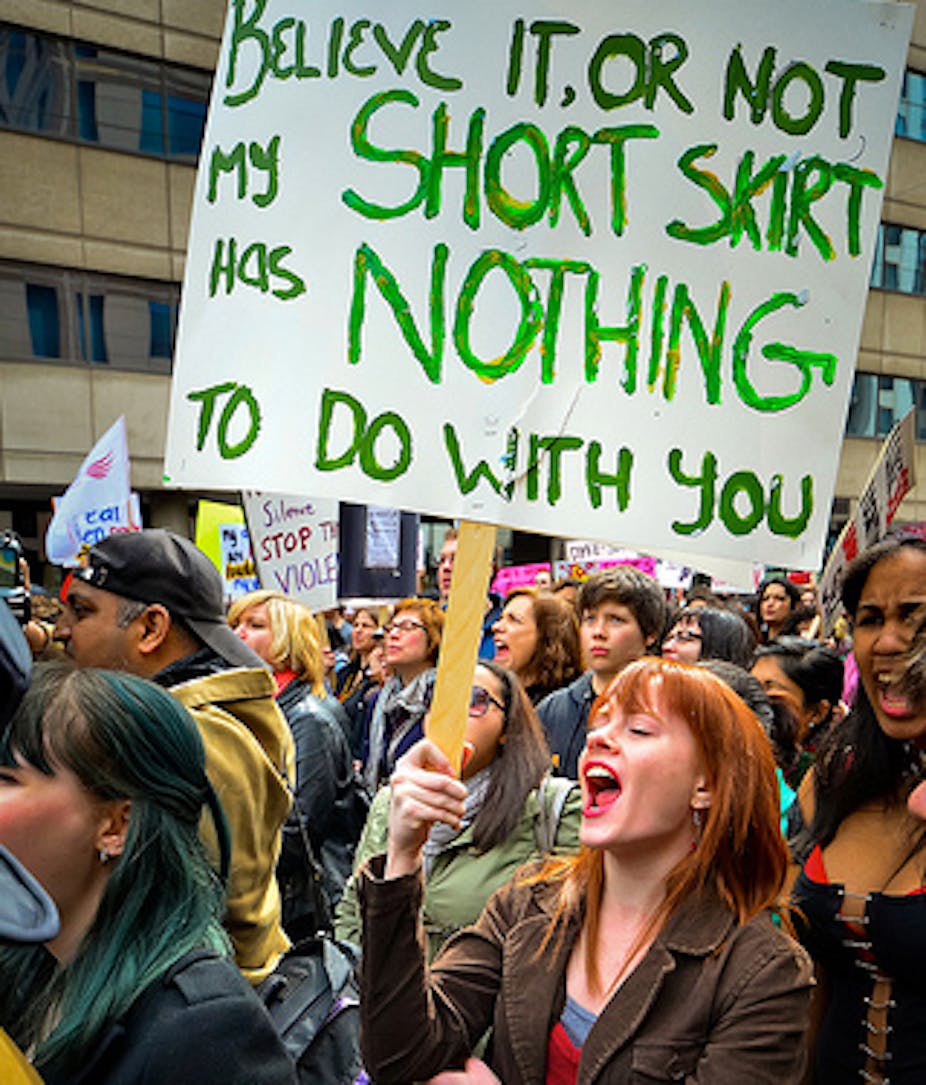
The movement of slutwalking is the fascinating phenomena of what happens when the political passions of the second-wave fantastically crash into the third-wave’s warm embrace of sexuality performed in all its spectacular, confronting and revealing glory.
Spontaneously instigated following a Toronto policeman’s spurious safety advice – “women should avoid dressing like sluts in order not to be victimised” – the slutwalking movement sees women taking to the streets to raise awareness about their rights to safety irrespective of their sartorial style.
Reminiscent of attempts to capture and rebrand traditional slurs like queer, dyke and c—t, slutwalking attempts to wrench the very word, the very dress style, that the Toronto cop claims places women in peril. By taking ownership of the word, of embracing the label, women – in all their diverse ordinariness – are daring to both accept the slut slur and demand their rights to security.
On one hand, the need for such a movement in 2011 seems laughable. After decades of feminist awareness, decades of Take Back The Night marches, decades of legislation and decades and decades of public awareness, surely such a consciousness raising effort is anachronistic. Surely we’re beyond the need to state the bleedingly obvious that men are responsible for rape and not women.
And yet, as the Toronto buffoon aptly demonstrated, rape mythology isn’t something able to be relegated to the bad old days.
One of the ugliest examples from Australia occurred not so long ago in 2006 when a Muslim cleric not only blamed women for their own victimisation, but revoltingly likened them to meat:
“If you take out uncovered meat and place it outside on the street, or in the garden or in the park, or in the backyard without a cover, and the cats come and eat it … whose fault is it, the cats or the uncovered meat? The uncovered meat is the problem.”
Footballer Spida Everitt sent his infamous Milo Tweet in 2010 musing about a spate of sexual misconduct allegations and warning girls: “At 3am when you are blind drunk & you decide to go home with a guy ITS NOT FOR A CUP OF MILO!” Commenting on the very same scandal, morning television host Kerri-Anne Kennerley dared dub the female football groupies as strays.
In a world that likes to think of itself as so very modern, as so very evolved, and as so very politically correct, how very ironic it is that the amount of cleavage a woman is shows or how much attention she lavishes on a footballer is still enough to apparently downplay her victimisation. Enough to negate a man’s abuse of power, horrendous judgment and misogyny.
Women marching for their rights to be treated equally – under the law, in the zeitgeist, in the bedroom – is nothing new. The new, the fresh, comes from the label. The third-wave, to date, has received a bad reputation as the lazy, academic, anything-and-everything goes arm of feminism. Slutwalking proves this isn’t the case.
Depressing that we need to walk this way; triumphant that there’s enough of us still enraged to do it.
Join the conversation
Comments (11)
Adam Thomas
(logged in via Twitter)
I agree with you, but there's one thing about your article that stood out to me.
"Surely we’re beyond the need to state the bleedingly obvious that men are responsible for rape and not women."
Not all rape is a man raping a woman. When a woman rapes a man it is not the man that is responsible. When a man rapes another man it's not both their responsibilities. The same goes for when a woman rapes another woman. All rape is an attacker raping a victim. It is always the attacker's responsibility not the victim's. Please don't perpetuate the myth that rape is always a man raping a woman.
Belinda O'Connor
Student (logged in via email @gmail.com)
It is not always a man raping a woman, but the numbers are overwhelmingly skewed that way. And if men are raped, it is usually by another man.
http://www.rainn.org/get-information/statistics/sexual-assault-victims
http://en.wikipedia.org/wiki/Rape_by_gender
Etc - these statistics are not hard to find (though of course they will always be incomplete due to the stigma for both men and women in reporting sexual assault - one of the things slutwalk is protesting).
It is important to note that the fight…
show full comment
Paul Richards
Our Growth - evolving equality as humans
Gender equality is one of the most emotive issues of our time, and reconciling the argument is paramount to our evolution as humans. Acknowledgment that women and men are biologically different is fundamental to reconciling this issue.
Being biologically different doesn't make us unequal, less deserving of consideration or respect.
Realistically we all need to accept and be fully aware of the other genders biological triggers. Choosing to respect the…
show full comment
Micheal Peridido
(logged in via Facebook)
I think it is a brilliant idea. However you pointed out the obvious, after SO many years of "take back the night" marches people are getting tired of the back-lash against women. What I find really odd is that people STILL think in terms of rape being perpetrated by men (ie the penetrator) towards women (the penetrated). This is what 1970's feminism was saying. Rape is not about a penis, rape is about and has always been about power, not sex, as people can be raped by all kinds of genders. Gender…
show full comment
Mary Tracy
(logged in via Twitter)
Men are responsible for rape, not women. Men don't just rape women who dress "provocatively", they rape women of all ages wearing all sorts of clothes. Men have been known to rape elderly women as well, after all.
And yet, second wave feminists were also right. Women dress up provocatively for men, there is no way to deny that. It is, in a way, internalized patriarchy.
Chris Langan-Fox
Dr (logged in via email @gmail.com)
Where a person is negligent they must take some responsibility for what happens. Some negligence is culpable.
If for instance one leaves ones open topped BMW parked with the keys in and it is stolen, the thief is certainly responsible for the theft, but one is also responsible for creating the occasion of theft and facilitating it. One is effectively an accomplice before the fact.
To argue that one ought to be able to leave the car unattended in such circumstance defies credulity.
The same goes for women who choose to dress in a manner that even other women consider to be recklessly provocative.
Eliza Hutchens
(logged in via Facebook)
Ah, so if you went out on the town with the boys, and decided to wear your best shirt, and those pants that hug your butt just right, it would be reasonable to expect to have your basic rights and liberties violently taken from you?
A woman is not a car. A woman is not a piece of meat. And absolutely regardless of what a woman wears, it is never acceptable to rape.
The message of your opinion is simply that men are too primal and simple to control their desire for sex when something sexually appealing is put before them. What a very, very disappointing truth.
Christopher Angus
(logged in via email @yahoo.com.au)
Eliza, while I certainly wouldn’t think it reasonable to have such rights and liberties taken from me purely because of my clothing, I know that in such a hostile atmosphere I must be aware of my surroundings and react accordingly. The problem is that, although in an ideal world clothing should have no impact on my treatment, right now it does and I simply have to be aware of that to avoid trouble.
Believe me when I say that it frustrates me to no end that so many men out there behave like violent…
show full comment
Belinda O'Connor
Student (logged in via email @gmail.com)
I believe you are mistaken if you think women don't *constantly* consider how they dress, where they go and when, who they talk to etc, will impact not only on their safety but also on to what extent people will perceive them to be at fault when their safety is violated.
It doesn't matter what you wear, where you go and when, who you talk to, you can still be raped. Most rapes happen inside the home anyway, and to people known to the rapist.
The argument of what you wear is really a tired old myth that rapists use to get away with it.
Women *do* constantly guard their safety, as society has taught them from a young age that it will be their fault if someone else does something to them, but ultimately no one can guarantee 100% their safety against rape - men included. To imply people have any control over being raped is victim blaming, pure and simple.
janakin
(logged in via Twitter)
Is that the Chris Langan-Fox who is the Liaison for National Coalition for Men, Tasmania: http://ncfm.org/lead-with-us/chapters/? This Chris Langan-Fox: http://whoiswhoinfathersrights.blogspot.com/2009/08/amfortas-percy-kingfish-king-amfortas.html? Just trying to establish the context.
janakin
(logged in via Twitter)
Indeed disappointing that we still need to be having this discussion.
Because I'm a pedant, I did want to point out that second-wave feminism and radical feminism are not synonymous. While radical feminism had a much higher profile during the second wave than it does now, there were still many more liberal feminists than radical feminists during the second wave. The distinction as I learned it was that radical feminists believe that the entire hetero-patriarchal system had to be be undone in order for women to attain equality, while liberal feminists seek equality through reform within existing structures.