The Conversation
Subscribe
  • Academic rigour, journalistic flair
  • For curious minds
  • Expert news and views
  • Debate and ideas
  • From the curious to the serious

Hot Topics

  1. Gay marriage
  2. Australia in the Asian Century
  3. Convergence review
  4. Federal Budget 2012
  5. War on drugs
  6. Bob Brown
  7. Explainer
  8. Square Kilometre Array
  9. Medical myths
  10. Transparency and medicine

Sharks in the city: Getting to know the neighbours

The vast majority of Australians live in coastal cities. This means most of us have sharks as neighbours. Living alongside sharks in metropolitan cities in Australia requires urban resilience. Unlike birds, deer, rats or other land-animals sharks often “live” somewhere else, but visit coastal cities…

T2rcw5pr-1324339310
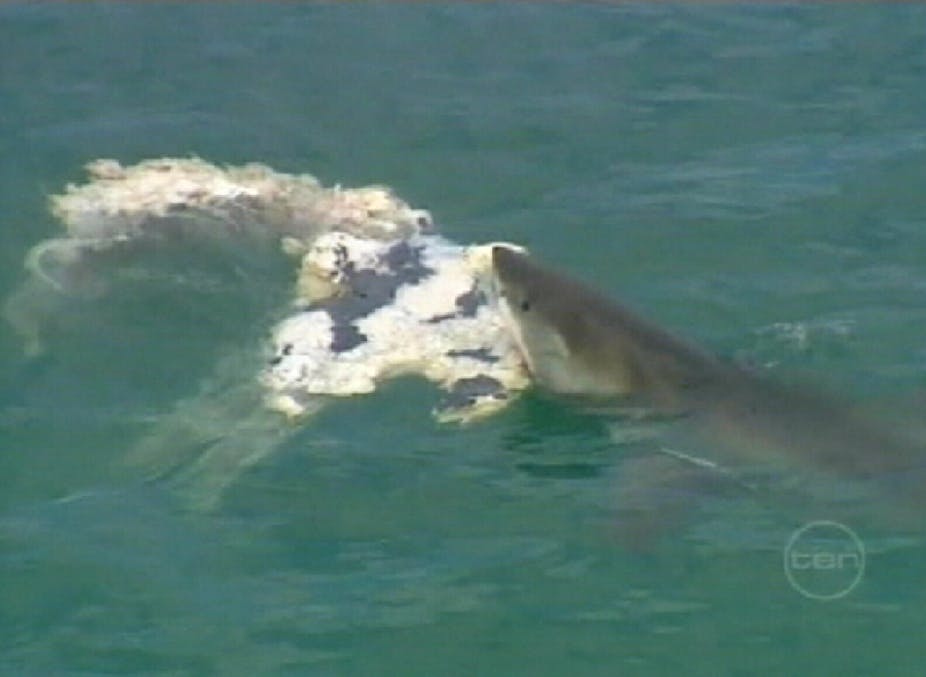
A White Shark feeds on a whale carcass off a Perth metropolitan beach in 2009. This was happening before Homo Sapiens existed. AAP/Channel10

The vast majority of Australians live in coastal cities. This means most of us have sharks as neighbours.

Living alongside sharks in metropolitan cities in Australia requires urban resilience. Unlike birds, deer, rats or other land-animals sharks often “live” somewhere else, but visit coastal cities in Australia to enjoy the warmer water at the same time of the year that we do. Since there is no feasible way to relocate sharks, unlike bats for instance, adapting to sharks in the city means focusing on public awareness and prevention.

During the summer, shark numbers increase in the inner-most city centers along the Brisbane River, Gold Coast canals, Paramatta River, and Sydney Harbour. The takeaway in living next door to sharks; however, is not that they are there; it is that they ignore us so often.

No news is good news

Being ignored by sharks does not usually make the news. When there are shark bites these are generally front page stories and can be incredibly tragic. But reports are often unable to give the entire context. Part of a larger snapshot would note how many Australians live near the coast and how many sharks go out of their way to avoid us in the water. There are two illustrations of this. First, the numbers: “more than 8 in 10 Australians (85%) lived within 50 kilometres of the coastline,” and 65% live in “major urban centres.” In addition, the number of Australians moving to coastal areas between 1996 and 2004 was 12 times higher than the national average. This all adds up to a lot more people in the water and more development of coastal urban areas.
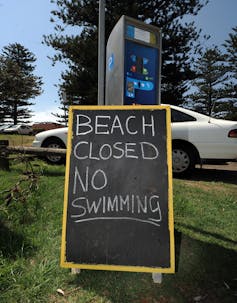
We only notice shark attacks because they are so rare. AAP

Second, sharks do swim away. On Australia Day 2011, as hundreds of bathers competed in the Harbour Swim, two tagged bull sharks also swam in the Sydney Harbour region. In total, seven mature male bull sharks were in vicinity.

This story repeats itself in Port Stephens, where juvenile great white sharks have been tagged and the tracking shows them staying behind the surf zone, and further afield in Cape Town South Africa, Shark Spotters have had over 1,000 white shark sightings, signaled the public and watched the sharks swim away.

Yet even as unlikely and infrequent as shark bites are, there is a natural tension on the use of ocean beaches, rivers, estuaries and harbours. Being aware of the shared waterways is important and recognizing the impact that human behavior or development can have on sharks is key.

Being good neighbours

Some rules for living next door to sharks include the following: first, do not take away their food. Over-fishing or building on areas that diminish the coastal habitats where sharks find fish can alter patters and bring sharks into areas where people are.

Second, what we dispose of in the water can attract sharks or the fish that sharks hunt. Sewage outfalls and abattoirs can put waste near metropolitan beaches and attract marine life that sharks eat.

Third, being a good neighbor means paying attention to personal behavior. Avoiding times in the water when we know bull sharks tend to be more likely, such as dawn or dusk, is helpful as is awareness of water temperature. Bull sharks like warm, cloudy water so being aware of how warm and murky the water is can be key.

A learning process

As a people we are still learning how to live along the coast, with the animals that already live there. In the past, sharks were seen as an urban blight. In the 1960’s, Japanese shark finners were hired to fish and fin sharks near Sydney’s beaches. Today, healthy harbours and estuaries mean more people want to live near them and more baitfish in the water. It does mean that more awareness is needed but it also means that sharks avoid more people, more often.

Prevention education in urban settings acknowledges that these areas are active ecosystems. Tagging and tracking is now part of beach safety in Queensland, New South Wales, Western Australia, and South Australia and through research at CSIRO. The next step is community engagement to make sure we understand what impact we have on shark numbers and movements.

Sharks in the city is not a simple story, but with a bit of caution and effort we are capable of being more resilient when we understand our neighbours better.

Join the conversation

Comments (7)

  1. Permalink
    Mark Carter

    Mark Carter

    (logged in via Facebook)

    At the root of almost every extinction or environmental disaster there seems to always be some character who could make a minor change to their life but wont for the pettiest of reasons.
    Half of all urban journeys could easily be made by bike, but they aren't, so our cities are polluted and congested. Oran utans could be saved if we stopped buying non-FSC timber and products with cheapo palm oil in, but we don't. And shark-human conflict could be eliminated by ocean swimmers making minor adjustments to their routines, ut they won't, so the sharks must go.
    What pathetic brats we are.

    1. Permalink
      rob alan

      rob alan

      BotWatch (logged in via email @orakk.net)

      'What pathetic brats we are.'

      Nail on the head Mark.

      I ask myself. What is it about some folks who believe the world was created for their own indulgences and all other life forms are to kneel before them or die?

      Lets just kill every thing and be done with all this inconvenience of primates taking any responsibility for their own actions.

    2. Permalink
      Russell Hamilton

      Russell Hamilton

      Librarian (logged in via email @gmail.com)

      "shark-human conflict could be eliminated by ocean swimmers making minor adjustments to their routines"

      Mark - what 'minor adjustments' can people make who have to swim before or after work, ie dawn or dusk?

      You'll be glad to know that about 5 years ago I changed the habit of a lifetime and switched from driving to the beach to riding a bike - that was one of the minor adjustments I could make to live a less damaging life.

  2. Permalink
    Russell Hamilton

    Russell Hamilton

    Librarian (logged in via email @gmail.com)

    Once again the advice: "Avoiding times in the water when we know bull sharks tend to be more likely, such as dawn or dusk".

    Well, no. Dawn and dusk is when most people who work normal hours can get to the beach for a swim. That's when I swim. We've had a lot of sharks off Perth beaches this summer and it has stopped many people swimming.

    I don't care about a few sharks being killed if that's the price to be paid for enjoying a swim.

    1. Permalink
      Nick Kermode

      Nick Kermode

      (logged in via email @hotmail.com)

      14 (possibly 15) Shark bite deaths in 218 years in WA. If that makes taking a swim without killing more sharks seem dangerous to you, I suggest you wrap yourself up in cotton wool and never leave the house! And using your safety reasoning I find it astonishing that you ride to the beach, an activity much more likely to kill you than a shark!
      I dive the Seaway entrance at the Gold Coast regularly and barely a time goes by without seeing bull sharks. They are always there. As are the many surfers…

      show full comment

      1. Permalink
        Russell Hamilton

        Russell Hamilton

        Librarian (logged in via email @gmail.com)

        Nick - why are you directing your cotton wool suggestions to me - as I said, I'm still swimming everyday, with the sharks. But numbers of swimmers are clearly down so even though people know the risk is slight, the sighting of sharks, after the fatalities, and the 'Beach Closed' signs have their effect.

        The bike ride IS more likely to kill me than a shark (tell that to Mark above, since he doesn't understand people's reluctance to cycle), but there's not so many cars around early in the morning and I follow a circuitous route to avoid any traffic!

        I'll just have to hope that a billion prospering Chinese with a taste for shark fin soup will take care of the problem.