
Traditionally, the work of marketers has been to encourage the shopper to buy. For decades, marketers have focused on understanding, segmenting, or empirically dissecting a product or brand’s existing customer base to identify and grow the customer base.
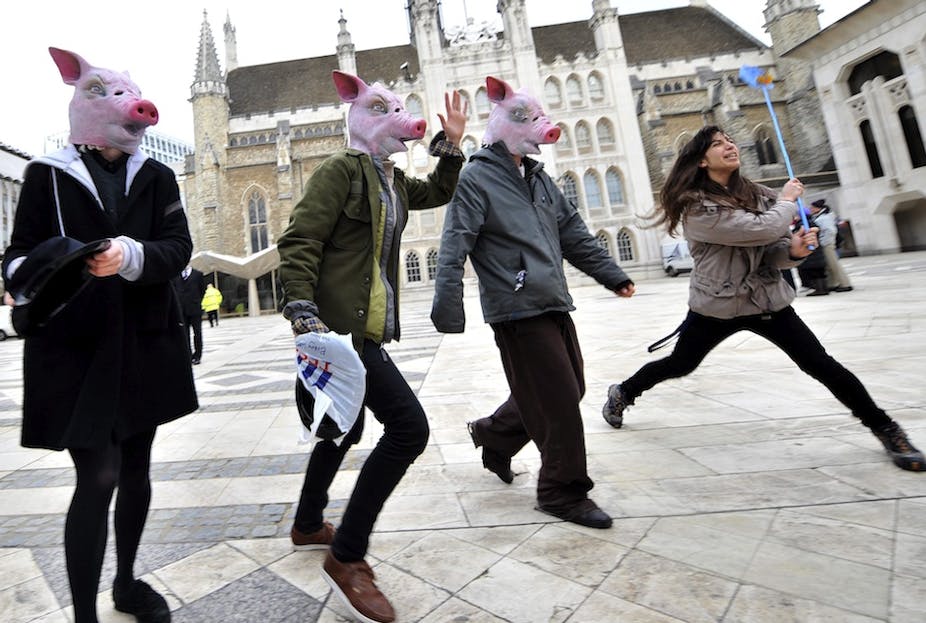
But what happens when consumers choose not to shop? Once thought of as on the fringe, consumer resistance movements that eschew consumption are becoming increasingly mainstream. These so-called “inscrutable shoppers” are commonly anti-globalisation, anti-sweatshop, anti-chain store movements, and anti-technology.
Three distinct groups of consumers relevant to consumer resistance in retail have emerged: the ethical consumer, the green consumer and the activist consumer – each taking on in varying degrees the roles of citizen, activist and/or rebel.
These groups tend to be political and supportive of social movements against corporate dominance, including consumer boycotts (such as anti-corporate protests against Starbucks coffeemakers) and consumer co-operatives.
Mainstream examples can be found in the growing popularity of lifestyle movements which centre on finding a simpler and more sustainable lifestyle in response to the consumer society – “downshifting”, voluntary simplifying, and slow living.
More extreme examples are the “dumpster divers”, a consumer with a such a honed “waste-not” mentality that they are driven to retrieve discarded food items.
But what all these movements show is the importance and relevance of anti-consumption practices in the construction of modern consumer identities.
So how should retailers react? Historically, consumer trends such as these have evolved quite slowly, providing retailers with the opportunity to analyse the implications and make informed decisions.
But against the backdrop of high levels of social turbulence and fragmentation, and with the advent of online communities and social networks, the pace and nature of trend cycles has changed dramatically.
Not only are trends emerging more rapidly, but accelerated social diffusion and instantaneous communication among consumers mean rapid information exchange.
For example, within weeks of the Deepwater Horizon oil spill in the Gulf of Mexico, the Facebook group Boycott BP reached 34,000 members. A year on from the oil leak being capped, it has reached 800,000.
Such speed of information transfer and ease of consumer response is unprecedented in human history. As a result of such change, consumers are capricious, with the individual consumer constantly seeking new forms of interaction with retail.
Retailers globally have been confronted with consumer resistance to traditional retailing models through the advent of online coupons – Groupon has been touted as one of the fastest growing companies in history, with sales exceeding $500 million within two years of inception.
In this instance, consumers are resisting full-price offers in favour of seeking “daily deals” through online providers and are increasingly sharing these experiences with their social community.
Although a challenge, consumer resistance can provide opportunities. For instance, during poor economic conditions, some retailers are driven to develop innovative strategies around offering cash or a trade-in in exchange for unwanted electronics.
During tough economic times, Amazon was able to re-engage consumers in the purchase process by offering gift cards in exchange for second-hand video games. The gift card idea was ingenious as, rather than paying cash for used games, Amazon re-engaged consumers to purchase more from Amazon.com.
Savvy retailers can meet specific challenges, such as consumer boredom. For example, the mall-based family centre KidZania entertains and educates children by immersing them in a simulated city where children role-play as citizens.
T-shirt designers Threadless cater for the consumer who wants to co-create the product; similarly Shoes of Prey allows customers to design and customise their own shoes.
Others have responded in a way that has maintained or increased their customer base. For example, luxury lingerie brand La Perla has embraced the “slow shopping movement” to enhance the customer experience by engaging them in the story of the product during a leisurely online or store visit.
In drawing out the implications for retailers, we propose a number of strategies by which retailers can connect and engage with today’s shopper, ranging from the offer of edutainment within the physical store environment, to a holistic strategy of thinking global, acting local.
Other technological advances mean that retailers are increasingly able to connect with and engage consumers across multiple channels, and to involve consumers in the communication and creation to mitigate consumer resistance.
Sean Sands is co-author of Inscrutable Shoppers – consumer resistance in retail with Stella Minahan and Carla Ferraro.
Join the conversation
Comments (11)
Lorna Jarrett
PhD candidate, science education; Physics teacher (logged in via email @diment.org)
So what you're saying is savvy retailers should respond by investigating ways of getting the anti-shoppers back into the consumerist fold?
Good luck with that. What your article fails to mention is that these people find materialist consumption depressing, fulfilling and pointless. As the saying goes: "buying stuff you don't need, with money you don't have, to make impressions that don't last on people you don't care about". They have discovered that buying less stuff actually leads to more happiness. Savvy retailers aren't going to persuade them to go back.
Also: "anti-technology"? Seriously?? How exactly does that fit with your example of the use of facebook to disseminate the BP boycott?
Byron Smith
(PhD candidate in Christian Ethics at University of Edinburgh)
I heartily agree.
"But what all these movements show is the importance and relevance of anti-consumption practices in the construction of modern consumer identities."
The point of anti-consumerism is not that retailers need to lift their game in order to win back lost customers; it is that the elevation of consumption into the primary basis or expression of identity leads to withering of the soul and degradation of the living spaces of the planet. As Lorna says, the liberating discovery that embracing less can mean more life is not simply another lifestyle choice to place on the shelf to inflate the profits of the most market-savvy corporations. There is a difference between ethical consumerism, green consumerism and anti-consumerism.
elbatxeb
(logged in via Twitter)
Anti *disposable* technology?
PS you make dumpster diving sound like eating scraps off a stranger's plate - the stuff that can be found in supermarket bins would amaze the average punter!! This is NOT a gnawed on chicken bone we are talking about.
I'm not sure about Australia, but certainly in other countries the "desirable" shelf space is something suppliers compete for. This may have improved - I fervently hope so!!! - but guess what happens (happened) to the stock sold by X company that was on the eye-level shelf (regardless of condition / perishability / etc) before Y company made an agreement with the supermarket?
Yup, it gets chucked in the bin.
Like cans of baked beans.
Apparently cheaper to dump than pay staff to reorganise stock onto other shelves.
Lorna Jarrett
PhD candidate, science education; Physics teacher (logged in via email @diment.org)
Years ago I was between jobs in a capital city, living round the corner from an upmarket baker / patisserie. Every morning they bagged and put on the pavement about 10-20Kg of the previous day's artisan loaves, fruit-breads, croissants and cakes. Sure, I had to scrape cream off the walnut-and-fig sourdough once, but if you've not tried the inappropriately-named "dumpster diving", don't knock it.
justinehumphry
(logged in via Twitter)
Really I'm not sure that "how should retailers react?" is the key question or really one that matters, at least not to me. What about how effective are anti-consumption campaigns, how we can understand these in relation to broader social and technological events and movements, how we can participate in them or find out more about specific campaigns. What about - where do anti-consumerist movements fail? It's great to have an article on this topic and I want to know more about it but I think we can open this up to many more angles.
Lorna Jarrett
PhD candidate, science education; Physics teacher (logged in via email @diment.org)
One factor that I think is significant in the "withering of the soul" that stems from consumerism (apart form the credit card bills) is that consumerism is essentially a non-creative exercise. Those who consciously consume less have to be more creative. Perhaps they're more creative people to start with, or they discover hidden powers of creativity, or they learn to be creative - I don't claim to know which. They learn to make and repair things, they learn craft and technical skills. They make things…
show full comment
Dale Bloom
Laboratory analyst (logged in via email @mail.com)
Lorna, I would totally agree.
A relative and I have agreed that we would not send each other presents such as birthday or Christmas presents that cost more than $5. This is more difficult than it seems, but has lead to a considerable variety of novel and interesting presents being sent, and it certainly does make someone more imaginative when choosing something to buy or make.
Andy Scerri
(Research Fellow, Global Cities Institute at RMIT University)
I agree with much of what you say Lorna and Byron, though I'm not qualified to talk about "withering of the soul", I do feel that over-consumption leads to "degradation of living spaces of the planet" and unnecessary labour exploitation.
Sean, your lack of insight into the movement that you profess to study is a little alarming, 'Shoes of Prey' take advantage of extremely low wages etc. by offshore manufacturing in China:
http://www.shoesofprey.com/content/team.html
Something that seems…
show full comment
Tim Niven
Unspecified (logged in via email @yahoo.com.au)
I would like to reiterate what Justine has said: how retailers win back "capricious" "anti-" consumers is the kind of question only interesting to, perhaps, retailers/marketers, etc. If this is the perspective taken at the Australian Centre for Retail Studies, then fine, no problem - but a stale and narrow focus, and misses the far more important questions.
Also, "anti-" is an unfortunate way to try and cast the many people described in the article, missing the nuance, and reducing (often) serious and thoughtfully considered opinions/choices to something that sounds like a "capricious" emotional "reaction against". Although it may be a wieldy generalisation, it still obscures more than it reveals. Consider, for example, people who are not "against" consumerism (i.e. not "anti-") but simply want nothing to do with it. It's a false dichotomy to exclude this option, like Bush's "You're with us, or you're against us" - there's a third option, which is neither of the above.
Andy Scerri
(Research Fellow, Global Cities Institute at RMIT University)
By way of amending my last article, the Threadless company does indeed claim that "Most of our tees are manufactured in the US, India, Egypt, and Mexico. The tees made overseas are manufactured in updated facilities. We have confirmed the labor conditions are 100% up to US standards."
See, http://support.threadless.com/ics/support/default.asp?deptID=15140
Derek McKinnon
Manager (logged in via email @atcm.com.au)
"Three distinct groups of consumers relevant to consumer resistance in retail have emerged: the ethical consumer, the green consumer and the activist consumer – each taking on in varying degrees the roles of citizen, activist and/or rebel."
You forgot the miserly consumer. I don't buy because I'd prefer to have money in the bank.