
The Conversation
Subscribe
  • Academic rigour, journalistic flair
  • For curious minds
  • Expert news and views
  • Debate and ideas
  • From the curious to the serious

Hot Topics

  1. Gay marriage
  2. Australia in the Asian Century
  3. Convergence review
  4. Federal Budget 2012
  5. War on drugs
  6. Bob Brown
  7. Explainer
  8. Square Kilometre Array
  9. Medical myths
  10. Transparency and medicine

The beginning of the end for automobility?

Car travel is becoming a victim of its own success. If we in the West had only kept cars for ourselves, automobility could have survived much longer. But we shared them with the rest of the world, and now car travel is doomed. In 1950 world car numbers were a little over 50 million, with around 80…

Yr6fhdkp-1328064661
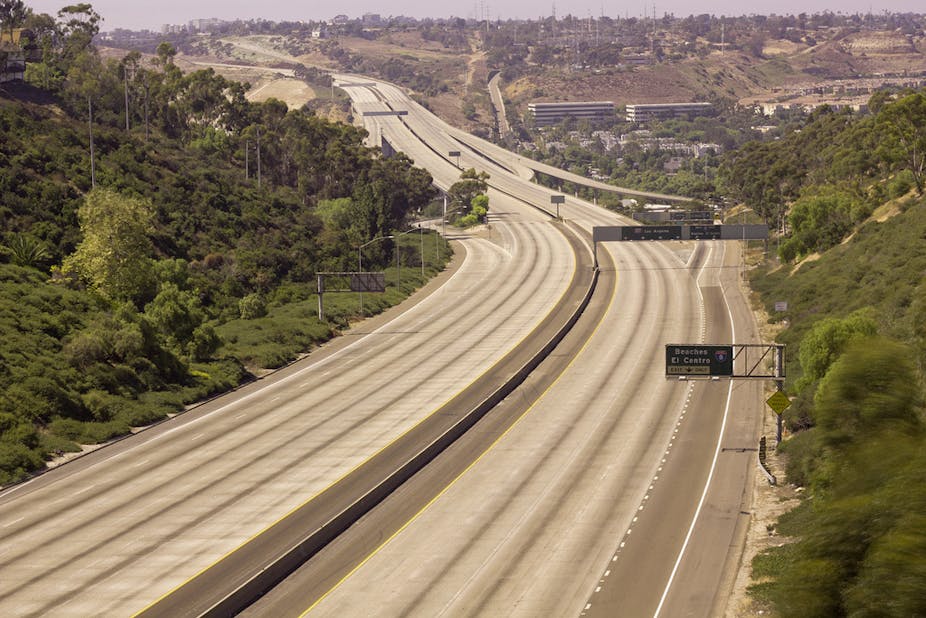
Future freeways could be very different places. johnsnape

Car travel is becoming a victim of its own success. If we in the West had only kept cars for ourselves, automobility could have survived much longer. But we shared them with the rest of the world, and now car travel is doomed.

In 1950 world car numbers were a little over 50 million, with around 80% of them in North America. Today, cars (taken here as including all light four-wheel vehicles for personal travel) number over 800 million globally, and China has overtaken the US as the leading purchaser of new cars.

Car ownership in OECD countries is typically 400 or more per 1000 persons. In Australia it’s over 650. Despite the rising rate of car sales in China — and to a lesser extent India and other major industralising countries — ownership there is still comparatively low (typically 30 or fewer per 1000 people). But aspirations for ownership are high.

Globally, cars seem set for a bright future; experts talk of up to two billion cars on the world’s rapidly expanding highway networks by 2030. If all the world’s projected 9.3 billion people in 2050 enjoyed the present Australian rate of ownership, there would be over six billion cars.

But it won’t happen — not on this planet. We face a number of interconnected environmental and resource problems, but the two that most obviously relate to transport are global oil depletion and global climate change. Together, they’ll spell the end of automobility.

Globally, annual oil production may already be near its peak, with little further increase expected. More importantly, on a per capita basis, oil consumption peaked in 1978, and has fallen 20% since then.

We no longer have the twin safety valves that helped ease the situation in the 1980s and 1990s — the progressive substitution of other fuels for oil in power plants, and the collapse of the USSR, which cut that region’s oil consumption by half. Intensified international competition for remaining oil will not be a recipe for world harmony.

As for global warming, by any reckoning we in the West have used our quota of climate-change-causing greenhouse gas emissions (and the same is probably true for oil).

Many will agree that oil depletion and global warming are serious problems, but still argue that one or more of a variety of technical fixes will overcome them. Suggestions include liquid fuels derived from biomass, plug-in hybrid electric vehicles (the current favourite), or major gains in vehicle efficiency.

Though there are plans for “second-generation” biofuels, all biomass fuels are presently derived from foodstuffs and have limited expansion potential in a food-short world. Plug-in hybrids would also save oil, but would increase CO₂ emissions in most countries (including Australia) where electricity is primarily produced from fossil fuels. Measurable gains in vehicle efficiency are slow in coming: the efficiency of present Ford vehicles in the US is no better than that of the model-T Ford.

Major transport change is already occurring in Australia. Over the past decade, public transport patronage has grown strongly in our cities, while car travel in terms of passenger-kilometres per person has been falling since at least 2005. It has also dropped in a number of other high-mobility OECD countries, including the US.

These changes, although welcome, are too small and are coming far too slowly. We can ignore climate change, perhaps for another decade or so – that is essentially our present, grown-up, response. But oil shortages cannot be ignored, and are likely to lead the changes that will spell the end of the global car dream.

The Conversation

Comments (148)

Comments on this article are now closed.

  1. Permalink
    Wheeled Pedestrian

    Wheeled Pedestrian

    (logged in via Twitter)

    @Russell Feel free to crawl over broken glass; a comment that really speaks volumes of the human condition. The scenario presented here is, on the face of it (based on Russell's comments), rather bleak. But in actual fact, it will bring with it a host of positive opportunities. Apart from the obvious opportunity to reverse climate change for the planet and future generations, it will mean that we will finally have our cities and communities back. The motor vehicle dominates our public spaces at the expense of people. Personally, I believe a massive hike in carbon fuel prices will be a welcome reprieve.Heresy? You bet.

  2. Permalink
    Phillip Smith

    Phillip Smith

    urban designer (logged in via email @deickerichards.com.au)

    In my view the eventual demise or significant decline of automobility will not just come about because of fuel sources though. Cars are responsible for unnecessarily expanding the size of our cities/urban places which will need to be more compact and interconnected for a whole range of sustainability/survival reasons. Cars are inherently unhealthy, regardless of how they're fuelled and that will mean the progressive reduction in their dominance.

  3. Permalink
    Paul Richards

    Paul Richards

    (logged in via Twitter)

    Patrick - Thanks for the article it appreciated.

    We have subsidised the Motor Vehicle Industry using public funding, spending literally millions of pounds, what has become many billions of dollars since1948 and over eight billion just in 2010 - 11. Our legacy is a history of hit and miss success of tiny production runs creating uniquely Australian vehicles. Not to mention a largely imported transport infrastructure and de-humanised cites. Although certain models of these satellite plants, at…

    show full comment

  4. Permalink
    John Harland

    John Harland

    bicycle technician (logged in via email @gmail.com)

    Cars don't allow us to do now what cars used to allow us to do.

    And public transport has the potential to do far more than it does now. Particularly if we start planning cities instead of allowing them simply to sprawl.

    It is pretty meaningless basing a generic criticism of public transport on a system such as that in Melbourne in peak hour, when there has been gross underinvestment for a long time. By contrast, there has been very high levels of investment per traveller on the road system…

    show full comment

    1. Permalink
      Noel McFarlane

      Noel McFarlane

      Cycling advocate (logged in via email @geminibicycle.com.au)

      John you are so right.
      I guess most has been said. Overall a failure in Australia over the last 60 years when private interests, the media and a complicit bureaucracy in many cases, allowed little or no worthwhile debate and we got what we now have.
      Is it getting better?
      Well, RN recently renamed their evening 6pm slot "drive time". I am disgusted.

  5. Permalink
    Noel McFarlane

    Noel McFarlane

    Cycling advocate (logged in via email @geminibicycle.com.au)

    Oil supply and carbon emissions may be sufficient challenges to see a big change. Space is another part of it though. In Australia a single person requires a vehicle that takes up, with its buffer, 25-30 square metres. Then at both ends of the trip, a large portion of which are only a few kilometres, the vehicle requires a lot of storage space.
    After decades of academic awareness of problems we still see, particularly here in Australia, more big roads being built. Private motoring still has a lot…

    show full comment

  6. Permalink
    John Harland

    John Harland

    bicycle technician (logged in via email @gmail.com)

    In my understanding, Noel, that is correct.

    The cooling systems are needed for high-level nuclear waste and they will have backup systems for extended failure of power supply but there is no way to make them entirely self-sustaining over a period of decades and probably much less than that - maybe only days.

    You could, conceivably, devise a thermosiphon cooling arrangement that didn't require pumping but diagrams I have seen do not hint at that.

    Not even that would be immune from any need of maintenance, however.

  7. Permalink
    Chris Sanderson

    Chris Sanderson

    CEO (logged in via email @jindibah-community.org)

    Hi Patrick, well I agree with a lot of what you say.

    However I think you underestimate the role that PHEV's and EV's will play over the next decade as people really start to experience the consequences of CO2 emissions.

    Most people are still not connecting the dots of the signals that Mother Nature keeps sending us. Like more frequent and more extreme floods, droughts, etc in Australia.

    History shows that at the beginning of every period of major change, those who stand to lose, deny…

    show full comment

  8. Permalink
    Graham R.L. Cowan

    Graham R.L. Cowan

    Researcher (logged in via email @eagle.ca)

    The late John McCarthy, Lisp-inventing computer science professor, remarked,

    Individual mobility is much valued, and no amount of propaganda has succeeded in making people forego it. As fast as countries become prosperous, their citizens buy cars even when their wise men oppose it.

    Nuclear production of motor fuel can easily support six billion cars, with much less environmental damage than existing hydrocarbon mining operations and waste dumping are doing.

    Motorists today subsidize government. When this ceases to be true, governments will become less hostile to car alternatives, but even if such alternatives are favoured, cars will still be much desired.

    1. Permalink
      Michael Peck

      Michael Peck

      (PhD researcher in energy security at the Centre for International Security Studies, at University of Sydney)

      'Nuclear production' of liquid fuels really means 'thermal production' since it is the heat that does the work of reforming some base set of chemicals into the various fuels. Think too of all the economic growth required to build up and maintain a 6 billion vehicle fleet, and what that also means in terms of heat.

      The heat is a problem, and consitutes a fundamental thermodynamic limit to economic growth. This isexplained by physicist Tom Murphy.

      For a very clear analysis of the thermodynamic limits of utilsing the solar flux, and of economic growth please see his two excellent posts 'Galactic-Scale Energy' and 'Can Economic Growth Last?' via these links:

      http://tinyurl.com/769v4ns / also see 'Sustainable Means Bunkty to Me'
      http://tinyurl.com/5wf4g5a

      1. Permalink
        Graham R.L. Cowan

        Graham R.L. Cowan

        Researcher (logged in via email @eagle.ca)

        "Think too of all the economic growth required to build up and maintain a 6 billion vehicle fleet, and what that also means in terms of heat.

        The heat is a problem, and consitutes a fundamental thermodynamic limit to economic growth. This isexplained by physicist Tom Murphy."

        It surely does. Billions of cars at several time-averaged kilowatts each amount to trillions of watts; maybe tens of TW, with the other activities that would go along with, the, as you say, "required economic growth". Tens of TW that the earth must shine away in the far infrared, along with the ~120000 TW that the Sun gives it.

        Murphy's blog had some sort of catchy title ... what was that title, do you recall?

        1. Permalink
          Michael Peck

          Michael Peck

          (PhD researcher in energy security at the Centre for International Security Studies, at University of Sydney)

          'Do the Math' - The key point he makes is that 'continued growth in energy use becomes physically impossible within conceivable timeframes' ~ it has to come to an end in about 2 centuries.

          I won't try to summarise his posts (very readable, amusing and concise they are too), but his blog is here: http://physics.ucsd.edu/do-the-math

          1. Permalink
            Lorna Jarrett

            Lorna Jarrett

            PhD candidate, science education; Physics teacher (logged in via email @diment.org)

            Nice blog thanks Michael - I like things like this that include formulas, calculations, things that can be followed through and checked on. Us physicists like things simple!

            One tiny hitch - thesis to write...

      2. Permalink
        Mark Duffett

        Mark Duffett

        (logged in via Facebook)

        Yes, heat is an ultimate limit, but that doesn't mean that 6 billion vehicles takes us anywhere near it. Rather, nuclear or other thermal fuelling of this fleet (bearing in mind that our current transport already produces a fair amount of heat) will add only an amount somewhere between 'minor' and 'negligible' to global warming:

        http://bravenewclimate.com/2010/02/26/nuclear-wont-cook-earth/

        Note especially the comment therein from none other than GRL Cowan: "the papers you cite assume exponentially increasing flow of heat from man-made devices into the Earth’s surface and troposphere. Of course, if this increase never stops, and is of such an annual percentage rate that after centuries it could become harmful to the earth, then it could, after centuries, become harmful. Or in the phrasing of the abstract, “could eventually”. If dogs grew increasingly large wheels, we could eventually not need streetcars."

  9. Permalink
    Chris Sanderson

    Chris Sanderson

    CEO (logged in via email @jindibah-community.org)

    For those who correctly were anti-nukes in the 60's and 70's, in addition to Barry Brook's website, it's worth reading Tom Blees 'Prescription for the Planet'. Not surprisngly the technology has got a lot safer and less expensive with IFR's and they eat nuke warheads and the world's store of nuclear waste as fuel. Cheap and solves a big problem. Russia, China and India will install them../Chris

  10. Permalink
    Chris Sanderson

    Chris Sanderson

    CEO (logged in via email @jindibah-community.org)

    Hi Lorna, Protesting about nuclear energy in the ‘60’s, ‘70’s & ‘80’s made sense as history has shown.

    However since then the teams of hundreds of scientists working at the Argonne Labs in the US, listened to the criticisms and fears and toiled away to eventually come up with Integral Fast Reactor (IFR) technology.

    It is orders of magnitude safer than previous generations, it consumes today’s nuclear waste, including nuclear munitions as its fuel, is a lot less expensive to set up and de-commission…

    show full comment

  11. Permalink
    Russell Hamilton

    Russell Hamilton

    Librarian (logged in via email @gmail.com)

    A few years ago it looked like peak oil was an inescapable problem about to hit us, but since then we've exploited tar sands and new sources of gas etc Then there's nuclear for electricity, and if coal can be made clean we'll be ok for a long time. The sugar Australia produces would be better used for ethanol than for putting in our stomachs. Aren't people starting to produce fuels from bacteria living on waste, and sea-water? So, if anything, the crisis of supply seems to be receding into the future (if not the climate crisis).

    Public transport will never allow us to do what cars can do, especially in hugely sprawling cities like Perth. So even if we don't have cheap oil, people will still want a private option like motor scooters - I would rather crawl on hands and knees over broken glass to get to work than ever go back to public transport.

    1. Permalink
      Paul Richards

      Paul Richards

      (logged in via Twitter)

      Russell - public transport can do incredible things, it easy for our mindset to be locked in by the automobile propaganda we have all been subject to. Having lived in Perth the train line north and south can easily be ramped up. They are working on increasing densities there also by rerating the blocks.

      Having worked on the planning for humanising the coast from Mandurah to Yanchep. I know the densities and height restrictions are sorted as is much of the coastal planning. Since the 1950 Perth…

      show full comment

      1. Permalink
        Russell Hamilton

        Russell Hamilton

        Librarian (logged in via email @gmail.com)

        Paul - public transport can be incredibly horrible too. I used public transport to get to work for years until the train was so crowded that it was just a very nasty way to start your day - nasty enough for me to pay a lot of money to park in the city. I still see the news reports of trains so crowded people can't get on to them - and this when we're comparatively prosperous, so I don't see much hope of the train service ever being an option for civilised commuting.

        Until recently I was helping…

        show full comment

        1. Permalink
          Paul Richards

          Paul Richards

          (logged in via Twitter)

          Russell - understanding the concept of humanised cities is a lot to ask when first hearing about it. By no means have they dispensed with motor vehicles in countries where it is successful, but many trips by individuals are unnecessary and wasteful. The most obvious provision for light rail you can see close to you, is Marmion St - Fremantle to Booragoon has a corridor set aside for it.

          Interestingly I am very familiar with the route you are talking about, not only that but have looked after…

          show full comment

          1. Permalink
            Russell Hamilton

            Russell Hamilton

            Librarian (logged in via email @gmail.com)

            Paul - here's how your proposed Marmion St rail would work: I would trudge to Marmion St (in the rain, today, or the sweltering heat of the last few days, carrying my briefcase and the other container my lunch is in) and wait for train. This would trundle along Marmion St to, as you say, Booragoon. Presumably there I change to a bus to take me to the ridiculous station in the middle of the freeway/Canning Bridge.

            (Someone mentioned Jakarta - which is co-incidentally what I thought of last night…

            show full comment

            1. Permalink
              Paul Richards

              Paul Richards

              (logged in via Twitter)

              Russell - I might suggest you ride a Melbourne train or tram in peak hour and you might appreciate what you have in Perth. I have commuted on public transport in both cities and know where it is better. Having my family in Melville am familiar with your commute. As for the heat, it's one of the reasons I live here, but there are trade offs. Perth has great cycling infrastructure and I miss it.

              No one thinks it is is inappropriate to use a motor bike, in fact that is why it would be better. Nothing…

              show full comment

              1. Permalink
                Russell Hamilton

                Russell Hamilton

                Librarian (logged in via email @gmail.com)

                Paul, lines like "you might appreciate what you have" are never going to win anyone over!

                Your link doesn't work for me, but if is to those nifty bikes that look like little cars, well, that's straight away more appealing - at least it looks like a car.

                My bike is from your beloved Netherlands and I would never be so ambitious as to think of doing anything to the annoying thing - it has to go to the bike shop for repairs, despite puncture proof tyres and tubes, and strips of kevlar in between and some goo in the tubes etc etc Obviously you have never ridden on the path over the Stirling Bridge and down Tydeman Road. Shattered glass the whole way - the word maintenance is not in the Main Roads Department's dictionary.

                1. Permalink
                  Paul Richards

                  Paul Richards

                  (logged in via Twitter)

                  I am surprised you have issues with Schwabe tyres. My friends with Dutch bikes here and the Netherlands speak highly of them because of their weight and longevity. They are heavy machines, even my Mango only weight 25 kg.

                  As for the tyre problem on the Stirling Bridge, complain to the council. Glass bottles are and glass slivers are a major problem, they should address the issue. I worked on the Southern Gateway Project, had a great deal to do with MRD and yes they are bureaucratic, but they will do something if you raise it.

                  Take it any way you want "you might appreciate what you have", being squeezed into trams and trains here is very real. I never did appreciate Perth's public transport personally. There is one issue we don't have that will go un-said, I don't miss that part of Perth's Public transport : / Wishing you well.

                  Paul's Mango link will work.
                  http://youtu.be/65ssP0vJ5s4

              2. Permalink
                Paul Richards

                Paul Richards

                (logged in via Twitter)

                I don't hate cars and follow F1 and MotoGP, it's just we have followed corporations propaganda and have biased our transport infrastructure toward motor vehicles.
                I might add to the detriment of pedestrians, bikes and motor cycles.

        2. Permalink
          Lorna Jarrett

          Lorna Jarrett

          PhD candidate, science education; Physics teacher (logged in via email @diment.org)

          Frankly I'm astonished that the article fails to mention the infamous Asian traffic jams (ok probably not unique to Asia but the worst personal anecdotes I've heard all come from Asian cities with Jakarta as a stand-out).

          The failure of private car transport in these cities mean that frankly you'd be quicker crawling over broken glass, although you'd probably want your own air supply.

          Climate change and alternative fuels notwithstanding, cars just take up too much room to be a viable form of transport for modern urban areas.

          Look on the bright side - humanising cities and getting the lucky able-bodied out of their cars will not only help THEM in their fight against obesity, it'll help people like you who care for elderly and disabled people and need to use private cars. Fewer able-bodied people in private cars means less gridlock for everyone.

        3. Permalink
          Ashley Hooper

          Ashley Hooper

          Farm worker (logged in via email @gmail.com)

          Russell, public transport is undoubtedly less convenient for certain daily movement patterns, but in lieu of a miraculous new energy source many of us are probably going to have to learn to do without cars, just as most of our ancestors did as recently as 60 years ago. Yes, this will necessitate more thinking about where we live in relation to where we work, proximity to family members etc.

          There is no guarantee of an intersection between what is convenient or desirable and what is practicable - your message implies that there is. To be blunt: peak oil and climate change don't care how inconvenient it is to you to pick up your mother's laundry.

          1. Permalink
            Russell Hamilton

            Russell Hamilton

            Librarian (logged in via email @gmail.com)

            "There is no guarantee of an intersection between what is convenient or desirable and what is practicable - your message implies that there is. To be blunt: peak oil and climate change don't care how inconvenient it is to you to pick up your mother's laundry"

            I was suggesting that the most convenient intersection for me will be a motorbike (perhaps with a sidecar for the laundry!). It won't be being crowded like a sardine into some train carriage.

    2. Permalink
      Graham R.L. Cowan

      Graham R.L. Cowan

      Researcher (logged in via email @eagle.ca)

      " I would rather crawl on hands and knees over broken glass to get to work than ever go back to public transport."

      You might change your mind if you encounter public transport in a country whose government doesn't get several percent of its income from motor fuel taxation. When such governments operate public transport, they naturally want to do so in such a way that no-one who can take the car takes the bus.

  12. Permalink
    Derek McKinnon

    Derek McKinnon

    Manager (logged in via email @atcm.com.au)

    Give me freedom or give me death, including the freedom to travel. The communists in Russia stopped people from travelling by issuing passes. The modern latte sipping communists try to do the same by carbon pricing. Your hatred of the car is based on old fashioned class warfare, you just change the argument to whatever sounds best at the time. What will you do once all cars are electric and we generate our power via nuclear? I'm sure you'll find another reason to attack car use.

    1. Permalink
      Lorna Jarrett

      Lorna Jarrett

      PhD candidate, science education; Physics teacher (logged in via email @diment.org)

      We don't hate cars, we just realise that when an idea has had its day it's time to move on. EVs still take up room on roads and room to park; the laws of physics mean that individualised transport in massive cities in a world of 7 billion people (and counting) just doesn't scale. Obesity won't be tackled until people are less sedentary.

      Throwing cheap insults around may make you feel better but it doesn't change the facts. Most people find it uncomfortable to contemplate change but that doesn't mean change can be avoided. Better to face the future than have it bite you on the bum while you're contemplating the past.

      1. Permalink
        Lorna Jarrett

        Lorna Jarrett

        PhD candidate, science education; Physics teacher (logged in via email @diment.org)

        One more thing. You can get a hell of a lot of work done on the train (ear-defenders over headphones may look silly but it makes for a wonderful cone of silence). It might not be perfect but it's infinity-percent better than trying to transcribe / analyse data / bash out a paper while driving - because none of those things are possible while driving.

        Maybe some of you people have enough time on your hands to enjoy the luxury of sitting in a traffic-jam listening to classic-FM, but for those of us with lots to do the train wins out every time.

          1. Permalink
            Lorna Jarrett

            Lorna Jarrett

            PhD candidate, science education; Physics teacher (logged in via email @diment.org)

            It's often a close thing - but I know where there are usually a triad of regulars who like to hog 5 seats. Most people are put off by their sheer rudeness but my ear-defenders mean I can't hear their grumbling, and the necessity of getting my PhD written *in my spare time* means I couldn't care less whether they think half the train belongs to them.

            Maybe if we didn't subsidise the fossil fuel industry so much, we could afford more / better trains.....

            1. Permalink
              Russell Hamilton

              Russell Hamilton

              Librarian (logged in via email @gmail.com)

              And if we didn't subsidise public transport so much we could afford new bridges and tunnels for cars, but in the end, we'll need to do both.

    2. Permalink
      Paul Richards

      Paul Richards

      (logged in via Twitter)

      Derek - thankfully we don't need the permission of the "silent generation" or the "baby boomer" for the changes. Plans for humanising cities are rolling out now, just sit back and enjoy the process. Time to stop it was over twenty years ago.

      The traffic infrastructure is biased toward motor vehicles and it will change, the mindset of advocates of this bias will linger. This countries roads were opened up by pedestrians, horses and the bicycle. All of the gazetted road improvements that made motoring…

      show full comment

  13. Permalink
    Michael Peck

    Michael Peck

    (PhD researcher in energy security at the Centre for International Security Studies, at University of Sydney)

    Thanks for the article Patrick.

    You note, rightly, that 'measurable gains in vehicle efficiency are slow in coming'.

    But the thing is they won't be improving much anytime soon.

    The internal combustion engine's maximum theoretical efficiency is under 50%. This is fundamentally determined by its operating ambient and combustion temperatures. While advances have been made through for example computerised engine and gearbox management, improved materials and other engineering tweaks, these…

    show full comment

  14. Permalink
    Leo Kerr

    Leo Kerr

    Consultant (logged in via email @myelectriccar.com.au)

    I can't believe the bold statement that "global oil depletion and global climate change" will spell the end of automobility. Of course they are not two reasons but the first part of the statement is inexorably linked to the second - global oil depletion - or in other words the dependence of the global automotive fleet on oil. That situation will change dramatically over the next two decades with fully electric vehicles taking over from a 'hybrid' interlude in automotive technology. EV's are being…

    show full comment

  15. Permalink
    Noel McFarlane

    Noel McFarlane

    Cycling advocate (logged in via email @geminibicycle.com.au)

    When will this thread die? NO. That is not my question. I am not a scientist but probably this will be read by someone who can tell me...

    A TV program I saw about what would happen if humans suddenly vanished/died (not going to happen) said that the nuclear waste cooling operations would run out of power when their back up fuel ran out. Then the waste would heat up and many catastrophes would occur. Is this true about them needing human managed cooling for a very long time?

    1. Permalink
      Paul Richards

      Paul Richards

      (logged in via Twitter)

      Noel, my guess is you are talking about fuel rods. When taken out of the reactor, the rods make about five percent of the heat they did. The rod heat production goes down with time as the fissionable products stabilise into other radioactive atoms. Still highly dangerous to life on earth.

      These are called spent fuel rods and typically take ten years to cool after being removed from a reactor. This is why if cooling systems fails, as in the Japanese earthquake March 2011, the rods started becoming…

      show full comment

  16. Permalink
    James Szabadics

    James Szabadics

    Technical Development and R&D Manager, Plantation Timber Industry (logged in via email @technologist.com)

    Reading this automobility without oil is doomed. You would assume after reading this that electric vehicle technology, hydrogen fuel cells etc must be a dead end technologies. Never mind that Brazil fuels 80% of its vehicle fuels with ethanol from sugar cane and 30% of its electricity from burning the stalks. All of that with 10% of its arable land planted to sugar cane.

    I think that there are still too many cars on our roads today and that cars are used for too many very short trips and that…

    show full comment

    1. Permalink
      Eclipse Now

      Eclipse Now

      Manager of design firm (logged in via email @optusnet.com.au)

      In 2010 Brazil produced close to 7 billion US Gallons of ethanol.

      I think in Barrels of oil per day, so lets convert gallons to barrels by dividing that 7 billion gallons by 42 to get barrels.

      I make that 166 million barrels of oil per year. That's impressive! But here's the reality pill none of us seem to want to take. The world burns 86 million barrels of oil A DAY!

      Brazil's ethanol wouldn't quite run the *world* for 2 days.

      1. Permalink
        Lorna Jarrett

        Lorna Jarrett

        PhD candidate, science education; Physics teacher (logged in via email @diment.org)

        Thing about fossil fuels is they represent millions / hundreds of millions of years' biological productivity in a concentrated form. What we're digging up and burning every year is the end result of millions of years' plant growth. No matter how much of the world's land / sea area and bioproductivity we co-opt, there's just no way that we can keep up, so biofuels at the very best represent only a stop-gap measure.

        Fuels cells etc? With a world population set to be 50% larger before it stabilises, climate change, peak output and the need to conserve soil and water putting the screws on fossil fuel production, this is going to be an energy-hungry world.

        Can the world continue to afford the resources to indulge those rugged individualists who'd rather crawl over broken glass than get in a train with their fellow humans?

        1. Permalink
          Russell Hamilton

          Russell Hamilton

          Librarian (logged in via email @gmail.com)

          "Can the world continue to afford the resources to indulge those rugged individualists who'd rather crawl over broken glass than get in a train with their fellow humans? "

          Lorna, we're talking about the future of civilisation, ie there won't be any, if people allow themselves to be treated worse than cattle and crammed into trains.

          . Anyway, let's look at the total energy people use: have you flown off to any holidays in the last 20 years Lorna? Because I haven't. I'll admit to getting some…

          show full comment

          1. Permalink
            Paul Richards

            Paul Richards

            (logged in via Twitter)

            Russell, have you actually looked at videos of todays European Humanised Cites we are talking about and infrastructure these cites are modelling?

            Read Gan Gehld " ......... we have lost our sense of the human scale as planners and architects."~ Jan Gehl ~

            http://youtu.be/dauJhq7dXMI
            http://youtu.be/hnq1SvmZUYU

            The fear of a future you speak of is his main reason for developing better cities for people. Taking the bias away from the motor vehicle, balancing it with human needs. Not cramming, jamming and crowding people out of space as you suggest.

          2. Permalink
            Lorna Jarrett

            Lorna Jarrett

            PhD candidate, science education; Physics teacher (logged in via email @diment.org)

            "Lorna, we're talking about the future of civilisation, ie there won't be any, if people allow themselves to be treated worse than cattle and crammed into trains".

            OK, so you have a train phobia. Maybe you had a bad experience, like someone I worked with who had her bag snatched on a late-night train. Nothing would persuade her back onto a train either.

            I've learned by experience that there's no reasoning with people in your situation. Nothing will persuade you to get on a train again, so you…

            show full comment

            1. Permalink
              Lorna Jarrett

              Lorna Jarrett

              PhD candidate, science education; Physics teacher (logged in via email @diment.org)

              Incidentally, my manager used to drive 2 hours to a distant campus for a part-time position. I suggested he try the train just once. Despite the fact that the train trip was more like 2 1/2 hours each way, the following day he announced that he was never driving to that campus again. He'd got 3 hours' work done while travelling, as opposed to none.

            2. Permalink
              Russell Hamilton

              Russell Hamilton

              Librarian (logged in via email @gmail.com)

              "OK, so you have a train phobia. Maybe you had a bad experience .... I accept you're unlikely to overcome your personal fears or prejudices ..."

              Lorna, if you're going to become an academic try to learn to read for comprehension. I stated earlier that I had caught the train to work for YEARS, and certainly that included the odd bad experience, which didn't make me stop catching the train. What did was the ever increasing crowdedness to the point where you had to almost force yourself on to the…

              show full comment

              1. Permalink
                Eclipse Now

                Eclipse Now

                Manager of design firm (logged in via email @optusnet.com.au)

                Hi Russell,
                While I love the idea of a city designed around trains and trolley buses, I also hate crowding. My concern is that as peak oil approaches it only takes some very small percentage of drivers to switch to the train network to totally swamp it. I forget what the head of ASPO Australia said... was it 7%? 12% Whatever the case, it was very low. Only 12% of drivers moving onto trains would crash the transport grid.

                Crowding itself doesn't disprove the necessity of trains. Far from it; it demonstrates the need we have to predict peak oil and plan for it. All of which our governments have dismally failed to do, despite running their own peak oil taskforce in 2007 and concluding that it would take decades to prepare for!

              2. Permalink
                Lorna Jarrett

                Lorna Jarrett

                PhD candidate, science education; Physics teacher (logged in via email @diment.org)

                I'm standing by all my assertions thanks. Surely you understand that most Australian trains aren't as crowded as the ones you caught? If you're extrapolating your own experiences to state that civilisation will end then obviously you've got a phobia!

                Other assertion - you may enjoy living in the suburbs and growing fruit but (a) that doesn't mean this is a viable option for most Australians into the future and (b) I have plenty of space and quiet, grow my own fruit and veggies, have swathes of bushland at my doorstep and A TEN MINUTE WALK TO THE EXPRESS TRAINS INTO THE CAPITAL. Don't need to live in the city to have good public transport!

                1. Permalink
                  Russell Hamilton

                  Russell Hamilton

                  Librarian (logged in via email @gmail.com)

                  "Surely you understand that most Australian trains aren't as crowded as the ones you caught?"

                  No, I don't know that. One of the other lines in Perth is even more crowded than the line I was on. And in this conversation Paul wrote that the trams in Melbourne were even more crowded than Perth trains. Perhaps it is you who are unusually lucky, to have a seat on your commute.

                  1. Permalink
                    Lorna Jarrett

                    Lorna Jarrett

                    PhD candidate, science education; Physics teacher (logged in via email @diment.org)

                    The plural of anecdote ain't data, especially when the plural is in single figures! Say we got credible stats on the Australian train system as a whole and say it was in general, too crowded. That would just mean we need more trains.

                    The suburban dream just doesn't scale to present and future population levels. And as more people go to uni, the idea that every student and staff member will drive, becomes more and more untenable: even if you could replace the streets with freeways you just couldn…

                    show full comment

                    1. Permalink
                      Russell Hamilton

                      Russell Hamilton

                      Librarian (logged in via email @gmail.com)

                      Lorna, in the absence of data I was simply referring to the experiences recorded in this conversation. You say that crowded trains "just mean we need more trains." But I already said "news reports of trains so crowded people can't get on to them - and this when we're comparatively prosperous, so I don't see much hope of the train service ever being an option for civilised commuting". Realistically, do you think commuting by train is ever likely to be more pleasant than now? Certainly not if there…

                      show full comment

                      1. Permalink
                        Eclipse Now

                        Eclipse Now

                        Manager of design firm (logged in via email @optusnet.com.au)

                        Russell can wish all he likes, but after peak oil the average car price will rise maybe $20k to $30k due to expensive electric car technology. No other liquid fuel energy system can scale, not with today's technology. Time to buy a pushbike and write to your local members about the need for instant trolley-bus lines! Trolley buses avoid all that bike disrupting rail. They also allow the trolley bus to go off on side streets, or drive around obstacles, and then quickly whip back onto the main power-lines. We're going to need them!

                        1. Permalink
                          Russell Hamilton

                          Russell Hamilton

                          Librarian (logged in via email @gmail.com)

                          I haven't got a clue about energy sources, but apparently W.A. is the Saudi Arabia of gas, so I guess we'll have enough of that to run our cars for a while. Conversion to gas isn't $20k - more like 10% of that.

                          What about coal - can coal be liquified somehow and used as a fuel? We've got an awful lot of coal.

                          1. Permalink
                            Lorna Jarrett

                            Lorna Jarrett

                            PhD candidate, science education; Physics teacher (logged in via email @diment.org)

                            "I haven't got a clue about energy sources, but apparently W.A. is the Saudi Arabia of gas, so I guess we'll have enough of that to run our cars for a while".

                            Well maybe - if you don't mind this becoming an everyday occurrence:

                            http://au.news.yahoo.com/video/nsw/watch/28207131/

                            By the way the Petersham they refer to IS the one right in the middle of Sydney. Yep, they're drilling for gas under a densely populated urban area. And every time there's a leak or a spill or an explosion (this is just the latest of many) it's a "one-off" and "not the fault of the current owners".

                            So no, I'm not too keen on gas.

                      2. Permalink
                        Paul Richards

                        Paul Richards

                        (logged in via Twitter)

                        Russell, you are coming across as a man obsessed with the status quo. Are you actually saying we need more cars?

                        "building more roads doesn't decrease congestion" is a myth, who here said that?

                        All I see here is everyone advocating more appropriate traffic infrastructure, a balanced use of motor vehicles, cycles, and public transport. With me in particular advocating the architectural overview of Humanising Cities. What Patrick is promoting is our need to change course and direction and being aware of wow change is coming.

                        What we have now is a totally motor vehicle biased infrastructure.

                        No one is saying only to build public transport and dump motor vehicles.

                        An example of the good infrastructure we are advocating is this well designed motor vehicle intersection, that has been humanised ; http://youtu.be/ki-kUVaPLvc

                        1. Permalink
                          Russell Hamilton

                          Russell Hamilton

                          Librarian (logged in via email @gmail.com)

                          Pau - I was quoting Lorna who was saying that building roads doesn't decrease congestion - see comment above mine.

                          I'm not obssessed with the status quo because I have set my heart against any change. I want to keep in my life the benefits that car convenience gives me. On a summer day, like today, I not only have my morning swim, but I have another in the evening after work. A beautiful walk along Port-Leighton beaches (cool breeze, still warm sun) and a relaxing sunset swim. There aren't many…

                          show full comment

                          1. Permalink
                            Paul Richards

                            Paul Richards

                            (logged in via Twitter)

                            "I have set my heart against any change" Hey Russell, that's ok. It's where you are and that is appropriate, your heart is in the right place. But earth's population has already exceeded 7 billion, and sustainable growth is an oxymoron; http://goo.gl/tkAZp

                            Gaia, may well sort the growth issue, even if humans fail to.

                            1. Permalink
                              Russell Hamilton

                              Russell Hamilton

                              Librarian (logged in via email @gmail.com)

                              Paul - that sentence is meant to read that I haven't set my heart against change - and especially not because I love the status quo. You'll be glad to know that the behemoth from the Netherlands had its punctured tube replaced on Saturday, so I am again riding to the beach for my morning swim. Also, am thinking of breaking my long standing ban on flying and thinking about a holiday in Buenos Aries and Havana - I feel like a change!

                  2. Permalink
                    Paul Richards

                    Paul Richards

                    (logged in via Facebook)

                    Russell, personally I can assure you few commuters fifteen kilometers out and further, travelling in to Melbourne have seats and haven't had for over fifteen years on trams or trains.

                    In Perth you are talking about trains that haven't even been on rails for that long. Seats here have been removed so more people can fit in vertically, trams have been made with pull down seats along walls only for off peak travel.

          1. Permalink
            Lorna Jarrett

            Lorna Jarrett

            PhD candidate, science education; Physics teacher (logged in via email @diment.org)

            I'm very sceptical. The original experiments were decades ago, and with motivation of "holy grail" levels of energy I'm sure that there's been no shortage of effort. I think that with the looming end of cheap fossil energy, the desire to believe that something's going to come and save us, is strong.

              1. Permalink
                Lorna Jarrett

                Lorna Jarrett

                PhD candidate, science education; Physics teacher (logged in via email @diment.org)

                We've already got a cracker of a fusion reactor beaming free energy at us for the foreseeable future (well, until it eats us anyway). If only the fossil fuel fossils invested a fraction of what they spend propping up their industry on solar technologies...

                1. Permalink
                  Eclipse Now

                  Eclipse Now

                  Manager of design firm (logged in via email @optusnet.com.au)

                  Hi Lorna,
                  for the longest time I resisted the idea of nuclear power. But after reading Prof Ted Trainer's critiques of solar power, and now Barry Brooks, head of climate department at Adelaide Uni, I'm a fan of NEW, SAFE, GenIV nuclear power that will EAT all the old nuclear waste. Indeed, depending on assumptions the world's stockpile of waste is now worth $30 trillion dollars as it could run the world for the next 500 years in GenIV reactors like the IFR.

                  I LOVE the idea of solar energy, I really do. But the biggest problem is both the expense / unit of energy coupled with the impossibility of providing reliable, baseload power. It can't do it. It just can't, not at any price western civilisation is prepared to pay for energy. No wonder we keep burning coal! And every time Dr Mark Diesendorf debates Barry Brooks poor old Mark looks like an idealist looking for some facts.
                  http://bravenewclimate.com/renewable-limits/

                  1. Permalink
                    Paul Richards

                    Paul Richards

                    (logged in via Twitter)

                    Eclipse, there is a trail of misinformation as tragic as the toxic outcomes littering the globe. Rather than quote where, how, why the waste issue is nothing short disastrous for life on earth, I will refer you to a french/german TV-channel ARTE, produced in 2009. It was broadcasted once on Oct. 20, 2009.

                    http://youtu.be/QEbjYr8rubA

                    I trust that your critical thinking will see the issues clearly.

                    As for the "new, safe,generation IV nuclear power", I have read extensively on the subject and understand the physics and engineering. All I can say is refer to the history of secrecy, misinformation and propaganda served to the gullible for over sixty years.

                    "Learn from science that you must doubt the experts. As a matter of fact, I can also define science another way: Science is the belief in the ignorance of experts."
                    ~ Richard Feynman - American physicist ~

                    1. Permalink
                      Eclipse Now

                      Eclipse Now

                      Manager of design firm (logged in via email @optusnet.com.au)

                      I haven't watched your doco, but please don't tell me Helen Caldicott had anything to do with it? I won't watch anything by her given what a screeching anti-science conspiracy theory whack-job she's become. Her interviews with George Monbiot were excruciatingly embarrassing. She came across as whacky and uninformed as climate science deniers.

                      As for your claims on misinformation about GenIV's, are you saying the physics is wrong? Pull the other one. We have over 300 reactor year's experience with…

                      show full comment

                        1. Permalink
                          Mark Duffett

                          Mark Duffett

                          (logged in via Facebook)

                          Paul, the doco is about nuclear waste. As such, Gen IV nuclear technology virtually entirely negates it. Your next objection? The industry? Industries as such are a human construct, they can be reformed. The issue of industry behaviour needs to be considered separately from that of technology. Otherwise, whither Areva, the French nuclear power company - but also a major player in renewable energy. By your logic, then, the solar energy industry must be irredeemably corrupt as well.

                          1. Permalink
                            Paul Richards

                            Paul Richards

                            (logged in via Twitter)

                            The solar industries electrical engineers, scientists working in this field operate in a completely different atmosphere and a culture. Why would you expect the Energy industry to leave solar out of their investment portfolio? They are help by energy multinationals, but operate in a completely different culture.

                            On the other hand, bad corporate culture, with webs of deception regarding the nuclear industries practice right up to this day, begs the question. Can we trust them with the planets…

                            show full comment

                              1. Permalink
                                Paul Richards

                                Paul Richards

                                (logged in via Twitter)

                                Mark, you actually feel George Monbiot is an appropriate source of unbiased information on the nuclear industries waste issue and future technology? Really?
                                He works as a journalist for a news service who accepts advertising from the nuclear industries agencies. Just another in the long line of high profile people to use hope faith and the utopian dream to sell and industry with the worst human health record on the planet. A strategy used effectively by big tobacco year after year, and recently…

                                show full comment

                                1. Permalink
                                  Mark Duffett

                                  Mark Duffett

                                  (logged in via Facebook)

                                  I'd have hoped you were more interested in what Monbiot had to say than who he is. He's constructing an argument, not acting as a primary information source. Apparently you're unable to address the former (and note he provides references for the latter). And just quietly, your characterisation of him and especially The Guardian is so far off beam as to be ridiculous. You do realise that Monbiot only adopted a position that could be construed as pro-nuclear (and a highly equivocal one at that) POST…

                                  show full comment

                                  1. Permalink
                                    Paul Richards

                                    Paul Richards

                                    (logged in via Twitter)

                                    Mark, I have corresponded with George Monbiot personally. Hold a great deal of his stances on the environment and business. Have received his weekly pieces by subscription for over ten years. I am more informed on his position than you can imagine, he has been pro nuclear for longer than March 2011 that is a mater of record. But I agree he has switched his opinion.

                                    Having been where you are, fully appreciate how important your value system is to you, respect it and grasp why you are bewildered…

                                    show full comment

                            1. Permalink
                              Eclipse Now

                              Eclipse Now

                              Manager of design firm (logged in via email @optusnet.com.au)

                              Seriously Paul Richards, stop raving about energy systems as having a 'culture', it's just sounds silly and paranoid. Show us the figures! If you want to see 'nuclear culture' at it's best, check out this 2 minute promo by Dr Barry Brook, head of climate at Adelaide University.
                              http://www.youtube.com/watch?v=98frSed0F5

                              1. Permalink
                                Paul Richards

                                Paul Richards

                                (logged in via Twitter)

                                " ... stop raving about energy systems as having a 'culture'" Hmmm ........ interesting take. I think you have the wrong end of the stick.

                                The only culture I talked about was the military nuclear energy industry. Given most engineers and specialist nuclear scientist who enter civilian installations are trained in that culture, it's perfectly logical. It may not be palatable I agree, but hardly paranoid.

                                Did you have the balls to watch the video documentary on current nuclear industry?
                                http://youtu.be/QEbjYr8rubA

                                I have followed up all your recommendations, even the last video.

                                It came back with this tag from YouTube; "The URL contained a malformed video ID.
                                Sorry about that."

                      1. Permalink
                        Lorna Jarrett

                        Lorna Jarrett

                        PhD candidate, science education; Physics teacher (logged in via email @diment.org)

                        Plutonium is what nuclear weapons are made out of, so in what sense do fast breeder reactors"eat weapons"?

                        As for the statement that we have too little nuclear waste - I am just stunned. I can only guess you're trollong or very, very naive about this issue.

                        1. Permalink
                          Eclipse Now

                          Eclipse Now

                          Manager of design firm (logged in via email @optusnet.com.au)

                          Lorna, I'm not a scientist and you're a Phd candidate for science education. And I have to explain this to you? Did you even *read* the wiki?
                          http://en.wikipedia.org/wiki/Megatons_to_Megawatts

                          As for Integral Fast Reactors NOT producing nuclear bombs, you need to read up on the *grade* of plutonium they produce as they fission the uranium into various grades of plutonium and other fission products. IFR's simply don't produce weapons grade plutonium: but they *can* eat it. I mean, if you read…

                          show full comment

                          1. Permalink
                            Lorna Jarrett

                            Lorna Jarrett

                            PhD candidate, science education; Physics teacher (logged in via email @diment.org)

                            Eclipse Now: "Lorna, I'm not a scientist and you're a Phd candidate for science education. And I have to explain this to you? Did you even *read* the wiki? "

                            OK ... where to start?

                            1. Yes I am a scientist - actually a physicist - so don't you think it's possible that I might already understand the physics better than you? I don't mean to be rude but I did spend 7 years studying the subject. I'm sure you know lots more than I do about design than I do, and I wouldn't dream of lecturing you…

                            show full comment

                            1. Permalink
                              Mark Duffett

                              Mark Duffett

                              (logged in via Facebook)

                              Actually, it does sound great. Compared with other widely dispersed toxic materials like mercury, lead and PCBs, which have been responsible for large scale health problems, nuclear waste is pretty good, as waste goes. It is solid, robust, self-contained, relatively small in volume and gets less toxic with time. And a few centuries isn't even as long as arguably the most dangerous pollutant of all, CO2, will be at elevated concentration in the atmosphere as a result of our current energy consumption…

                              show full comment

                              1. Permalink
                                Paul Richards

                                Paul Richards

                                (logged in via Twitter)

                                Rod Adams - is an ex-military US Navy Submarine Officer with a value system suited to this culture. As a source, questionable as he is a nuclear industry lobbyist. [unashamedly looking for funding]

                                Maybe, Kirk Sorensen he actually works in the industry. At Teledyne Brown Engineering, who produce nuclear hardware, and is currently lecturing on this subject to the industry. He has been researching the nuclear fuel cycle for many years in connection with a strong interest in thorium as a planetary energy source.

                                http://youtu.be/rv-mFSoZOkE

                                  1. Permalink
                                    Paul Richards

                                    Paul Richards

                                    (logged in via Twitter)

                                    "........ what Adams (in this instance) states is not true? Mark Duffett

                                    No the industry don’t call what Adams does lying, it’s called lobbying selling possible scenario, dreams of future events, selling. Raising capital for projects, changing public opinion, he is part of the right wing “think tank”. He tells truths, but omits some serious points and like a car salesman it is prudent to remember caveat emptor.

                                    Kirk Sorenson parallels the mechanic and designer of the car. He actually designs…

                                    show full comment

                                    1. Permalink
                                      Mark Duffett

                                      Mark Duffett

                                      (logged in via Facebook)

                                      Paul, you continue to miss my point, so I'll have another go at spelling it out. If I wrote "nuclear energy is the best thing since sliced bread" and cited Adams' opinion in support, then your focus on his background would be justified. But in this case all I did was point to evidence that happened to be presented on his blog, which was based on a peer-reviewed paper (http://cat.inist.fr/?aModele=afficheN&cpsidt=2532990), in support of my contention that the IFR had progressed a good deal beyond the 'theoretical design' characterisation of Lorna and Wikipedia.

                                      If you have a problem with that evidence, then by all means let's hear it. But please, enough with the ad hominems.

                                      1. Permalink
                                        Paul Richards

                                        Paul Richards

                                        (logged in via Twitter)

                                        "IFR had progressed a good deal beyond the 'theoretical design' Mark Duffett

                                        Mark I do agree, most of the people involved in the experiment on IFR are desperately seeking more funding after the project failed.

                                        So where is the IFR project, who has outlined the contract, where is it starting and which corporations are involved in tendering? Which nuclear manufacturer is actually involved?

                                        There was a proposal put forward by the typical industry "think tank" recently, that is all. Some of…

                                        show full comment

                                        1. Permalink
                                          Mark Duffett

                                          Mark Duffett

                                          (logged in via Facebook)

                                          If you're as familiar with Monbiot as you said, you should know better than that: http://www.guardian.co.uk/commentisfree/2011/dec/05/sellafield-nuclear-energy-solution

                                          Answers to your questions are, respectively, Sellafield, the UK Government, Sellafield and GE-Hitachi. Notwithstanding that the proposal is only three quarters of an IFR as it does not include the reprocessing plant (but this can easily be added on subsequently and Monbiot argues compellingly why it should be http://www.monbiot.com/2012/02/02/nuclear-vs-nuclear-vs-nuclear/), fundamentally it is IFR technology.

                                    1. Permalink
                                      Mark Duffett

                                      Mark Duffett

                                      (logged in via Facebook)

                                      Are you out and out saying that what Adams (in this instance) states is not true? That he's mistaken, or lying? Because if not, you're just throwing out red herrings. It might be different in other fields, but discussions in science and technology still (thank goodness) ultimately reduce down to facts, not 'value systems'.

                            2. Permalink
                              Eclipse Now

                              Eclipse Now

                              Manager of design firm (logged in via email @optusnet.com.au)

                              Lorna, Lorna, Lorna.
                              I never pretended to understand even the BASIC physics of nuclear energy, let alone trying to tread on your turf. I just asked whether or not you'd even read about Integral Fast Reactors? Your snooty appeal to your own authority was a lazy attempt to hide the fact that you obviously know *nothing* about nuclear *history* even if you could run rings around me in a physics lab.

                              Ooops. Never heard of the EBR 2 hey? You should hang out at Professor Barry Brook's blog, Brave…

                              show full comment

                              1. Permalink
                                Lorna Jarrett

                                Lorna Jarrett

                                PhD candidate, science education; Physics teacher (logged in via email @diment.org)

                                Look I could spend ages picking holes in your comment above but given your responses all over this thread there's obviously no point.

                                Just one thing - on a site where academics hang out you're really not going to win over too many people citing Wikipedia and blogs...

                                1. Permalink
                                  Paul Richards

                                  Paul Richards

                                  (logged in via Twitter)

                                  It's getting confusing Lorna - that comment was linked to me - but I see it is written to the pseudonym Eclipse Now. I enjoy all your comments, the critical thinking is evident.

                                  I guess the value systems, levels of thought, state of personal development are so varied, some can't help but quote inappropriate sources. The Conversation was constructed as a conduit to the wider public, so for me it's ok if they quote wikipedia.

                                  But you are right, those with access to the published scientific journals will look down their noses. But that's another story, on another thread.

                                  1. Permalink
                                    Lorna Jarrett

                                    Lorna Jarrett

                                    PhD candidate, science education; Physics teacher (logged in via email @diment.org)

                                    Thanks Paul! I have worked with a lot of erudite people over the years, maybe some of it has rubbed off.

                                    Perhaps I'm a little oversensitive to Wikipedia, having received a lot of research assignments (in high school AND uni) whose reference lists consisted of nothing but "Wikipedia" or even "Google" and in extreme cases, "the Internet". Seriously.

                                    On the whole I think Wikipedia is a fascinating model for sharing knowledge and a good starting point for research. The important thing being "starting…

                                    show full comment

                                  1. Permalink
                                    Eclipse Now

                                    Eclipse Now

                                    Manager of design firm (logged in via email @optusnet.com.au)

                                    Oh Lorna, and I'd just point out the irony here. This "The Conversation" article has comments. To some, that would make *this* very discussion a 'blog'. I'm not just recommending scribble on the toilet wall here, as you appear to be tarnishing everything published on the internet. I'm recommending the written work by Professor Barry Brook, head of the climate department at Adelaide University. And yes, his writing happens to appear on this modern thing we call the 'internet' in a 'web-log'. Get with the modern world.

                                    Here are the limits to renewable energy. You'll find all manner of links to peer-reviewed scientific papers PROVING that renewable energy will hardly keep up with the new demands for energy, let alone shut down old coal-fired power plants. If you want to face a climate catastrophe, go on promoting 'unreliables'. Go ahead. The planet you'll be hurting is your own.
                                    http://bravenewclimate.com/renewable-limits/

                                    1. Permalink
                                      Lorna Jarrett

                                      Lorna Jarrett

                                      PhD candidate, science education; Physics teacher (logged in via email @diment.org)

                                      Maybe you honestly think your comments actually are a form of rational discussion. When you put up strawman arguments and make personal comments about people you've never met and know nothing about, you only make yourself look silly. Here are a few - see if you can work out where you're going wrong:

                                      "you appear to be tarnishing everything published on the internet" (have a look at what I actually wrote)
                                      "this modern thing we call the 'internet' in a 'web-log'. Get with the modern world" (rude - also a pretty weird thing to say to someone who's communicating with you *on the internet*)
                                      "peer-reviewed scientific papers PROVING that renewable energy will hardly keep up with the new demands" (can't actually prove anything of the sort - although you might enjoy Saul Griffith's Long Now talk - with calculations - on how they CAN).

                                      1. Permalink
                                        Mark Duffett

                                        Mark Duffett

                                        (logged in via Facebook)

                                        Er, Lorna, you do realise that the scenario Saul Griffith painted in his Long Now talk did NOT show that renewables can do the decarbonisation job? Because as I understand it, the single largest contribution in it came from...new nuclear. And never mind that his calculation was in watts, which solar and wind only produce about 30% of the time, as opposed to nuclear's 80% plus.

                                        1. Permalink
                                          Lorna Jarrett

                                          Lorna Jarrett

                                          PhD candidate, science education; Physics teacher (logged in via email @diment.org)

                                          Mark, I've listened to it at least twice though, I could be wrong but I don't recall any significant reliance on nuclear. Any excuse to listen to it again...

                                          As for using Watts - this was whole point - and the real genius of Saul's talk!! By looking at energy per unit time you can factor in things like the amount of time that solar cells etc. work, the lifespa of Mont Blanc versus cheap pens etc. So PV only produced energy 30% of the day? Divide the average power over the productive time by 3 and you have average power for the 24 hours. So it's all been factored in already.

                                          1. Permalink
                                            Mark Duffett

                                            Mark Duffett

                                            (logged in via Facebook)

                                            Lorna, I'm was only going off the visual version (http://www.slideshare.net/energyliteracy/longnow-16-jan-09), but you can also see it in the precis given by Stewart Brand: http://www.slideshare.net/energyliteracy/longnow-16-jan-09

                                            But further to EN's point, surely you can see that Griffith's framing of the issue in watts is an oversimplification in some respects? Sure it takes capacity factors into account, but that still assumes electricity supply can be averaged out, e.g. an oversupply from PV at noon can be used to make up the shortfall at night. It can't, and nor is there any prospect of it doing so at the scale required. This is the fundamental problem for any scheme relying largely on non-hydro renewables; the implied overbuild of back-up alternative generation to maintain a reasonable level of reliability is massive.

                                              1. Permalink
                                                Lorna Jarrett

                                                Lorna Jarrett

                                                PhD candidate, science education; Physics teacher (logged in via email @diment.org)

                                                Thanks Mark. One of the other things I liked about the talk was how he sets up the audience with a description of how huge a job it is to build renewable plant at the required rate - the compares it to the output of Nokia, Coca-cola etc. In other words, it's a big job but it's not beyond us if the political will was there. If ONLY the political will was there...

                                          2. Permalink
                                            Eclipse Now

                                            Eclipse Now

                                            Manager of design firm (logged in via email @optusnet.com.au)

                                            Lorna said:
                                            "30% of the day? Divide the average power over the productive time by 3 and you have average power for the 24 hours. So it's all been factored in already."

                                            That's what you'd do if you wanted to be *DISHONEST* about renewable energy. Because people want power ALL day, don't they? So what do we do the rest of the day after we've already spent tens of thousands of dollars on Solar PV on our roofs? (Oh yeah, this is in an unsubsidised world so that the government doesn't go bankrupt…

                                            show full comment

                                            1. Permalink
                                              Lorna Jarrett

                                              Lorna Jarrett

                                              PhD candidate, science education; Physics teacher (logged in via email @diment.org)

                                              Eclipse Now: "That's what you'd do if you wanted to be *DISHONEST* "

                                              If PV produced average 1KW 100% of the day, you'd divide by 1and get 1KW
                                              If it produced ave 1KW for 50% of the day, you'd divide by 2 and get 0.5KW
                                              If it produced ave 1KW for 25% of the day you'd divide by 4 and get 0.25KW.

                                              1. Permalink
                                                Eclipse Now

                                                Eclipse Now

                                                Manager of design firm (logged in via email @optusnet.com.au)

                                                Hi Lorna,
                                                if PV produced an average 1KW 100% of the day we wouldn't be having this discussion.
                                                (You *know* what I'm saying, but are purposely avoiding addressing the fatal problem with unreliables. Once again.)

                                      2. Permalink
                                        Paul Richards

                                        Paul Richards

                                        (logged in via Twitter)

                                        Lorna,
                                        appreciate your critical thinking and rational discussions.
                                        Disappointed to see you have suffered abuse over the theoretical generation four nuclear reactors.

                                        
My best research on this issue is that Bill Gates as the primary investor in Terrapower, has the best chance at implementing new generation four reactor technology. During talks in December 2011 at China's Ministry of Science and Technology he introduced a generation four nuclear reactor proposal to the Chinese Government…

                                        show full comment

                                        1. Permalink
                                          Mark Duffett

                                          Mark Duffett

                                          (logged in via Facebook)

                                          On that last link, rumours of the death of the GE-Hitachi proposal using Generation IV/IFR technology for Sellafield have been greatly exaggerated:
                                          "...the Guardian has confirmed that talks between GE Hitachi, Decc and the NDA are continuing..."

                                          "A spokesperson for the NDA (Nuclear Decommissioning Authority) said: "The statement that the NDA has rejected the GE Hitachi Prism reactor is completely without foundation.""

                                          http://www.guardian.co.uk/environment/2012/feb/02/nuclear-reactors-consume-radioactive-waste

                                        2. Permalink
                                          Lorna Jarrett

                                          Lorna Jarrett

                                          PhD candidate, science education; Physics teacher (logged in via email @diment.org)

                                          Paul - the abuse doesn't bother me but the ad hominems and broken-record stuff are so BORING!! And childish too actually, although the comment about "running away" was kinda funny.

                                          I'm pretty sure I haven't said anywhere here that I would never under any circumstances consider nuclear power. However the arguments in favour would have to be a lot more convincing than what I've seen here - and when people resort to abuse it's a sure sign they either aren't capable of constructing a rational argument or for some emotional reason can't cope with others disagreeing with their point of view.

                                          Funny how a discussion on humanising cities (a topic I'm intensely interested in) has morphed into a hard-sell session on nuclear power (which I'm not).

                                          1. Permalink
                                            Paul Richards

                                            Paul Richards

                                            (logged in via Facebook)

                                            Lorna - I hope you are comfortably deflated after being in a puffed state : )

                                            "But I can't stand seeing rosy misinformation about energy systems being sprinkled around like so much fairy dust." Eclipse Now

                                            " ... ay, there's the rub"
                                            1594, William Shakespeare, The Tragedy of Hamlet, Prince of Denmark

                                            Using balanced critical thinking is difficult in the "foresight process", emotionsl often cloud the dialogue, but are essential. Foresight workshops I have attended can get very heated, leading them is a real challenge ; )

                                            George Monbiot's point about critical thinking and using the skill in a balanced way is so applicable here.

                                            "We have to challenge the ideas we like far more fiercely than the ideas we don't like," ~ George Monbiot ~

                                            Wishing you well,
                                            the "fairy dust" sprinkler.

                                            1. Permalink
                                              Lorna Jarrett

                                              Lorna Jarrett

                                              PhD candidate, science education; Physics teacher (logged in via email @diment.org)

                                              Actually Paul I've got a dislocated shoulder from patting myself on the back. If only I'd known it was such a risky thing to do!

                                              I like the George Monbiot quote - it reminded me of this, which was brought to my attention recently, and which Monbiot commented on in the Guardian:

                                              http://pss.sagepub.com/content/23/2/187.full.pdf+html

                                              Hope you have a great weekend. Being a slackarse stoodent, all days of the week are essentially the same to me (in my defence, this is the first time in my PhD candidature that I've not had a real job on the side).

                                              cheers

                                              1. Permalink
                                                Paul Richards

                                                Paul Richards

                                                (logged in via Facebook)

                                                Lorna - good article. SD is more of an overview, and parallel.

                                                Spiral Dynamics covers an overview of value systems development that the Gordon Hodson and Michael A. Busseri article and their finding agree with it.

                                                One back at you, I am a visual learner so this a visual aid - http://goo.gl/IlyxV

                                                Just focus on the stages of development, the left side of the graphic.

                                                SD is about the various levels of development of value systems, individuals, groups, cultures, corporations, religion…

                                                show full comment

                                          2. Permalink
                                            Eclipse Now

                                            Eclipse Now

                                            Manager of design firm (logged in via email @optusnet.com.au)

                                            Lorna,
                                            you made all sorts of inaccurate claims about nuclear power and I tried to answer them, but then you puffed yourself up about being a Phd student in physics and how wonderful you were, patting yourself on the back etc while I was so dense and should just take your word for it.

                                            But all the while the irony is I'm just asking you to use your English and READ some history of nuclear power, which you obviously still don't have a clue about. So many inaccuracies and errors in such a few short…

                                            show full comment

                                        3. Permalink
                                          Paul Richards

                                          Paul Richards

                                          (logged in via Twitter)

                                          Mark - Caroline Lucas, the UK's only Green Party MP, said recently:
                                          "Despite claiming that it wants an open debate on the UK's energy future, the government has already made it clear in the proposals for electricity market reform and in its dismissive response to the Fukushima disaster that it is betting its money on nuclear. Given what we know about the strength of nuclear industry lobbying, there needs to be far greater transparency around the decisions that will determine where our electricity…

                                          show full comment

                          2. Permalink
                            Eclipse Now

                            Eclipse Now

                            Manager of design firm (logged in via email @optusnet.com.au)

                            PS: Lorna, it's *possible* to retinker the IFR to make bombs grade material, but that would also be OBVIOUS! I'm talking about legitimately inspected IFR's running the normal fuel reprocessing routines. A rouge state could mess up their IFR fuel system to fashion bombs, but it would be easier and safer for them and CHEAPER to just build a graphite fission pile. That remains the case with or without nuclear power. Uranium fission piles are not that hard to come by. A cheap inexhaustible safe and clean supply of power IS hard to come by. Defying the increasingly powerful IAEA would be suicidal for a country's energy security, economic growth, and ultimately state security.
                            We can use nuclear power and control proliferation. It's not that hard. And having burned up 16000 warheads worth of plutonium already, I'm convinced we should give these IFR's a go as they are commercialised over the next 10 years!

                            1. Permalink
                              Eclipse Now

                              Eclipse Now

                              Manager of design firm (logged in via email @optusnet.com.au)

                              Typo: the last sentence sounds like I'm saying IFR's are around today. I meant to write:

                              And having burned up 16000 warheads worth of plutonium already in today's reactors, I'm convinced we should build out AP1000's and other safe reactors until the IFR's are commercialised over the next 10 years!

                              1. Permalink
                                Paul Richards

                                Paul Richards

                                (logged in via Twitter)

                                " ...... having burned up 16000 warheads worth of plutonium" Hmmm ......... interesting story, it always sounds so plausible, believable.

                                Yes, warheads are partially incorporated in MOX fuel or re processed plutonium. The plutonium converts to other toxic radioactive material, it doesn't burn up. You do realise that the waste from MOX is reprocessed again and again stored don't you?

                                The toxic waste issue doesn't go away, as it has a half life of toxicity for a half a million years. Longer than any governing power has ever had control on earth.

                                It literally hasn't burned up as the "story" you are repeating implies.

                                Have you watched the video documentary on current nuclear industry? After coming out with the story you have, I already know the answer. People took a great deal of risk to make it so we can do our due diligence on the issue; http://youtu.be/QEbjYr8rubA

                                Are you going to step up and do your due diligence on the nuclear waste issue?

                                  1. Permalink
                                    Mark Duffett

                                    Mark Duffett

                                    (logged in via Facebook)

                                    Incorrect. We were within 18 months of a working prototype in 1994, with most of the components built and tested. Don't know where you pulled 2060 from, sounds like bull to me. As is your 'half a million years' half life figure. The time for the (minuscule amount of) waste from an IFR to decay to background levels (never mind half life) is 300 years.

                                    And will you please stop banging on about your video. No, I'm not going to spend 98 minutes and who knows how many megabytes watching it, for the reason given above: "Paul, the doco is about nuclear waste. As such, Gen IV nuclear technology virtually entirely negates it." What part of 'entirely negates' did you not understand?

                                    1. Permalink
                                      Paul Richards

                                      Paul Richards

                                      (logged in via Twitter)

                                      Mark, the agencies say very soon " that's the story". Spin for funding? Time will tell.
                                      This industry is very creative at keeping 1940/50s dream alive.

                                      "the Generation IV systems are expected to become available for commercial introduction in the period between 2015 and 2030 or beyond"
                                      ~ The Generation IV International Forum ~

                                      Other industry sources say 2060, even if the European Gen IV program goes ahead it's projected completion is 2025. All imagined futures.

                                      All these are "if's" and the whole senario is still theoretical requiring faith, which you have in abundance. That is totally appropriate for your level of thought.

                                      As for the issue of waste, It is disappointing you can't afford time to do your due diligence. Looks like your value system is transparent after all. Those who study foresight will grok that. Highly evolved Blue - SD

                                      http://www.world-nuclear.org/

                        2. Permalink
                          Mark Duffett

                          Mark Duffett

                          (logged in via Facebook)

                          'we have too little nuclear waste' is just a somewhat cack-handed way of reinforcing the point that Generation IV reactors eat the stuff. I'd have thought this a Good Thing, especially to those who see uranium mining as a Bad Thing.

                  2. Permalink
                    Lorna Jarrett

                    Lorna Jarrett

                    PhD candidate, science education; Physics teacher (logged in via email @diment.org)

                    I'd love to be that enthusiastic about nuclear - but I grew up in Britain in the 1980s. Faslane, Chernobyl, WIndscale, the jaw-dropping nightmare that is Dounreay's "hole in the ground", the mothballed reactors at Fairlie (to expensive to decomission properly), Greenham Common...

                    Maybe if I'd grown up in Australia with nothing scarier than Lucas Heights' famously washing-machine sized reactor anywhere nearby I'd feel differently. But my parents told me that in the 1950s when they started rolling…

                    show full comment

                    1. Permalink
                      Chris Sanderson

                      Chris Sanderson

                      CEO (logged in via email @jindibah-community.org)

                      Hi Lorna, Well that's my background as well. However I recognise that all technology changes, including nuclear. It's easier to continue to say no, but that doesn't do much justice to a PhD.
                      There's a high probability we will eventually get the benefits of IFR - if only as an insurance against renewables being unable to be unrolled fast enough.
                      If you are interested have a look at Barry Brooks site:
                      http://bravenewclimate.com/2010/06/10/ifr-fad-5/
                      If you join his email list you get all the latest news. I've personally met and discussed this stuff with Tom Blees, Jim Hansen and Barry Barry Brook. I believe them...../Chris

                      1. Permalink
                        Paul Richards

                        Paul Richards

                        (logged in via Twitter)

                        Chris Lorna has the right to be wary. Anyone who is coming on strong in defence of a sixty year experiment that has failed dismally and literally done incalculable damage to life on earth, really does need to do there due diligence regarding nuclear waste and what happens to it.

                        After watching this current documentary link below, on the subject, please come back and tell us the "theoretical gen IV IFR reactor" is safe and that you still trust a nuclear industry to be honest about the future.

                        http://youtu.be/QEbjYr8rubA

                        1. Permalink
                          Eclipse Now

                          Eclipse Now

                          Manager of design firm (logged in via email @optusnet.com.au)

                          Paul Richards,
                          I hope you're not suggesting they can't burn warheads. You talk about doing 'due diligence' but did you even read the WIKI!? Check the sources if you must. Knock your socks off!

                          "From 1995 through September 2010, 400 metric tons of highly-enriched uranium from Russian nuclear warheads have been recycled into low-enriched-uranium fuel for U.S. nuclear power plants. The first plant to receive fuel containing uranium under this program was the Cooper Nuclear Station in 1998.[1] This program has eliminated the equivalent of 16,000 nuclear warheads. The Megatons to Megawatts government-to-government program goal of eliminating 500 metric tons of warhead material is scheduled to be completed in 2013. Currently, one in 10 American homes, businesses, schools and hospitals receive electricity generated by Megatons to Megawatts fuel.[2]"
                          http://en.wikipedia.org/wiki/Megatons_to_Megawatts

                    2. Permalink
                      Eclipse Now

                      Eclipse Now

                      Manager of design firm (logged in via email @optusnet.com.au)

                      Before getting patronising about our little reactor, maybe you should think how important Australian attitudes to nuclear power really are given that we are the Saudi Arabia of uranium.

                      Also, banning Integral Fast Reactors with "Neutron Leak" is like banning modern aviation because of the Hindenberg. No, it's worse, because I'll grant that modern planes still crash. It's like banning anyone owning an aviation museum where all the planes stay firmly on the ground. Do you know about "Neutron Leak…

                      show full comment

    2. Permalink
      Michael Peck

      Michael Peck

      (PhD researcher in energy security at the Centre for International Security Studies, at University of Sydney)

      One major problem with biofuels is that they are reliant on photosynthesis - a very slow, energy inefficient process.

      Two fundamental issues here are the flow of energy required and energy cost of producing energy (the energy returned on energy invested - EROI).

      Biofuels just don't scale up (and nor does shale oil or tar sand). Sure it's efficient in the tropics to produce sugar cane ethanol, but that doesn't scale up to world (liquid fuel) demand. In the US, the EROI for corn-based ethanol…

      show full comment

      1. Permalink
        Lorna Jarrett

        Lorna Jarrett

        PhD candidate, science education; Physics teacher (logged in via email @diment.org)

        Thanks Michael. I understand why biofuels don't scale but can you clarify why this isn't the case for shale / tar sand? I understand that the ecological impact of these (and coal seam gas of course) make them an unadvisable source of fuel but is it also the case they they're not viable in terms of EROI?

        1. Permalink
          Michael Peck

          Michael Peck

          (PhD researcher in energy security at the Centre for International Security Studies, at University of Sydney)

          Lorna, the scaling issue with tar sands and shales is EROI-related, in that a low EROI implies lots of infrastructure (and energy) for extraction and processing.The key point is that the rate of output (flow) from their production - while it can be scaled up somewhat by adding more infrastructure - is slow, and ultimately cannot make up much of the decline in flow from other oil production. Also, despite the scale of the resource only some 20% is feasibly recoverable. All these factors are complicated by economic and technological factors as well, but these unconventional petroleum resources are not the panacea for "peak oil" that some claim them to be.

          For a good overview see: SMIL, V. (2010) Energy myths and realities: bringing science to the energy policy debate, American Enterprise Institute, Washington D.C.

          1. Permalink
            Lorna Jarrett

            Lorna Jarrett

            PhD candidate, science education; Physics teacher (logged in via email @diment.org)

            Thanks Michael for the explanation and the reference. I really enjoyed this talk by Saul Griffith based on power calculations (it even has a happy ending):

            http://blog.longnow.org/2009/01/19/saul-griffith-climate-change-recalculated/

            I worry about the lack of basic science in policy-making. While some of us were beaten with sticks until we understood that efficiency = useful energy out / TOTAL energy in, it seems that such fundamental realities are completely missing from policy-making - resulting in decisions like Sydney's desalination plant.

            1. Permalink
              Michael Peck

              Michael Peck

              (PhD researcher in energy security at the Centre for International Security Studies, at University of Sydney)

              Someone just reminded me of this pertinent quote from Lord Kelvin:

              "When you can measure what you are speaking about, and express it in numbers, you know something about it; but when you cannot measure it, when you cannot express it in numbers, your knowledge is of a meagre and unsatisfactory kind."

              1. Permalink
                Russell Hamilton

                Russell Hamilton

                Librarian (logged in via email @gmail.com)

                "When you can measure what you are speaking about, and express it in numbers, you know something about it ...;"

                Obviously that only applies in a limited sense - I wouldn't expect to hear them declaring that in the Arts Faculty. (The economists had lots of numbers, but it didn't work out so well for them these past few years).

              2. Permalink
                Lorna Jarrett

                Lorna Jarrett

                PhD candidate, science education; Physics teacher (logged in via email @diment.org)

                I suffered more than my share of both Kelvin and numbers but experience has shown he was right. Not about the age of the Earth of course - it was another Scot that worked that out. Why Scots are responsible for every major development in Western civilisation is a whole other thread.

              3. Permalink
                Mark Duffett

                Mark Duffett

                (logged in via Facebook)

                This is one of my all-time favourite quotes. However, in deploying it, I'm always mindful that Kelvin also provides a classic example of getting a major issue (the age of the Earth) way wrong due to flawed assumptions: He too failed to take nuclear energy into account! Admittedly his excuse that it hadn't been discovered yet is a rather good one.

            2. Permalink
              Lorna Jarrett

              Lorna Jarrett

              PhD candidate, science education; Physics teacher (logged in via email @diment.org)

              Of course, with coal seam gas mining permitted in Sydney's water catchment protection area, maybe the pollies were taking the long-term view on the desal plant. Sell the gas to the export companies, let them contaminate the catchment, then charge everyone for desalinated water. I'm off to buy some water tanks.

      2. Permalink
        Russell Hamilton

        Russell Hamilton

        Librarian (logged in via email @gmail.com)

        "Biofuels just don't scale up (and nor does shale oil or tar sand). Sure it's efficient in the tropics to produce sugar cane ethanol, but that doesn't scale up to world (liquid fuel) demand."

        Michael - if we can grow enough sugar cane up in the Ord River area to produce ethanol for ourselves, then that could be part of a solution, for ouselves. Then there's this kind of research, which seems to be starting to produce results:

        http://aquaticbiofuel.com/category/algae/page/2/

  17. Permalink
    Michael Burrows

    Michael Burrows

    Mr (logged in via email @gmail.com)

    Yes, welcome and far too slow coming. Born in 1961 and watching Neil Armstrong on the 'old' black & white just prior to my 8th birthday, I thought we'd be getting around like The Jetsons before too long.

    Having recently acquired a lawnmower, powered by a lithium-battery; I was surprised at the torque produced: easily enabling completion of task at hand. Though this technology is still developing, I believe like scooters and other vehicles will soon adorn our markets.
    Affordable and available to the masses could be a step in the right direction.
    As en ex-commuter of public transport in Melbourne, Sydney and Brisbane, I remain very disappointed in the services offered/provided. Crowded, unreliable, dirty including people using the services that appear to have never been taught the manners of tissues and/or handkerchiefs.
    Is or are there studies into the 'real retardation' of our advancement - Luddites, Christians, Oil Companies,......................?