


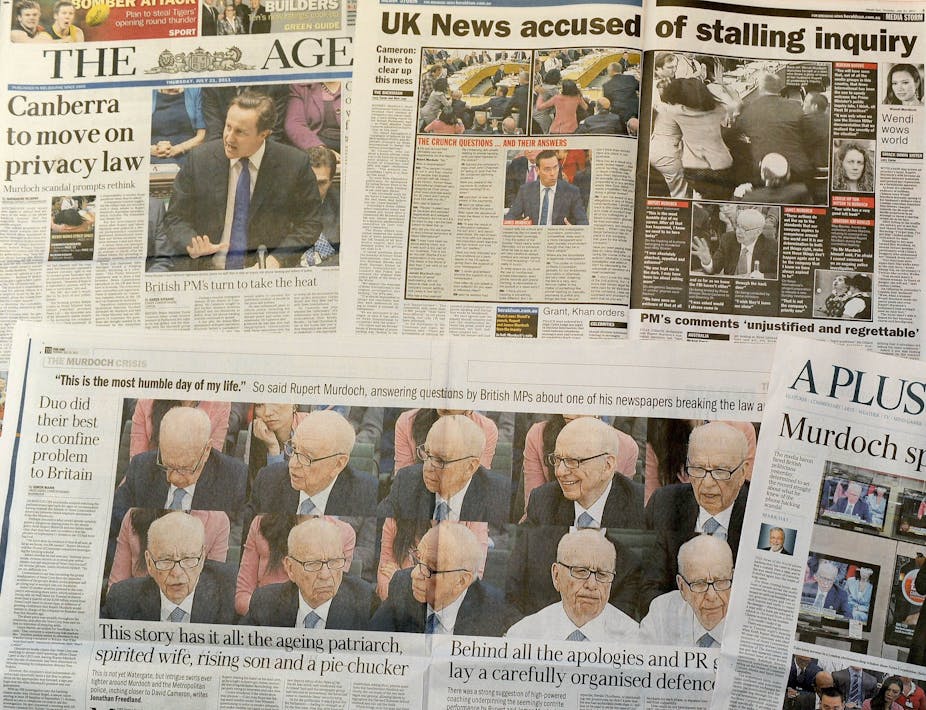
While “Murdochgate” rolls on, the question of what it means for Australia has inevitably been attracting considerable attention.
In this discussion, News Ltd itself has played a leading role. For those with an interest in the Australian media, watching the developing local response to the crisis has been fascinating.
In its wake, CEO John Hartigan publicly stated his confidence no comparable wrongdoing had taken place in Australia, whilst committing to a review of all editorial expenditure over the last three years.
This can be criticised, of course, given that the failure of such internal enquiry has become massively apparent in the UK. Yet there is no reason to believe this inquiry will be a sham – particularly given the potential risks this might bring.
Rather, Hartigan’s response represented a pre-emptive strike in the inevitable debate about whether and how to regulate the Australian press. He sought to demonstrate both that News Ltd can be trusted and that self-regulation works. Notably, his letter also praised the current Press Council, expressing support for stronger ethical codes, guidelines and complaint handling. “Look”, he tells us, “the system works, and we’ll make it work better still”.
The next day, Bob Brown called for a public inquiry into media regulation, noting that while “TV and radio broadcasting requires a licence, there is no licensing or independent oversight of major newspapers”. This generated a more aggressive response, particularly in The Australian.
The weekend edition carried the (on-message) headlines “News of the World Scandal Wouldn’t Happen Here” and “Press Council on the case of casual attitude to ethics”. On Monday, this was followed by “News Licences Just Fine for Stalin’s Russia”. Again praising the Press Council, this article argued that “the last thing that should come out of this awful business is a de facto licensing system for newspapers”. Similarly, the government’s proposed privacy laws have been represented as a potential threat to “freedom of the press”.
In this debate, concepts of “free speech”, “independence” and “freedom of the press” have quickly surfaced and been used as synonyms. However, there are dangers in such conflation.
Here, a consideration of the UK case is instructive. There, the Press Complaints Commission, the British counterpart to the Press Council, will almost certainly be a casualty of the hacking scandal, having dismissed reports that phone hacking was far more widespread than News International claimed. David Cameron publicly stated that “the way the press is regulated today is not working”, that the PCC had “failed” and is “ineffective and lacking in rigour”.
These sentiments echo the long-standing criticisms of the Campaign for Press and Broadcasting Freedom, an organisation notably concerned to promote freedom for journalists, which they see as threatened by self-regulation. They have been particularly critical of the PCC, arguing that its shortcomings stem from its lack of independence from the newspaper industry, and inadequate mechanisms for enforcing high standards.
Notably, many of the criticisms levelled at the PCC also apply to the Australian Press Council. As an industry-funded body whose remit includes defending freedom of the press, it has been seen as compromised. Where upheld, adjudications about press reporting come long after the initial wrong, and usually have far less prominence. Beyond this, the Press Council has no power to fine or use other means to effectively discipline newspapers in cases of ethical breaches.
Arguments against more effective press regulation can also appear dubious. In The Conversation, Malcolm Turnbull argues that the reason broadcasters are licensed while newspapers aren’t is because they are using public spectrum. He claims that licensing newspapers would also mean the necessity of licensing websites, which would suppress free speech.
This is misleading. Broadcast regulation partially developed out of technological necessity, but was also strongly informed by concerns regarding the potential influence of broadcast media. Unlike the press, it also developed at a time when far more widespread concerns about the power of mass media had become prevalent.
While not all of these were warranted, the suggestion regulation is unnecessary because the press are less influential is questionable. In Australia, the press remain the pre-eminent medium that sets the political agenda. While emergent web-based media are important, their significance pales in comparison. In a country where News Ltd controls 70% of newspapers, the issue of media power remains a significant concern, as illustrated by the current campaign against carbon pricing being conducted by some outlets.
Suggesting licensing equates to governmental manipulation is as suspect as claims it must be “one size fits all”. Are Australian broadcasters outlets really state mouthpieces? Australia’s most trusted journalism outlet, the ABC, is also its most regulated (though governmental attempts to discipline the ABC also highlight the need for media outside the public sector). Yet there may also be other models of regulation worth exploring, such as this recent contribution from the UK blogosphere.
Against suggestions it couldn’t happen in Australia some, such as Natalie Fenton, have argued that the UK hacking scandal was a direct result of the pressures brought upon commercial media by the rise of global competition and declining newspaper profits, from which Australia is hardly immune. We shouldn’t wait for a parallel crisis before considering more effective regulation.
The problem that remains, for both journalists and the public, was well captured by A J Liebling: Freedom of the press is guaranteed only to those who own one.
Ensuring free speech and democratic journalism, nevertheless, remains a more important goal. While I have little confidence that, beyond privacy regulation, we are likely to see substantial change in Australia, we should have a more serious conversation.