
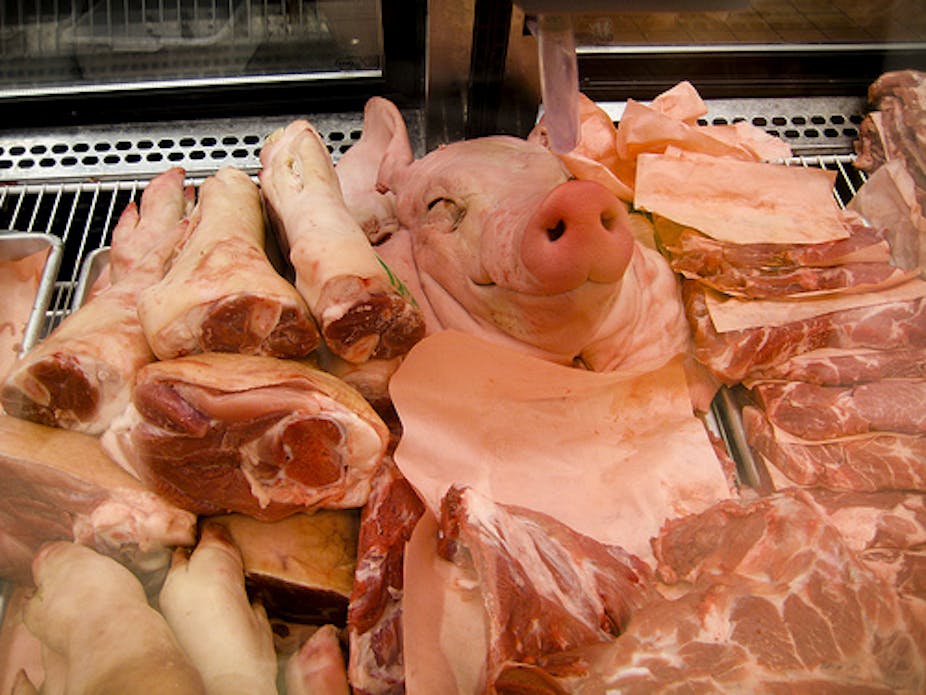
Why do we feel sick at the thought of eating dog, but hungry at the thought of eating pig (bacon) with our eggs?
Or how we can feel so outraged about whaling while continuing to enjoy fish and chips? Why do some animals appear to deserve our concern and consideration and others so much less so?
The problems with eating meat are important from a psychological standpoint. How do we all do it? That is, how do so many people manage to eat so much meat while also readily espousing their love for animals?
The way we consume meat is becoming a problem. Meat production is resource intensive and has a significant impact on the environment, compared to less resource expensive food products. But as the human population grows in size and in wealth, meat consumption is steadily on the increase. In countries where meat was once a delicacy it is now the central component of many dishes.
Even the ways we produce meat increasingly conflict with our love of animals. In order to service increasing meat consumption, the practice of raising meat, killing meat, and producing meat is becoming ever more inhumane.
Yet even with the knowledge that factory farming is cruel and unsustainable, many of us still manage to enjoy meat. The question remains: how do we all do it?
I refer to this apparent contradiction between people’s love for meat and their concern for animal welfare as the “meat paradox”. How can people love animals and also love meat?
One way to do this is to forget the link between meat and animals. People rarely enjoy thinking about where meat comes from, the processes it goes through to get to their tables, or the living qualities of the animals from which it is extracted.
Forgetting or ignoring the chain of meat production allows people to mentally separate meat from animals, so they can eat pork or beef without thinking about pigs or cows.
But forgetting about where meat comes from is not always possible. Many restaurants specializing in beef use pictures of cows to advertise their products, or advertise the special genetic properties of wagyu beef or the diets of grain feed beef. Even with these reminders, we still manage to chow down when the meat reaches our table.
To resolve the meat paradox people need to deny that animals have morally relevant qualities. Specifically, they deny that that animals have minds. When something or someone is thought to possess a mind we begin to care about their welfare, we begin to empathize with them.
Denying mental qualities to animals reduces cognitive dissonance over their consumption. While people might be quite happy to learn of the genetic properties of Wagyu cows which give their meat a high quality marbling, it is unlikely that they would be just as happy to learn that those same cows also have a particular genetic predisposition to experiencing pain, or that they have particularly good memories.
Laboratory-based psychology experiments demonstrate how this denial of the mind helps us resolve the meat paradox.
In one of our studies, participants were asked to either consume a piece of beef-jerky or a cashew nut as part of a consumer study. They were then asked to indicate all the animals that they thought were worthy of moral concern. Finally, they were asked look at a picture of a cow and rate its mental capacities.
Participants who ate beef-jerky indicated that they thought fewer animals were worthy of moral concern and rated the cow as having fewer mental capacities, compared to participants who ate a cashew nut.
In order to demonstrate that denying minds to animals we eat is something we do to specifically justify our meat-eating behavior we ran a different study.
This time, participants were asked to write a short essay about where meat comes from. Half were told they would be sampling a piece of beef or lamb after writing the essay, the other half were told they would be sampling an apple.
While we were getting plates and cutlery for food sampling we asked them if they would be willing to help out with a different task. We showed them a picture of either a cow or a lamb and asked them to rate the animal’s mental capacities. We found that participants who thought they would have to eat meat denied animals more mind than participants who thought they would be eating an apple.
As we are increasingly made aware of the environmental, health, and moral hazards associated with the consumption of meat, there is no doubt this will begin to affect people’s behavior. Yet satisfying our hunger is a fundamental human drive and meat has been on the menu for a very long time.
Our research suggests that people are rather persistent in finding ways to justify their use of animals for food. Meat forms part of a culinary culture in almost any country, and as humans we do our best to protect our cultural practices from threat.
But people are also particularly sensitive to what they put into their mouths, and while people may enjoy eating meat, they don’t like eating minds.
Continuing to raise awareness of animals' pain and suffering associated with meat consumption may be an important avenue to combating an ever-increasing, and unsustainable, use of animals products of food.
Join the conversation
Comments (16)
Paula Rose
(logged in via Twitter)
When I think of meat and pets, I always think of what is in commercial "pet-foods" I have 2 cats which as all felines are carnivores they have to eat meat to live, I cannot bring myself to feed my cats cans of "goop" or corn based dry "food". I feed my cats fresh raw free range meat (which is cheaper than goop) and personally caught local fish occasionally. I have a friend who worked in a factory poultry farm, he quit due to the standards at the farms - one of the things he couldn't get was the other…
show full comment
Barry Calderbank
(logged in via Facebook)
Excellent article - thanks. You make one error. You claim that "the practice of raising meat, killing meat, and producing meat is becoming ever more inhumane." Thanks to ground breaking research by the UK's Humane Slaughter Assn and the willingness of industry in the UK, US and here in Aust, the slaughter process has become more, not less, humane in recent years. And research by Temple Grandin and a various others have made livestock handling much more humane (incl at abattoirs). The animal…
show full comment
Bea Elliott
(logged in via Facebook)
Hi Barry - I can see how you might have slight leanings to one ideology being a sheep producer. I can also see how one might view the new slaughtering methods attributed to Ms Grandin as more "humane" than previous ones. But there's some things missing in this justification, if one were to base eating meat on these suppositions.
One is that these systems are mostly designed for cattle - Her methods of chutes and curves does lessen fear/anxiety on the way to the kill box... But pig, sheep, lamb…
show full comment
Caesar Naywin
(logged in via Facebook)
"To resolve the meat paradox people need to deny that animals have morally relevant qualities. Specifically, they deny that that animals have minds."
Soo much meaning in it.
Tarina La Rue
(logged in via Facebook)
I have cat and fish companions which I love unconditionally. No, I don't eat meat and I too find it quite strange when people I know profess this same love for their "pets" think nothing of eating any other creature. Hypocracy/ignorance/or the attitude that what they don't see or know about simply doesn't register with them. It's almost as if carnivores place animals in order of (human) merit. Dogs and cats are "pets".
Paul Tagell
(logged in via Twitter)
Really like this article - it's something I've grappled with for ages.
David Baker
(logged in via Twitter)
It's quite interesting to think about this from a psychological perspective - thanks for the article.
My 2 year old daughter know that "chicken" is a feathered creature that clucks but also something yummy that she eats. She will move seamlessly from imitating the chicken's sounds to chowing down. To onlookers, this is both funny and disturbing (in varying proportions depending on one's own moral compass).
I wonder if this is how so many of us disassociate the animal from the food - because we've been trained to do so from a very young age. The word "chicken" therefore has dual and very different meanings. Maybe this is my mind's way of making sure that I keep eating all of that yummy meat? Food for thought...
Xavier Shay
(logged in via Twitter)
Following this reasoning, maybe even the idea that it is tasty has also been learned from a young age? My discussions with people who were raised vegetarian certainly suggests this, so too does the fact that the "tasty-ness" is often unlearned a while (perhaps a year or so) after becoming veg*n.
In my experience tradition is also a strong psychological force in attitudes towards food (such as turkey for Christmas, bacon for Sunday breakfast, etc...). I'd love to see some research into that.
William Cheong
(logged in via Facebook)
Meat-diet do have a strong, but somehow kind of indirect consequences of effects towards global warming.
Thanks to the author to remind us again, where do the meat comes from.
Of course, poultry are from farms. With increase demand for poultry, more farms needed, so more lands will be cutdown from rich forest, and lead to deforestation, at last some kind of terms near to environmental issue.
So do need more food and water to feed the poultry, and need to grow more, by more lands as well. And more lives out there to share the food, water and air with us.
More deforestation, more pollutions, more carbon emissions, and so on...
Stuart Cooper
(logged in via Facebook)
Eating meat doesn't necessarily have to come with a side serve of cognitive dissonance. If you're of primarily utilitarian values, and draw the line of "inalienable right to life" at self consciousness, then the whole deal makes perfect moral sense, provided the animals are treated in methods that minimize any pain caused.
At that point, the only human "food" animal that might cross the line is whales, which may or may not be self-conscious (AFAIK no studies have been done to show if whales are self conscious or not - Dolphins are, so in the lack of other evidence it seems fair to assume whales probably are also).
And yes, it also leaves me in the basket where it's ok to eat dogs and cats. Which I'm ethically fine with btw.
Jo Shaw
(logged in via Facebook)
Melissa, did you know there is vegan dog food available? I'm not sure how much it costs, but I'm guessing it wouldn't be much more expensive than buying normal dog food. Apparently dogs also eat fruit and vegetables also, something I discovered recently!
Melissa Starling
(logged in via Facebook)
A lot of people think I'm odd, but I would rather eat an animal I knew than an animal I didn't. Maybe it's a kind of self-flagellation. I want to know who I'm eating and what kind of life they had. I want to spare a thought for what they went through so I could have a dose of protein. It is a paradox, but we don't necessarily have to divorce ourselves from the process or go vegetarian to deal with it. One can make ethical choices about meat. Free range chicken and pork, grass fed beef and lamb, organic meats... My main problem is feeding my dogs. I can't afford for them to be ethical as well!
John Ngo
(logged in via Twitter)
I've recently started reading The China Study by Dr. T. Colin Campbell, a book that explores the health implications of animal based diets and this 'denial of the mind' is something that I've been trying to come to terms with myself.
Raising awareness of the pain and suffering of animals is a great start, but I wonder what else we can do considering that I myself seem to struggle with reducing my own consumption of meat.
Bea Elliott
(logged in via Facebook)
Hi John - I suppose we can also as often as we can, acknowledge that aside from the pain and suffering - All beings are pretty much like us in that they only wish to be left alone. And they too just wish to live. The only thing that really distinguishes "food animals" from "pet animals" is the silliness in our heads, that we never question.
A step towards granting all nonhumans equal moral consideration... I recommend a free movie available online called "Earthlings". Best to you - And thanks for being open minded in your search for truth. ;)
Carlos Caceres
Reader, Materials, (logged in via email @uq.edu.au)
You appear to have little regard for historically linked events, a material basis for the way we think or social classes connected to property and wealth, which is surprising for somebody doing, or claiming to do, social sciences. Still, you may consider the following situation worth of some analysis:
I suppose you know vegetarians abound in India. On a closer look, Indian vegetarians concentrate on the upper caste, the Brahmans/Brahmins. Hindu Castes are intimately linked to land ownership in…
show full comment
Carlos Caceres
Reader, Materials, (logged in via email @uq.edu.au)
If this is not another example of a pseudoscience, I have not seen any. And you claim you are not a vegan tru and tru (nothing wrong with that, but you should not pretend that you are not one; that denial must the reason for the blatant bias in your article).
Back you your article, where do you draw a line, then: Do you realize that when you brush your teeth, you kill millions of bacteria, all with the same Darwinian impulse to survive like monkeys' (humans included), cows', etc? How about the…
show full comment