The Conversation
Subscribe
  • Academic rigour, journalistic flair
  • For curious minds
  • Expert news and views
  • Debate and ideas
  • From the curious to the serious

Hot Topics

  1. Gay marriage
  2. Australia in the Asian Century
  3. Convergence review
  4. Federal Budget 2012
  5. War on drugs
  6. Bob Brown
  7. Explainer
  8. Square Kilometre Array
  9. Medical myths
  10. Transparency and medicine

The mystery of stay-at-home dads

The picture of a dad with a toddler in his arms happily waving as mum heads off to work is attractive – it suggests a more equal, sharing and caring type of world. But is this a reality of family life or simply media myth making? Last week, the Guardian’s headline “Stay-at-home dads on the up: one…

52209064_4d0d7effff_z
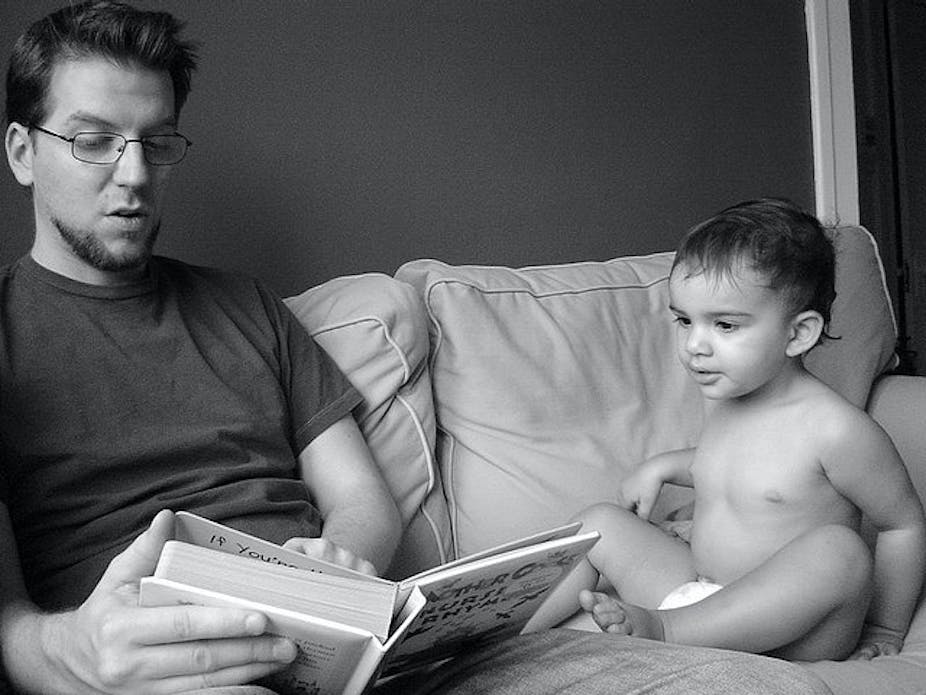
Data on aspects of fathering, including the number of stay-at-home dads is patchy in Australia. Paolo.Pace

The picture of a dad with a toddler in his arms happily waving as mum heads off to work is attractive – it suggests a more equal, sharing and caring type of world.

But is this a reality of family life or simply media myth making?

Last week, the Guardian’s headline “Stay-at-home dads on the up: one in seven fathers are main childcarers” seemed to be announcing a major shift in gender roles.

The survey being quoted was from Aviva, one of the biggest insurers in the United Kingdom, which asked 2000 parents about child care.

Of the respondents, a quarter of the dads (26%) either gave up work or reduced working hours after the birth of children, and 44% said they regularly looked after children while their partner worked.

But the big news was how many dads were taking over from mums.

When asked “What is the gender of the person in your household who carries out the majority of childcare?” a whopping 14% pointed to the dad. That meant, Aviva figured, that 1.4 million men in the United Kingdom are now stay-at-home-dads.

New-age fathering and money were equal drivers of the change.

Almost half of stay-at-home-dads (43%) said they felt “lucky” to have the opportunity to spend more time with their kids, while 46% of families said their decision allowed the main income earner, the mother, to keep working.

Could these figures translate to Australian families? Possibly.

In 2010, adults who were not in the labour force were asked why they were not looking for work. Out of the 168,000 who gave their main reason as looking after children 8,500 (5%) were men.

If the pattern in Australia is similar to was recorded in Aviva’s UK survey and as many men again are the main caregiver because their wives are earning more, then Australia would have around 10% stay-at-home dads.

While this figure is below the United Kingdom (14%), it still shows a promising trend.

One in ten families where dad does the caring is hardly the 50-50 implied by “equal care”, but it still may reflect an important change.

The trouble is, relying on private businesses to measure change and media to interpret the figures leaves a lot of room for exaggeration.

Only last April the Guardian ran a very similar story, again quoting as fact, a survey from Aviva.

The headline last year was even more dramatic “Tenfold rise in stay-at-home fathers in 10 years”.

In that story, just 18 months ago, the number of stay-at-home dads was reported as 600,000 or 6% of the respondents.

After a tenfold rise in ten years, it seems that an extra 800,000 families switched roles in just 18 months, more than doubling the percentage of homes where dad does the most caring.

So perhaps there is a major change afoot. Certainly, the way parents arrange care of their children is an important social question. That is reason enough to ask for accurate and regular measures of parenting.

But in Australia, we are some way from having good data. We track mothers and mothering quite well but our data on fathers and fathering is patchy.

This means judging change is still guesswork.

Our basic record of births, for example, lists the mother’s age, smoking status and Aboriginality but contains nothing about fathers. And our major national study of children interviews mothers about every aspect of the child’s life but leaves forms on some topics for fathers to complete.

In the lead up to the introduction of paid paternity leave next year, getting the records straight on how many fathers and mothers there are, and then asking fathers as well as mothers who does what, will help us track important social changes in family life.

Join the conversation

Comments (10)

  1. Permalink
    David Thompson

    David Thompson

    (Research Officer In Men's Health at University of Western Sydney)

    Ben, that issue of lacking data might sound obvious but is a common problem we come against in male health - the systems and cultures are generally well-placed to collect data on the 'traditional' female candidates but less well-placed when dealing with males. Usually because when systems were designed and implemented, they often didn't meet a need for considering males.

    Knowing the extent of the 'problem' with confidence is important to understanding the problem but without that data and processes in place to reliably collect it, they're operating in the dark.

    1. Permalink
      Dale Bloom

      Dale Bloom

      Laboratory analyst (logged in via email @mail.com)

      With the significant decline in motherhood (and womanhood) inside the country, more fathers may have to become the primary carer as well as the primary breadwinner to ensure better outcomes for their children

      However, if too many men reduce their work hours, it will produce a major skills shortage and could bankrupt many companies.

      Of all the work undertaken by women, almost half their work hours (44%) occur in only 3 industries: education, healthcare and retail.

      At least 2 out of these 3 industries…

      show full comment

      1. Permalink
        Paul Dalgarno

        Paul Dalgarno

        (Editor, The Conversation)

        Hi Dale, as the husband of a "current" Australian woman, and as a "current" man, I am surprised, and a little embarrassed, by the last line of your comment. The idea of men scrabbling about to find a "better wife" is laughable, and sounds like something from a Dickens novel.

      2. Permalink
        stephen prowse

        stephen prowse

        (logged in via Twitter)

        A couple of comments:

        If men reduce their work hours to care for children, then women will increase theirs in proportion. Many women in this position are more highly paid professional women with highly productive careers.

        It is a rather odd and somewhat insulting comment to belittle education, healthcare and retail as non-wealth creating. These service industries contribute just as much to wealth creation as do other male dominated service professions eg law.

        The increase in fathers staying home to care for children is a long overdue shift which probably has more benefits than costs which will become clearer upon the collection of more data....

  2. Permalink
    Ilan Katz

    Ilan Katz

    (logged in via LinkedIn)

    The data are important for understanding and tracking what is happening and to whom. For example it is not clear in the Guardian article whether the majority of stay at home dads are middle class, skilled individuals who could be earning relatively high wages (although less than their partners), or whether they have low eduction/skills and would therefore have low paid or casual employment if they did work. In the long run it will also be important to track the effects on long term family income, pensions etc. The effects of career breaks on women are now reasonably well established but less so for men.

    Also Dale I would be interested in the source of the research on the relative impacts of single fathers as opposed to single mothers on children. I would assume that single fathers are probably demographically different and that may account for differences but I have not seen the studies. Your last comment is a bit inappropriate, I have to say.

    1. Permalink
      Dale Bloom

      Dale Bloom

      Laboratory analyst (logged in via email @mail.com)

      Stephen, Mark, Paul, LLan
      The biggest and possibly most reliable study undertaken in Australia that looked at work and child care hours was this “Family Structure, Usual and Preferred Working Hours, and Egalitarianism in Australia”

      This study was a part of the longitudinal HILDA survey, and I would think that prior to the HILDA survey, very little reliable data was available about fathers or men in general, and so much said about fathers and men was based on conjecture or misinformation only…

      show full comment

      1. Permalink
        Dale Bloom

        Dale Bloom

        Laboratory analyst (logged in via email @mail.com)

        Adding to the HILDA paper “Family Structure, Usual and Preferred Working Hours, and Egalitarianism in Australia” is also this paper “Hours of Work and Gender Identity: Does Part-time Work”
        http://econrsss.anu.edu.au/pdf/DP507.pdf

        The main finding of that paper “Partnered women’s life satisfaction is increased if their partners work full-time. Male partners’ life satisfaction is unaffected by their partners’ market hours but is increased if they themselves are working full-time.”

        So if the father stays at home to look after the children, and the mother works full time, it will satisfy neither.

        In the Australia version of motherhood, it could also lead to the divorce courts and the father only sees the children every second weekend while paying the mother child support. With about 1 in 4 children currently involved in such a system, it is now very much a part of Australian family life.

    1. Permalink
      thomas connelly

      thomas connelly

      bibliopole (logged in via email @gmail.com)

      How is this a non-sequitur? I always thought that this phrase meant something like "does not follow." Surely we need more and better data at all times. Seeing how this article is describing a fairly new phenomenon it must follow that we need better data.

      "So perhaps there is a major change afoot. Certainly, the way parents arrange care of their children is an important social question." Does this not imply the need for more research and better data?

      Or as Bill and Ted might say it is a predictable non-non-sequitur