


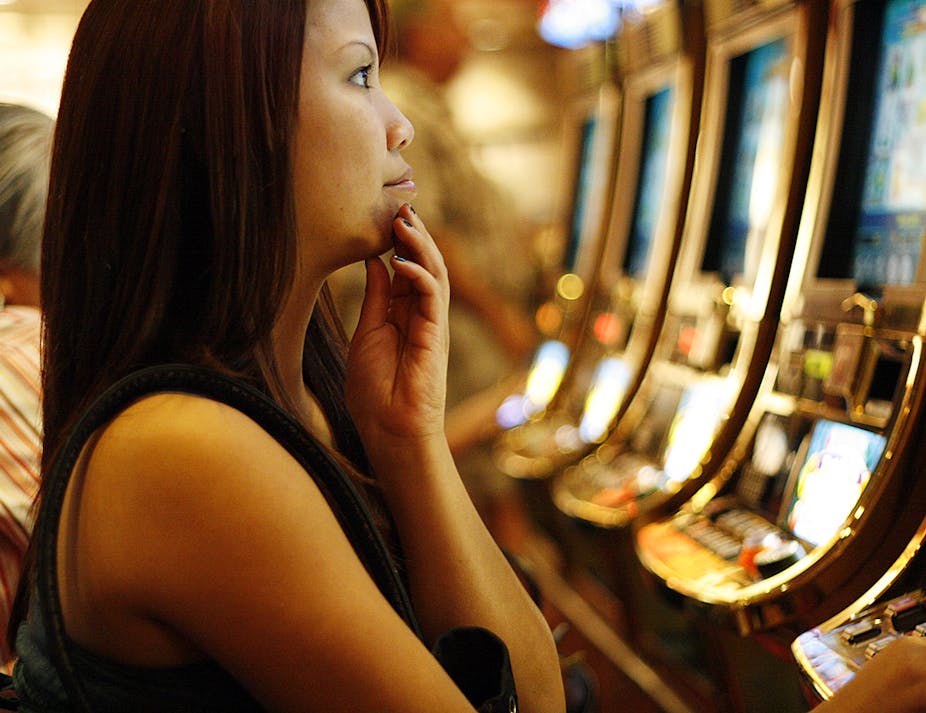
GAMBLING IN AUSTRALIA – Addiction to gaming machines (or “pokies”) is of growing concern in Australian society. In Victoria alone there are 30,000 of these hi-tech poker machines with many in suburban venues.
Based on 2010 figures, Victorian gamblers are losing around $3 billion a year on poker machines.
So here’s a suggestion: why not make pokies harder to play?
Actor Michael Caine, during a Michael Parkinson interview in which he was discussing his approach to life, once said: “Use the difficulty.” Essentially, this was a spin on the old proverb: “Necessity is the mother of invention.”
Caine’s maxim is also the inspirational basis of a my philosophy for design known as “antiusability”.
The manner in which one is compelled to use any system can alter the user’s behaviour in a positive or negative way: the design aspects of an interface can be either features or obstructions, or both.
The focus on difficulty in antiusability is akin to the work of French cultural theorist Paul Virilio, whose writings about technology in relation to speed and power led him, in the late 1970s, to coin the term “dromology”, meaning the logic of speed. Similar musings made me contemplate antiusability as “the logic of difficulty”.
A high level of usability implies a system that is easy to learn and remember; it also suggests the design is efficient, agreeable both visually and aurally, and fun to use. It suggests that certain features should be automatic. But who should be in control at all times – the user or the machine?
Making using more bruising
When I first outlined the concept of antiusability at OZCHI 2006 in a presentation called The Antiusability Manifesto, I thought of it in terms of introducing graduated difficulty into a given system to reinforce the idea of conscious control by a user.
A couple of simple, common examples for this are child-proof bottle caps and speed bumps on roads. Both are safety features designed to make people think about a calibrated hurdle.
Online, password access systems, yes-no permission screens, parental internet controls and audio feedback alarms are further instances of this concept in action.
A more wacky case of antiusability is illustrated by the “crying invoice”, a Belgian company’s attempt to make customers pay on time by embedding an audio chip in bills so that weeping sounds emanate when the envelope is opened.
With the crying invoice, an element of emotional complexity is introduced in the hope that feelings of empathy (on the part of the customer) will lead to less tardiness in bill payment.
Could this approach be developed? What if images of systems developers and their families were displayed in some kind of sentimental fashion (maybe sitting round a table together, with empty plates and hungry faces) each time one installed computer software. Conceivably, this could reduce piracy by humanising the hard-working technicians. (Then again, it could merely provide another avenue for hacks to exploit).
Taking a poke at pokies
It could be argued that pokies are too easy to use: insert some coins into a slot or swipe a card, push a button, perch on your stool, stare in a trance-like state at flashing lights while time seems to stand still, listen to a cacophony of sound effects and lose your hard-earned cash, or win on the odd occasion.
Antiusability offers the potential to transform gambling behaviour at gaming machine sites by subtly manipulating the interface between the user and the device – this can be accomplished through clever yet delicate alterations either in the gaming machine itself or in the surrounding environment.
The mandatory placement of clocks as an attachment to gaming machines in Victoria has already been one tactic of this kind. This simple adjustment has made gamblers at least more consciously aware of how much time is passing.
Another more ambitious strategy would be to design pokies so that the gaming experience involves a discernible narrative, rather than simply trying to match various shapes on the screen.
Video games such as Puzzle Quest 2 provide a good mix of simple, pokies-like gameplay and narrative that could be adapted for the purposes of gambling.
Such methods would both tax the attention-spans and boost the skill-set of players. By implementing antiusability in this way, venues would be creating at atmosphere that allows the gambler to actually enjoy the gaming experience, rather than being lulled into an addictive, unenjoyable stupor.
Would it work? Who knows, but it’s probably worth a flutter.
This is part six of The Conversation’s Gambling in Australia series. Read the previous instalments here:
- Part One: Gambling in Australian culture: more than just a day at the races
- Part Two: Promotion of gambling short-changes Australian sport … and its fans
- Part Three: Get rich or die trying: when gambling becomes a problem
- Part Four: Want to win at gambling? Use your head
- Part Five: Pokies punties and taxpayers both lose when govts and industry get too cosy