The Conversation
Subscribe
  • Academic rigour, journalistic flair
  • For curious minds
  • Expert news and views
  • Debate and ideas
  • From the curious to the serious

Hot Topics

  1. Gay marriage
  2. Australia in the Asian Century
  3. Convergence review
  4. Federal Budget 2012
  5. War on drugs
  6. Bob Brown
  7. Explainer
  8. Square Kilometre Array
  9. Medical myths
  10. Transparency and medicine

What could gender equity goals for men’s well being look like?

Achieving equity between men and women requires keeping track of important markers of difference between the genders. While the focus has traditionally been on areas where women are most disadvantaged, there’s a good case for setting equity goals for men. At the end of last month, the Australian Bureau…

2722400187_1cdc4a0be6_b
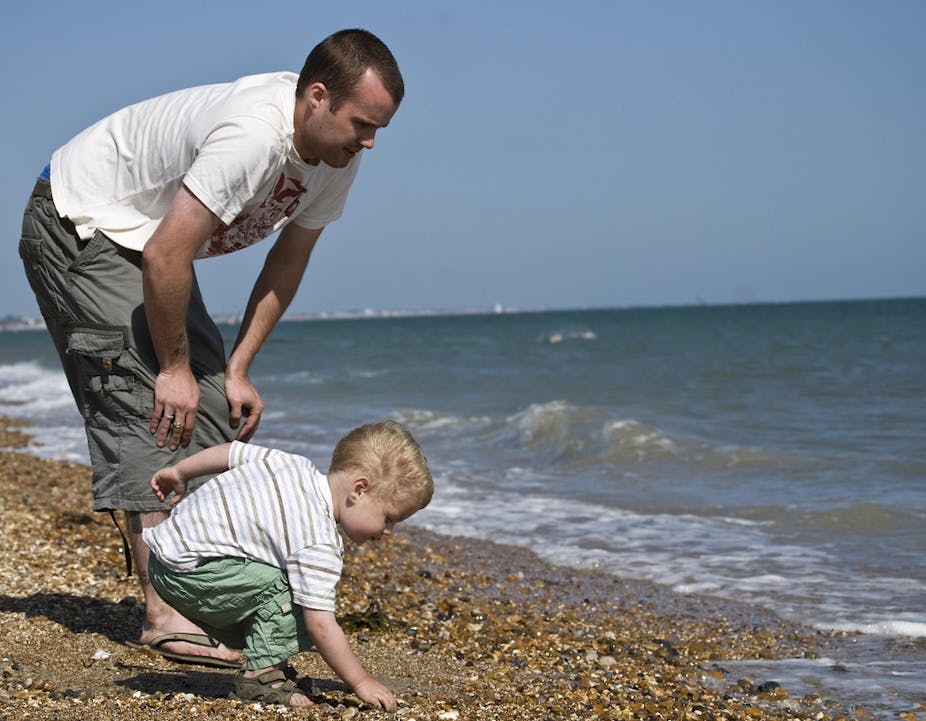
Promoting men’s care responsibilities to be equal to that of women might be quite a challenge. Chris. P

Achieving equity between men and women requires keeping track of important markers of difference between the genders. While the focus has traditionally been on areas where women are most disadvantaged, there’s a good case for setting equity goals for men.

At the end of last month, the Australian Bureau of Statistics (ABS) launched its first set of Australian Gender Indicators.

Statistics on men and women in the areas of economic security, education, work and family balance, health, safety and justice, democracy, governance and citizenship were made available in a user-friendly format on the ABS web page.

Welcoming the release, the Hon. Kate Ellis, Minister for the Status Of Women noted “disparities still exist between women and men, particularly when it comes to women’s safety, economic security and leadership."

She pointed to the 2% of women (compared to 0.4% of men) who reported violence from a current or previous partner in the past 12 months, and the lower labour force participation rate for women with children, compared to men in a similar situation.

Men’s dominance of the top 200 ASX company boards (91.6% of company directors are men) was her third target.

Levelling the field

Perhaps there should also be a “minister for men” to equally welcome the gender indicators. The thought begs the question of which disparities would be highlighted for lifting men’s status.

Minister Ellis’s position is the result of decades of agitation by women advocates protesting discrimination, abuse and oppression. But we have seen no such groundswell of men’s advocates, even in the highly politicised arena of family separation.

In the health area, men’s health advocates (many of them women) have successfully drawn on the obvious disparities in core health indicators such as mortality.

A male baby born in 2009 could expect to live to 79.3 years with a 40.9% chance of reaching 85 years, while a female baby born at the same time could look forward to 83.9 years with a 57.3% chance of seeing her 85th birthday.

The different causes of death between the genders are no mystery.

Men die at twice the rate of women from lung cancer and almost twice the rate for ischaemic heart disease. Young men suicide and are killed in traffic accidents three times as often as young women.

Many, if not most of these deaths are preventable, leaving the way open for governments to take the lead in addressing risk factors and service responses.

Areas for action

The 2010 National Male Health Policy emphasises the social determinants of health, veering away from comparisons with women’s health status. Instead, it targets equal health outcomes between groups of males.

On the face of it, using female rates as benchmarks would make sense since equalising the death rates of Indigenous and non-indigenous men, for instance, would still leave the male death rate unacceptably high.

Comparing males and females in occupational areas below that of company director may also be appropriate. The lack of men in child care, teaching, nursing and community sector work could be acknowledged as an equity problem.

The excess of males in the dirtiest and most dangerous occupations – males account for 91% of hands crushed, burnt or amputated, for instance – could be become another gender equity issue.

Some changes have already been enacted.

Forward movement

The Sex Discrimination Act (1984) has been amended to make employment discrimination on the grounds of family responsibility unlawful for fathers as well as mothers and the Fair Work Act (2009) instituted the right for working men with children to request flexible working arrangements to balance work and family commitments.

Equity reformers examining service use may find a useful template in the United Kingdom where the Equality Act 2010 has placed a legal responsibility upon public bodies to identify specific gender equality issues and areas for action and to actively promote gender equality.

The Scottish Government has launched a four-year project to promote the role of fathers and men as carers in children’s services and challenge the associated stereotypes of male roles.

Promoting men’s care responsibilities to be equal to that of women rather than aiming to balance men and women’s workforce participation might be quite a challenge.

Minister Ellis noted that “[T]he Australian Government is leading by example, setting a target of 40% women on Australian Government boards by 2015.”

What would “leading by example” in the area of men’s involvement in caring roles look like? Perhaps setting a target where men on Australian Government Boards took family leave to be with their children or ageing relatives 40% as often as women?

Join the conversation

Comments (9)

  1. Permalink
    Alice Gorman

    Alice Gorman

    (Lecturer in Archaeology at Flinders University)

    A major problem, as highlighted by Mindy, is how masculinity is constructed, and there is a particularly Australian brand of it. Not going to the doctor, driving and drinking recklessly, bottling up emotions, etc etc, are all ways that men in this country shore up their masculinity. A recent edition of the 7 pm Project featured a story on the issues with "blackface" and in the same programme used "girly" twice as a derogatory and insulting term.

    Mindy is right too about the feminisation of professions…

    show full comment

  2. Permalink
    John Harland

    John Harland

    bicycle technician (logged in via email @gmail.com)

    I was delighted to find that almost 50% of riders on our local bikepath are women. This is pretty close to northern European levels and it a great achievement of all those involved in creating it and linking it with other cycle routes. Women are generally deterred from cycling due to what they experience as aggressive interactions with traffic.

    In contrast, I find the bikepath stultifyingly boring and slow. I enjoy riding the road and enjoy the constant interactions of cycling in traffic. To me…

    show full comment

  3. Permalink
    John Macdonald

    John Macdonald

    (Foundation Chair in Primary Health Care at University of Western Sydney)

    I find the tone of some of the comments on Fletcher’ to me very balanced article which offers the chance to open up a debate, interested more in defending positions rather than entering into dialogue. “Gender” has to mean more than women or a women’s perspective on the world. There is something quasi-religious about some positions on gender which hold on to Absolute Truths.
    Let’s be clear: patriarchy is a reality and many women suffer from it.
    “Masculinity”, however, has come, especially in Australia…

    show full comment

    1. Permalink
      Margo Saunders

      Margo Saunders

      (logged in via email @aapt.net.au)

      Abhorrent? Certainly not. Far from denying the relevance to women's health of concepts of 'femininity' (or what it means to be a woman) and gendered beliefs and attitudes towards prevention and treatment, I would argue that such concepts have been prominent in discussions of everything from body image to preventive screening to dietary choices. No lack of rationality or compassion -- just an acknowledgedment of the compelling international evidence that beliefs about what it means to be a man -- or a woman -- are powerful influences on how individuals regard, and look after, their health and the health of those close to them. Requirements around gender sensitivity and gender equity in health policies and programs, including approaches to health literacy (the ways that people access, interpret and apply health information) would go a long way towards ensuring that gender-based perspectives and needs -- however they come about -- are not overlooked.

      1. Permalink
        John Macdonald

        John Macdonald

        (Foundation Chair in Primary Health Care at University of Western Sydney)

        “Masculinity” has acquired an undeniable negative connotation in the western gender discourse (I would be delighted to hear what proponents of this all explaining reality see to be the positive attributes of masculinity): maleness it seems is essentially flawed and needs fixing. I suggest that “femininity” has no such negative connotations in this discourse, partly because it has not been subjected to the outpouring of ideologically-driven commentary which “masculinity” has experienced.

  4. Permalink
    Margo Saunders

    Margo Saunders

    (logged in via email @aapt.net.au)

    The social determinants approach to men's health can be overstated, at the risk of downplaying other key factors. An important article published this year in the Journal of Health & Social Behaviour ("Macho men" and preventive health care: implications for older men in different social classes, by K Springer and D Mouzon) provides additional support for the already-strong evidence about the role of masculinity (dominant notions of 'what it means to be a man') in men's health-related beliefs, attitudes…

    show full comment

  5. Permalink
    Mindy Johnson

    Mindy Johnson

    (logged in via Facebook)

    A Minister for Men? I would say that most of them already have the interests of men in mind predominantly, even if not deliberately.

    How would a Minister for men stop young men from taking risks in cars when their families can't? How would a Minister for men make men go to the doctor more often and get checked out?

    The lack of men in the childcare, nursing and teaching professions is recognised as an equity problem - pay those people more and watch the men come in. Those occupations are low paid because they are traditionally female occupations. Would a Minister for Men have the power to change the pay scales so that these occupations were paid more?

    How are you going to change employer expectations so that people taking leave to care for children or relatives are not sidelined as 'not really here for the company?' I'm really curious because despite all the hard work of women for years the inequity is still there, so how will a Minister for Men actually change anything?

    1. Permalink
      Nicholas Parsons

      Nicholas Parsons

      (logged in via Facebook)

      I think the questions raised by Mindy are very valid and just the sort of questions a Minister for Men would have to look at. Similar to the questions the Minister for the Status of Women would have to consider with respect to women.

      However, I think the idea of a "Minister for Men" was more to raise the issue of gender equality being about equality for both genders, not just improving the situation of women, though no doubt the situation of women is more ergent. I don't think we actually need a Minister for Men, but it may be a good idea if the portfolio for the Minister for the Status of Women was broadened to include gender equity in its broad sense. We may never know what issues men face in terms of equity because noone is looking at the issue from this perspective, except, apparently, this author. So further research in this area could be useful. I don't think increased understanding or awareness could be a bad thing.

  6. Permalink
    Dale Bloom

    Dale Bloom

    Laboratory analyst (logged in via email @mail.com)

    Men have shown considerable caring and concern for others that is often overlooked. Almost anything purchased from a shop in Australia has to adhere to various Australian standards, and this is to ensure safety for the purchaser.

    Every building has to be built to adhere to a vast range of building standards to ensure safety for the occupants, and codes of practice in the workplace are also becoming more stringent to improve worker safety.

    In fact, many companies operating in other countries could…

    show full comment