
How does gender affect the way people perceive Julia Gillard’s communication style?
Australians’ responses to Julia Gillard seem complex and ambiguous, embodying the contradictions involved in how women are expected to communicate compared with what is expected of leaders.
Reaction to Gillard’s communication style also appears to be divided along gender lines, with males being concerned about her accent, and females commenting on her relative “detachment”.
Attitudes like this to Gillard may expose some lingering cultural insecurities on the part of Australians.
Different types of Australian accent have been shown to encode different values to listeners. When Australians were asked to evaluate Australian voices with a range of accents – termed cultivated, general and broad – it was found males with broad Australian accents were rated as reliable, strong and trustworthy, while women with broad Australian accents were rated as uneducated and unlikely to be in professional positions.
The different values associated with male and female Australian accents may explain why Bob Hawke might have been seen as a larrikin, but still a good bloke, while Julia Gillard’s accent causes some embarrassed responses.
When I asked people informally what they thought of Julia Gillard’s communication style, some young males commented that Julia’s accent reduced her credibility as a leader on the world stage.
The complexity of reactions is apparent: while some young men were uncomfortable with Gillard representing Australia to the world, others said that is good to have a Prime Minister who speaks “like us”; and that “rural and regional Australians can relate to her, she talks like them”.
It seems gender is highly relevant to people’s perception of Gillard’s accent, with negative attributes attached to her broader Australian speech, at least by males.
An arguably more significant factor is that women’s talk typically encodes meanings of care, nurturing and support for the other, while meanings associated with competition, directness and individualism are typical of men’s talk.
Since males have traditionally occupied positions of institutionalised leadership and power, successful communication in these positions has become associated with directness and confrontation.
The paradox for women in leadership positions is the implied need to communicate both care and competition.
Julia Gillard faces the “damned if you do, damned if you don’t” dilemma: if she is forceful and direct she is too aggressive, if she’s indirect, she’s weak and indecisive.
These gendered expectations of talk were highlighted at the time of the Queensland floods, when Anna Bligh and Julia Gillard appeared in televised interviews.
Anna Bligh successfully conveyed high level of competence as a leader as well as being empathetic, caring, showing emotion and sharing personal experiences.
Some women that I have talked to say that by contrast Julia Gillard appeared detached and cool.
Perhaps, in the same way as an assertive woman may be referred to as aggressive, calm professionalism in a woman can be interpreted as a lack of engagement or involvement.
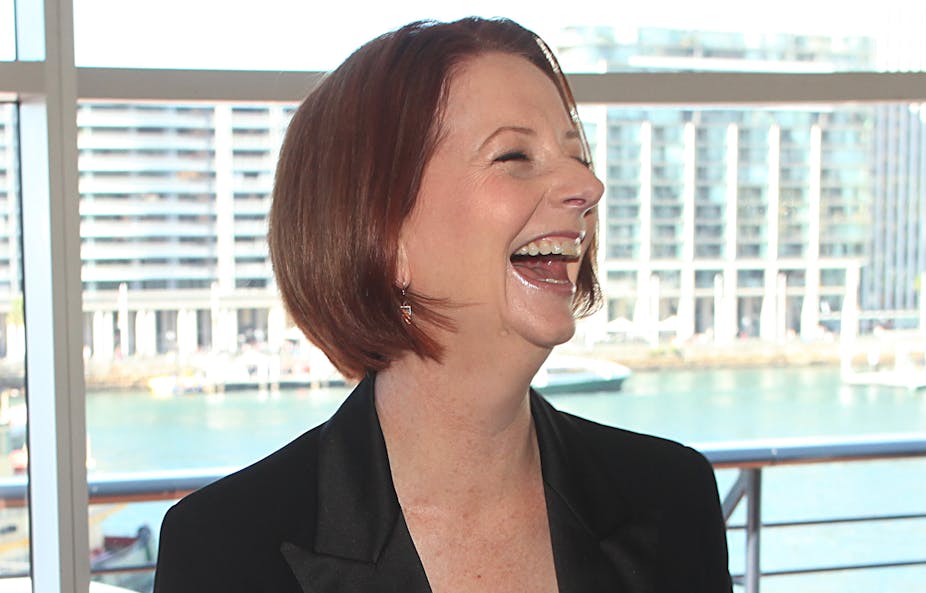
In unscripted, informal moments Julia exhibits markers that are expected of female communication: shared laughter and nurturing.
She smiles, laughs, and touches Wayne Swan and Mark Latham with a caring, calming hand. The complexities are revealed again, however, by the fact that some media interpretations were that the touches were displays of her power.
It appears that the gender of the audience is a relevant factor. Women seem more concerned with the lack of expressions of care and nurturing in Gillard’s communication style, while men seem more concerned with accent.
And while some people approved of a leader who “sounds like us”, one 20-year-old male said “Bogan chicks don’t sound intelligent”.
Perhaps it is a case of residual cultural cringe: we like the idea that our Prime Minister is a ‘ranga’ who speaks like an ordinary Australian, but at the same time we’re a little embarrassed.
Join the conversation
Comments (19)
Ramiro P
(logged in via Twitter)
A propos the expectations that assigned gender roles inspire, it's a little annoying when journalists see the need to describe what Gillard is wearing at special events. It would be odd to read about the kind of tie that Joe Hockey is wearing, or the cut of the jacket that Swan is sporting.
Sunghwa O'Mahony
Database developer (logged in via email @gmail.com)
As a new comer to this country who does not have yet any particular opinion of this country’s PM, I also find this article very interesting. The ambiguity this article addresses in people’s perceptions of the PM, I also experienced something similar when I watched her first time on TV giving a speech -her broad Australian accent making her sound like someone I could easily relate to but her facial expressions getting me to think otherwise. However, this was only my first impression of someone I didn’t know anything about and this would not dictate my electoral vote for that person.
Regarding the embarrassment associated with ‘broad Australian accent’, I hope this country sees a few more great politicians (of either gender) who speak like the PM to change this gender and linguistic stereotyping.
Michelle Donaghy
(logged in via email @gmail.com)
Interesting article. I often wonder about the gender imbalance in media and social commentary generally on criticisms in regard to the look and sound of prominent women. I guess it makes great fodder for caricature artists and impersonators.....
I fervently await your follow up article:
"When Julia talks part 2: why does her gender speak louder?"
Nick Warren
(logged in via Facebook)
I agree with most of the points raised in this artilce, however the lack of expression from Julia really annoys me. I believe this could be helped by opening her mouth more while she speaks and not altering the way she speaks. Australia is a very multi-cutural place that (generally) accept people for who they are, so i wish she could show more of her real self and then mayb she might be a bit more believable, maybe....
Jennifer Peck
(Lecturer and convenor of Honours in Linguistics Department of Linguistics at Macquarie University)
Thanks for all the comments, everyone. It's great to see multiculturalism in the debate:)
And, yes, Michelle, the question is 'Why'? Why are women in business judged differently from men when they speak, and ... yes... why does Julia's hair matter so much?
Though she has given rangas new status dont you think?
Caroline W Moir
(logged in via email @gmail.com)
Absolutely Jennifer and Michelle...and as a friend of mine pointed out recently, the interviewers are having a hard time deciding what to call her. She is referred to as "Julia" or "Julia Gillard" in the press and on TV. When John Howard and Kevin Rudd were PM were they referred to as Kevin and John? NO! Mr Howard and Mr Rudd...so why isn't she Ms Gillard...it's not that difficult.
Rowan Pryor
(logged in via Facebook)
That comment in paragraph 8 about how Julia speaks like people from rural and regional Australia, pure gold! Whoever came up with that concept is a genius!
I think this is also reflective of how both Australians see themselves and how we are viewed from worldwide, that we are relaxed, layed back and indeed a little 'boganish', which is a trait that other countries envy and that Australians are happy to be known as. Hence, Julia Gillard's language and how she talks works for both the people that vote for her within our shores, but also reflects how Australians are viewed from an outsiders perspective.
Jennifer Peck
(Lecturer and convenor of Honours in Linguistics Department of Linguistics at Macquarie University)
Great observation rowan!
we're proud of that bit of a bogan in us - probably why we have the word - as one person emailed me from spain 'the words ranga and bogan in this article wouldn't be understood by non-australians' - power to bogans!!!
Kavashen Pather
(logged in via Facebook)
I enjoyed reading the article and I agree with your points made
Mehreen Javed
Aspiring musician and/or academic. (logged in via email @students.mq.edu.au)
As for the comments on gender, I feel that people do still have difficulty interpreting her as a 'successful' female leader - but however I don't believe it's linked to her accent.
My feeling is that any leader who is representing our country politically (whether it'd be male or female) would be publicly scrutinised by the media, people and the general public because of their accent, mannerisms, vocabulary - etc. There is a general public perception that a figure who is representing their country…
show full comment
Pat Ross
Mrs (logged in via email @hotmail.co.uk)
Interesting article Jenny, I'm disappointed she doesn't sound more Welsh!!!
Jim Culbertson
Mr (logged in via email @bigpond.com)
Thanks for your insights Jennifer. I'm also interested in hearing your thoughts about the importance of substance and content in communication vs form and style. Where Gillard lets herself and government down is in her inability (or perhaps unwillingness) to present her views with strong messages focused on well considered content. Her content does not sell her audience and draw them to conclusions that she may share. Short, sharp, unexpected, unsubstantiated, tokenistic, single-minded, rhetorical...are terms I would use to describe her pitch.
Shaun Williams
Interested Observer (logged in via email @electric-echo.com)
Thanks for this Jennifer, you've helped me understand this oddity better. It certainly appears that the Australian electorate are unfairly fickle when it comes to our female leaders. Why do we contrast so poorly with say New Zealand's obvious tolerance? Let's hope that the same qualities that got these ladies through the male dominated political ranks prove successful with the wider electorate over time, otherwise we'll really have something to be embarrassed about.
evan harris
Minister of religion (logged in via email @bigpond.com)
I find it really annoying when commentary presumes to analyse public figures like the PM whose office is to provide inspiration and leadership to the nation. This journalistic habit appears not to value the place our politiciuans play in managing the country, and ghoulishly searches the innuendos and psychologises, not the leader, but themselves. Accent? This is nonsense, and has been ever since Evatt, Menzies and Thatcher.
Ramiro P
(logged in via Twitter)
Well, I am not surprised at all at the fact that a person working for a linguistics department makes an analysis of a public figure's accent. I don't think this diminishes or adds to Gillard's professional role as Prime Minister. I think the focus of this article is not so much on Julia Gillard but on the social attitudes to both her communication style and her accent.
Luci Foote
(logged in via Facebook)
Your article shows us the value we place on gendered language as a society, and also the need to develop as awareness of the "rules" placed on talk. Equally, your article draws out a definite theme of sexist attitudes within the Australian public concerning how we percieve individuals based on gender and speech. I would acknowledge that Julia Gillard cannot win with either way.
Peter Breis
(logged in via LinkedIn)
You may as well declare us all to be bigoted red-head haters, when we all know it comes out of a bottle, like all her 'causes'. Looks fake, sounds fake and probably is fake.
The fact is she mouths ridiculous. platitudinous slogans concocted by her equally talentless minders. She says nothing and sounds like she means it.
The running is then left for others to pick up this basket case of a government and keep it on the course it repeatedly wanders away from. What on earth do they believe in? Got me beat.
The clincher is when she talks about her passion, when everything else says there is none.
Caroline W Moir
(logged in via email @gmail.com)
I think that Julia has been having some sort of speech pathology to try and "soften" her acccent. This is why she is deliberately speaking slowly and why folks may perceive her as detached. Her speech is unnatural sounding. She sounds like she's trying to impersonate Margaret Thatcher (God forbid). And while I do not think that accent is such a big deal in Aus compared to the UK and the USA (where it is such a solid marker of "class"), she is definitely trying to make alterations. If I were her I would not bother. True strength should not need spin and if she is insecure about her accent enough to try to change it then that's a sign of weakness (and that goes for mena and women).
jim morris
(logged in via email @yahoo.com)
Ms Peck suggests that not liking the sound of Julia Gillard's voice "may expose some lingering cultural insecurities". So where do I go to be re-educated?
After studying Islam at university and then working in a Muslim country for five years I am now an 'Islamaphobe'. So where do I go to be re-educated?
My 6 year old went 'yuck' when she saw two men kissing on Neighbours. So where does she go to be re-educated?
And the progressives wonder why they are not universally loved despite being so spiritually superior.