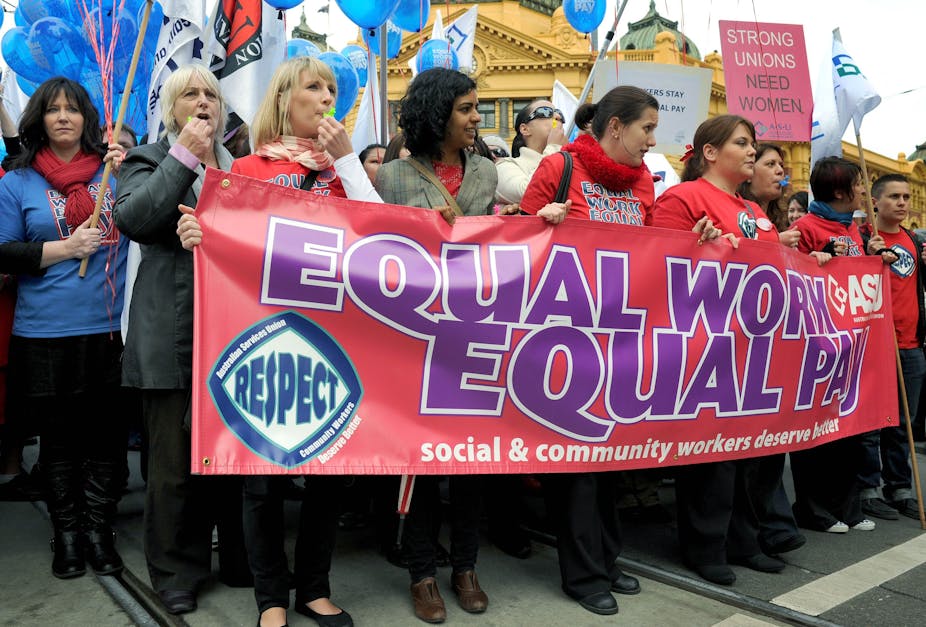
Last week’s Equal Pay Day highlighted the fact that despite decades of supposed reform, women’s average full-time weekly earnings remains 17.2% below men.
Is this obvious to our employers? Worryingly, it appears not.
According to Helen Conway, Director of the Equal Opportunity in the Workplace Agency (EOWA) there is “clear evidence” many employers do not understand what pay equity means.
To understand the problem of pay equity and investigate it, employers can use a pay equity audit to identify inequities and remove barriers to women’s workforce participation and career progression.
But little of this appears to be happening in Australian workplaces.
A 2010 EOWA survey results reports that while a significant number of organisations reveal a gender pay gap in their workplaces, less than 40% conduct an annual pay equity analysis.
Further, EOWA reports that only half of organisations that do conduct some analysis had actually developed an action plan to address the gap.
“They are effectively in denial about any gender pay gap which exists in their organisations,” Conway says.
Yet the means to encourage employers to investigate possible sources of gender pay gaps are easily available through EOWA initiatives such as the Mind the Gap, an online pay equity course which helps them review and report on gender pay equity progress.
Assistance, business cases, and comparative research and statistics are easily available through EOWA, which is also leading the development of an Australian Standard on Gender-inclusive Job Evaluation and Grading.
So given that we are moving in the right direction of making available resources and evidence-based justification for Equal Pay, why don’t more organisations undertake a remuneration analysis and redress the gender pay gap?
Can we reach a position in our economic consciousness where different work patterns for men and women are accommodated flexibly and without prejudice?
It seems the legislative route to redressing the gender pay gap is alive, but struggling.
According to Conway, the three legal options available for Australian women to achieve pay equality – equal remuneration applications, sex discrimination claims and adverse action claims have proved to be very difficult avenues for pursuing pay equity.
“The cases are complex for all participants. There are few cases and there is not yet a substantial body of expertise for developing and running them. The costs and time involved can be substantial,” she says.
“… In view of the prevalence and scale of pay equity problems that need addressing, processing them all through the legal system would be putting a long cavalcade of camels through the eye of a very small needle.”
With the consolation that 2009’s Fair Work Act and its first test case in the social and community workers case will serve as a guiding benchmark for other sectors and organisations, it still begs the question: what hope do women have for pay equity when it can be addressed only by the hand of the law?
Although Conway suggests a wide range of other solutions – such as collective enterprise bargaining and changes in HR and management practices – it is clear that it is not the means that is lacking, but the willpower to change and acknowledge the value of women in the workplace.
More measures will inevitably deliver visible change, but the core values which support this entrenched bias towards women might remain unaffected.
What is needed for sustainable change is more than workplace measures. Tackling notions of gender inequality in the consciousness of Australian society through education and developing critical thinking in children, youth and adults to question gender-based discrimination which must also be pursued alongside workplace and government measures.
For organisational policies to become positive policies, they must support the well-being of men and women, equally.
As it is evident that individual well-being impacts on organisational well-being and productivity, there is a clear business case to value women and to demonstrate this through equitable policies and practices.
Join the conversation
Comments (7)
Lindsay Davis
(logged in via email @hotmail.com)
The discussion on the gender gap in pay issues is almost always the same thing: because the female average wage is less than the males that is conclusive proof that females are discriminated against. Rubbish.
I was under the impression that it is a legal requirement there is equal pay for equal work. This is the way it should be. However, does this does mean equal pay for unequal responsibilities, performance, reliability or length of service. Should a lady (or man) be paid the same as a man…
show full comment
Andrew Hack
Business Analyst and Full-Time Law Student UNDA (logged in via email @gmail.com)
I agree absolutely. Unfortunately, this line of 'equality' thinking is far too simplistic to see the these facts. They are trying to compare apples with oranges.
Equal pay for equal work laws ignore the unintended consequences that government interference has. In fact, when you look at ALL the consequences of such laws you will see that it has the opposite effect of what it is trying to achieve. If a woman does not have the same qualifications as a male going for the job then you are denying the…
show full comment
Lorna Jarrett
(PhD candidate at University of Sydney)
@Lindsay
1. Use of the word "lady" says a lot about your attitude to women.
2. There's no apostrophe in "maths teacher"
3. As an accredited high school physics teacher more highly qualified than any other I have met or heard of; and highly skilled and experienced (I didn't sit around on my arse for ten years) I can assure you that discrimination does exist.
Tim Paton
Automotive Engineer (logged in via email @timpaton.net)
Anybody who takes a long break from the paid workforce will re-enter at a lower position (and hence lower pay rate) than somebody who worked right through.
The fact is that more women work as stay-at-home parents and carers than men (whether or not that is a good thing is a different debate entirely). So it should come as no surprise that these (mostly) women will re-enter the paid workforce at a financial disadvantage.
My earning power is better now than it was six years ago, when my partner left the workforce to care for our children. At best, her earning power would now be the same as it was six years ago... possibly less, as her skills are no longer current nor well practised.
I have male friends who are stay-at-home Dads while their partners continue to build a career. They are in the minority.
Raising children is not a good career move for anybody... if income earning potential is the only measure.
Jai Seeber
Electrical Engineer (logged in via email @gmail.com)
I agree with @Lindsay, the issue is not one of employer discrimination, at least not in the traditional sense.
In Western Australia at least, it's the gap between the male dominated mining industry and the rest of the economy that would have the biggest impact. But this also applies to other, highly compensated male dominated industries like IT / Software development.
These industries are not male dominated because of employer discrimination. In fact, I'd argue that an equally qualified job seeking…
show full comment
Craig S Wright
(PhD; Adjunct Lecturer in Computer Science at Charles Sturt University)
The argument compares different roles and classes of individuals.
The only statistically sound measure of fairness is to compare like qualities where all values are held but for the one being tested. In this instance, sex. This would mean matching classes of individuals, never a simple task, but all of the following factors would need to be considered in creating a multi-stage cluster sample:
1 Age
2 Years of continuous employment
3 Education
4 Productivity
Age is simple, but Education is a difficult…
show full comment
Craig S Wright
(PhD; Adjunct Lecturer in Computer Science at Charles Sturt University)
And as an example from the USA. The General Accountability Office (GAO) Report GAO-04-35, is used to show discrimination, but the people citing this completely ignore the determining factors:
Women have fewer years of work experience.
Women in the workforce are also less likely to work a full-time schedule and are more likely to leave the labor force for longer periods of time than men, further suppressing women's wages. These differing work patterns lead to an even larger earnings gap between men and women - suggesting that working women are penalized for their dual roles as wage earners and those who disproportionately care for home and family.