
The Conversation
Subscribe
  • Academic rigour, journalistic flair
  • For curious minds
  • Expert news and views
  • Debate and ideas
  • From the curious to the serious

Hot Topics

  1. Gay marriage
  2. Australia in the Asian Century
  3. Convergence review
  4. Federal Budget 2012
  5. War on drugs
  6. Bob Brown
  7. Explainer
  8. Square Kilometre Array
  9. Medical myths
  10. Transparency and medicine

Will climate change increase bushfires? Not knowing is no excuse for not talking

Scientists are increasingly expected to engage with the media to communicate their findings. My research leads me to believe Hobart is at risk from a severe bushfire disaster – but what are my responsibilities in talking to the press about this? To get a run in the media, there is strong pressure to…

Ft8nvt39-1327281351
If speaking up helps avoid devastating bushfires, scientists should take the risk. AAP

Scientists are increasingly expected to engage with the media to communicate their findings. My research leads me to believe Hobart is at risk from a severe bushfire disaster – but what are my responsibilities in talking to the press about this?

To get a run in the media, there is strong pressure to add spice and tell an interesting story; but qualifications and complexity get in the way. This problem particularly affects climate change research – some argue that climate scientists should stick to the facts, highlight the uncertainties and avoid alarmist statements.

Climate change modelling can never provide detailed weather forecasts into the future. Modelling also can’t tell us how climate change will affect specific places. Ecology is extremely difficult to build into climate change models, so models also can’t grapple with how the biosphere will respond to climate change.

This makes it difficult for ecologists to “stick to the facts” when talking about climate change. In a nutshell, there are enormous uncertainties about how ecosystems will respond to climate change.

A good example is the occurrence of bushfires.

Severe bushfires happen only after a specific sequence of weather patterns. First, wet, warm conditions must create abundant plant growth. A dry spell must then convert the plant growth to combustible fuel. Finally, hot, dry, windy conditions are required to spread a fire once it’s ignited by either lightning or people.

I cannot – and nor can anyone else – predict with any confidence when the next bushfire disaster will occur. The only certainty is that there will be severe bushfire when all these factors align in the future. Such fires will occur regardless of climate change.

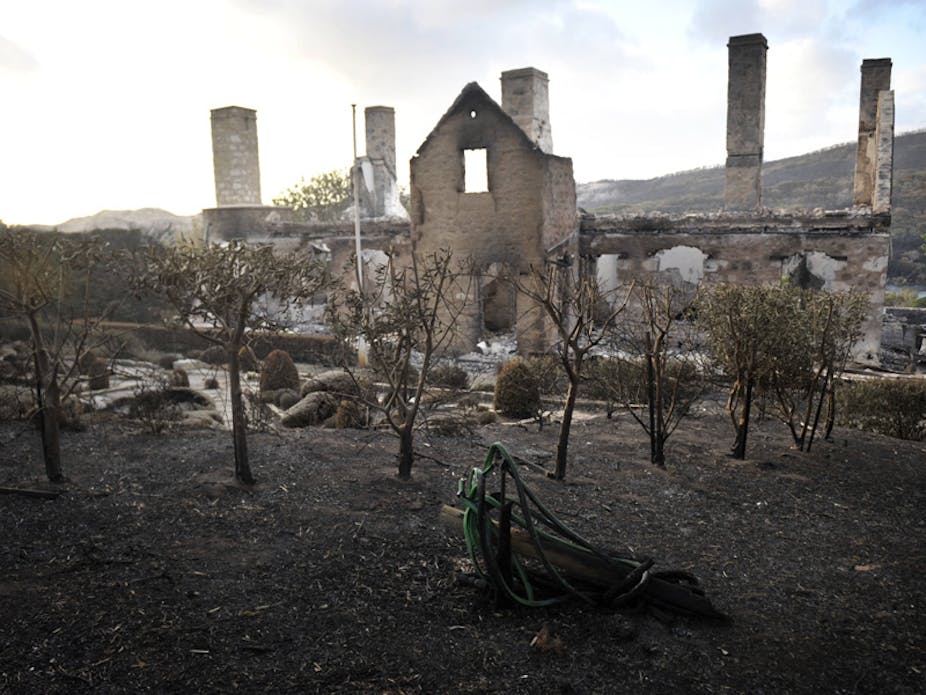
Hobart's intrusion into bushland put it at risk during 2006's bushfires. AAP

The uncertainty in ecological forecasts has substantial consequences for ecologists engaging with the media. Consider, for instance, my conviction that Hobart, where I live, is at risk from severe bushfires. Hobart suffered severe damage due to a bushfire disaster on February 7, 1967. The Black Saturday Victorian bushfires, on the same date in 2009, underscored the destructive potential of bushfires in a bushland urban environment, similar to that surrounding much of Hobart.

Meteorological records point to a trend of increasing fire weather over the past 20 years, reflecting another trend of drying and warming. And there is concern this trend will continue. Bushfire disasters have been occurring around the world over the past decade and it is reasonable to extrapolate these disasters to Hobart, which, like many cities, is sprawling into flammable bushland.

It is unclear how much extra risk climate change adds to the threat. At a practical level it doesn’t matter much if, for example, a severe bushfire like the 2009 Victorian disaster is due to climate change or not. Climate change is an additional compounding factor to a currently dysfunctional relationship with flammable landscapes. But there is no question climate change is a potent “hook” for an issue the media is only interested in immediately after a disaster.

It is easy to criticise scientists, saying they’ve crossed the line into advocacy when they “exaggerate” the risk of climate change or “jump to conclusions” that an extreme event is attributable to climate change. Yet these criticisms must be balanced against the recognition that extreme events can cause disastrous harm to our society.

What is the socially responsible route to communicating a risk of ecological disaster, given high levels of uncertainty? A scientist could remain silent, privately evaluating their hypothesis. But this is a selfish approach and at odds with the expectation that scientists should have “policy impact” and thus serve the society that supports them.

A safer strategy for a scientist is to write a technical paper and rely on others with less technical expertise to repackage this information for the general public. But this is a recipe for glossing over the details and sexing up the story.

Finally, scientists can directly engage with the media. However, scientists typically have very little media savvy, and any training they get is more directed at the art of playing the game. It’s about focusing on performance and being able to handle the media rather than thinking through complex ethical issues associated with communicating high levels of uncertainty.

I dread the next bushfires in Hobart as they could easily exceed the Victorian disaster in scale and trauma. I am hoping for the best, but expect the worse: perhaps you can call me alarmist. I am also acutely aware that over-selling risk is counterproductive.

I know there must be substantial “buy in” from society to mitigate the risk of ecological disasters, like those posed by bushfires and climate change. The rub is that this can only be achieved through education and media outreach.

Scientists are crucial in this process, by both creating knowledge and communicating it to the public. Advocacy and media smarts are part of the deal of being effective scientists in the 21st century. So too is an ability to cop and handle flak.

We must be brave and speak up.

Join the conversation

Comments (41)

  1. Permalink
    Ken Fabian

    Ken Fabian

    Mr (logged in via email @westnet.com.au)

    In spite of uncertainties it doesn't take genius to see that there are good reasons to expect more intense bushfires in Australia due to climate change. Even the windows of opportunity for safe fuel reduction burning can and will be impacted by rising minimum overnight temperatures during cooler months, as much as risks for fire severity will be increased by rising maximum temperatures during hotter months.

    The old method, of lighting cool weather fires with a strong expectation that they will self extinguish during cool nights from dew build up will be less reliable when the nights are warmer and less areas are getting reliable and predictable cool nights that cause dew that reduces flammability. And isn't rising minimum temperatures, even more than rising maximum temperatures a feature of climate change so far? Just doing safe fuel reduction burning will be ever more labour and cost intensive and more likely to escape containment.

  2. Permalink
    James Jenkin

    James Jenkin

    EFL Teacher Trainer (logged in via email @gmail.com)

    Professor Bowman says scientitsts should speak up about climate change because “extreme events can cause disastrous harm to our society".

    Fair enough - but you could suggest, when we talk about possible effects of climate change, we need to look at how likely they are, as well as how serious they are.

    1. Permalink
      Paul Richards

      Paul Richards

      (logged in via Twitter)

      James, you may well have a point.
      However there will always be a reluctance to go into great detail when using foresight as we are dealing with future events, and this is a specialist field. At best future events are projected probabilities and at worst fueled purely by the human imagination.

      If you have followed "The Conversation" you will be aware that any foresight information published here receives "comments" clearly triggering emotional responses not disimilar to the know stages of grief…

      show full comment

      1. Permalink
        stephen prowse

        stephen prowse

        (logged in via Twitter)

        Paul, you have hit the nail on the head. I believe that scientists have a responsibility to communicate their science to the public, recognising all that that entails. In the AGW discussion this means communicating information on temp, sea level, ocean acidity etc. Most scientists are not well equipped to communicate forecasts, hypotheses and projections that affect our lifestyles, homes, jobs, families and futures, ie where there are social implications.

        If I can quote from a recent article…

        show full comment

        1. Permalink
          Paul Richards

          Paul Richards

          (logged in via Facebook)

          Stephen - I have studied "foresight" but am not a practitioner. However, you might find Spiral Dynamics interesting. Clare Graves made it his life's work, if you are a visual learner here is a link to the best visual chart I know. Leave the Quadrant data till later, just read the Spiral Dynamics;
          http://pialogue.info/definitions/spiral_dynamics_aqal_BIG.jpg
          Good start if you learn by reading better.
          http://en.wikipedia.org/wiki/Spiral_Dynamics

          Email me if like.

    2. Permalink
      Andrew Glikson

      Andrew Glikson

      (Earth and paleo-climate scientist at Australian National University)

      James writes: "when we talk about possible effects of climate change, we need to look at how likely they are, as well as how serious they are."

      Basic climate science, confirmed by direct observations, indicates that rising temperatures result in (A) heat waves and thereby fires, (B) regional draughts; (C) enhanced hydrological cycle, i.e. evaporation and precipitation, leading to floods; (D) increased intensity of cyclons due higher sea water tempeature,

      No single extreme weather event, i…

      show full comment

      1. Permalink
        John Nicol

        John Nicol

        (logged in via Facebook)

        Andrew,
        As you are well aware, none of the speculative findings of “climate science” taken from the AOGCMs are verifiable by “direct observation”.

        We have yet to be shown a “projected” distribution of temperatures for 2010 which fitted even approximately to those which were measured in that year. Is this too much to ask before we restructure our fragile economy for the purpose of meeting the demands of those promoting the idea that carbon dioxide is causing “unprecedented” global warming…

        show full comment

        1. Permalink
          Andrew Glikson

          Andrew Glikson

          (Earth and paleo-climate scientist at Australian National University)

          John,

          I wish you were correct and that dangerous anthropogenic climate change would not occur.

          You are arguing not with me but with:

          1. The laws of physics (Planck, Stefan-Bolzman, Krichhof laws of black body radiation).
          2. Basic climatology.
          3. The bulk of the scientific peer review literature (I sent you a number of key papers earlier).
          4. The world's premier climate research organizations (NASA/SISS, NOAA, NSIDC, Hadley-met, Tyndale, Potsdam Climate Impact, CSIRO, BOM and numerous…

          show full comment

          1. Permalink
            Paul Richards

            Paul Richards

            (logged in via Twitter)

            Andrew G, I admire your persistence.
            It's commendable, thanks for the article.
            Defending the science and advocating the position of those who are on board is appreciated.

            I like Tim's attitude, admire the inventiveness, it is creative.

          2. Permalink
            John Nicol

            John Nicol

            (logged in via Facebook)

            Andrew,

            Thank you for your remarks. I am sorry if my comments which were directed at what you had said about "highest" temperatures in the last ten years, appeared to represent an argument with you. I have seen these comments before and I was merely trying to point out the common fallacy of interpreting the effect of somewhat random variations of a parameter superimposed on a possibly cyclical function which has reached a peak, as indicating that these "necessarily" highEST values have a somewhat…

            show full comment

            1. Permalink
              Chris O'Neill

              Chris O'Neill

              Telecommunications Engineer (logged in via email @optusnet.com.au)

              John Nicol:

              "but do not accept in any way the results of more modern and much more accurate spectroscopy by Barett and Hug"

              It beggars belief that only a researcher with views accepted by very few scientists such as Hug would be nearly the only person to make use of the most accurate spectroscopy available. This amounts to a conspiracy theory. But as I said before, since you don't accept climate science, you have the luxury of not needing to be honest.

              1. Permalink
                John Nicol

                John Nicol

                (logged in via Facebook)

                It is of continuing interest for me to witness the weakness in the arguments supporting the hypotheis that carbon dioxide can cause significant increases in global temperature, while its supporters refuse to be drawn into any discussion on the science. Instead they immediately attack anyone seeking to participte in a sensible, even if superficiasl, discussion on the science

                Instead they attach labels such as sceptic and denier, then seek to identify and denigratwe other people with whom the person…

                show full comment

                1. Permalink
                  Chris O'Neill

                  Chris O'Neill

                  Telecommunications Engineer (logged in via email @optusnet.com.au)

                  Dear John,

                  Whatever happened to "the temperature trend has been downwards since 2002"?

                  Refuse to be drawn into any discussion on the science indeed. What a hypocrite you are.

        2. Permalink
          Tim Scanlon

          Tim Scanlon

          (Climate and Agronomic Extension at Department of Agriculture and Food - Western Australia)

          I love reading John Nicol's inevitable replies to climate articles. He and his denier mates - Bob Carter, David Evans, Ian Plimer, etc - always manage to say such funny things about climate and climate change. They are comedic genius'.

          The part I really appreciate is their satire of climate change data. John has a great one here with his statement "Rapid warming has stopped at least for the moment, but the randomness remains and from that, as with any system one considers, there MUST be some years…

          show full comment

          1. Permalink
            John Nicol

            John Nicol

            (logged in via Facebook)

            Tim,

            I am glad to know that you enjoy my contributions. Since from your comments you are obviously a much more highly regarded scientist than those you list above, could I ask you a couple of questions?

            1. Can you point me to charts published by CSIRO or the IPCC which show how closely the models are able to reproduce the actual known climate in the large regions over which it is claimed they are best at representing the climate, please, and the tracking of the global temperature by these…

            show full comment

            1. Permalink
              Tim Scanlon

              Tim Scanlon

              (Climate and Agronomic Extension at Department of Agriculture and Food - Western Australia)

              Hi John, I am honoured that you want to include me in your comedy team by "asking me some questions". I guess I'm to play the straight man and explain the jokes to people.

              Another classic post from you John, going straight for the comedic gold by phrasing your post as though scientists don't ever reference other's work and that science is not building upon other's knowledge and filling in the gaps. Brilliant. To imply that only one scientist's work or that person's work is valid in a discussion…

              show full comment

              1. Permalink
                John Nicol

                John Nicol

                (logged in via Facebook)

                Thanks for your brilliant response Tim. Unfortunately I missed your comments on the topic of climate change which I had believed was part of the title of this thread.

                You really should be prepared to selflessly share your superior understandingof the subject with all of us, but are obviously too busy calculating the global temperature over perhaps the next 10 to 20 years.

                But you did give us all a laugh with your ready wit. So thank you for that. John Nicol

                1. Permalink
                  Tim Scanlon

                  Tim Scanlon

                  (Climate and Agronomic Extension at Department of Agriculture and Food - Western Australia)

                  Thanks for the compliment John, but my satire is not even close to your levels of wit.

                  Once again, another great post John, "missing my comments on the topic", lol. Another great misdirection, as is the implication of wanting to debate the topic. The irony used here is terrific, only a truly great comedian could dodge and weave around a topic like this. Throwing in as many one liners whilst avoiding counterpoints, I hope to one day be as good as you. If only I hadn't spent so many years focused on science.

            2. Permalink
              Chris O'Neill

              Chris O'Neill

              Telecommunications Engineer (logged in via email @optusnet.com.au)

              John Nicol:

              "the present time when the temperature trend has been downwards since 2002"

              This just isn't intellectually honest. There is no significant downwards trend. The trend in GISTEMP has been TINY (-0.000177096 per year) while the trend in UAH is also small but positive.

              I fully realize that as someone who denies climate science, you have the luxury of not needing to be honest.

              1. Permalink
                John Nicol

                John Nicol

                (logged in via Facebook)

                You may think so Chris but there are others who agree with me:

                "In September, Nobel Prize-winning physicist Ivar Giaever, a supporter of President Obama in the last election, publicly resigned from the American Physical Society (APS) with a letter that begins: "I did not renew [my membership] because I cannot live with the [APS policy] statement: 'The evidence is incontrovertible: Global warming is occurring. If no mitigating actions are taken, significant disruptions in the Earth's physical and…

                show full comment

                1. Permalink
                  Chris O'Neill

                  Chris O'Neill

                  Telecommunications Engineer (logged in via email @optusnet.com.au)

                  John Nicol:

                  "You may think so Chris but there are others who agree with me"

                  What? What happened to your "temperature trend has been downwards since 2002" assertion? I see, you're just running a Gish gallop. Sorry, I'm not naive enough to be taken in but such a dishonest tactic.

                  "The reason is a collection of stubborn scientific facts."

                  If "temperature trend has been downwards since 2002" is an example of your "stubborn scientific facts" then the only thing that's stubborn is your refusal to acknowledge the facts.

                  "The lack of warming for more than a decade—indeed, the smaller-than-predicted warming over the 22 years since the U.N.'s Intergovernmental Panel on Climate Change (IPCC) began issuing projections"

                  "Smaller-than-predicted" meaning 0.174 deg C/decade instead of 0.2: http://www.woodfortrees.org/plot/gistemp/from:1990/plot/gistemp/from:1990/trend Oh my God. What a scandal. Call a Royal Commission. 0.174 instead of 0.2! How will the IPCC ever live that down?!

        3. Permalink
          Paul Richards

          Paul Richards

          (logged in via Twitter)

          Right on queue,
          John pipes up demonstrating a "comment" that is a clear illustration of my remarks early on;

          "If you have followed "The Conversation" you will be aware that any foresight information published here receives "comments" clearly triggering emotional responses not disimilar to the know stages of grief.
          So GCC is often dealt with as pure human imagination and not science." earlier comment

          Adding to my earlier comments on individuals responses - qualifying that this depends…

          show full comment

        4. Permalink
          Chris O'Neill

          Chris O'Neill

          Telecommunications Engineer (logged in via email @optusnet.com.au)

          John Nicol:

          "We have yet to be shown a “projected” distribution of temperatures for 2010 which fitted even approximately to those which were measured in that year."

          John Nicol must be talking about some planet other than earth because the measured temperature for 2010 fits right within the AR4 model runs: http://tamino.files.wordpress.com/2012/01/ar4mods.jpg

          1. Permalink
            John Nicol

            John Nicol

            (logged in via Facebook)

            G'day Chris,

            I have had a good look at Tamino's picture but find very little similarity between it and the projections provided by the IPCC prior to the current decade. The statements concerning comparisons with real data made in AR4, admitting that such truthing is "just about to begin" are there for all to see and there is no compaprable presentation up to 2007 as Tamino purports to be reporting.

            Chris, it beggars belief that had they (IPCC) had in their kit an honest plot similar to…

            show full comment

            1. Permalink
              Chris O'Neill

              Chris O'Neill

              Telecommunications Engineer (logged in via email @optusnet.com.au)

              John Nicol:

              "I have had a good look at Tamino's picture but find very little similarity between it and the projections provided by the IPCC prior to the current decade."

              Ignoring of course the projections provided by the IPCC in this decade e.g. http://www.ipcc.ch/publications_and_data/ar4/wg1/en/faq-8-1-figure-1.html

              "I have been incontact with various units and the head of CSIRO climate unit for some six years asking for just this type of definitive representation of the output from models."

              You must be very happy now that it has been published in AR4. I wonder why you didn't mention that?

              "Their one concern was with temperature and they did not do that very well either."

              Isn't it time for you to stop living in the past? How about reading AR4 sometime. Probably more productive than writing about how little you know on blogs.

              1. Permalink
                John Nicol

                John Nicol

                (logged in via Facebook)

                Hi Chris,

                I had thought that this thread had burned out but am happy to make one last entry.

                Both the Tamino plots and the one from the IPCC are simply showing that by putting in the right parameters and adjusting them from point to point - what the IPCC reporters refer to as "tweaking" or something similar, - meaning they can adjust sufficient inputs by appropriate amounts to caus the models to deliver a given known result. This is a first stage in testing the models and a very necessary…

                show full comment

                  1. Permalink
                    John Nicol

                    John Nicol

                    (logged in via Facebook)

                    Michael,

                    No Michael, they dfon't actually use the word "tweak" but this term has been used elsewhere, is a standard way of describing careful adjustment of parameters which is explained carefully in the sections of AR4 wgich I quoted in response to a similar question from Chris O'Neill above. My reference is IPCC Report AR4 2007 Sections 8.1, 8.1.1, 8.1.2, 8.1.2.1, 8.1.2.2, 8.1.2.3 and 8.1.2.4. Read them carefully and completely, several times perhaps, until you understand fully what they are…

                    show full comment

                    1. Permalink
                      Michael J. I. Brown

                      Michael J. I. Brown

                      (ARC Future Fellow and Senior Lecturer at Monash University)

                      http://tamino.files.wordpress.com/2012/01/ar4mods.jpg may be of interest, as it compares some individal AR4 models runs with recent temperatures. Similar plots can be found on SKS.

                      "Tweaking" is a commonly used term but isn't in IPCC AR4. Perhaps it is best to avoid the use of " " unless the text is actually a quote from the relevant document or person

                      1. Permalink
                        John Nicol

                        John Nicol

                        (logged in via Facebook)

                        Thanks Michael.

                        Yes, the number of delimiting indicators on this Word Press Blog are a bit limited but I will be more careful perhaps in future. I have looked at Tamino's site and I believe you will find, that since he is only testing what he claims are AR4 models, these will suffer from the same limitations as those described in the references I have given - they will be made to fit the data so as to ensure boundary conditions etc are OK.

                        I must say, that as an "astophysicist" or "astronomer…

                        show full comment

                1. Permalink
                  Chris O'Neill

                  Chris O'Neill

                  Telecommunications Engineer (logged in via email @optusnet.com.au)

                  This thread burned out only because you chose to ignore my response to your (I presume) regurgitation of a Wall Street Journal talking point. So I'll repeat it here.

                  You said:

                  "The lack of warming for more than a decade—indeed, the smaller-than-predicted warming over the 22 years since the U.N.'s Intergovernmental Panel on Climate Change (IPCC) began issuing projections"

                  "Smaller-than-predicted" meaning 0.174 deg C/decade instead of 0.2: http://www.woodfortrees.org/plot/gistemp/from:1990

                  show full comment

                  1. Permalink
                    John Nicol

                    John Nicol

                    (logged in via Facebook)

                    Chris,

                    One more response only here.

                    My reference is IPCC Report AR4 2007 Sections 8.1, 8.1.1, 8.1.2, 8.1.2.1, 8.1.2.2, 8.1.2.3 and 8.1.2.4. Read them carefully and completely, several times perhaps, until you understand fully what they are saying. John

                    1. Permalink
                      Chris O'Neill

                      Chris O'Neill

                      Telecommunications Engineer (logged in via email @optusnet.com.au)

                      "the smaller-than-predicted warming over the 22 years since the U.N.'s Intergovernmental Panel on Climate Change (IPCC) began issuing projections"

                      Also, figure 6.20 6.21 etc of SAR show projections. You're wrong if you think those projections are all too high or even most of them too high.

                      1. Permalink
                        Paul Richards

                        Paul Richards

                        (logged in via Twitter)

                        Chris - all this back and forth about the issues loses sight of the overview. It is all about "Risk Management". We take a huge risk if we do nothing and Climate Change is real, if we don't we save a fortune.

                        If we act as if it is happening it will cost the economy a fortune.
                        If it costs a fortune but save many thousands of times more, in life, infrastructure, in other words civilisation itself. It is very very cheap.

                        Which decision do you want to be party to, just taking into account
                        "Risk Management", and not science?

                        This denial banter just doesn't cut it, why bother.

                        1. Permalink
                          Chris O'Neill

                          Chris O'Neill

                          Telecommunications Engineer (logged in via email @optusnet.com.au)

                          "all this back and forth about the issues loses sight of the overview"

                          Indeed. That's why I occasionally add statements like "I'll leave you to move around your 0.052 degree deck chairs" in response to reality-denialists. They're arguing about the second decimal place of warming forecasts and claiming it's a "wild exaggeration". But they just ignore the facts that they don't want to deal with and go off on a deck-chair-moving tangent.

                          1. Permalink
                            Paul Richards

                            Paul Richards

                            (logged in via Twitter)

                            Chris - those who been around here since the start, understand your feelings.
                            But your time is valuable.

                            Their voice is creak against a thunderous roar of evidence. You are mostly fighting, [depending who] one of the "five stages of grief". Generally the "bargaining" stage, after all, these guys have lost their projected future, this is serious stuff : /

                            People don't ever change emotional decisions with logic, it's a lost cause. No matter how correct you are.

                            Still a man has to do what a man has to do. Wishing you well.

                            http://en.wikipedia.org/wiki/K%C3%BCbler-Ross_model

            2. Permalink
              Michael J. I. Brown

              Michael J. I. Brown

              (ARC Future Fellow and Senior Lecturer at Monash University)

              It beggars belief that John Nicol, the chair of the "sceptic" Australian Climate Science Coaltion (ACSC), knows so little about climate science.

              There are plots similar to the one introduced by Chris O'Neill in Chapter 8 of IPCC AR4 (http://www.ipcc.ch/publications_and_data/ar4/wg1/en/faq-8-1.html).

              The data used to generate such plots is available from the IPCC Data Distribution Centre.

              The data, models and plots have been widely available for years, so why does John Nicol claim to be completely unaware of them?

              1. Permalink
                John Nicol

                John Nicol

                (logged in via Facebook)

                It beggars belief that Michael Brown, who suigests that his knowledge of climate science is so significant, even though he refuses to discuss this "knowlwdge", probably for fear of being exposed as somewhat ignorant of the subject, doesn't realise that both of the plots he referes to showing correspondence between model results and measured valus of temperature, in fact relate to the continuous adjustment of parameers to make the models fit the dasta for each year. The IPCC refers to this as…

                show full comment

                1. Permalink
                  Michael J. I. Brown

                  Michael J. I. Brown

                  (ARC Future Fellow and Senior Lecturer at Monash University)

                  Since John Nicol is trying to rewrite climate science, one would expect him to know climate science thoroughly. Instead he often makes glaring errors. Many of his conjectures about climate science are false.

                  For example, does the IPCC refer to "tweaking" as John Nicol suggests? No. A search for "tweak" or "tweaking" at http://www.ipcc.ch/publications_and_data/ar4/wg1/en/contents.html reveals nothing.

                  I have pointed out ignorance and error, but have never claimed to have a knowledge of the subject comparable to professional climate scientists.

                  1. Permalink
                    Paul Richards

                    Paul Richards

                    (logged in via Facebook)

                    Michael - As you are aware at best future events are projected probabilities and at worst fuelled purely by the human imagination positive or not.

                    Any foresight information published here e.g. GCC - receives "comments" clearly triggering emotional responses, not dissimilar to the know "stages of grief". Which is a totally understandable response, given some respondents "value system" and "stage of personal evolvement" and their their projected future is on the line.

                    Interestingly they are highly…

                    show full comment