The Conversation
Subscribe
  • Academic rigour, journalistic flair
  • For curious minds
  • Expert news and views
  • Debate and ideas
  • From the curious to the serious

Hot Topics

  1. Gay marriage
  2. Australia in the Asian Century
  3. Convergence review
  4. Federal Budget 2012
  5. War on drugs
  6. Bob Brown
  7. Explainer
  8. Square Kilometre Array
  9. Medical myths
  10. Transparency and medicine

Will consumer horror undo the meat industry?

Last year, revelations of cruelty to cows in Indonesian abattoirs led to outrage in Australia. The assumption was that these sorts of things could never happen here. Last week, a NSW abattoir was closed on the grounds of animal cruelty. Morally, the meat industry is on the back foot. But do Australians…

R73x7zhy-1329101823
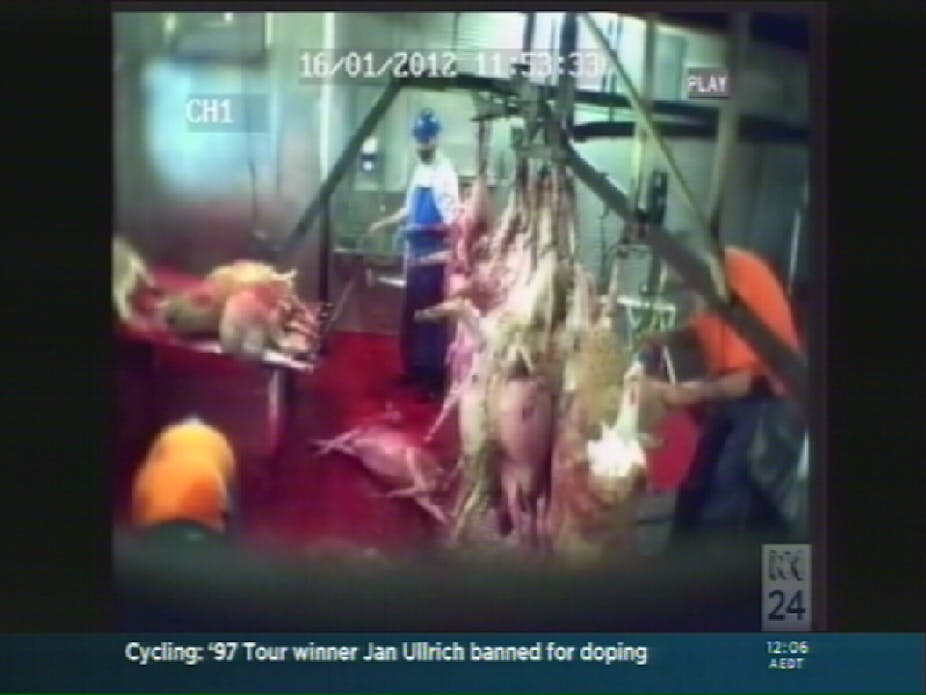
Revelations of cruelty in Australian abattoirs cause outrage, but probably not boycotts. ABC/AAP

Last year, revelations of cruelty to cows in Indonesian abattoirs led to outrage in Australia. The assumption was that these sorts of things could never happen here. Last week, a NSW abattoir was closed on the grounds of animal cruelty. Morally, the meat industry is on the back foot. But do Australians care enough about animal welfare to put a dent in its profits? Is there an economic argument for treating meat animals better?

My starting point: eat no animals. I am a political economist, meaning that I do not use the neoclassical paradigm – mainstream economics, free market economics, neoliberalism – in my research. But in the light of yet more revelations of animal cruelty in the food chain, I wondered what mainstream economics has to say about meat-eating.

When economics leads to kindness

Mainstream economics claims to be ethically neutral: animal cruelty per se has no greater significance or value than animal kindness, or any other possible human desire. It argues that consumer desires drive the economic system to the benefit of everyone. Let consumer desire reign without hindrance and economic resources will be efficiently allocated between industries. Consumers will be provided with what they want at the lowest possible cost.

Animals are simply an input into the production system, with no intrinsic value in and of themselves. The value of animals exists only insofar as humans value them – as meat, belts, jumpers, etc, or as sentient beings which feel pain and suffering.

How much do we want humane meat? AAP

So if carnivorous consumers desire the humane treatment of food animals, and those consumers are prepared to pay for this treatment in the form of higher meat prices, a responsive economic system will supply exactly that.

Of course, the “humane” product will have to be differentiated from the “non-humane”, and in a way consumers can trust. If this were the desire of large numbers of consumers, we would expect to see the suppliers of meat demanding national programs of accreditation and labeling. They would be calling in the inspectors, and marketing their officially-certified humane approach.

If not consumer power, will legislation or tax help?

But they are not. Indeed, there is evidence to suggest that the last thing the food industry wants to see is a fully-informed consumer.

Last year, two US economists estimated the relationship between positive and negative media coverage of animal welfare issues and the demand for meat. They concluded that the US demand for meat does respond to media coverage of animal welfare issues, but that this response is far smaller than the response to price changes.

Changes in the meat industry are not being pushed by the industry – capitalism has not yet offered them an incentive. Instead, we have seen changes to the industry enforced by legislative changes in the US and Europe. In Europe, they have banned battery cages. California has banned gestation crates for pigs.

It would be perfectly logical for the government to impose a greenhouse gas tax on suppliers. The production and consumption of meat creates significant negative externalities in the form of public health issues, the environment and climate change. We should all be wondering why the meat industry has been excluded from the carbon tax.

It took legislation to get rid of gestation crates in California. farmsanctuary.org

But this is not the economic answer to animal welfare. A carbon or methane tax is more likely to worsen food animal well-being, as firms attempt to extract even more profit from each animal. This involves those practices which most closely align the animal with a production unit rather than a living sentient being.

One bad abattoir ruins the whole bunch

As is so often the case with exposés like that in NSW, the industry has labelled the operations as aberrant, “rogue.” They are telling meat eaters not to tar their meat – “processed” in a different facility – with the same cruel brush. Many meat eaters are genuinely concerned about the well-being of the animals they eat; telling them cruelty is rare lets the eaters and the industry off the hook.

But, seriously, how can these operations in fact be “rogue”? The abattoir in question had been visited on four separate occasions by the government body ensuring compliance with the legislation. What hidden aberrant practices were going on at this abbatoir? The training, the equipment, the procedures?

The truth seems to be, as we have found over and over again, that these practices are quite standard; not written down by managers but allowed to be carried on.

But the research, and experience overseas, has shown us that if we want to see change, we can’t rely on the market. One revelation – or two or three – will not be enough to move consumers to put welfare above price. As long as the industry can convince us that most abattoirs are humane, quality and value will guide consumers.

So if we want to see change, legislative reform, including mandatory CCTV, is the solution. Until we can see what is going on in all abattoirs, consumers won’t have the information they need to make the choices that will bring change.

Join the conversation

Comments (14)

  1. Permalink
    Barry Calderbank

    Barry Calderbank

    Farmer (logged in via email @activ8.net.au)

    No argument with most of your points Gillian. But a few gripes.

    Firstly, farmers do want better consumer knowledge about what they eat. We are battling against cheap imports not just (or in some cases, even) on price. We are required to meet certain standards (in the use of chemicals, animal welfare etc) but imports are allowed from countries that do not require the same standards. The British pig industry has been skewered by its own government doing just that, for example. And the result…

    show full comment

    1. Permalink
      Tim Scanlon

      Tim Scanlon

      (Climate and Agronomic Extension at Department of Agriculture and Food - Western Australia)

      Well said Barry.

      I've actually done research that has taken me into abattoirs on a few occassions. I have never seen the conditions that are implied by both this article and the drama surrounding this issue. I think this comes down to QA practices as much as anything.

      The big issue here is the disconnect people have between their food and its production. This isn't just an issue with meat, but with all foods. People just assume that food comes from a store and are shocked that steak comes from…

      show full comment

      1. Permalink
        Monika Merkes

        Monika Merkes

        (Honorary Associate, Australian Institute for Primary Care & Ageing at La Trobe University)

        Hi Tim
        As noted in the abstract, the study uses data from non-metropolitan areas (581 counties); that suggests that Chicago wasn't covered by this study. The authors compared slaughterhouses with other industries in the 581 counties. Tim, if you want to look at the full article but don't have access to it I can send it to you, just email me.

        The following is quoted from the article:
        '… the slaughterhouse employment variable has a significant positive effect on arrests for rape and for other…

        show full comment

  2. Permalink
    Mary Mannison

    Mary Mannison

    Retired Academic (logged in via email @optusnet.com.au)

    Thanks for the quote, Lyndel.

    Being sensitive about the manner of death seems to miss the point. It's the horrific act of killing being clothed in do-good feelings. Meat eaters ask yourselves this: if you had to go out and kill an animal in order to eat mean, would you do it? Why ask someone else to?

    1. Permalink
      Troll Bait

      Troll Bait

      Computer Geek (logged in via email @yahoo.com.au)

      Actually I think it's you who has missed the point. The manner of death is extremely important. I know that if I was about to be eaten by a lion I'd much prefer that he killed me quickly...

      I hunt for my meat, I decided a long time ago that it was the only way I could be 100% sure of an instant and clean kill. I know that I can hit a 1" point out to 300m every time with a cold barrel shot in non-gusting wind of up to 15km/h. At 100m I can put 5 consecutive rounds on a 0.3" dot (most hunting…

      show full comment

  3. Permalink
    Monika Merkes

    Monika Merkes

    (Honorary Associate, Australian Institute for Primary Care & Ageing at La Trobe University)

    Great article, Gillian, thank you. I share your views, and in particular your starting point: eat no animals. Slaughterhouses are violent places, and it's systemic. Working conditions are abysmal and might explain to some extent the horrific animal abuse that comes to the public's attention every now and then. Also, the violence in such places spills over. Research has shown that slaughterhouse employment increases the crime rate in surrounding communities http://oae.sagepub.com/content/early/2009/06/02/1086026609338164.abstract.

  4. Permalink
    Lyndel Thomas

    Lyndel Thomas

    (logged in via Facebook)

    Thank you Gillian. A terrific article about a great injustice to our fellow sentient beings! As far as I am concerned meat eating is a lower practice and something that we should be rising above.
    NO DEMAND - NO PROBLEM!
    As long as their are slaughterhouses there will be battlefields - Leo Tolstoy.

    1. Permalink
      Troll Bait

      Troll Bait

      Computer Geek (logged in via email @yahoo.com.au)

      So only sentient life is sacred, and all other forms of life can just suck it and die on our whim? They're not worthy.

      You're saying that the type of life you choose to destroy to sustain your own puts you on a higher or lower standing on some kind of arbitrary scale of social standing?

      Interesting. Slightly crazy and illogical, but interesting... O.o

  5. Permalink
    Andrew McNicol

    Andrew McNicol

    (PhD candidate (Media) at University of New South Wales)

    "But this is not the economic answer to animal welfare. A carbon or methane tax is more likely to worsen food animal well-being, as firms attempt to extract even more profit from each animal."

    "... the US demand for meat does respond to media coverage of animal welfare issues, but that this response is far smaller than the response to price changes."

    I feel that these two ideas together suggest a carbon tax on animal agriculture would be a positive step for animal welfare, if only because the…

    show full comment

  6. Permalink
    Shirley Birney

    Shirley Birney

    retiree (logged in via email @tpg.com.au)

    I daresay the inhumane treatment of food animals commenced in 1788 when livestock were transported to the colony. The culture of cruelty that prevails right across this industry is not new but has merely been obscured from the public gaze – the duping of a nation of meat eaters by industry and regulators.

    The extremely rare prosecutions of animal abusers are a result of animal activists and discerning citizens.

    Yet despite the disturbing footage provided to the media by activists and whistleblowers…

    show full comment

  7. Permalink
    Mark Chambers

    Mark Chambers

    Business & Marketing Consultant (logged in via email @iinet.net.au)

    Hello Jay Jay , it may pay you to look up the definition of "sentient" in your computer dictionary . I am not a vegetarian 'nor' am I taking sides in your own personal debate .
    However , the definition of sentient is such that it opposes your current argument by illustrating its shortcomings . Good luck with your next attempt , I will be interested to read your more objective opinion once you submit it . Have a good day .

    1. Permalink
      Troll Bait

      Troll Bait

      Computer Geek (logged in via email @yahoo.com.au)

      WoW, just WoW!

      You know I read your post, read it again, read my post, then read your's once more time; and I can't for the life of me work out if you've just made a post worthy of a 'Troll of the Year' award, or you've just ascended to a whole new level of stupid.

      Given you're a "Business & Marketing Consultant" I'm leaning towards the latter, but either way my hat's off to you Sir, it's a noteworthy feat.

  8. Permalink
    Mark Chambers

    Mark Chambers

    Business & Marketing Consultant (logged in via email @iinet.net.au)

    Good article Gillian . I have noticed that there is a growing number of semi-vegitarians , those people who understand the moral dilemma of demanding better animal welfare whilst at the same time eating animals . The trend with people who fit into this demographic is not to eat 'half the amount of meat' compared with previous consumption patterns , nor is it to only eat meat 'half as often' , it is to only eat certain meats . Eg ; No red meat but a higher frequency of white meat . Hypocrisy…

    show full comment

  9. Permalink
    wilma western

    wilma western

    (logged in via email @bigpond.com)

    1. Why would the extra inspection and certification increase the cost of meat when all caracses are already inspected stamped etc - this would just be an extra to what's already being done - at least in the majority of abattoirs in Australia ? There seems to be lesser surveillance of the few small abattoirs still in existence. Free range pig producers in the Morwell district protested about the closure of that abattoir as it meant their pigs had to be transported further.
    2. Most of the far reaching…

    show full comment