

Those who call for the Occupy movement to have a coherent set of demands at its birth ignore the history of social and protest movements.
Often, the coherence to the programs of protest movements is only retrospectively secured: it only “makes sense” when seen historically.
It is not clear yet what will result from Occupy. And this uncertainty is precisely the point.
New realities
Truly radical and revolutionary situations establish new coordinates of action, feeling and thought. They do not merely slot in with what exists.
If successful, they forge a new language and a new grammar of political claims.
If unsuccessful, they can lay dormant, stalking the future – their potential unrealised yet present.
Our reality today is defined by the successful struggles of the past. And it is this reality itself that confers “sense” on the actions of those previous actors.
So too is it their role in shaping our present reality which makes these events and struggles “successful.”
The conservative game of “what if?” history likes to toy with these pasts. What if 1917 had not happened in Russia? What if Germany had won either of the World Wars? The progressive version of this gambles, instead, on the future: what if we don’t act now?
Openness and propriety
The novelty of certain political protest can disrupt easy categorisation. The “openness” of the political situation today can make many observers uncomfortable.
There have been derogatory reactions to the “meaninglessness” of the Occupy protests, to their “ragtag” make-up and their refusal to, as yet, formulate a full set of demands.

The anxiety here reminds us of that around the London riots earlier this year. What both moments reveal — despite the many differences in their situations — is an inability for some commentators to tolerate the ambiguity of a protest that begins with no demands in a familiar and “proper” form.
The protests we see today do look different from the form familiar to us over the past half century. So critics claim that this is an “improper” form of protest, that the “proper” form would be different (“better organised,” “more coherent,” “more realistic,” and so on).
This emergent form of protest has a basic message: “we are here”. The current occupations, for example, are concerned with assembly — gathering people together for discussion about our shared social reality, as well as literally embodying an apparently forgotten polis.
And yet, what is often missed in the dismissal of these protests is that it is the arch contest of political dispute.
That is, politics is grounded in the establishment of what is proper and what is improper – from this, everything else flows; the “commonsense” of the day is established.
Similarly, the language of the “possible” and the “impossible,” or the “realistic” and the “unrealistic,” is deeply political and ideological.
For example, we are told that the eradication of inequality is “impossible.” These everyday terms harbour an ideological kernel: they are attempts to constrain action to a prescribed domain. So a politics can be formed around these limits.
East Germany
As a researcher of the end and afterlife of the German Democratic Republic (GDR), I find a few interesting parallels in the historical situations of today’s movement and that which saw the end of East German socialism in 1989.
Clearly, today, we do not live in an authoritarian gerontocracy with Stalinist characteristics. So the similarities are necessarily limited by this difference.
But the lessons are there: they lay in the role of the historical account and the way movements generate demands.
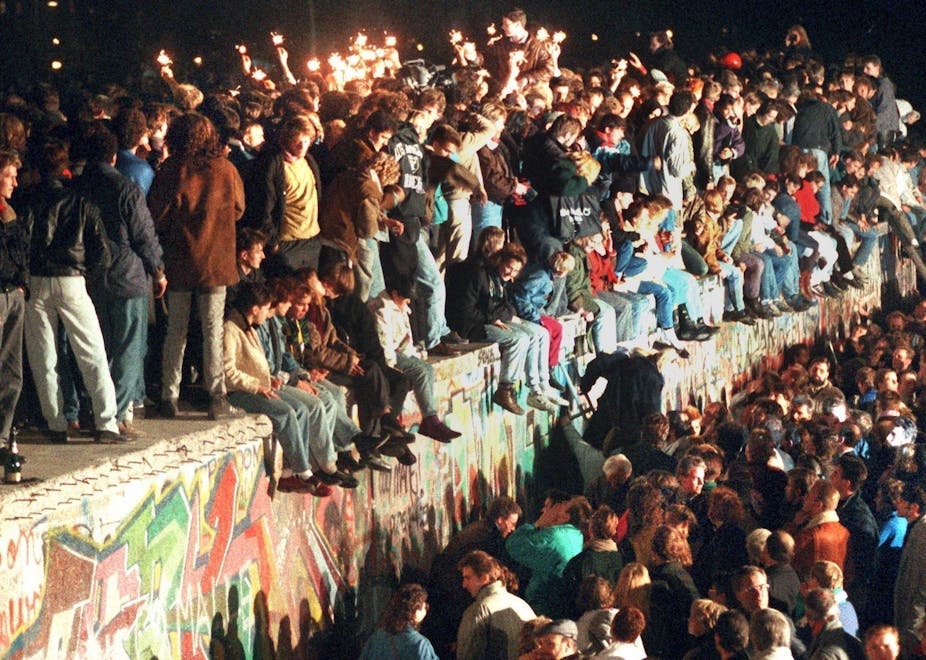
The movement which eventually led to the “Fall of the Berlin Wall” in Germany was fostered by many groups with radically different agendas. But they all latched on to the possibilities offered by assembling at prayer meetings held in the remaining – largely Protestant – churches in the GDR.

Churches were the seedbed for the movement that followed from the prayer meetings. They offered a chance for assembly and quasi-public, relatively free spaces for the exchange of ideas.
The diverse groups at these protests could barely agree on the fundamentals. Some thought it was time to call for a reform of socialism and others called for a complete move to capitalism.
But as the movement grew and gained popular support, it came to issue demands for reform and overhaul of the well-embedded status quo.
In such situations, groups may ultimately make demands that, at the tentative beginning of their mobilisation, may even have surprised themselves: the situation forces an opening into which the movement steps, therein reworking what was once thought possible or realistic.
The shock of the rapidity of this change – it all happened within the space of a year – is captured in the title of a book about the downfall of the Soviet Union: “Everything was forever, until it was no more.”
“Realistically,” some would have said, early on in 1989, “if you want to take on the state, it will act violently in response. Just as it did in 1953.”
Eventually the movement was large enough to answer the live question of a violent put-down by the police and People’s Army. The size of protests was of a scale to reframe the notion of what was “realistic”.
No more gaps
But what does such a smooth narrative leave out? For one, it suggests an all-at-once and consciously directed process.
The GDR movement, from the start, had serious intent. Yet its form and content was inchoate.
So the common picture skips over the many important deliberations, as well as the hundreds of gatherings needed to make and move on decisions.
The most basic error to flow from this is to confuse a successful movement at its popular height for its scrawny beginnings: the wilful error of comparing the end of one movement with the beginning of another.

The historian Gareth Dale has calculated the scale of the revolutionary sequence in the GDR: “between August 1989 and April 1990, 2,600 public demonstrations and over 300 rallies took place, as well as over 200 strikes and a dozen factory occupations. The largest three of the 2,600 demonstrations attracted well over 1 million people.”
So, ultimately, the narrative of “The Fall of the Wall” makes a process which took literally thousands of meetings in many cities coherent.
It also brings together what was necessarily unhomogenised and internally antagonistic. How could anti-socialist and anti-capitalist (and anti-fascist and environmental and…) groups ever do anything together, we might wonder?
How might they make demands and establish the re-unified Germany we know today?
Strange lessons
The smooth narratives we are told about history, like that of “The Fall of the Wall,” lead “realistic” commentators – be they political scientists or newspaper columnists or Twitter snarks – to lambast new political formations for not having a cohesive ideological platform and too few participants.
We might well imagine a newspaper article from the GDR early on in 1989: “A ragtag bunch of long-haired idealists has gathered for three consecutive Mondays to talk about change in the GDR. Less than a hundred people were in attendance as talk swung without clear logic between the environment and the economy.”
Such political experiments can fail or have unintended consequences. But there may be a productive antagonism at play. As in the GDR, if the movement holds and achieves hegemony, these antagonisms will be drawn together and “resolved” by the movement itself.
One lesson of both successful and unsuccessful protests is that there is contingency at the heart of political mobilisation. Decisions to protest, stand ground, change tactics, move sites and so on, led onto open paths.
But the decisions are ultimately decisive and may well come to be narrated as either “commonsense” and “realistic” or “foolish” and “unrealistic”.
In the alchemical act of historical narration, disunity becomes unity. It is the ending which grants an organic “natural” consistency to the preceding events. Indeed, the ending can seemingly efface all traces of inconsistency. This does not mean that future history will then be without dispute.
Endgame
So what is the other lesson to take from history?
History shows us that those movements that persist and act with broad support can shift the very coordinates of the system from which they set out.
Today’s “sensible cynics” may scoff from the sidelines: but, then, cynicism and disavowal are leading features of ideology today.
Snark comes easily, change does not.
Foreclosing early on future possibilities is the conservative’s wager.